10 Results for "

CO2 fixation

" in MedChemExpress (MCE) Product Catalog:
Products (10)

10 Results for "CO2 fixation" in MCE Product Catalog:

Cat. No.: HY-164642
CAS No.: 24218-00-6
Synonyms: RuBP
Ribulose 1,5-bisphosphate (RUBP) is a vital photosynthetic intermediate and substrate. Ribulose 1,5-bisphosphate acts as both product and substrate for Thermococcus kodakarensis KOD1 R15Pi. Ribulose 1,5-bisphosphate tightly binds to inactive RuBP carboxylase sites in plant leaves.Ribulose 1,5-bisphosphate serves as the key substrate for CO2 fixation in photosynthesis. Ribulose 1,5-bisphosphate supports carboxylation and regeneration processes in photosynthesis. Ribulose 1,5-bisphosphate determines the dynamic transition temperature of photosynthetic control. Ribulose 1,5-bisphosphate can be used for photosynthesis and enzyme mechanism research .
loading...
    loading...
Cat. No.: HY-116482
CAS No.: 13684-56-5
Target:  

Herbicide

Research Areas:  

Others

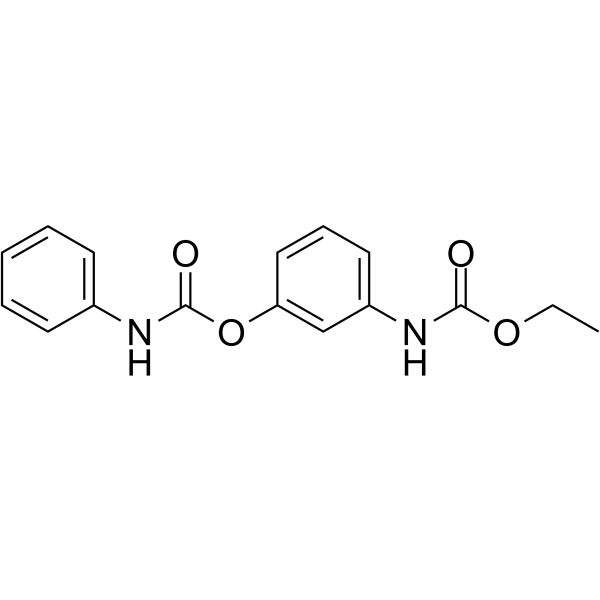
Desmedipham is a selective systemic phenyl-carbamate herbicide. Desmedipham acts by disrupting CO2 fixation and the production of intermediary energy components-ATP and NADPH2 and inhibition of Hill reaction .
loading...
    loading...
Cat. No.: HY-E70241
CAS No.: 157786-88-4
Research Areas:  

Infection Metabolic Disease

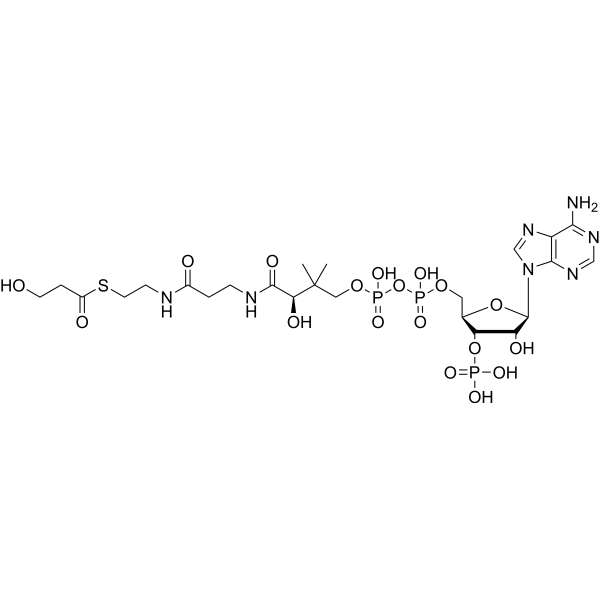
3-Hydroxypropionyl-CoA is a metabolic intermediate and enzyme substrate/product that functions in multiple metabolic pathways. 3-Hydroxypropionyl-CoA serves as a substrate for 3-Hydroxypropionyl-CoA dehydratase (HY-E71752), a product of 3-hydroxypropionyl-CoA synthetase, and a hydrolysis substrate for Ehd3p. 3-Hydroxypropionyl-CoA participates in autotrophic CO2 fixation, modified β-oxidation, and reverse hydration reactions. Accumulation of 3-Hydroxypropionyl-CoA inhibits fatty acid β-oxidation at the Fox2p site and induces metabolic toxicity. 3-Hydroxypropionyl-CoA can be used in studies of hematogenously disseminated candidiasis .
loading...
    loading...
Cat. No.: HY-116482R
CAS No.: 13684-56-5
Research Areas:  

Others

Desmedipham (Standard) is the analytical standard of Desmedipham. This product is intended for research and analytical applications. Desmedipham is a selective systemic phenyl-carbamate herbicide. Desmedipham acts by disrupting CO2 fixation and the production of intermediary energy components-ATP and NADPH2 and inhibition of Hill reaction .
loading...
    loading...
Cat. No.: HY-E71752
Research Areas:  

Others

3-Hydroxypropionyl-CoA dehydratase (EC 4.2.1.116) catalyses a step in the 3-hydroxypropanoate/4-hydroxybutanoate cycle, an autotrophic CO2 fixation pathway found in some thermoacidophilic archaea.
loading...
    loading...
Cat. No.: HY-E71751A
Research Areas:  

Others

3-Hydroxypropionate dehydrogenase (NADP+) (EC 1.1.1.298) catalyses the reduction of malonate semialdehyde to 3-hydroxypropanoate, a key step in the 3-hydroxypropanoate and the 3-hydroxypropanoate/4-hydroxybutanoate cycles, autotrophic CO2 fixation pathways found in some green non-sulfur phototrophic bacteria and archaea, respectively.
loading...
    loading...
Cat. No.: HY-W559123
CAS No.: 72850-64-7
Target:  

Herbicide

Research Areas:  

Others

Flurazole is a herbicide safener mainly used for pre-treating crop seeds (especially sorghum seeds) to protect seeds from herbicide damage without reducing the herbicide's weed control efficacy. Flurazole regulates photosynthesis, CO2 fixation, and the synthesis of nucleic acids, proteins and lipids in isolated soybean cells, exerting stimulatory effects at low concentrations and inhibitory effects at high concentrations .
loading...
    loading...
Cat. No.: HY-E71753
Research Areas:  

Others

3-Hydroxypropionyl-CoA synthase (EC 6.2.1.36) catalyses a step in the 3-hydroxypropanoate/4-hydroxybutanoate cycle, an autotrophic CO2 fixation pathway found in some thermoacidophilic archaea.The enzymes from Metallosphaera sedula and Sulfolobus tokodaii can also use propionate, acrylate, acetate, and butanoate as substrates, and are thus different from EC 6.2.1.17 (propionate-CoA ligase), which does not accept acetate or butanoate.
loading...
    loading...
Cat. No.: HY-164642B
CAS No.: 1897433-92-9
Synonyms: RuBP sodium hydrate (purity ≥90%,TLC)
Ribulose 1,5-bisphosphate sodium hydrate (purity ≥90%,TLC) (RUBP sodium hydrate (purity ≥90%,TLC)) is a vital photosynthetic intermediate and substrate. Ribulose 1,5-bisphosphate sodium hydrate (purity ≥90%,TLC) acts as both product and substrate for Thermococcus kodakarensis KOD1 R15Pi. Ribulose 1,5-bisphosphate sodium hydrate (purity ≥90%,TLC) tightly binds to inactive RuBP carboxylase sites in plant leaves.Ribulose 1,5-bisphosphate sodium hydrate (purity ≥90%,TLC) serves as the key substrate for CO2 fixation in photosynthesis. Ribulose 1,5-bisphosphate sodium hydrate (purity ≥90%,TLC) supports carboxylation and regeneration processes in photosynthesis. Ribulose 1,5-bisphosphate sodium hydrate (purity ≥90%,TLC) determines the dynamic transition temperature of photosynthetic control. Ribulose 1,5-bisphosphate sodium hydrate (purity ≥90%,TLC) can be used for photosynthesis and enzyme mechanism research .
loading...
    loading...
Cat. No.: HY-164642C
CAS No.: 1897433-92-9
Synonyms: RuBP sodium hydrate (purity≥99.0%,TLC)
Ribulose 1,5-bisphosphate sodium hydrate (purity≥99.0%,TLC) (RUBP sodium hydrate (purity≥99.0%,TLC)) is a vital photosynthetic intermediate and substrate. Ribulose 1,5-bisphosphate sodium hydrate (purity≥99.0%,TLC) acts as both product and substrate for Thermococcus kodakarensis KOD1 R15Pi. Ribulose 1,5-bisphosphate sodium hydrate (purity≥99.0%,TLC) tightly binds to inactive RuBP carboxylase sites in plant leaves.Ribulose 1,5-bisphosphate sodium hydrate (purity≥99.0%,TLC) serves as the key substrate for CO2 fixation in photosynthesis. Ribulose 1,5-bisphosphate sodium hydrate (purity≥99.0%,TLC) supports carboxylation and regeneration processes in photosynthesis. Ribulose 1,5-bisphosphate sodium hydrate (purity≥99.0%,TLC) determines the dynamic transition temperature of photosynthetic control. Ribulose 1,5-bisphosphate sodium hydrate (purity≥99.0%,TLC) can be used for photosynthesis and enzyme mechanism research .
loading...
    loading...

