7 Results for "

Fluoride ion

" in MedChemExpress (MCE) Product Catalog:
Products (7)

7 Results for "Fluoride ion" in MCE Product Catalog:

Cat. No.: HY-Y0971
CAS No.: 429-41-4
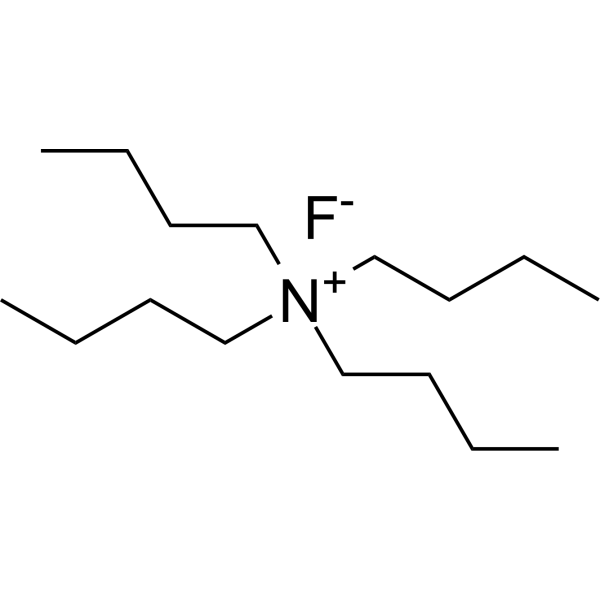
Synonyms: TBAF
Tetrabutylammonium fluoride is an organic compound containing both ammonium and fluorine functional groups. It is commonly used as a reagent in various chemical synthesis applications, especially as a source of fluoride ions for nucleophilic reactions. Tetrabutylammonium fluoride has several properties that make it suitable for these applications, including its high solubility in polar solvents and its ability to selectively activate certain chemical bonds. In addition, it can be used as a catalyst for organic reactions and as an electrolyte for batteries.
loading...
    loading...
Cat. No.: HY-P11111
CAS No.: 1501983-51-2
Target:  

Drug Derivative

Research Areas:  

Others

QP5 is an Amelogenin (HY-P71627)-derived peptide. QP5 binds to hydroxyapatite and demineralized enamel surfaces, temporarily stabilizes amorphous calcium phosphate (ACP), and regulates the crystallization of hydroxyapatite. QP5 promotes remineralization of artificial enamel caries in vitro, and acts synergistically with fluoride to enhance enamel caries remineralization. QP5 can be used in studies related to enamel caries and early enamel caries .
loading...
    loading...
Cat. No.: HY-W095635
CAS No.: 17787-40-5
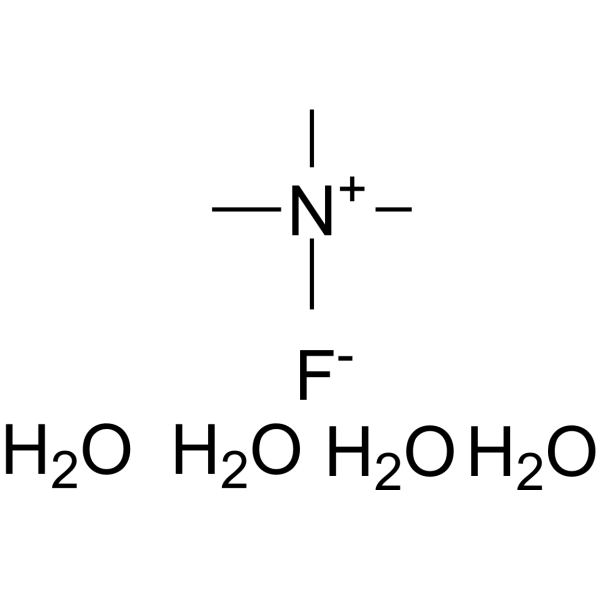
Tetramethylammonium fluoride tetrahydrate (TMAF) is a quaternary ammonium salt. TMAF is commonly used as a weak base and a source of fluoride ions in various organic reactions, including nucleophilic substitution, functional group deprotection, and ring-opening polymerization. Unlike other fluoride sources, TMAF is compatible with many functional groups, making it a versatile tool in synthetic chemistry. Functional reagents, In addition, TMAF has been used as a fluorinating agent in medicinal chemistry, for the preparation of radiotracers and protein modification in biochemistry, and the tetrahydrate form of TMAF is more stable and easier to handle than the anhydrous form.
loading...
    loading...
Cat. No.: HY-W106762
CAS No.: 81-32-3
Synonyms: 3,4,9,10-Perylenetetracarboxylic acid
Research Areas:  

Others

Perylene-3,4,9,10-tetracarboxylic acid (3,4,9,10-Perylenetetracarboxylic acid) is a chemical intermediate. Derivatives formed from Perylene-3,4,9,10-tetracarboxylic acid can serve as colorimetric and fluorescent chemosensors with selectivity for fluoride ions, and also act as charge generation materials in electrophotographic photoreceptors, organic electrophotographic photoreceptors, optoelectronic and photonic devices .
loading...
    loading...
Cat. No.: HY-W036734
CAS No.: 23868-34-0
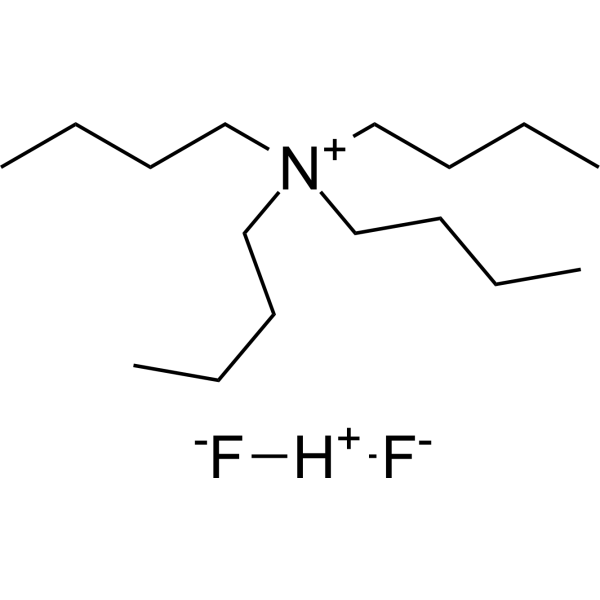
Tetrabutylammonium (hydrogen difluoride) is a quaternary ammonium salt containing fluoride ions. It is a highly active and effective reagent, often used in organic synthesis reactions, especially for the modification of organic molecules with fluorine atoms. Tetrabutylammonium (hydrogen difluoride) is also used as a catalyst for various chemical reactions such as esterification and transesterification. Additionally, it is used in the production of specialty chemicals such as surfactants and detergents.
loading...
    loading...
Cat. No.: HY-P10386
Target:  

Bcl-2 Family

Research Areas:  

Cancer

155H1 (Compound 11) is a stapled peptide, that covalently binds hMcl1 (172-323) with IC50 of 18 nM .
loading...
    loading...
Cat. No.: HY-D3126
CAS No.: 2420449-92-7
Target:  

Fluorescent Dye

Research Areas:  

Others

IOPBA is a fluorescent probe that can be used for the detection and bioimaging of trivalent iron ions Fe 3+ and fluoride ions F - in living cells. IOPBA emits blue fluorescence in its native state, but upon the introduction of Fe 3+, it forms a Fe 3+-IOPBA π-complex, where Fe 3+ ions coordinate with two phenyl groups of IOPBA, resulting in fluorescence quenching. IOPBA returns to its free state and recovers its original fluorescence after F - sequesters Fe 3+ to form the more stable [FeF6] 3- and dissociates the Fe 3+-IOPBA complex. The excitation wavelength of IOPBA is 342 nm, and its emission wavelength is 458 nm .
loading...
    loading...

