

14 Results for "

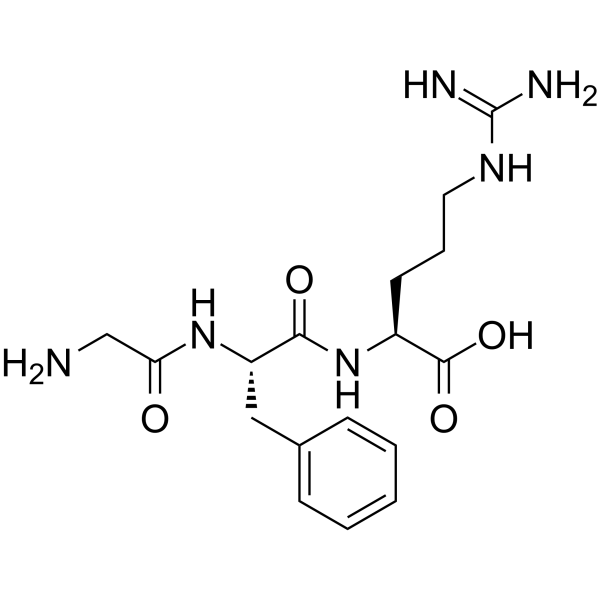
Gly-Phe-Arg

" in MedChemExpress (MCE) Product Catalog:
Products (14)

14 Results for "Gly-Phe-Arg" in MCE Product Catalog:

Cat. No.: HY-P0296
CAS No.: 121822-47-7
Target:  

Peptides

Research Areas:  

Others

Gly-Phe-Arg is a superpotent synthetic tripeptide mimics of the mud-crab pumping pheromone.
loading...
    loading...
3
3 Cited Publications
Cat. No.: HY-P2295
Target:  

SARS-CoV

Research Areas:  

Others

Dabcyl-KTSAVLQSGFRKME-Edans TFA is a fluorogenic peptide. Dabcyl-KTSAVLQSGFRKME-Edans TFA is used as the substrate to measure the enzymatic activities of protease forms. Dabcyl-KTSAVLQSGFRKME-Edans TFA has the potential for study 2019-nCoV (COVID-19) infection .
loading...
    loading...
Cat. No.: HY-P1271
CAS No.: 142211-96-9
Synonyms: Catestatin (cattle)
Target:  

nAChR

Research Areas:  

Cardiovascular Disease

Catestatin is a 21-amino acid residue, cationic and hydrophobic peptide. Catestatin is an endogenous peptide that regulates cardiac function and blood pressure . Catestatin is a non-competitive nicotinic antagonist acting through nicotinic acetylcholine receptors (nAChRs) to inhibit catecholamine release .
loading...
    loading...
Cat. No.: HY-P3395
CAS No.: 197151-46-5
Synonyms: Human chromogranin A 352–372
Target:  

nAChR

Catestatin human, a catecholamine release-inhibitory peptide, is a pleiotropic peptide involved in cardiovascular protection with its antihypertensive and angiogenic effects. Catestatin human can be used in the study of inflammatory diseases .
loading...
    loading...
Cat. No.: HY-P1271A
Target:  

nAChR

Research Areas:  

Cardiovascular Disease

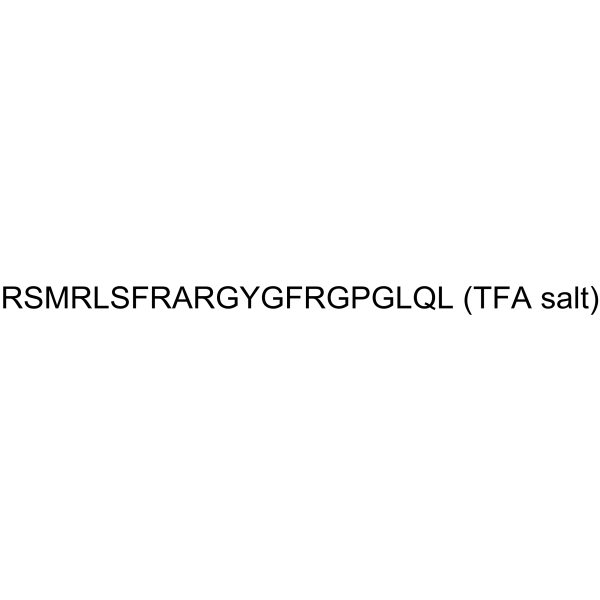
Catestatin TFA is a 21-amino acid residue, cationic and hydrophobic peptide. Catestatin TFA is an endogenous peptide that regulates cardiac function and blood pressure . Catestatin TFA is a non-competitive nicotinic antagonist acting through nicotinic acetylcholine receptors (nAChRs) to inhibit catecholamine release .
loading...
    loading...
Cat. No.: HY-P10603
CAS No.: 858602-44-5
Target:  

Antibiotic Bacterial

Research Areas:  

Infection

SP1 is an α-peptide encoded by the mating pheromone MFα1 gene in Candida albicans, which can induce cell growth arrest at the mating type locus MTLa in Candida albicans. SP1 can be used in the study of the prevention and treatment of Candida albicans infection .
loading...
    loading...
Cat. No.: HY-P10344
CAS No.: 932391-88-3
Target:  

Fluorescent Dye

Research Areas:  

Infection

MCA-AVLQSGFR-Lys(Dnp)-Lys-NH2 is a fluorescent substrate used for fluorescence resonance energy transfer (FRET) protease assays. This substrate is employed to measure the activity of SARS-CoV-2 3CLpro .
loading...
    loading...
Cat. No.: HY-P11313
Synonyms: Rat chromogranin A367–387
Target:  

nAChR Akt

Research Areas:  

Cardiovascular Disease

Catestatin (rat) (Rat chromogranin A367–387) is a potent, reversible, noncompetitive, and noncooperative nicotinic cholinergic antagonist derived from chromogranin A (A367-387). Catestatin (rat) inhibits norepinephrine release in rat PC12 pheochromocytoma cells (IC50 = 1.2 μM), and blocks desensitization of norepinephrine release (IC50 = 0.62 μM). Catestatin (rat) exerts antiadrenergic effects through the endothelial PI3K-AKT-eNOS pathway in rat papillary muscles and isolated cardiomyocytes. Catestatin (rat) maintains mitochondrial membrane potential in I/R cardiomyocytes and increases phosphorylation of AKT at S473, GSK3β at S9, PLB at T17, and eNOS at S1179. Catestatin (rat) reverses desensitization of 22Na + uptake. Catestatin (rat) can be used for the study of nicotinic cholinergic receptor regulation and catecholamine release control mechanisms .
loading...
    loading...
Cat. No.: HY-P10705
Research Areas:  

Cancer

KGFRWR is a short peptide sequence, belonging to self-assembling peptides (SAPs), which can self-assemble into functional nanostructures, typically nanofibers, under physiological conditions. KGFRWR can be used to target tumor cells and tumor vasculature, exhibiting antitumor activity .
loading...
    loading...
Cat. No.: HY-P10604
CAS No.: 678138-45-9
Target:  

Antibiotic Bacterial

Research Areas:  

Others

SP2 is a 14-amino acid long active peptide that can induce growth arrest in MTLa cells of the mating type locus of Candida albicans .
loading...
    loading...
Cat. No.: HY-P10572
HG1 Toxin is a peptide found in the venom of the scorpion Heterometrus fulvipes, which has the activity of inhibiting potassium channel Kv1.3. HG1 Toxin also has the activity of inhibiting trypsin (Ki=107 nM) and can be used in the study of autoimmune diseases .
loading...
    loading...
Cat. No.: HY-P3395B
Target:  

Peptides

Research Areas:  

Others

Catestatin sCst TFA is a scrambled control peptide that serves as a negative control for Catestatin TFA (HY-P1271A) .
loading...
    loading...
Cat. No.: HY-P11478
CAS No.: 1461673-77-7
Catestatin (mouse) is an antimicrobial peptide. Catestatin (mouse) robustly activates Mrgprb2 with an EC50 of 59.73 μM. Catestatin (mouse) is effective in promoting MRSA clearance from wound infections. Catestatin (mouse) dampens the inflammatory immune response to MRSA infection .
loading...
    loading...
Cat. No.: HY-P3395A
Target:  

Peptides

Research Areas:  

Others

Catestatin sCst is a scrambled control peptide that serves as a negative control for Catestatin (HY-P1271) .
loading...
    loading...
  • 1

