7 Results for "

Hydroxyphenyllactic acid

" in MedChemExpress (MCE) Product Catalog:
Products (7)

7 Results for "Hydroxyphenyllactic acid" in MCE Product Catalog:

1
1 Cited Publications
Cat. No.: HY-113219
CAS No.: 306-23-0
Purity:  99.95%
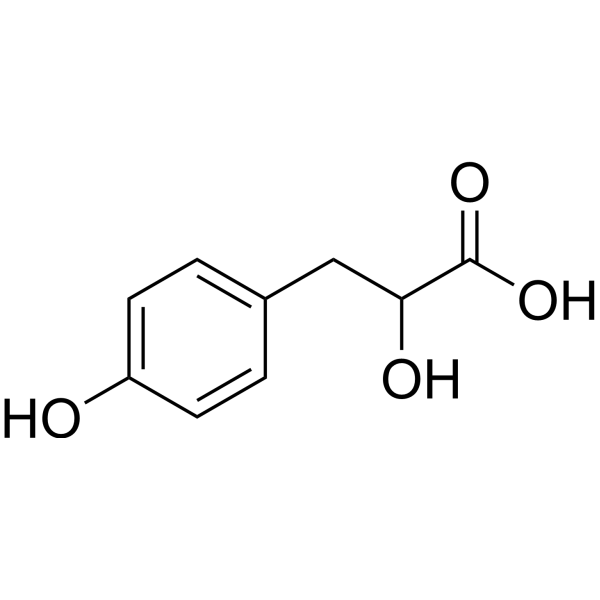
Hydroxyphenyllactic acid is an antifungal metabolite.
loading...
    loading...
Cat. No.: HY-113219R
CAS No.: 306-23-0
Hydroxyphenyllactic acid (Standard) is the analytical standard of Hydroxyphenyllactic acid. This product is intended for research and analytical applications. Hydroxyphenyllactic acid is an antifungal metabolite.
loading...
    loading...
Cat. No.: HY-P10563
CAS No.: 2580150-96-3
Synonyms: BHV-1100
Target:  

CD38 IFNAR

Research Areas:  

Cancer

Noraramtide (BHV-1100) is an antibody-recruiting molecule. Noraramtide binds to CD38 and recruits natural killer (NK) cells to mediate antibody-dependent cellular cytotoxicity. Noraramtide enhances the capacity of autologous cytokine-induced memory-like (CIML) NK cells to produce IFNγ and CD107a, thereby improving their cytotoxicity against multiple myeloma cells. Noraramtide can be used in the research of multiple myeloma .
loading...
    loading...
Cat. No.: HY-N3997
CAS No.: 3033950-58-9
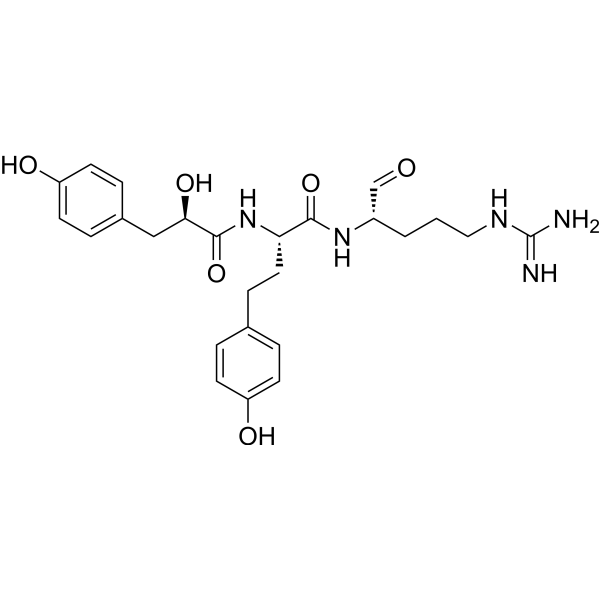
Nostosin G is a unique example of a linear peptide containing three subunits, 4-hydroxyphenyllactic acid (Hpla), homotyrosine (Hty), and argininal. Nostosin G has potent trypsin inhibitory property with an IC50 value of 0.1 μM .
loading...
    loading...
Cat. No.: HY-W654234
CAS No.: 2249814-89-7
Hydroxyphenyllactic acid-d3 is the deuterium labeled Hydroxyphenyllactic acid (HY-113219). Hydroxyphenyllactic acid is an antifungal metabolite .
loading...
    loading...
Cat. No.: HY-113219S
Hydroxyphenyllactic acid-d4 is the deuterium labeled Hydroxyphenyllactic acid (HY-113219). Hydroxyphenyllactic acid is an antifungal metabolite .
loading...
    loading...
Cat. No.: HY-N9274
CAS No.: 100201-57-8
Target:  

Endogenous Metabolite

Research Areas:  

Others

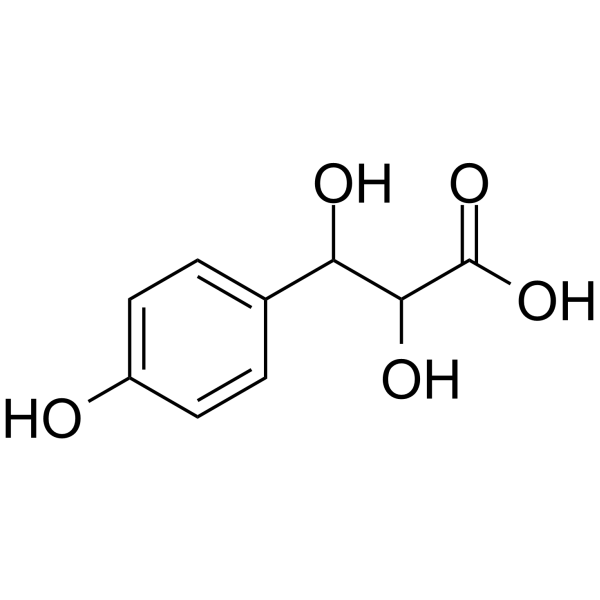
3-Hydroxy-3-(4-hydroxyphenyl)-lactic acid is a key metabolite in the P. roqueforti fermentation approach, with quantitative data of 10.2 ± 1.1 µM in Tyr 1 (presence of L-tyrosine) of .
loading...
    loading...

