1. Search Result
Search Result
Results for "

Lipid C 3

" in MedChemExpress (MCE) Product Catalog:

16

Inhibitors & Agonists

1

Fluorescent Dyes

2

Biochemical Assay Reagents

7

Isotope-Labeled Compounds

4

Oligonucleotides

Cat. No. Product Name Target Research Areas Chemical Structure
  • HY-D1581

    Fluorescent Dye Others
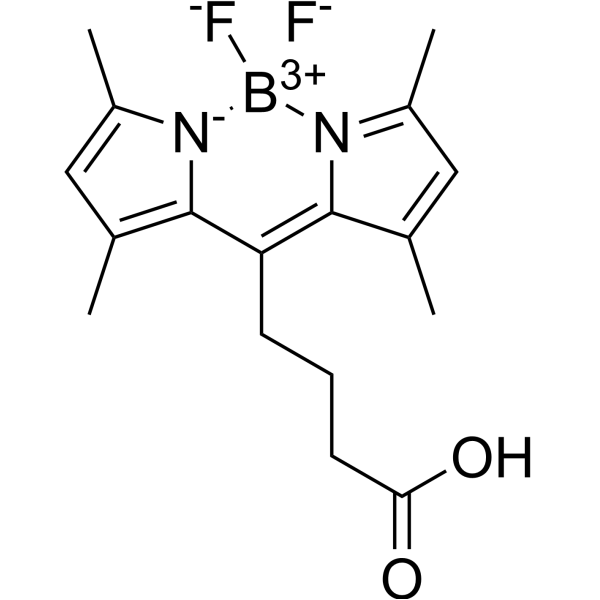
    BODIPY 505/515-8-C3-COOH is a green fluorescing derivative, as a fluorescent dye for imaging lipid droplets in nannochloropsis. BODIPY 505/515-8-C3-COOH can be used for the research of flow cytometric high-throughput screening and cell sorting .
    BODIPY 505/515-8-C3-COOH
  • HY-145225

    Liposome Others
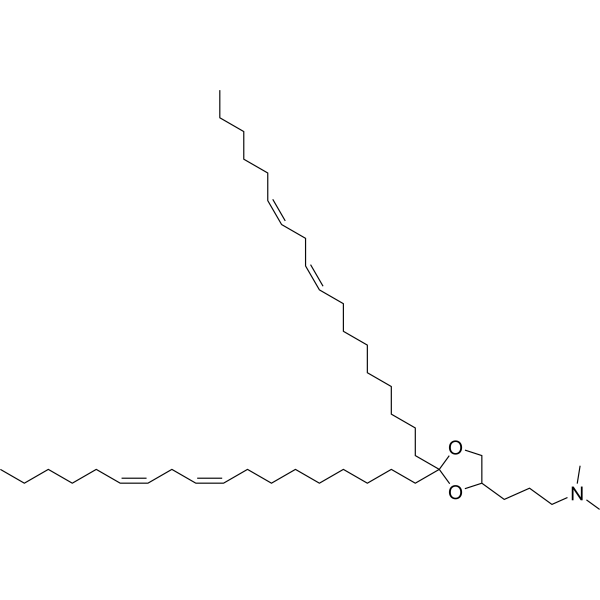
    DLin-K-C3-DMA, a cationic lipid, can be used in the synthesis of nucleic acid-lipid particle to delivery of nucleic acid .
    DLin-K-C3-DMA
  • HY-B0430S

    Isotope-Labeled Compounds Endogenous Metabolite Others
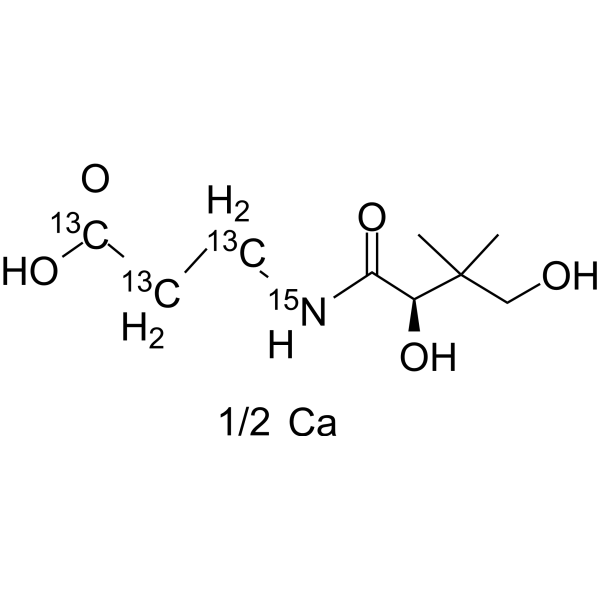
    Pantothenic acid- 13C3, 15N (hemicalcium) is the 13C-labeled and 15N-labeled D-Pantothenic acid. D-Pantothenic acid is an essential trace nutrient that functions as the obligate precursor of coenzyme A (CoA). D-Pantothenic acid plays key roles in myriad biological processes, including many that regulate carbohydrate, lipid, protein, and nucleic acid metabolism .
    Pantothenic acid-13C3,15N hemicalcium
  • HY-W770183

    Isotope-Labeled Compounds Others
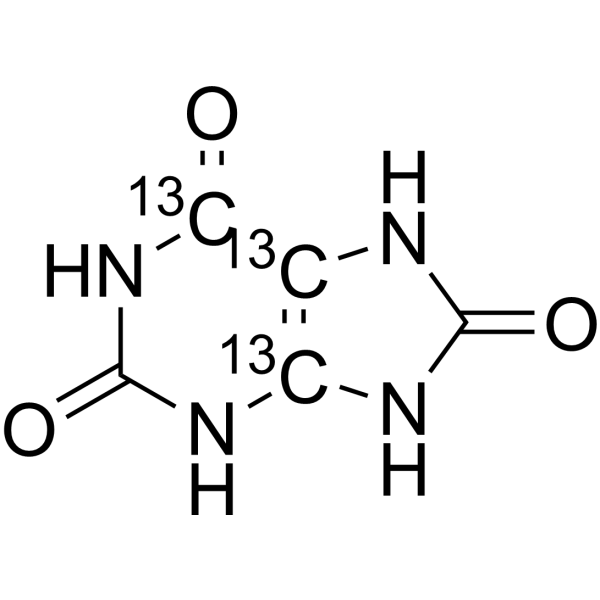
    Uric acid- 13C3 is 13C-labeled Uric acid (HY-B2130). Uric acid is the end product of purine metabolism in the human body. Uric acid can scavenge reactive oxygen species (ROS), such as singlet oxygen and peroxynitrite, and inhibit lipid peroxidation.
    Uric acid-13C3
  • HY-112251S

    Isotope-Labeled Compounds Others
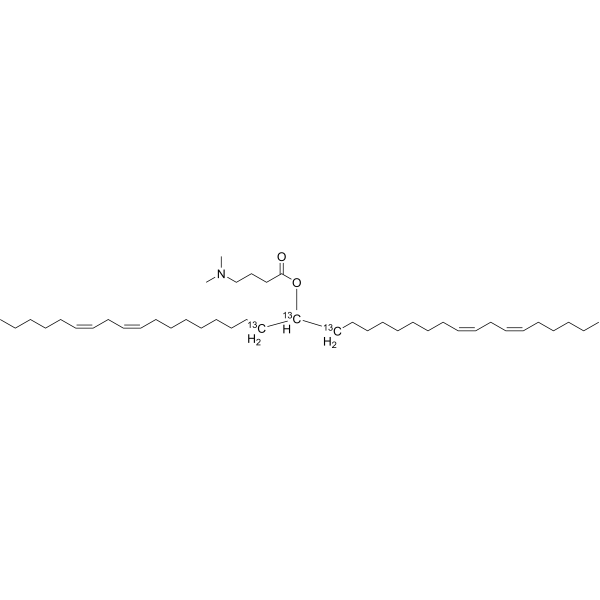
    D-Lin-MC3-DMA- 13C3 is the 13C labeled D-Lin-MC3-DMA. D-Lin-MC3-DMA, an ionizable cationic lipid, is a potent siRNA delivery vehicle .
    D-Lin-MC3-DMA-13C3
  • HY-W590573

    Biochemical Assay Reagents Others
    C3 Ceramide is a lipid featuring two hydrophobic tails, one saturated and the other unsaturated. Ceramides may be used in developing lipid nanoparticles or liposomes.
    C3 Ceramide
  • HY-158861

    G1-nPr-C14E

    Liposome Others
    C3-K2-E14 is a multi-ionizable amino-lipid featuring a central tertiary amine with two identical branches and an n-propyl group. Each branch features a propanamide linking to a branched amine, each with two C14 arms and a hydroxyl. Ionizable lipids such as this may be applied in the development of lipid nanoparticles for drug discovery.
    C3-K2-E14
  • HY-168380

    Biochemical Assay Reagents Others
    Lipid C3 can be used to synthesize lipid-like nanoparticles (LNPs) for delivery of mRNA .
    Lipid C3
  • HY-D1056A5

    LPS, from Escherichia coli (K-235)

    Toll-like Receptor (TLR) Inflammation/Immunology
    Lipopolysaccharides, from E. coli (Escherichia coli) K-235 are lipopolysaccharide endotoxins and TLR-4 activators derived from E. coli, classified as S-type LPS, which can activate pathogen-associated molecular patterns (PAMP) of the immune system and induce cellular secretion of migrasomes. Lipopolysaccharides, from E. coli K-235 exhibit a typical three-part structure: O-antigen (O-antigen), core oligosaccharide (core oligosaccharide), and lipid A (Lipid A). Lipopolysaccharides, from E. coli K-235 have a mitogenic effect on C57BL/10ScN spleen cells. Additionally, LPS purified using butanol and deoxycholic acid methods stimulates spleen cells in C57BL/10ScCR and C3H/HeJ mice .
    It is recommended to prepare a solution with concentration ≥2 mg/mL. Vortex thoroughly for more than 10 minutes. Due to the adsorption characteristics of LPS, silanized container or low adsorption centrifuge tubes should be used for aliquoting and storage, and mix thoroughly before use.
    Lipopolysaccharides, from E. coli K-235
  • HY-W336094

    1,3-Dilinolein

    Biochemical Assay Reagents Metabolic Disease
    1,3-Glyceryl dilinoleate (Compound 8, 1,3-Dilinolein) is an unsaturated diacylglycerol with Linoleic acid (HY-N0729) (18:2) side-chains attached at both the C-1 and C-3 positions, which can be used for lipid research .
    1,3-Glyceryl dilinoleate
  • HY-109506S10

    129Y83-13C

    Isotope-Labeled Compounds Liposome Endogenous Metabolite Others
    DPPC- 13C3 (129Y83- 13C) is the 13C-labeled DPPC (HY-109506). DPPC (129Y83) is a phosphoglyceride that can be used to prepare lipid monolayers, bilayers, and liposomes. DPPC is the main lipid component of pulmonary surfactant. Dppc-liposome can be effectively used as a delivery vector to induce an immune response against GSL antigen in mice .
    DPPC-13C3
  • HY-W777281

    Isotope-Labeled Compounds Glucocorticoid Receptor Wnt Endocrinology
    Fluocinolone acetonide- 13C3 is the 13C-labeled Fluocinolone (Acetonide) (HY-B0415). Fluocinolone is a glucocorticoid glucocorticoid receptor agonist. Fluocinolone is effective in preventing both lipid accumulation and inflammation. Fluocinolone can promote the proliferation of DPCs and has the potential role in repairing injured pulp tissues. Fluocinolone can be used to study the prevention of chemotherapy-induced peripheral neuropathy caused by Paclitaxel (HY-B0015) .
    Fluocinolone acetonide-13C3
  • HY-W654296

    Isotope-Labeled Compounds PPAR Cytochrome P450 Biochemical Assay Reagents Estrogen Receptor/ERR Others
    Octocrylene- 13C3 is the 13C-labeled Octocrylene (HY-A0087). Octocrylene is an organic ultraviolet (UV) filter that absorbs mainly UVB radiation and shorter UVA wavelengths. Octocrylene acts as a partial agonist of PPARγ, which alters the gene transcription profile of lipid metabolism enzymes. In addition, Octocrylene is cytotoxic and genotoxic to human skin fibroblasts and mediates the biosynthesis of estrogens such as estriol in zebrafish larvae, while affecting antioxidant pathways including glutathione transferase and peroxisomes .
    Octocrylene-13C3
  • HY-179863

    Biochemical Assay Reagents Metabolic Disease
    BODIPY 505/515-C3-CONH-Oleic acid is a lipid that can be used to prepare lipid nanoparticles (LNPs) for drug delivery.
    BODIPY 505/515-C3-CONH-Oleic acid
  • HY-21191S

    PFBS-13C3 sodium

    Isotope-Labeled Compounds Biochemical Assay Reagents Parasite Metabolic Disease
    Perfluorobutanesulfonic acid- 13C3 (PFBS- 13C3) sodium is the 13C-labeled Perfluorobutanesulfonic acid (HY-21191). Perfluorobutanesulfonic acid is a surfactant that can disrupt the development of pancreatic organs and lipid metabolism regulation in zebrafish. Perfluorobutanesulfonic acid can harm the reproductive ability of nematodes (Caenorhabditis elegans) and alter the physiological functions of their offspring .
    Perfluorobutanesulfonic acid-13C3 sodium
  • HY-181062

    HSP Apoptosis Autophagy ULK RIP kinase CDK Cancer
    VWK147 is a second-generation HSP90 C-terminal domain (CTD) inhibitor. VWK147 targets the CTD dimerization interface, prevents HSP90 CTD dimerization, disrupts co-chaperone PPID binding to HSP90 CTD, and inhibits HSP90 chaperone function dependent on dimerization. VWK147 reduces protein levels of HSP90 client proteins ULK1, RIPK1, and CDK4 without inducing a heat shock response. VWK147 induces cell death, including apoptosis, in Cisplatin (HY-17394)-sensitive and -resistant urothelial carcinoma cells. VWK147 induces LC3-II accumulation, inhibits autophagosome-lysosome fusion to block canonical autophagy, and induces non-canonical LC3 lipidation independent of ULK1 and PIK3C3 complexes. VWK147 can be used for the research of urothelial carcinoma .
    VWK147

Inquiry Online

Your information is safe with us. * Required Fields.

Salutation


Country or Region *

Applicant Name *


Organization Name *

Department *


Email Address *


Product Name *

Cat. No.


Requested quantity *

Phone Number *


Remarks

Inquiry Online

Inquiry Information

Product Name:
Cat. No.:
Quantity:
MCE Japan Authorized Agent:

