21 Results for "

MR-1

" in MedChemExpress (MCE) Product Catalog:
Products (21)

21 Results for "MR-1" in MCE Product Catalog:

1
1 Cited Publications
Cat. No.: HY-126855
CAS No.: 60320-05-0
Purity:  99.92%
Synonyms: 7-Sulfocholic acid
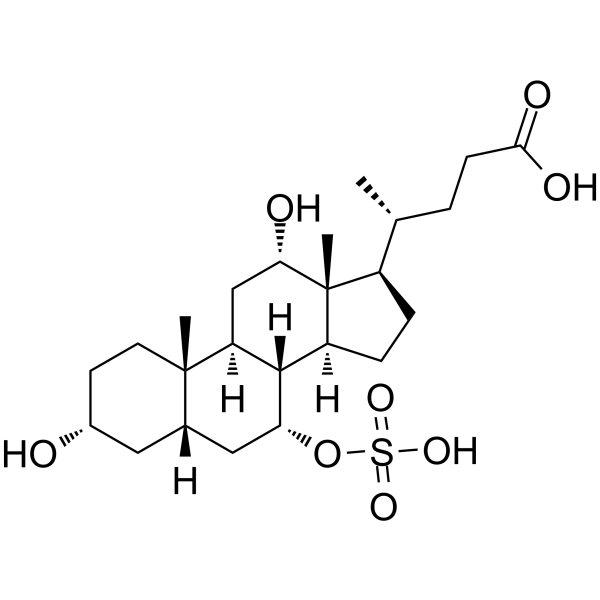
Cholic acid 7-sulfate (7-Sulfocholic acid) is a selective agonist targeting TGR5 (EC50=0.17 μM) and a ligand for MHC class I-related protein (MR1). As a gut-restricted TGR5 agonist, cholic acid 7-sulfate binds to TGR5 on enteroendocrine L cells, induces GLP-1 secretion, and improves glucose tolerance in a TGR5-dependent manner. Cholic acid 7-sulfate also acts as an endogenous ligand for MR1, promoting the survival of mucosal-associated invariant T cells MAIT and the expression of homeostatic gene signatures, affecting MAIT cell development and function. Cholic acid 7-sulfate is mainly used in the research of diabetes and MAIT cell-related immune regulation [1] .
1
1 Cited Publications
Cat. No.: HY-P71133
Purity:  ≥ 95%, as determined by reducing SDS-PAGE.
Synonyms: Plasminogen activator inhibitor 1; Endothelial plasminogen activator inhibitor; Serpin E1; MR1; Pai1; Planh1;
Species:  
Source:  
Cat. No.: HY-150356MR1
Category:  

Phenylpropanoids

Target:  

Reference Standards

Mixture of Aflatoxins in Acetonitrile (Standard) is mainly used for the detection of aflatoxins in grain, oils, foods and traditional Chinese medicines
Cat. No.: HY-150354MR1
Synonyms: #N/A
Target:  

Reference Standards

Research Areas:  

Others

Mixture of 9 Antioxidants in Acetonitrile (Standard) is mainly used for the determination of antioxidants in food and is suitable for the use of standard products in GB 5009.32
Cat. No.: HY-150353MR1
Synonyms: #N/A
Target:  

Reference Standards

Research Areas:  

Endocrinology Cancer

17-Estradiol, Estriol, Ethinylestradiol and Estrone in Methanol (Standard) is mainly used for the detection of hormone components in foods and cosmetics, and is suitable for use as standard products in GB 31658.7.
Cat. No.: HY-P990134

Target:  

TNF Receptor IFNAR

Research Areas:  

Inflammation/Immunology Cancer

Anti-Mouse CD40L/CD154 Antibody (MR-1) is an anti-mouse CD40L/CD154 IgG monoclonal antibody. Anti-Mouse CD40L/CD154 Antibody (MR-1) reduces the expression of IFN signaling pathway and lowers the level of IFN-β. Anti-Mouse CD40L/CD154 Antibody (MR-1) can prolong the survival time of transplants. Anti-Mouse CD40L/CD154 Antibody (MR-1) can be used for researches on cancer, inflammation conditions and xenotransplantation such as pancreatic cancer and autoimmune cholangitis [1] .
Cat. No.: HY-124004
CAS No.: 29769-49-1
Purity:  ≥95.0%
Synonyms: Ac-6-FP
Research Areas:  

Inflammation/Immunology

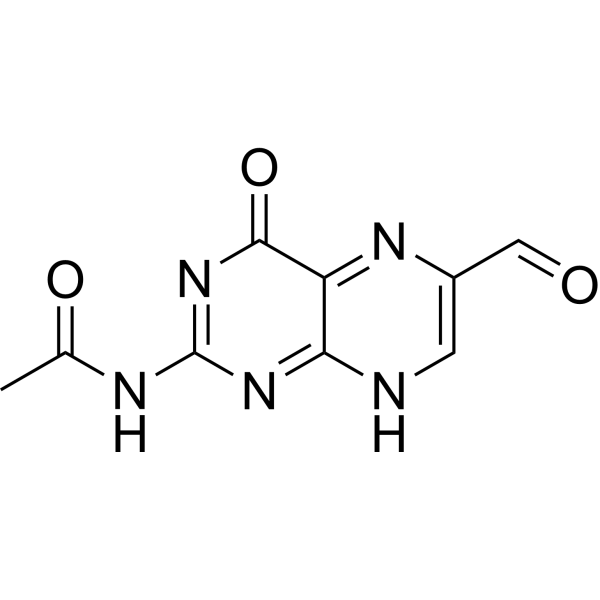
Acetyl-6-formylpterin (Ac-6-FP) is a hapten that covalently binds to MR1 through residue Lys43 of the protein, resulting in protein upregulation. Acetyl-6-formylpterin (Ac-6-FP) can be used in the study of inflammation [1].
Cat. No.: HY-32955
CAS No.: 444120-91-6
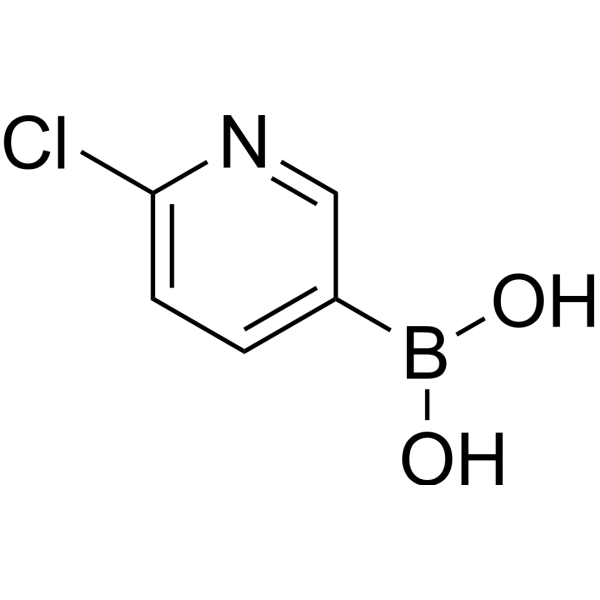
2-Chloropyridine-5-boronic acid is a mandelate racemase (MR) inhibitor with a Ki value of 8.5 μM against Pseudomonas putida MR .
Cat. No.: HY-P990269

Target:  

TNF Receptor

Research Areas:  

Inflammation/Immunology Cancer

Anti-Mouse CD40L/CD154 (LALA-PG) Antibody (MR-1) is a mouse-derived IgG2a κ type antibody inhibitor, targeting to mouse CD40L/CD154. Anti-Mouse CD40L/CD154 (LALA-PG) Antibody (MR-1) is a chimeric version of the original MR-1 antibody (HY-P990134). The variable domain sequences are identical to the original MR-1 but the constant region sequences have been switched from Armenian hamster IgG to mouse IgG2a. Anti-Mouse CD40L/CD154 (LALA-PG) Antibody (MR-1) contains a LALA-PG mutation in the Fc fragment rendering it unable to bind to endogenous Fcγ receptors. Anti-Mouse CD40L/CD154 (LALA-PG) Antibody (MR-1) blocks CD40/CD40L signaling. Anti-Mouse CD40L/CD154 (LALA-PG) Antibody (MR-1) can be used for researches of cancer, inflammation and immunology.
Cat. No.: HY-W168754
CAS No.: 16296-42-7
Target:  

MHC

Research Areas:  

Others

DB28 is a novel MR1 ligand. DB28 decreases cell surface expression of MR1 and competitively inhibits activation of MAIT cells by agonist ligands [1].
Cat. No.: HY-157281
CAS No.: 23140-55-8
Purity:  99.96%
Synonyms: PLIII
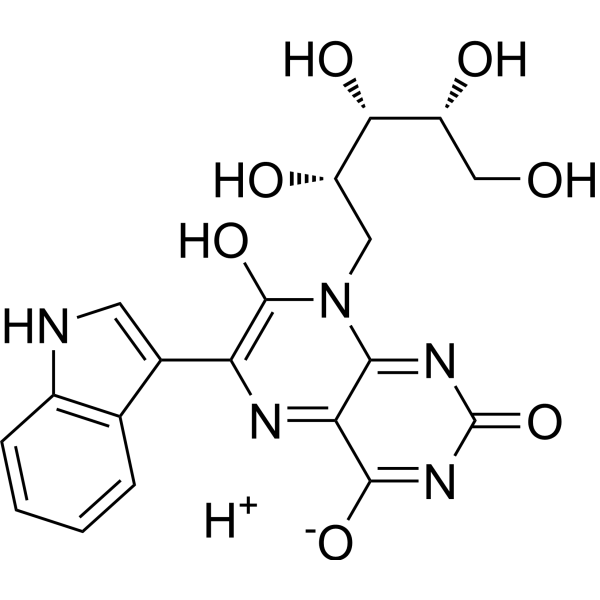
Photolumazine III (PLIII) is a microbial metabolite and derivative of Riboflavin (HY-B0456). Photolumazine III binds MR1 with high specificity. Photolumazine III supports efficient TCR binding. Photolumazine III acts as an antigen to activate cells. Responses to Photolumazine III trigger immune reactions [1].
Cat. No.: HY-P990270

Target:  

TNF Receptor

Research Areas:  

Inflammation/Immunology Cancer

Anti-Mouse CD40L/CD154 (D265A) Antibody (MR-1) is a mouse-derived IgG1 κ type antibody inhibitor, targeting to mouse CD40L/CD154. Anti-Mouse CD40L/CD154 (D265A) Antibody (MR-1) is a chimeric version of the original MR-1 antibody (HY-P990134). The variable domain sequences are identical to the original MR-1 but the constant region sequences have been switched from Armenian hamster IgG to mouse IgG1. Anti-Mouse CD40L/CD154 (D265A) Antibody (MR-1) contains a D265A mutation in the Fc fragment rendering it unable to bind to endogenous Fcγ receptors. Anti-Mouse CD40L/CD154 (D265A) Antibody (MR-1) blocks CD40/CD40L signaling. Anti-Mouse CD40L/CD154 (D265A) Antibody (MR-1) can be used for researches of cancer, inflammation and immunology.
Cat. No.: HY-RS08637
Research Areas:  

Others

MR1 Human Pre-designed siRNA Set A contains three designed siRNAs for MR1 gene (Human), as well as a negative control, a positive control, and a FAM-labeled negative control.

Cat. No.: HY-163122
CAS No.: 616-76-2
Target:  

Hapten

Research Areas:  

Inflammation/Immunology

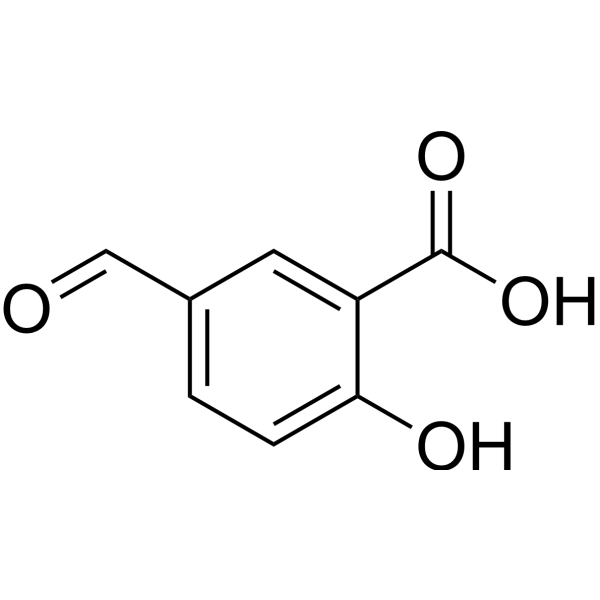
5-Formylsalicylic acid (5-F-SA), a hapten, strongly upregulates MR1 expression (MR1 ligand) [1].
Cat. No.: HY-126855S
CAS No.: 1332881-66-9
Synonyms: 7-Sulfocholic acid-d4
Cholic acid 7-sulfate-d4 (7-Sulfocholic acid-d4) is the deuterium labeled Cholic acid 7-sulfate (HY-126855). Cholic acid 7-sulfate is a selective agonist targeting TGR5 (EC50=0.17 μM) and a ligand for MHC class I-related protein (MR1). As a gut-restricted TGR5 agonist, cholic acid 7-sulfate binds to TGR5 on enteroendocrine L cells, induces GLP-1 secretion, and improves glucose tolerance in a TGR5-dependent manner. Cholic acid 7-sulfate also acts as an endogenous ligand for MR1, promoting the survival of mucosal-associated invariant T cells MAIT and the expression of homeostatic gene signatures, affecting MAIT cell development and function. Cholic acid 7-sulfate is mainly used in the research of diabetes and MAIT cell-related immune regulation [1] .
Cat. No.: HY-182894
Target:  

Virus Protease SARS-CoV

Research Areas:  

Infection

MR1-114 is an orally active SARS-CoV-2 papain-like protease (PLpro) inhibitor with an IC50 of 0.037 μM. As a broad-spectrum inhibitor, MR1-114 maintains submicromolar activity against SARS-CoV-2 Delta, Omicron B.1.1.529 and Omicron BA.5 variants, with EC50 values of 0.18 μM, 0.39 μM and 0.20 μM, respectively. MR1-114 can be used for the research of coronavirus disease 2019 (SARS-CoV-2 infection) [1].
Cat. No.: HY-P705394
Purity:  ≥ 95%, as determined by reducing SDS-PAGE.
Synonyms: MR1 & B2M; Major histocompatibility complex class I-related protein 1; MR1; MHC class I-related protein 1; Class I histocompatibility antigen-like protein; MR1
Species:  
Source:  
Cat. No.: HY-P11249
Target:  

nAChR

Research Areas:  

Neurological Disease

Mr1.1[S4Dap, C16Pen] is a highly active and selective nAChR (human α9α10 nAChR IC50 = 4.0 nM, rat α9α10 nAChR IC50 = 2.7 nM) inhibitor. Mr1.1[S4Dap, C16Pen] can significantly relieve pain and has significant stability. Mr1.1[S4Dap, C16Pen] can be used for the study of neuropathic pain [1].
Cat. No.: HY-RS10777
Research Areas:  

Others

PNKD Human Pre-designed siRNA Set A contains three designed siRNAs for PNKD gene (Human), as well as a negative control, a positive control, and a FAM-labeled negative control.

Cat. No.: HY-P84718
Synonyms: HLALS

Host:  

Mouse

Application:  

IHC-P, ICC/IF, FC, ELISA

Reactivity:  

Human

