10 Results for "

MT1-MMP

" in MedChemExpress (MCE) Product Catalog:
Products (10)

10 Results for "MT1-MMP" in MCE Product Catalog:

2
2 Cited Publications
Cat. No.: HY-P4931
CAS No.: 720710-69-0
Target:  

MMP

Research Areas:  

Cancer

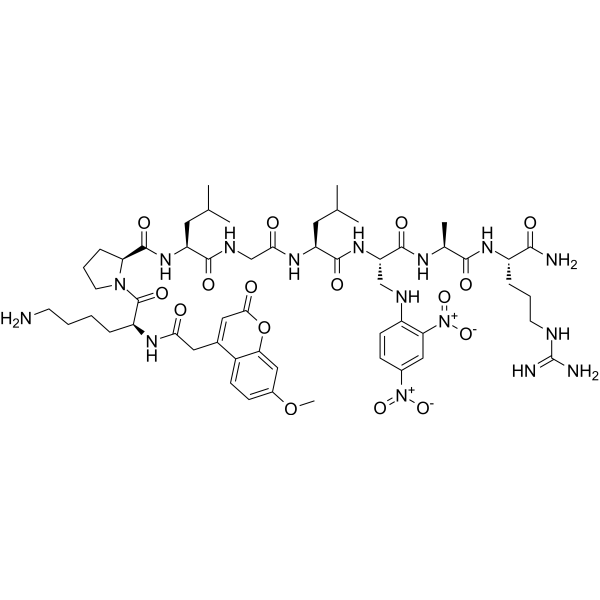
Mca-Lys-Pro-Leu-Gly-Leu-Dap(Dnp)-Ala-Arg-NH2 (FS-6) is a fluorescent peptide that is a quenched MMP peptide substrate. Mca-Lys-Pro-Leu-Gly-Leu-Dap(Dnp)-Ala-Arg-NH2 can be used for real-time quantification of MMP enzymatic activity. Mca-Lys-Pro-Leu-Gly-Leu-Dap(Dnp)-Ala-Arg-NH2 is an elongated peptide of MMP substrate (FS-1) and is active against collagenases (MMP-1, MMP-8, MMP-13 ) and MT1-MMP with higher specificity constants than FS-1 [1]. (Ex/Em=325 nm/400 nm)
loading...
    loading...
Cat. No.: HY-P4123
CAS No.: 1231898-26-2
Target:  

MMP

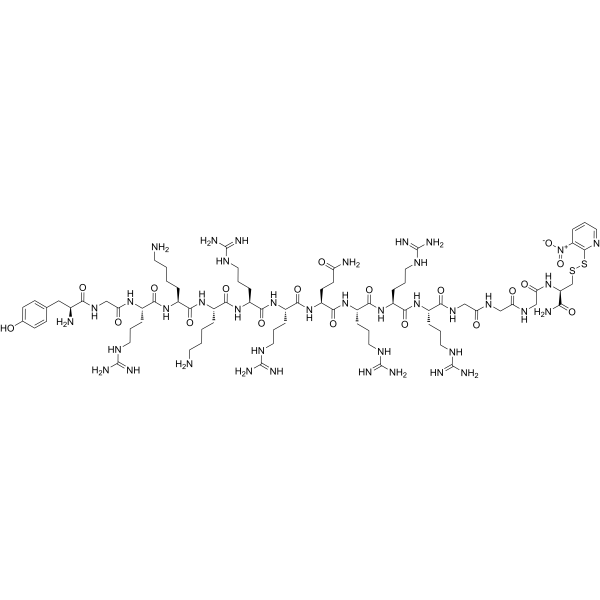
TAT (47-57) GGG-Cys (Npys) is a cell-penetrating peptide and delivery carrier derived from TAT. TAT (47-57) GGG-Cys (Npys) facilitates the translocation of conjugated drug molecules across cell membranes. TAT (47-57) GGG-Cys (Npys) acts as a delivery carrier for MT1-MMP inhibitors. TAT (47-57) GGG-Cys (Npys) is applicable to research on diseases associated with MT1-MMP activity, such as cancer, arthritis, heart disease, and vascular disorders [1].
loading...
    loading...
Cat. No.: HY-RS08528
Research Areas:  

Others

MMP14 Human Pre-designed siRNA Set A contains three designed siRNAs for MMP14 gene (Human), as well as a negative control, a positive control, and a FAM-labeled negative control.

loading...
    loading...
Cat. No.: HY-P10775
Research Areas:  

Cancer

BT1769 is a MT1-MMP-targeted (KD = 3.35 nM) Bicycle toxin conjugate. BT1769 can be used in the study for osteosarcoma. BT1769 consists of a novel bicyclic targeting peptide that selectively binds MT1-MMP; a cytotoxin MMAE; and an enzymatically cleavable dipeptide linker [1].
loading...
    loading...
Cat. No.: HY-P10775A
Target:  

MMP

Research Areas:  

Cancer

BT1769 acetate is a conjugate and antitumor agent targeting MT1-MMP, with a Kd value of 3.35 nM against human targets. BT1769 acetate exhibits favorable pharmacokinetic properties. BT1769 acetate specifically binds to MT1-MMP via its bicyclic peptide component, delivering the cytotoxic agent MMAE (HY-15162) to antigen-expressing cells. It effectively inhibits tumor growth, induces complete responses, and significantly prolongs event-free survival in osteosarcoma patient-derived xenograft models. BT1769 acetate shows extremely low activity in Ewing sarcoma models and can be used in osteosarcoma-related research [1] .
loading...
    loading...
Cat. No.: HY-P81845
Synonyms: MMP-14; MMP-X1; MT-MMP; MT1MMP; MTMMP1; WNCHRS; MT1-MMP; MT-MMP 1

Host:  

Rabbit

Application:  

WB, IHC-P, ICC/IF, FC, IP

Reactivity:  

Human, Mouse, Rat

loading...
    loading...
Cat. No.: HY-P81845A
Synonyms: MMP-14; MMP-X1; MT-MMP; MT1MMP; MTMMP1; WNCHRS; MT1-MMP; MT-MMP 1

Host:  

Rabbit

Application:  

WB, IHC-P, ICC/IF, FC, IP

Reactivity:  

Human, Mouse, Rat

loading...
    loading...
Cat. No.: HY-RS08530
Research Areas:  

Others

Mmp14 Rat Pre-designed siRNA Set A contains three designed siRNAs for Mmp14 gene (Rat), as well as a negative control, a positive control, and a FAM-labeled negative control.

loading...
    loading...
Cat. No.: HY-RS08529
Research Areas:  

Others

Mmp14 Mouse Pre-designed siRNA Set A contains three designed siRNAs for Mmp14 gene (Mouse), as well as a negative control, a positive control, and a FAM-labeled negative control.

loading...
    loading...
Cat. No.: HY-183626
CAS No.: 1247823-40-0
PAI-1-IN-1 is an orally active and specific PAI-1 inhibitor with an IC50 of <6.95 μM. PAI-1-IN-1 blocks the interaction between PAI-1 and serine proteases or LRP-1, and enhances plasmin generation. PAI-1-IN-1 restores macrophage efferocytosis and promotes macrophage polarization. PAI-1-IN-1 alleviates PAI-1-mediated inhibition of Furin, promotes MT1-MMP maturation, activates the NOTCH1 signaling pathway, inhibits proliferation and induces apoptosis. PAI-1-IN-1 promotes skeletal muscle regeneration and alleviates inflammation in a mouse model of skeletal muscle injury. PAI-1-IN-1 can be used in research on skeletal muscle injury-induced inflammation and chronic myeloid leukemia [1] .
loading...
    loading...

