7 Results for "

NSG mouse model

" in MedChemExpress (MCE) Product Catalog:
Products (7)

7 Results for "NSG mouse model" in MCE Product Catalog:

Cat. No.: HY-178775
Target:  

PI4K Parasite MAP4K PI3K

Research Areas:  

Infection

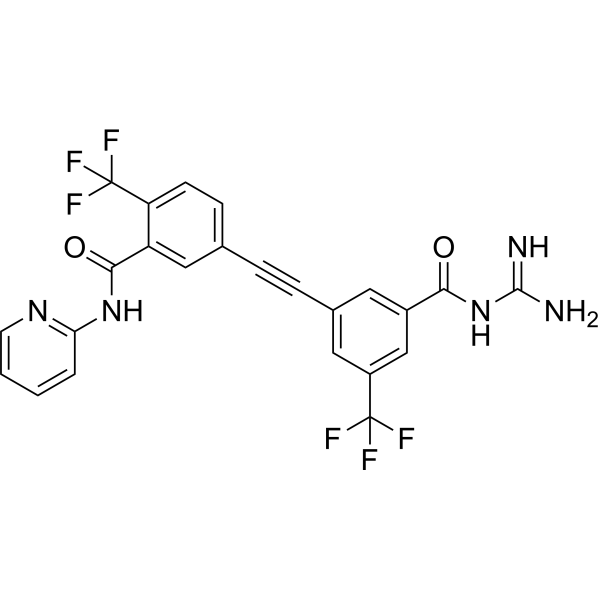
PI4K-IN-3 (Compound 27) is an orally active PI4K inhibitor with an IC50 of 1.9  nM for Plasmodium vivax PI4K. PI4K-IN-3 has no hERG channel inhibition and mammalian cytotoxicity. PI4K-IN-3 has significant selectivity against the human MINK1 and MAP4K4 kinases but with low selectivity against human PI3Kα and PI4Kβ. PI4K-IN-3 has potent antimalarial activity and significantly reduces parasitaemia in NSG mice mouse models of Plasmodium falciparum malaria .
loading...
    loading...
Cat. No.: HY-148178
CAS No.: 2260904-47-8
Purity:  99.50%
Target:  

Parasite

Research Areas:  

Infection

MMV688533 is an antimalarial agent. MMV688533 interferes with intracellular trafficking, lipid utilization, and endocytosis pathways in Plasmodium falciparum. MMV688533 rapidly kills asexual blood-stage Plasmodium falciparum and Plasmodium vivax parasites in vitro and reduces parasitemia in a Plasmodium falciparum NSG mouse model. MMV688533 can be used for the research of malaria .
loading...
    loading...
Cat. No.: HY-172953
Target:  

Parasite

Research Areas:  

Infection

Insecticidal agent 24 is an orally active pyridylspiroindoline frontrunner. Insecticidal agent 24 has antiplasmodial activity (Pf NF54 IC50: 0.08 μM). Insecticidal agent 24 inhibits hERG activity (IC50: 6.5 μM). Insecticidal agent 24 reduces parasitemia in a humanized immunodeficient NSG mouse Plasmodium falciparum infection model .
loading...
    loading...
Cat. No.: HY-184969
NUCC-0227579 is a VHL-recruiting PROTAC degrader targeting CD73, with a DC50 of 0.32 μM. NUCC-0227579 synergistically mediates CD73 degradation through the ubiquitin-proteasome pathway and the lysosomal pathway. NUCC-0227579 inhibits the conversion of AMP to adenosine, abrogates adenosine-mediated immunosuppression, upregulates the activities of the NF-κB and NFAT pathways, and enhances the secretion, activation and proliferation levels of IFN-γ and TNF-α. NUCC-0227579 downregulates NAD + synthesis in tumor cells, and inhibits the proliferation, migration and adhesion abilities of tumor cells under glutamine-deficient conditions. NUCC-0227579 significantly suppresses tumor growth in a humanized NSG mouse model of triple-negative breast cancer .
loading...
    loading...
Cat. No.: HY-181849
Research Areas:  

Cancer

MS2928 is a selective SETD8 inhibitor with an IC50 of 0.14 μM against SETD8 methyltransferase activity. MS2928 reduces cellular H4K20me1 levels and inhibits proliferation of SETD8-overexpressing multiple myeloma cells. MS2928 inhibits tumor growth in xenograft mouse models of SETD8-overexpressing multiple myeloma. MS2928 can be used for the study of SETD8 biological functions and multiple myeloma .
loading...
    loading...
Cat. No.: HY-182685
CAS No.: 2446681-27-0
Research Areas:  

Infection

MMV693183 is an orally active inhibitor of Plasmodium falciparum acetyl-CoA synthetase (AcAS), with an IC50 of 300 nM against Plasmodium falciparum. MMV693183 exhibits potent inhibitory activity against clinical isolates of malaria parasites, including Artemisinin (HY-B0094)-resistant strains. MMV693183 is metabolized in vivo into the active antimetabolite CoA-MMV693183, which exerts effects of killing asexual blood-stage parasites and blocking transmission to Anopheles mosquitoes by binding to and inhibiting the function of acetyl-CoA synthetase, thereby reducing the levels of acetyl-CoA and 4'-phosphopantetheine. In humanized mouse models, MMV693183 shows favorable in vivo efficacy, drug-like properties, and no significant cytotoxicity or off-target activity against human cells. MMV693183 is widely used in malaria-related research as a parasiticide and metabolic disruptor .
loading...
    loading...
Cat. No.: HY-P991896
Synonyms: AT14-012
AT1412 is a CD9-binding antibody. AT1412 binds to the tetraspanin protein CD9 and modulates CD9 function by enhancing T cell adhesion to endothelial cells (HUVECs) and transendothelial migration. AT1412 binds to B-ALL cell lines but not to T-ALL. AT1412 induces antibody-dependent cellular cytotoxicity in B-ALL cell lines. AT1412 binds to melanoma cells, B-ALL, gastric cancer, colorectal cancer, and pancreatic cancer cells [1] .
loading...
    loading...

