Search Result
Results for "
PEG polymer
" in MedChemExpress (MCE) Product Catalog:
244
Biochemical Assay Reagents
| Cat. No. |
Product Name |
Target |
Research Areas |
Chemical Structure |
-
- HY-Y0873
-
PEG300
Maximum Cited Publications
178 Publications Verification
Polyethylene glycol 300
|
Environmental Pollutants
Biochemical Assay Reagents
|
Others
|
|
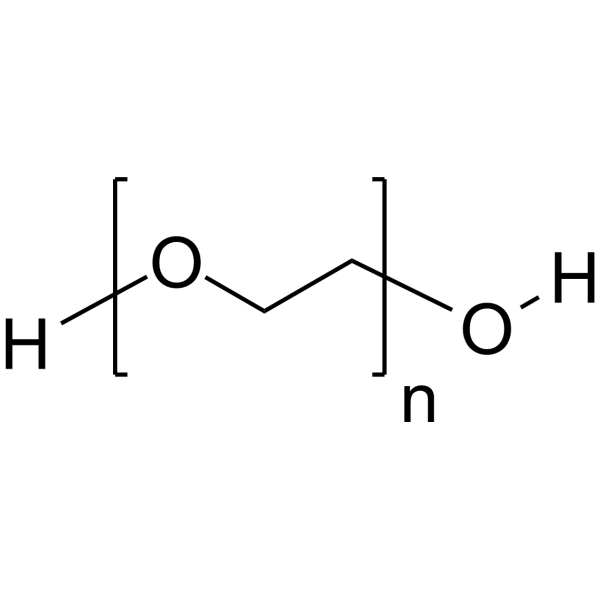
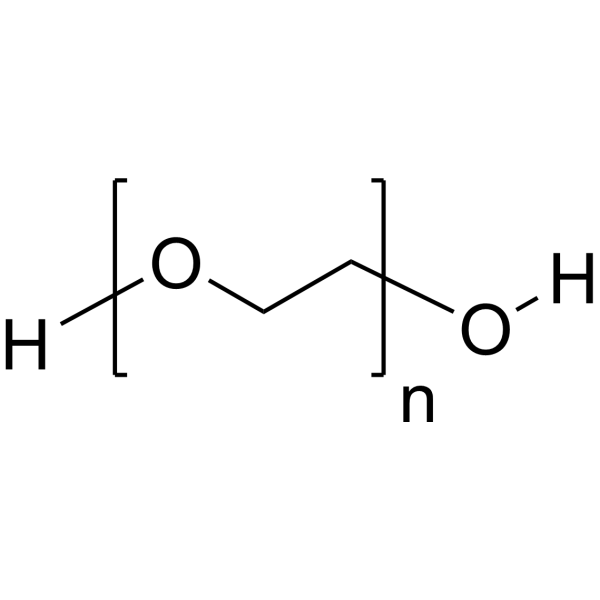
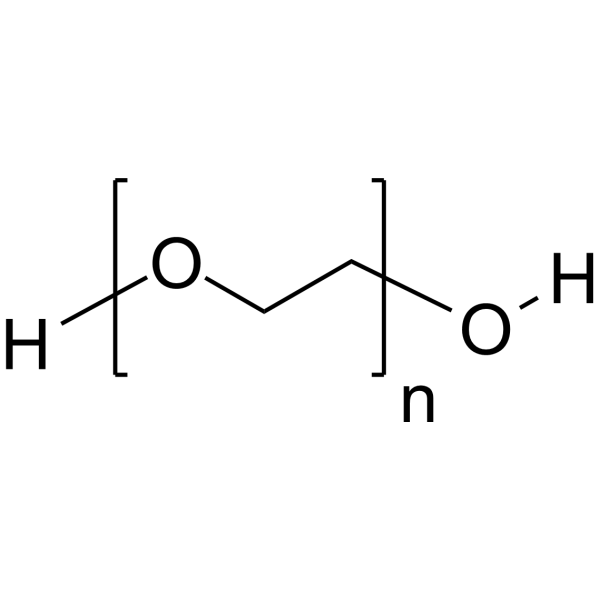
PEG300 (Polyethylene glycol 300), a neutral polymer of molecular weight 300, is a water-soluble, low immunogenic and biocompatible polymer formed by repeating units of ethylene glycol .
|
-
-
- HY-142979
-
|
(C2H4O)nC42H82NO10P
|
Liposome
|
Others
|
|
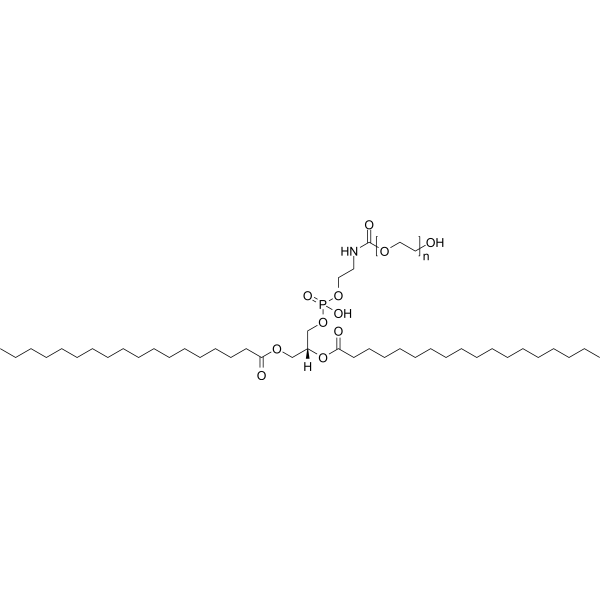
DSPE-PEG 2000 is a PEG polymer containing DSPE and amine end groups. DSPE-PEG 2000 can be used to form micelles as nanoparticles for drug delivery .
|
-
-
- HY-Y0873C
-
-
-
- HY-Y0873K
-
-
-
- HY-W440914
-
|
|
Fluorescent Dye
|
Others
|
|
DSPE-PEG1000-FITC is an amphiphile PEG polymer which has unsaturated lipid tails. The polymer can form micelles in an aqueous solution and can be used to prepare liposome/nano particles for drug nanocarriers. . Reagent grade, for research use only.
|
-
-
- HY-W440827
-
|
|
Liposome
|
Others
|
|
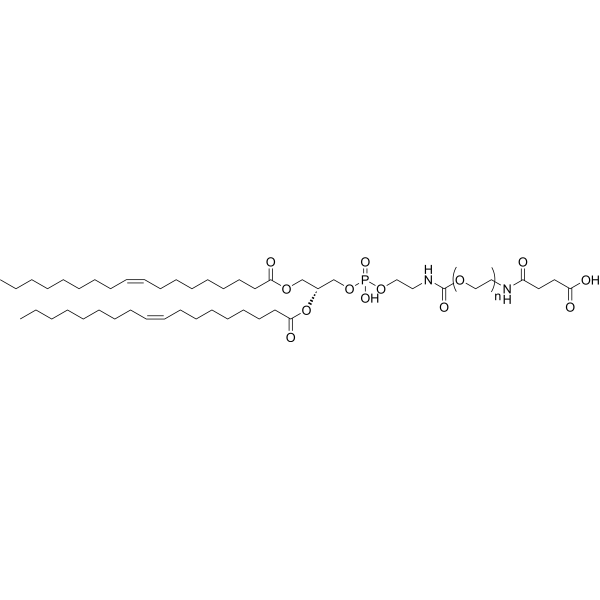
DOPE-PEG2000-COOH is a PEG polymer containing unsaturated DOPE phospholipids and carboxylic acids. DOPE-PEG2000-COOH can be used to prepare liposomes or other nanoparticles for drug delivery .
|
-
-
- HY-176499
-
|
|
Biochemical Assay Reagents
|
Others
|
|
PLGA38000-PEG10000 is an amphiphilic polymer. Amphiphilic polymers can be used in drug delivery studies due to their ability to self-assemble into discrete aggregates .
|
-
-
- HY-W440910
-
|
|
Liposome
|
Others
|
|
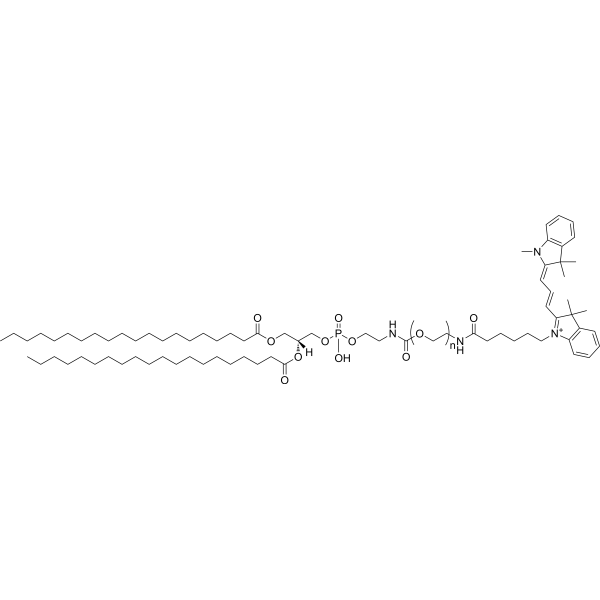
DSPE-PEG5000-Cy3 is a phospholipid PEG polymer with Cy3 dye used in labeling and fluorescence microscopy. The polymer can self-assemble in aqueous solution to form micelles/lipid bilayer and used to prepare liposomes or nanoparticles for nutrients delivery such as mRNA or DNA vaccine.
|
-
-
- HY-172351A
-
|
|
Biochemical Assay Reagents
|
Cancer
|
|
PEG6000-bis-amine synthesizes folate-conjugated polymeric micelles for encapsulation of the anticancer agent Rubitecan (HY-16560) .
|
-
-
- HY-172351B
-
|
|
Biochemical Assay Reagents
|
Cancer
|
|
PEG10000-bis-amine synthesizes folate-conjugated polymeric micelles for encapsulation of the anticancer agent Rubitecan (HY-16560) .
|
-
-
- HY-140656F
-
|
|
Fluorescent Dye
|
Others
|
|
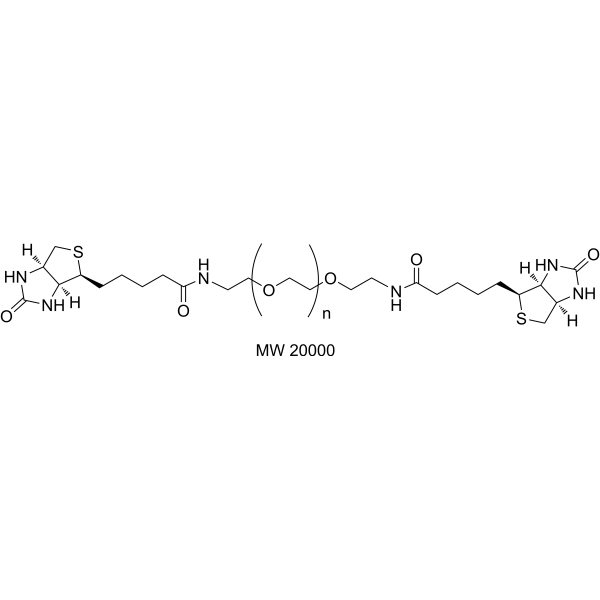
Biotin-PEG20000-Biotin is a biotin labeled PEG derivative. Biotin is an enzyme co-factor, can be used for labeling protein; PEG is a hydrophilic and water-soluble polymer with low toxicity.
|
-
-
- HY-167006
-
|
PLGA10000-PEG3000-Vinylsulfone
|
Biochemical Assay Reagents
|
Others
|
|
PLGA10000-PEG3000-VS (PLGA10000-PEG3000-Vinylsulfone) is an amphiphilic polymer. Amphiphilic polymers can be used in drug delivery studies due to their ability to self-assemble into discrete aggregates .
|
-
-
- HY-172351
-
|
|
Biochemical Assay Reagents
|
Cancer
|
|
PEG400-bis-amine synthesizes folate-conjugated polymeric micelles for encapsulation of the anticancer agent Rubitecan (HY-16560) .
|
-
-
- HY-W440945
-
|
|
Liposome
|
Others
|
|
Stearic acid-PEG2000-amine is an amphiphilic PEG polymer which forms micelles in an aqueous solution. The terminal amine can react with an NHS ester to form a stable amide linkage. The aliphatic chain of stearic acid can be used to encapsulate or congregate hydrophobic therapeutic agents while the PEG chain enhances overall solubility of the polymer. Reagent grade, for research use only.
|
-
-
- HY-W1048533H
-
|
Biotin-PEG1000-Thiol
|
Biochemical Assay Reagents
|
Others
|
|
Biotin-PEG1000-SH (Biotin-PEG1000-Thiol) is a biotin PEG polymer containing a thiol (-SH). Biotin-labeled compounds can then be linked to avidin or streptavidin for further purification or detection .
|
-
-
- HY-167055
-
|
PLLA4000-PEG2000-Vinylsulfone
|
Biochemical Assay Reagents
|
Others
|
|
PLLA4000-PEG2000-VS (PLLA4000-PEG2000-Vinylsulfone) is an amphiphilic polymer. Amphiphilic polymers can be used in drug delivery studies due to their ability to self-assemble into discrete aggregates .
|
-
-
- HY-167033
-
|
PLGA4000-PEG5000-Vinylsulfone
|
Biochemical Assay Reagents
|
Others
|
|
PLGA4000-PEG5000-VS (PLGA4000-PEG5000-Vinylsulfone) is an amphiphilic polymer. Amphiphilic polymers can be used in drug delivery studies due to their ability to self-assemble into discrete aggregates .
|
-
-
- HY-167047
-
|
PLLA5000-PEG1000-Vinylsulfone
|
Biochemical Assay Reagents
|
Others
|
|
PLLA5000-PEG1000-VS (PLLA5000-PEG1000-Vinylsulfone) is an amphiphilic polymer. Amphiphilic polymers can be used in drug delivery studies due to their ability to self-assemble into discrete aggregates .
|
-
-
- HY-167035
-
|
PLGA5000-PEG2000-Vinylsulfone
|
Biochemical Assay Reagents
|
Others
|
|
PLGA5000-PEG2000-VS (PLGA5000-PEG2000-Vinylsulfone) is an amphiphilic polymer. Amphiphilic polymers can be used in drug delivery studies due to their ability to self-assemble into discrete aggregates .
|
-
-
- HY-D2429
-
|
|
Fluorescent Dye
|
Others
|
|
Dextran-PEG-Cy3 is the Cy3 (HY-D0822)-labeled Dextran-PEG conjugate. Dextran-PEG is used as polymer-polymer systems for the high biocompatibility to maintain cell osmolarity. Dextran-PEG coatings can reduce nanoparticle cytotoxicity .
|
-
-
- HY-147205B
-
-
-
- HY-W440893
-
|
|
Biochemical Assay Reagents
|
Others
|
|
DSPE-PEG5000-OH is a linear phospholipid PEG polymer. The lipid tails allow encapsulation of hdyrophobic therapeutics while the PEG chain maintains its hydrophilicity. The polymer can be used for drug nanocarrier, such as liposomal anti cancer drug or mRNA/DNA vaccine.
|
-
-
- HY-W440891
-
|
|
Biochemical Assay Reagents
|
Others
|
|
DSPE-PEG1000-OH is a hydroxyl terminated phospholipid PEG polymer. The hydrophobic tails allow for the encapsulation and congregation of other hydrophobic drugs. The polymer can be used to prepare liposomes or lipid nanoparticles. Hydroxyl terminal can further derivatize the compound.
|
-
-
- HY-W440953
-
|
|
Biochemical Assay Reagents
|
Others
|
|
Stearic acid-PEG1000-CH2CO2H is an amphiphilic PEG polymer which forms micelles in an aqueous solution. The aliphatic chain of stearic acid can be used to encapsulate or congregate hydrophobic therapeutic agents while the PEG chain enhances overall solubility of the polymer.
|
-
-
- HY-N16038
-
|
|
Biochemical Assay Reagents
|
Others
|
|
Bis-DSPE PEG2000 sodium is a PEG polymer containing DSPE and amine end groups. Bis-DSPE PEG2000 sodium can be used to synthesize lipid nanoparticles for drug delivery .
|
-
-
- HY-W440909
-
|
|
Liposome
|
Others
|
|
DSPE-PEG3400-Cy3 is a phospholipid PEG polymer with Cy3 dye used in labeling and fluorescence microscopy. The polymer can self-assemble in aqueous solution to form micelles/lipid bilayer and used to prepare liposomes or nanoparticles for nutrients delivery such as mRNA or DNA vaccine.
|
-
-
- HY-W591338A
-
|
|
PROTAC Linkers
|
Others
|
|
HO-PEG10000-CH2COOH is a PEG polymer with -COOH that can be used as a PROTAC linker to the synthesis of PROTACs .
|
-
-
- HY-W591485
-
|
|
Biochemical Assay Reagents
|
Others
|
|
Acrylate-PEG1000-acrylate is a linear polymer formed by connecting acrylate groups at both ends of a PEG molecule and can be used for drug delivery .
|
-
-
- HY-W1048567E
-
|
|
Biochemical Assay Reagents
|
Others
|
|
mPEG40000-SCM is a high quality amine-reactive PEG product with a stable non-degradable functional group between the PEG polymer chain and the NHS ester .
|
-
-
- HY-W1048567A
-
|
|
Biochemical Assay Reagents
|
Others
|
|
mPEG2000-SCM is a high quality amine-reactive PEG product with a stable non-degradable functional group between the PEG polymer chain and the NHS ester .
|
-
-
- HY-W1048567H
-
|
|
Biochemical Assay Reagents
|
Others
|
|
mPEG3400-SCM is a high quality amine-reactive PEG product with a stable non-degradable functional group between the PEG polymer chain and the NHS ester .
|
-
-
- HY-W440936
-
|
|
Liposome
|
Others
|
|
Stearic acid-PEG5000-Rhodamine is a fatty acid containing PEG polymer which can self assemble in an aqueous solution to form micelles. The polymer can be used to prepare nanoparticles for drug encapsulation. The red dye rhodamine can be easily traced by fluorescence microscopy. Rhodamine has maximum absorption at 570 nm and emission around 595 nm.
|
-
-
- HY-W440935
-
|
|
Liposome
|
Others
|
|
Stearic acid-PEG3400-Rhodamine is a fatty acid containing PEG polymer which can self assemble in an aqueous solution to form micelles. The polymer can be used to prepare nanoparticles for drug encapsulation. The red dye rhodamine can be easily traced by fluorescence microscopy. Rhodamine has maximum absorption at 570 nm and emission around 595 nm.
|
-
-
- HY-W1048533C
-
|
Biotin-PEG5000-Thiol
|
Biochemical Assay Reagents
|
Others
|
|
Biotin-PEG5000-SH (Biotin-PEG5000-Thiol) is a biotin PEG polymer containing a thiol (-SH). Biotin-labeled compounds can then be linked to avidin or streptavidin for further purification or detection .
|
-
-
- HY-W1048533A
-
|
Biotin-PEG2000-Thiol,
|
Biochemical Assay Reagents
|
Others
|
|
Biotin-PEG2000-SH (Biotin-PEG2000-Thiol) is a biotin PEG polymer containing a thiol (-SH). Biotin-labeled compounds can then be linked to avidin or streptavidin for further purification or detection .
|
-
-
- HY-W1048533E
-
|
Biotin-PEG20000-Thiol
|
Biochemical Assay Reagents
|
Others
|
|
Biotin-PEG20000-SH (Biotin-PEG20000-Thiol) is a biotin PEG polymer containing a thiol (-SH). Biotin-labeled compounds can then be linked to avidin or streptavidin for further purification or detection .
|
-
-
- HY-W440892
-
|
|
Biochemical Assay Reagents
|
Others
|
|
DSPE-PEG3400-OH is an amphiphilic polydisperse PEG which can spontaneously self-assemble in aqueous solution. The polymer can be used to prepare liposoome for targeted drug delivery.
|
-
-
- HY-174954D
-
|
|
Biochemical Assay Reagents
|
Others
|
|
6-Arm-PEG3400-DA is a polymer consisting of a four-arm PEG core structure with acrylate groups attached to the ends of each PEG chain by chemical reaction, which can be used for drug delivery .
|
-
-
- HY-174954E
-
|
|
Biochemical Assay Reagents
|
Others
|
|
6-Arm-PEG5000-DA is a polymer consisting of a four-arm PEG core structure with acrylate groups attached to the ends of each PEG chain by chemical reaction, which can be used for drug delivery .
|
-
-
- HY-167019
-
|
PLGA2000-PEG5000-Vinylsulfone
|
Biochemical Assay Reagents
|
Others
|
|
PLGA2000-PEG5000-VS (PLGA2000-PEG5000-Vinylsulfone) is an amphiphilic polymer. Amphiphilic polymers can be used in drug delivery studies due to their ability to self-assemble into discrete aggregates .
|
-
-
- HY-167027
-
|
PLGA3000-PEG5000-Vinylsulfone
|
Biochemical Assay Reagents
|
Others
|
|
PLGA3000-PEG5000-VS (PLGA3000-PEG5000-Vinylsulfone) is an amphiphilic polymer. Amphiphilic polymers can be used in drug delivery studies due to their ability to self-assemble into discrete aggregates .
|
-
-
- HY-167051
-
|
PLLA1000-PEG5000-Vinylsulfone
|
Biochemical Assay Reagents
|
Others
|
|
PLLA1000-PEG5000-VS (PLLA1000-PEG5000-Vinylsulfone) is an amphiphilic polymer. Amphiphilic polymers can be used in drug delivery studies due to their ability to self-assemble into discrete aggregates .
|
-
-
- HY-167030
-
|
PLGA4000-PEG2000-Vinylsulfone
|
Biochemical Assay Reagents
|
Others
|
|
PLGA4000-PEG2000-VS (PLGA4000-PEG2000-Vinylsulfone) is an amphiphilic polymer. Amphiphilic polymers can be used in drug delivery studies due to their ability to self-assemble into discrete aggregates .
|
-
-
- HY-167032
-
|
PLGA4000-PEG3000-Vinylsulfone
|
Biochemical Assay Reagents
|
Others
|
|
PLGA4000-PEG3000-VS (PLGA4000-PEG3000-Vinylsulfone) is an amphiphilic polymer. Amphiphilic polymers can be used in drug delivery studies due to their ability to self-assemble into discrete aggregates .
|
-
-
- HY-167062
-
|
PLLA2000-PEG3000-Vinylsulfone
|
Biochemical Assay Reagents
|
Others
|
|
PLLA2000-PEG3000-VS (PLLA2000-PEG3000-Vinylsulfone) is an amphiphilic polymer. Amphiphilic polymers can be used in drug delivery studies due to their ability to self-assemble into discrete aggregates .
|
-
-
- HY-167005
-
|
PLGA10000-PEG2000-Vinylsulfone
|
Biochemical Assay Reagents
|
Others
|
|
PLGA10000-PEG2000-VS (PLGA10000-PEG2000-Vinylsulfone) is an amphiphilic polymer. Amphiphilic polymers can be used in drug delivery studies due to their ability to self-assemble into discrete aggregates .
|
-
-
- HY-167052
-
|
PLLA2000-PEG1000-Vinylsulfone
|
Biochemical Assay Reagents
|
Others
|
|
PLLA2000-PEG1000-VS (PLLA2000-PEG1000-Vinylsulfone) is an amphiphilic polymer. Amphiphilic polymers can be used in drug delivery studies due to their ability to self-assemble into discrete aggregates .
|
-
-
- HY-167038
-
|
PLGA5000-PEG5000-Vinylsulfone
|
Biochemical Assay Reagents
|
Others
|
|
PLGA5000-PEG5000-VS (PLGA5000-PEG5000-Vinylsulfone) is an amphiphilic polymer. Amphiphilic polymers can be used in drug delivery studies due to their ability to self-assemble into discrete aggregates .
|
-
-
- HY-167018
-
|
PLGA2000-PEG3000-Vinylsulfone
|
Biochemical Assay Reagents
|
Others
|
|
PLGA2000-PEG3000-VS (PLGA2000-PEG3000-Vinylsulfone) is an amphiphilic polymer. Amphiphilic polymers can be used in drug delivery studies due to their ability to self-assemble into discrete aggregates .
|
-
-
- HY-167013
-
|
PLGA1000-PEG5000-Vinylsulfone
|
Biochemical Assay Reagents
|
Others
|
|
PLGA1000-PEG5000-VS (PLGA1000-PEG5000-Vinylsulfone) is an amphiphilic polymer. Amphiphilic polymers can be used in drug delivery studies due to their ability to self-assemble into discrete aggregates .
|
-
- HY-167054
-
|
PLLA2000-PEG2000-Vinylsulfone
|
Biochemical Assay Reagents
|
Others
|
|
PLLA2000-PEG2000-VS (PLLA2000-PEG2000-Vinylsulfone) is an amphiphilic polymer. Amphiphilic polymers can be used in drug delivery studies due to their ability to self-assemble into discrete aggregates .
|
-
- HY-167020
-
|
PLGA3000-PEG1000-Vinylsulfone
|
Biochemical Assay Reagents
|
Others
|
|
PLGA3000-PEG1000-VS (PLGA3000-PEG1000-Vinylsulfone) is an amphiphilic polymer. Amphiphilic polymers can be used in drug delivery studies due to their ability to self-assemble into discrete aggregates .
|
-
- HY-167057
-
|
PLLA3000-PEG5000-Vinylsulfone
|
Biochemical Assay Reagents
|
Others
|
|
PLLA3000-PEG5000-VS (PLLA3000-PEG5000-Vinylsulfone) is an amphiphilic polymer. Amphiphilic polymers can be used in drug delivery studies due to their ability to self-assemble into discrete aggregates .
|
-
- HY-167040
-
|
PLLA10000-PEG1000-Vinylsulfone
|
Biochemical Assay Reagents
|
Others
|
|
PLLA10000-PEG1000-VS (PLLA10000-PEG1000-Vinylsulfone) is an amphiphilic polymer. Amphiphilic polymers can be used in drug delivery studies due to their ability to self-assemble into discrete aggregates .
|
-
- HY-167037
-
|
PLGA5000-PEG3000-Vinylsulfone
|
Biochemical Assay Reagents
|
Others
|
|
PLGA5000-PEG3000-VS (PLGA5000-PEG3000-Vinylsulfone) is an amphiphilic polymer. Amphiphilic polymers can be used in drug delivery studies due to their ability to self-assemble into discrete aggregates .
|
-
- HY-167043
-
|
PLLA10000-PEG3000-Vinylsulfone
|
Biochemical Assay Reagents
|
Others
|
|
PLLA10000-PEG3000-VS (PLLA10000-PEG3000-Vinylsulfone) is an amphiphilic polymer. Amphiphilic polymers can be used in drug delivery studies due to their ability to self-assemble into discrete aggregates .
|
-
- HY-167008
-
|
PLGA1000-PEG1000-Vinylsulfone
|
Biochemical Assay Reagents
|
Others
|
|
PLGA1000-PEG1000-VS (PLGA1000-PEG1000-Vinylsulfone) is an amphiphilic polymer. Amphiphilic polymers can be used in drug delivery studies due to their ability to self-assemble into discrete aggregates .
|
-
- HY-167058
-
|
PLLA3000-PEG3000-Vinylsulfone
|
Biochemical Assay Reagents
|
Others
|
|
PLLA3000-PEG3000-VS (PLLA3000-PEG3000-Vinylsulfone) is an amphiphilic polymer. Amphiphilic polymers can be used in drug delivery studies due to their ability to self-assemble into discrete aggregates .
|
-
- HY-167053
-
|
PLLA4000-PEG3000-Vinylsulfone
|
Biochemical Assay Reagents
|
Others
|
|
PLLA4000-PEG3000-VS (PLLA4000-PEG3000-Vinylsulfone) is an amphiphilic polymer. Amphiphilic polymers can be used in drug delivery studies due to their ability to self-assemble into discrete aggregates .
|
-
- HY-167049
-
|
PLLA4000-PEG5000-Vinylsulfone
|
Biochemical Assay Reagents
|
Others
|
|
PLLA4000-PEG5000-VS (PLLA4000-PEG5000-Vinylsulfone) is an amphiphilic polymer. Amphiphilic polymers can be used in drug delivery studies due to their ability to self-assemble into discrete aggregates .
|
-
- HY-167048
-
|
PLLA1000-PEG2000-Vinylsulfone
|
Biochemical Assay Reagents
|
Others
|
|
PLLA1000-PEG2000-VS (PLLA1000-PEG2000-Vinylsulfone) is an amphiphilic polymer. Amphiphilic polymers can be used in drug delivery studies due to their ability to self-assemble into discrete aggregates .
|
-
- HY-167041
-
|
PLLA5000-PEG3000-Vinylsulfone
|
Biochemical Assay Reagents
|
Others
|
|
PLLA5000-PEG3000-VS (PLLA5000-PEG3000-Vinylsulfone) is an amphiphilic polymer. Amphiphilic polymers can be used in drug delivery studies due to their ability to self-assemble into discrete aggregates .
|
-
- HY-167059
-
|
PLLA3000-PEG2000-Vinylsulfone
|
Biochemical Assay Reagents
|
Others
|
|
PLLA3000-PEG2000-VS (PLLA3000-PEG2000-Vinylsulfone) is an amphiphilic polymer. Amphiphilic polymers can be used in drug delivery studies due to their ability to self-assemble into discrete aggregates .
|
-
- HY-167046
-
|
PLLA1000-PEG1000-Vinylsulfone
|
Biochemical Assay Reagents
|
Others
|
|
PLLA1000-PEG1000-VS (PLLA1000-PEG1000-Vinylsulfone) is an amphiphilic polymer. Amphiphilic polymers can be used in drug delivery studies due to their ability to self-assemble into discrete aggregates .
|
-
- HY-167050
-
|
PLLA1000-PEG3000-Vinylsulfone
|
Biochemical Assay Reagents
|
Others
|
|
PLLA1000-PEG3000-VS (PLLA1000-PEG3000-Vinylsulfone) is an amphiphilic polymer. Amphiphilic polymers can be used in drug delivery studies due to their ability to self-assemble into discrete aggregates .
|
-
- HY-167029
-
|
PLGA4000-PEG1000-Vinylsulfone
|
Biochemical Assay Reagents
|
Others
|
|
PLGA4000-PEG1000-VS (PLGA4000-PEG1000-Vinylsulfone) is an amphiphilic polymer. Amphiphilic polymers can be used in drug delivery studies due to their ability to self-assemble into discrete aggregates .
|
-
- HY-167039
-
|
PLLA5000-PEG5000-Vinylsulfone
|
Biochemical Assay Reagents
|
Others
|
|
PLLA5000-PEG5000-VS (PLLA5000-PEG5000-Vinylsulfone) is an amphiphilic polymer. Amphiphilic polymers can be used in drug delivery studies due to their ability to self-assemble into discrete aggregates .
|
-
- HY-167044
-
|
PLLA5000-PEG2000-Vinylsulfone
|
Biochemical Assay Reagents
|
Others
|
|
PLLA5000-PEG2000-VS (PLLA5000-PEG2000-Vinylsulfone) is an amphiphilic polymer. Amphiphilic polymers can be used in drug delivery studies due to their ability to self-assemble into discrete aggregates .
|
-
- HY-167009
-
|
PLGA1000-PEG2000-Vinylsulfone
|
Biochemical Assay Reagents
|
Others
|
|
PLGA1000-PEG2000-VS (PLGA1000-PEG2000-Vinylsulfone) is an amphiphilic polymer. Amphiphilic polymers can be used in drug delivery studies due to their ability to self-assemble into discrete aggregates .
|
-
- HY-167026
-
|
PLGA3000-PEG3000-Vinylsulfone
|
Biochemical Assay Reagents
|
Others
|
|
PLGA3000-PEG3000-VS (PLGA3000-PEG3000-Vinylsulfone) is an amphiphilic polymer. Amphiphilic polymers can be used in drug delivery studies due to their ability to self-assemble into discrete aggregates .
|
-
- HY-167034
-
|
PLGA5000-PEG1000-Vinylsulfone
|
Biochemical Assay Reagents
|
Others
|
|
PLGA5000-PEG1000-VS (PLGA5000-PEG1000-Vinylsulfone) is an amphiphilic polymer. Amphiphilic polymers can be used in drug delivery studies due to their ability to self-assemble into discrete aggregates .
|
-
- HY-167060
-
|
PLLA3000-PEG1000-Vinylsulfone
|
Biochemical Assay Reagents
|
Others
|
|
PLLA3000-PEG1000-VS (PLLA3000-PEG1000-Vinylsulfone) is an amphiphilic polymer. Amphiphilic polymers can be used in drug delivery studies due to their ability to self-assemble into discrete aggregates .
|
-
- HY-167014
-
|
PLGA2000-PEG1000-Vinylsulfone
|
Biochemical Assay Reagents
|
Others
|
|
PLGA2000-PEG1000-VS (PLGA2000-PEG1000-Vinylsulfone) is an amphiphilic polymer. Amphiphilic polymers can be used in drug delivery studies due to their ability to self-assemble into discrete aggregates .
|
-
- HY-167061
-
|
PLLA2000-PEG5000-Vinylsulfone
|
Biochemical Assay Reagents
|
Others
|
|
PLLA2000-PEG5000-VS (PLLA2000-PEG5000-Vinylsulfone) is an amphiphilic polymer. Amphiphilic polymers can be used in drug delivery studies due to their ability to self-assemble into discrete aggregates .
|
-
- HY-167023
-
|
PLGA3000-PEG2000-Vinylsulfone
|
Biochemical Assay Reagents
|
Others
|
|
PLGA3000-PEG2000-VS (PLGA3000-PEG2000-Vinylsulfone) is an amphiphilic polymer. Amphiphilic polymers can be used in drug delivery studies due to their ability to self-assemble into discrete aggregates .
|
-
- HY-167010
-
|
PLGA1000-PEG3000-Vinylsulfone
|
Biochemical Assay Reagents
|
Others
|
|
PLGA1000-PEG3000-VS (PLGA1000-PEG3000-Vinylsulfone) is an amphiphilic polymer. Amphiphilic polymers can be used in drug delivery studies due to their ability to self-assemble into discrete aggregates .
|
-
- HY-167056
-
|
PLLA4000-PEG1000-Vinylsulfone
|
Biochemical Assay Reagents
|
Others
|
|
PLLA4000-PEG1000-VS (PLLA4000-PEG1000-Vinylsulfone) is an amphiphilic polymer. Amphiphilic polymers can be used in drug delivery studies due to their ability to self-assemble into discrete aggregates .
|
-
- HY-167045
-
|
PLLA10000-PEG5000-Vinylsulfone
|
Biochemical Assay Reagents
|
Others
|
|
PLLA10000-PEG5000-VS (PLLA10000-PEG5000-Vinylsulfone) is an amphiphilic polymer. Amphiphilic polymers can be used in drug delivery studies due to their ability to self-assemble into discrete aggregates .
|
-
- HY-167042
-
|
PLLA10000-PEG2000-Vinylsulfone
|
Biochemical Assay Reagents
|
Others
|
|
PLLA10000-PEG2000-VS (PLLA10000-PEG2000-Vinylsulfone) is an amphiphilic polymer. Amphiphilic polymers can be used in drug delivery studies due to their ability to self-assemble into discrete aggregates .
|
-
- HY-W440955
-
|
|
Biochemical Assay Reagents
|
Others
|
|
Stearic acid-PEG3400-CH2CO2H is an amphiphilic PEG polymer which forms micelles in an aqueous solution. The aliphatic chain of stearic acid can be used to encapsulate or congregate hydrophobic therapeutic agents while the PEG chain enhances overall solubility of the polymer.
|
-
- HY-W440956
-
|
|
Biochemical Assay Reagents
|
Others
|
|
Stearic acid-PEG5000-CH2CO2H is an amphiphilic PEG polymer which forms micelles in an aqueous solution. The aliphatic chain of stearic acid can be used to encapsulate or congregate hydrophobic therapeutic agents while the PEG chain enhances overall solubility of the polymer.
|
-
- HY-182662
-
|
|
Biochemical Assay Reagents
|
Others
|
|
Polymer blocking agent CA2000 is a polymer blocking agent composed of long PEG chains and terminal short amino groups. Polymer blocking agent CA2000 effectively reduces non-specific adsorption, significantly improving the accuracy and reliability of detection.
|
-
- HY-182662A
-
|
|
Biochemical Assay Reagents
|
Others
|
|
Polymer blocking agent CA4000 is a polymer blocking agent composed of long PEG chains and terminal short amino groups. Polymer blocking agent CA4000 effectively reduces non-specific adsorption, significantly improving the accuracy and reliability of detection.
|
-
- HY-179313
-
|
|
Biochemical Assay Reagents
|
Others
|
|
PEG-DPCA conjugate 1 is a PEG-DPCA conjugate that can co-assemble with mPEG-Amide-tri(DPCA) (HY-179320) into a supramolecular polymer hydrogel with nanofiber structures. The supramolecular polymer hydrogel exhibits shear-thinning behavior for injectable delivery, high drug loading, and degrades in vivo to release only DPCA and PEG, induces in vivo earhole regeneration in adult non-healing mice. PEG-DPCA conjugate 1 can be used for tissue regeneration research .
|
-
- HY-W591425A
-
|
|
Biochemical Assay Reagents
|
Others
|
|
Acrylate-PEG3400-acrylate is a linear polymer formed by connecting acrylate groups at both ends of a PEG molecule and can be used for drug delivery .
|
-
- HY-W591425
-
|
|
Biochemical Assay Reagents
|
Others
|
|
Acrylate-PEG2000-acrylate is a linear polymer formed by connecting acrylate groups at both ends of a PEG molecule and can be used for drug delivery .
|
-
- HY-W591427
-
|
|
Biochemical Assay Reagents
|
Others
|
|
Acrylate-PEG10000-acrylate is a linear polymer formed by connecting acrylate groups at both ends of a PEG molecule and can be used for drug delivery .
|
-
- HY-W591426
-
|
|
Biochemical Assay Reagents
|
Others
|
|
Acrylate-PEG5000-acrylate is a linear polymer formed by connecting acrylate groups at both ends of a PEG molecule and can be used for drug delivery .
|
-
- HY-W1048567
-
|
|
Biochemical Assay Reagents
|
Others
|
|
mPEG1000-SCM is a high quality amine-reactive PEG product with a stable non-degradable functional group between the PEG polymer chain and the NHS ester .
|
-
- HY-W1048567B
-
|
|
Biochemical Assay Reagents
|
Others
|
|
mPEG5000-SCM is a high quality amine-reactive PEG product with a stable non-degradable functional group between the PEG polymer chain and the NHS ester .
|
-
- HY-W1048567D
-
|
|
Biochemical Assay Reagents
|
Others
|
|
mPEG20000-SCM is a high quality amine-reactive PEG product with a stable non-degradable functional group between the PEG polymer chain and the NHS ester .
|
-
- HY-W1048567C
-
|
|
Biochemical Assay Reagents
|
Others
|
|
mPEG10000-SCM is a high quality amine-reactive PEG product with a stable non-degradable functional group between the PEG polymer chain and the NHS ester .
|
-
- HY-W1048533D
-
|
Biotin-PEG10000-Thiol
|
Biochemical Assay Reagents
|
Others
|
|
Biotin-PEG10000-SH (Biotin-PEG10000-Thiol) is a biotin PEG polymer containing a thiol (-SH). Biotin-labeled compounds can then be linked to avidin or streptavidin for further purification or detection .
|
-
- HY-W1048533I
-
|
Biotin-PEG3400-Thiol
|
Biochemical Assay Reagents
|
Others
|
|
Biotin-PEG3400-SH (Biotin-PEG3400-Thiol) is a biotin PEG polymer containing a thiol (-SH). Biotin-labeled compounds can then be linked to avidin or streptavidin for further purification or detection .
|
-
- HY-W1048533J
-
|
Biotin-PEG40000-Thiol
|
Biochemical Assay Reagents
|
Others
|
|
Biotin-PEG40000-SH (Biotin-PEG40000-Thiol) is a biotin PEG polymer containing a thiol (-SH). Biotin-labeled compounds can then be linked to avidin or streptavidin for further purification or detection .
|
-
- HY-179320
-
|
|
Biochemical Assay Reagents
|
Others
|
|
mPEG-Amide-tri(DPCA) is a PEG-DPCA conjugate that can self-assemble into a supramolecular polymer hydrogel with nanofiber structures. mPEG-Amide-tri(DPCA) supramolecular polymer hydrogel exhibits shear-thinning behavior for injectable delivery, high drug loading, and degrades in vivo to release only DPCA and PEG. mPEG-Amide-tri(DPCA) supramolecular polymer hydrogel induces in vivo earhole regeneration in adult non-healing mice. mPEG-Amide-tri(DPCA) can be used for tissue regeneration research .
|
-
- HY-174954B
-
|
|
Biochemical Assay Reagents
|
Others
|
|
6-Arm-PEG1000-DA is a polymer consisting of a four-arm PEG core structure with acrylate groups attached to the ends of each PEG chain by chemical reaction, which can be used for drug delivery .
|
-
- HY-174954C
-
|
|
Biochemical Assay Reagents
|
Others
|
|
6-Arm-PEG2000-DA is a polymer consisting of a four-arm PEG core structure with acrylate groups attached to the ends of each PEG chain by chemical reaction, which can be used for drug delivery .
|
-
- HY-174954
-
|
|
Biochemical Assay Reagents
|
Others
|
|
6-Arm-PEG400-DA is a polymer consisting of a four-arm PEG core structure with acrylate groups attached to the ends of each PEG chain by chemical reaction, which can be used for drug delivery .
|
-
- HY-174954A
-
|
|
Biochemical Assay Reagents
|
Others
|
|
6-Arm-PEG600-DA is a polymer consisting of a four-arm PEG core structure with acrylate groups attached to the ends of each PEG chain by chemical reaction, which can be used for drug delivery .
|
-
- HY-N16036
-
|
|
Biochemical Assay Reagents
|
Others
|
|
DOPE-PEG(2000)-HALO-TAG ammonium is a PEG polymer containing unsaturated DOPE phospholipids. DOPE-PEG(2000)-HALO-TAG ammonium can be used to prepare liposomes or other nanoparticles for drug delivery.
|
-
- HY-174954H
-
|
|
Biochemical Assay Reagents
|
Others
|
|
6-Arm-PEG10000-DA is a polymer consisting of a four-arm PEG core structure with acrylate groups attached to the ends of each PEG chain by chemical reaction, which can be used for drug delivery .
|
-
- HY-W115607
-
|
Poly(ethylene glycol)-bis-amine 4000
|
Biochemical Assay Reagents
|
Cancer
|
|
PEG4000-bis-amine synthesizes folate-conjugated polymeric micelles for encapsulation of the anticancer agent 9-nitrocamptothecin HY-16560 (HY-16560). Folic acid-conjugated polymer micelles are effective carriers of insoluble anticancer drugs, which can avoid macrophages and play a role in endocytosis of tumor cells mediated by folate receptors (FR).
|
-
- HY-W440903
-
|
|
Biochemical Assay Reagents
|
Others
|
|
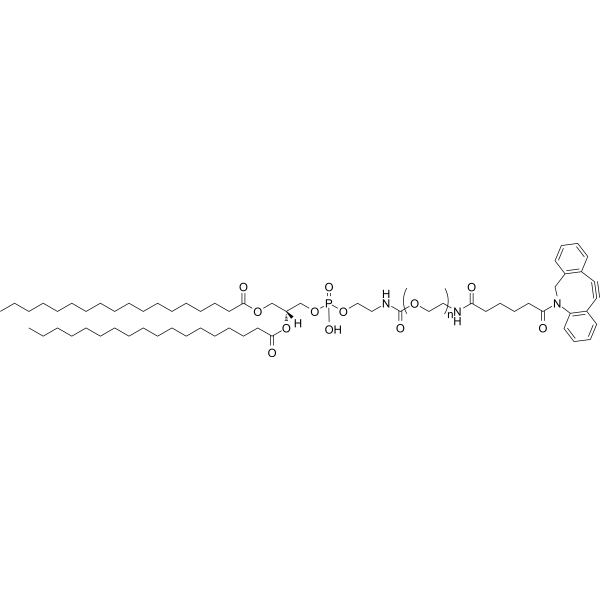
DSPE-PEG5000-IA is a cyclooctyne containing phospholipid PEG polymer. The polymer can self-assemble spontaneously in water to form micelles/lipid bilayer. It can be used to prepare nanoparticles or liposomes as drug carrier in targeted drug delivery system. The DBCO can react with azide molecule via copper free click chemistry to form a stable triazole bond.
|
-
- HY-W440926
-
|
|
Liposome
|
Others
|
|
Stearic acid-PEG1000-NHS is a cyclooctyne containing phospholipid PEG polymer. The polymer can self-assemble spontaneously in water to form micelles/lipid bilayer. It can be used to prepare nanoparticles or liposomes as drug carrier in targeted drug delivery system. The DBCO can react with azide molecule via copper free click chemistry to form a stable triazole bond.
|
-
- HY-W440831
-
|
|
Liposome
|
Others
|
|
DSPE-PEG1000-azide is a phospholipid with covalently attached polydisperse PEG. This polymer is commonly used for the preparation of long circulating liposomes. The azide moiety is reactive with alkyne to form a stable triazole bond.
|
-
- HY-W440897
-
|
|
Biochemical Assay Reagents
|
Others
|
|
DSPE-PEG3400-SH is a maleimide reactive PEG lipid. The amphiphilic polymer forms lipid bilayer in water and can be used to prepare liposomes for drug nanocarriers to deliver mRNA, DNA or siRNA.
|
-
- HY-155926
-
|
14:0 PEG750 PE ammonium; 1,2-Dimyristoyl-sn-glycero-3-phosphoethanolamine-N-[methoxy(polyethylene glycol)-750] ammonium
|
Liposome
|
Others
|
|
DMPE-PEG750 ammonium (14:0 PEG750 PE ammonium) is a PEG lipid functional end group used in the synthesis of liposomes (LPs) for the design of conjugated polymeric nanoparticles. Through biotin modification and carboxyl terminus, lipid nanoparticles (LNPs) further coupling with other biomolecules can be achieved. Functionalized nanoparticles can be used for targeted labeling of specific cellular proteins. With streptavidin as a linker, biotinylated PEG lipid-conjugated polymer nanoparticles are able to bind to biotinylated antibodies on cell surface receptors, yielding the utility of fluorescence-based imaging and sensing.
|
-
- HY-155931
-
|
DOPE-PEG550 ammonium; 1,2-Dioleoyl-sn-glycero-3-phosphoethanolamine-N-[methoxy(polyethylene glycol)-550] ammonium
|
Liposome
|
Others
|
|
18:1 PEG550 PE ammonium (DOPE-PEG550 ammonium) is a PEG lipid functional end group used in the synthesis of liposomes (LPs) for the design of conjugated polymer nanoparticles. Through biotin modification and carboxyl terminus, lipid nanoparticles (LNPs) further coupling with other biomolecules can be achieved. Functionalized nanoparticles can be used for targeted labeling of specific cellular proteins. With streptavidin as a linker, biotinylated PEG lipid-conjugated polymer nanoparticles are able to bind to biotinylated antibodies on cell surface receptors, yielding the utility of fluorescence-based imaging and sensing.
|
-
- HY-155924
-
|
14:0 PEG350 PE ammonium; 1,2-Dimyristoyl-sn-glycero-3-phosphoethanolamine-N-[methoxy(polyethylene glycol)-350] ammonium
|
Liposome
|
Others
|
|
DMPE-PEG350 ammonium (14:0 PEG350 PE ammonium) is a PEG lipid functional end group used in the synthesis of liposomes (LPs) for the design of conjugated polymer nanoparticles. Through biotin modification and carboxyl terminus, lipid nanoparticles (LNPs) further coupling with other biomolecules can be achieved. Functionalized nanoparticles can be used for targeted labeling of specific cellular proteins. With streptavidin as a linker, biotinylated PEG lipid-conjugated polymer nanoparticles are able to bind to biotinylated antibodies on cell surface receptors, yielding the utility of fluorescence-based imaging and sensing.
|
-
- HY-155927
-
|
14:0 PEG1000 PE ammonium; 1,2-Dimyristoyl-sn-glycero-3-phosphoethanolamine-N-[methoxy(polyethylene glycol)-1000] ammonium
|
Liposome
|
Others
|
|
DMPE-PEG1000 ammonium (14:0 PEG1000 PE ammonium) is a PEG lipid functional end group used in the synthesis of liposomes (LPs) for the design of conjugated polymer nanoparticles. Through biotin modification and carboxyl terminus, lipid nanoparticles (LNPs) further coupling with other biomolecules can be achieved. Functionalized nanoparticles can be used for targeted labeling of specific cellular proteins. With streptavidin as a linker, biotinylated PEG lipid-conjugated polymer nanoparticles are able to bind to biotinylated antibodies on cell surface receptors, yielding the utility of fluorescence-based imaging and sensing.
|
-
- HY-155934
-
|
DOPE-PEG5000 ammonium; 1,2-Dioleoyl-sn-glycero-3-phosphoethanolamine-N-[methoxy(polyethylene glycol)-5000] ammonium
|
Liposome
|
Others
|
|
18:1 PEG5000 PE ammonium (DOPE-PEG5000 ammonium) is a PEG lipid functional end group used in the synthesis of liposomes (LPs) for the design of conjugated polymer nanoparticles. Through biotin modification and carboxyl terminus, lipid nanoparticles (LNPs) further coupling with other biomolecules can be achieved. Functionalized nanoparticles can be used for targeted labeling of specific cellular proteins. With streptavidin as a linker, biotinylated PEG lipid-conjugated polymer nanoparticles are able to bind to biotinylated antibodies on cell surface receptors, yielding the utility of fluorescence-based imaging and sensing.
|
-
- HY-155933
-
|
DOPE-PEG3000 ammonium; 1,2-Dioleoyl-sn-glycero-3-phosphoethanolamine-N-[methoxy(polyethylene glycol)-3000] ammonium
|
Liposome
|
Others
|
|
18:1 PEG3000 PE ammonium (DOPE-PEG3000 ammonium) is a PEG lipid functional end group used in the synthesis of liposomes (LPs) for the design of conjugated polymer nanoparticles. Through biotin modification and carboxyl terminus, lipid nanoparticles (LNPs) further coupling with other biomolecules can be achieved. Functionalized nanoparticles can be used for targeted labeling of specific cellular proteins. With streptavidin as a linker, biotinylated PEG lipid-conjugated polymer nanoparticles are able to bind to biotinylated antibodies on cell surface receptors, yielding the utility of fluorescence-based imaging and sensing.
|
-
- HY-155932
-
|
DOPE-PEG1000 ammonium; 1,2-Dioleoyl-sn-glycero-3-phosphoethanolamine-N-[methoxy(polyethylene glycol)-1000] ammonium
|
Liposome
|
Others
|
|
18:1 PEG1000 PE ammonium (DOPE-PEG1000 ammonium) is a PEG lipid functional end group used in the synthesis of liposomes (LPs) for the design of conjugated polymer nanoparticles. Through biotin modification and carboxyl terminus, lipid nanoparticles (LNPs) further coupling with other biomolecules can be achieved. Functionalized nanoparticles can be used for targeted labeling of specific cellular proteins. With streptavidin as a linker, biotinylated PEG lipid-conjugated polymer nanoparticles are able to bind to biotinylated antibodies on cell surface receptors, yielding the utility of fluorescence-based imaging and sensing.
|
-
- HY-155925
-
|
14:0 PEG550 PE ammonium; 1,2-Dimyristoyl-sn-glycero-3-phosphoethanolamine-N-[methoxy(polyethylene glycol)-550] ammonium
|
Liposome
|
Others
|
|
DMPE-PEG550 ammonium (14:0 PEG550 PE ammonium) is a PEG lipid functional end group used in the synthesis of liposomes (LPs) for the design of conjugated polymeric nanoparticles. Through biotin modification and carboxyl terminus, lipid nanoparticles (LNPs) further coupling with other biomolecules can be achieved. Functionalized nanoparticles can be used for targeted labeling of specific cellular proteins. With streptavidin as a linker, biotinylated PEG lipid-conjugated polymer nanoparticles are able to bind to biotinylated antibodies on cell surface receptors, yielding the utility of fluorescence-based imaging and sensing.
|
-
- HY-155930
-
|
DOPE-PEG350 ammonium; 1,2-Dioleoyl-sn-glycero-3-phosphoethanolamine-N-[methoxy(polyethylene glycol)-350] ammonium
|
Liposome
|
Others
|
|
18:1 PEG350 PE ammonium (DOPE-PEG350 ammonium) is a PEG lipid functional end group used in the synthesis of liposomes (LPs) for the design of conjugated polymer nanoparticles. Through biotin modification and carboxyl terminus, lipid nanoparticles (LNPs) further coupling with other biomolecules can be achieved. Functionalized nanoparticles can be used for targeted labeling of specific cellular proteins. With streptavidin as a linker, biotinylated PEG lipid-conjugated polymer nanoparticles are able to bind to biotinylated antibodies on cell surface receptors, yielding the utility of fluorescence-based imaging and sensing.
|
-
- HY-155929
-
|
14:0 PEG5000 PE ammonium; 1,2-Dimyristoyl-sn-glycero-3-phosphoethanolamine-N-[methoxy(polyethylene glycol)-5000] ammonium
|
Liposome
|
Others
|
|
DMPE-PEG5000 ammonium (14:0 PEG5000 PE ammonium) is a PEG lipid functional end group used in the synthesis of liposomes (LPs) for the design of conjugated polymer nanoparticles. Through biotin modification and carboxyl terminus, lipid nanoparticles (LNPs) further coupling with other biomolecules can be achieved. Functionalized nanoparticles can be used for targeted labeling of specific cellular proteins. With streptavidin as a linker, biotinylated PEG lipid-conjugated polymer nanoparticles are able to bind to biotinylated antibodies on cell surface receptors, yielding the utility of fluorescence-based imaging and sensing.
|
-
- HY-155928
-
|
14:0 PEG3000 PE ammonium; 1,2-Dimyristoyl-sn-glycero-3-phosphoethanolamine-N-[methoxy(polyethylene glycol)-3000] ammonium
|
Liposome
|
Others
|
|
DMPE-PEG3000 ammonium (14:0 PEG3000 PE ammonium) is a PEG lipid functional end group used in the synthesis of liposomes (LPs) for the design of conjugated polymer nanoparticles. Through biotin modification and carboxyl terminus, lipid nanoparticles (LNPs) further coupling with other biomolecules can be achieved. Functionalized nanoparticles can be used for targeted labeling of specific cellular proteins. With streptavidin as a linker, biotinylated PEG lipid-conjugated polymer nanoparticles are able to bind to biotinylated antibodies on cell surface receptors, yielding the utility of fluorescence-based imaging and sensing.
|
-
- HY-174968A
-
|
4-Arm-PEG5000-Acrylate
|
Biochemical Assay Reagents
|
Others
|
|
4-Arm-PEG5000-AC (4-Arm-PEG5000-Acrylate) is a polymer consisting of a four-arm PEG core structure with acrylate groups attached to the ends of each PEG chain by chemical reaction, which can be used for drug delivery .
|
-
- HY-174968B
-
|
4-Arm-PEG10000-Acrylate
|
Biochemical Assay Reagents
|
Others
|
|
4-Arm-PEG10000-AC (4-Arm-PEG10000-Acrylate) is a polymer consisting of a four-arm PEG core structure with acrylate groups attached to the ends of each PEG chain by chemical reaction, which can be used for drug delivery .
|
-
- HY-174968
-
|
4-Arm-PEG2000-Acrylate
|
Biochemical Assay Reagents
|
Others
|
|
4-Arm-PEG2000-AC (4-Arm-PEG2000-Acrylate) is a polymer consisting of a four-arm PEG core structure with acrylate groups attached to the ends of each PEG chain by chemical reaction, which can be used for drug delivery .
|
-
- HY-174968C
-
|
4-Arm-PEG20000-Acrylate
|
Biochemical Assay Reagents
|
Others
|
|
4-Arm-PEG20000-AC (4-Arm-PEG20000-Acrylate) is a polymer consisting of a four-arm PEG core structure with acrylate groups attached to the ends of each PEG chain by chemical reaction, which can be used for drug delivery .
|
-
- HY-144012B
-
|
16:0 PEG550 PE; 1,2-Dipalmitoyl-sn-glycero-3-phosphoethanolamine-N-[methoxy(polyethylene glycol)-550] ammonium
|
Biochemical Assay Reagents
Liposome
|
Others
|
|
DPPE-PEG550 is a PEG lipid functional end group used in the synthesis of liposomes (LPs) for the design of conjugated polymer nanoparticles. Through biotin modification and carboxyl terminus, lipid nanoparticles (LNPs) further coupling with other biomolecules can be achieved. Functionalized nanoparticles can be used for targeted labeling of specific cellular proteins. With streptavidin as a linker, biotinylated PEG lipid-conjugated polymer nanoparticles are able to bind to biotinylated antibodies on cell surface receptors, yielding the utility of fluorescence-based imaging and sensing.
|
-
- HY-144012C
-
|
16:0 PEG750 PE; 1,2-Dipalmitoyl-sn-glycero-3-phosphoethanolamine-N-[methoxy(polyethylene glycol)-750] ammonium
|
Biochemical Assay Reagents
Liposome
|
Others
|
|
DPPE-PEG750 is a PEG lipid functional end group used in the synthesis of liposomes (LPs) for the design of conjugated polymer nanoparticles. Through biotin modification and carboxyl terminus, lipid nanoparticles (LNPs) further coupling with other biomolecules can be achieved. Functionalized nanoparticles can be used for targeted labeling of specific cellular proteins. With streptavidin as a linker, biotinylated PEG lipid-conjugated polymer nanoparticles are able to bind to biotinylated antibodies on cell surface receptors, yielding the utility of fluorescence-based imaging and sensing.
|
-
- HY-144012E
-
|
16:0 PEG3000 PE; 1,2-Dipalmitoyl-sn-glycero-3-phosphoethanolamine-N-[methoxy(polyethylene glycol)-3000] ammonium
|
Liposome
|
Others
|
|
DPPE-PEG3000 is a PEG lipid functional end group used in the synthesis of liposomes (LPs) for the design of conjugated polymer nanoparticles. Through biotin modification and carboxyl terminus, lipid nanoparticles (LNPs) further coupling with other biomolecules can be achieved. Functionalized nanoparticles can be used for targeted labeling of specific cellular proteins. With streptavidin as a linker, biotinylated PEG lipid-conjugated polymer nanoparticles are able to bind to biotinylated antibodies on cell surface receptors, yielding the utility of fluorescence-based imaging and sensing.
|
-
- HY-144012D
-
|
16:0 PEG1000 PE; 1,2-Dipalmitoyl-sn-glycero-3-phosphoethanolamine-N-[methoxy(polyethylene glycol)-1000] ammonium
|
Liposome
|
Others
|
|
DPPE-PEG1000 is a PEG lipid functional end group used in the synthesis of liposomes (LPs) for the design of conjugated polymer nanoparticles. Through biotin modification and carboxyl terminus, lipid nanoparticles (LNPs) further coupling with other biomolecules can be achieved. Functionalized nanoparticles can be used for targeted labeling of specific cellular proteins. With streptavidin as a linker, biotinylated PEG lipid-conjugated polymer nanoparticles are able to bind to biotinylated antibodies on cell surface receptors, yielding the utility of fluorescence-based imaging and sensing.
|
-
- HY-172380A
-
|
|
Biochemical Assay Reagents
|
Others
|
|
PCL-PEG-PCL diacrylate (MW 800) is an amphiphilic triblock copolymer composed of PEG and two polycaprolactones (PCL). PCL-PEG-PCL diacrylate (MW 800) can be cross-linked by free radical polymerization and/or photopolymerization to form a cross-linked hydrogel network .
|
-
- HY-W440914B
-
|
|
Fluorescent Dye
|
Others
|
|
DSPE-PEG10000-FITC is an amphiphile PEG polymer which has unsaturated lipid tails. DSPE-PEG10000-FITC can form micelles in an aqueous solution and can be used to prepare liposome/nano particles for drug nanocarriers .
|
-
- HY-143209B
-
|
|
Liposome
|
Cancer
|
|
DSPE-PEG3400 is a phospholipid-PEG polymer conjugate that can be used in drug delivery applications. DSPE-PEG3400 serves as a material for preparing nanocarriers, which is used to prolong blood circulation time, enhance stability and improve encapsulation efficiency .
|
-
- HY-172380
-
|
|
Biochemical Assay Reagents
|
Others
|
|
PCL-PEG-PCL diacrylate (MW 800) is an amphiphilic triblock copolymer composed of PEG and two polycaprolactones (PCL). PCL-PEG-PCL diacrylate (MW 800) can be cross-linked by free radical polymerization and/or photopolymerization to form a cross-linked hydrogel network .
|
-
- HY-W440914A
-
|
|
Fluorescent Dye
|
Others
|
|
DSPE-PEG400-FITC is an amphiphile PEG polymer which has unsaturated lipid tails. DSPE-PEG400-FITC can form micelles in an aqueous solution and can be used to prepare liposome/nano particles for drug nanocarriers .
|
-
- HY-144012H
-
|
16:0 PEG5000 PE; 1,2-Dipalmitoyl-sn-glycero-3-phosphoethanolamine-N-[methoxy(polyethylene glycol)-5000] ammonium
|
Liposome
|
Others
|
|
DPPE-PEG5000 (16:0 PEG5000 PE) is a polymer-lipid conjugate and LipoParticle stabilizer with a PEG chain of 5,000 g/mol molecular weight attached to its polar head, and it can be internalized by biological membranes. DPPE-PEG5000 enables LipoParticle to maintain colloidal stability after 20-fold dilution in PBS or cell culture medium, and prevents aggregate formation during lyophilization and rehydration. DPPE-PEG5000 helps enhance the non-cytotoxic property of LipoParticle formulations against human osteoblasts. DPPE-PEG5000 serves as a PEG lipid functional end group for synthesizing liposomes (LPs), is used in the design of conjugated polymer nanoparticles, and applies to research related to bone and joint infections .
|
-
- HY-W440885
-
|
|
Biochemical Assay Reagents
|
Others
|
|
DSPE-PEG5000-Ald is a phospholipid PEG polymer which can self-assemble spontaneously in water with their hydrophilic heads oriented toward the water (micelles). The polymer can be used to prepare liposome as a drug nanocarrier for administration of nutrients and therapeutic drugs, such as lipid nanoparticles in mRNA or DNA vaccines. The aldehyde is reactive with aminooxy to form a stable oxime linkage or with amine at pH < 7 to form a reversible imine bond.
|
-
- HY-172356A
-
|
|
Biochemical Assay Reagents
|
Others
|
|
Biotin-PEG-NH2 (Mn 5300) can be used for biotinylation of polymerized worm micelles for targeting and drug transfer to cells .
|
-
- HY-172356
-
|
|
Biochemical Assay Reagents
|
Others
|
|
Biotin-PEG-NH2 (Mn 3700) can be used for biotinylation of polymerized worm micelles for targeting and drug transfer to cells .
|
-
- HY-167357
-
|
|
Biochemical Assay Reagents
|
Others
|
|
PLLA3000-PEG1000-PLLA3000 is an amphiphilic triblock polymer based on polylactic acid derivatives that improves the specificity and cell affinity of PLA-based biomaterials. PLLA3000-PEG1000-PLLA3000 can be used in drug delivery research .
|
-
- HY-W440991
-
|
DOPE-PEG2000-NH2
|
Liposome
|
Cancer
|
|
DOPE-PEG-Amine (MW 2000) is a polydisperse PEG covalently attached to a phospholipid. The polymer is an amphiphilic molecule with hydrophobic fatty acid chains and hydrophilic PEG head which enables lipid bilayer or micelle formation in water. The phospholipid PEG can be used to prepare liposome or nanoparticles for targeted drug delivery and is reactive with alkyne to form a triazole ring.
|
-
- HY-167118
-
|
|
Biochemical Assay Reagents
|
Others
|
|
PLLA5000-PEG6000-PLLA5000 is an amphiphilic triblock polymer based on polylactic acid derivatives that improves the specificity and cell affinity of PLA-based biomaterials. PLLA5000-PEG6000-PLLA5000 can be used in drug delivery research .
|
-
- HY-167343
-
|
|
Biochemical Assay Reagents
|
Others
|
|
PLLA5000-PEG3000-PLLA5000 is an amphiphilic triblock polymer based on polylactic acid derivatives that improves the specificity and cell affinity of PLA-based biomaterials. PLLA5000-PEG3000-PLLA5000 can be used in drug delivery research .
|
-
- HY-167363
-
|
|
Biochemical Assay Reagents
|
Others
|
|
PLLA2000-PEG1000-PLLA2000 is an amphiphilic triblock polymer based on polylactic acid derivatives that improves the specificity and cell affinity of PLA-based biomaterials. PLLA2000-PEG1000-PLLA2000 can be used in drug delivery research .
|
-
- HY-167137
-
|
|
Biochemical Assay Reagents
|
Others
|
|
PLLA6000-PEG6000-PLLA6000 is an amphiphilic triblock polymer based on polylactic acid derivatives that improves the specificity and cell affinity of PLA-based biomaterials. PLLA6000-PEG6000-PLLA6000 can be used in drug delivery research .
|
-
- HY-167352
-
|
|
Biochemical Assay Reagents
|
Others
|
|
PLLA3000-PEG8000-PLLA3000 is an amphiphilic triblock polymer based on polylactic acid derivatives that improves the specificity and cell affinity of PLA-based biomaterials. PLLA3000-PEG8000-PLLA3000 can be used in drug delivery research .
|
-
- HY-167128
-
|
|
Biochemical Assay Reagents
|
Others
|
|
PLLA8000-PEG8000-PLLA8000 is an amphiphilic triblock polymer based on polylactic acid derivatives that improves the specificity and cell affinity of PLA-based biomaterials. PLLA8000-PEG8000-PLLA8000 can be used in drug delivery research .
|
-
- HY-167132
-
|
|
Biochemical Assay Reagents
|
Others
|
|
PLLA6000-PEG4000-PLLA6000 is an amphiphilic triblock polymer based on polylactic acid derivatives that improves the specificity and cell affinity of PLA-based biomaterials. PLLA6000-PEG4000-PLLA6000 can be used in drug delivery research .
|
-
- HY-167356
-
|
|
Biochemical Assay Reagents
|
Others
|
|
PLLA3000-PEG2000-PLLA3000 is an amphiphilic triblock polymer based on polylactic acid derivatives that improves the specificity and cell affinity of PLA-based biomaterials. PLLA3000-PEG2000-PLLA3000 can be used in drug delivery research .
|
-
- HY-167139
-
|
|
Biochemical Assay Reagents
|
Others
|
|
PLLA8000-PEG1000-PLLA8000 is an amphiphilic triblock polymer based on polylactic acid derivatives that improves the specificity and cell affinity of PLA-based biomaterials. PLLA8000-PEG1000-PLLA8000 can be used in drug delivery research .
|
-
- HY-167360
-
|
|
Biochemical Assay Reagents
|
Others
|
|
PLLA2000-PEG4000-PLLA2000 is an amphiphilic triblock polymer based on polylactic acid derivatives that improves the specificity and cell affinity of PLA-based biomaterials. PLLA2000-PEG4000-PLLA2000 can be used in drug delivery research .
|
-
- HY-167126
-
|
|
Biochemical Assay Reagents
|
Others
|
|
PLLA6000-PEG3000-PLLA6000 is an amphiphilic triblock polymer based on polylactic acid derivatives that improves the specificity and cell affinity of PLA-based biomaterials. PLLA6000-PEG3000-PLLA6000 can be used in drug delivery research .
|
-
- HY-167365
-
|
|
Biochemical Assay Reagents
|
Others
|
|
PLLA1000-PEG6000-PLLA1000 is an amphiphilic triblock polymer based on polylactic acid derivatives that improves the specificity and cell affinity of PLA-based biomaterials. PLLA1000-PEG6000-PLLA1000 can be used in drug delivery research .
|
-
- HY-167345
-
|
|
Biochemical Assay Reagents
|
Others
|
|
PLLA5000-PEG1000-PLLA5000 is an amphiphilic triblock polymer based on polylactic acid derivatives that improves the specificity and cell affinity of PLA-based biomaterials. PLLA5000-PEG1000-PLLA5000 can be used in drug delivery research .
|
-
- HY-167353
-
|
|
Biochemical Assay Reagents
|
Others
|
|
PLLA3000-PEG6000-PLLA3000 is an amphiphilic triblock polymer based on polylactic acid derivatives that improves the specificity and cell affinity of PLA-based biomaterials. PLLA3000-PEG6000-PLLA3000 can be used in drug delivery research .
|
-
- HY-167350
-
|
|
Biochemical Assay Reagents
|
Others
|
|
PLLA4000-PEG2000-PLLA4000 is an amphiphilic triblock polymer based on polylactic acid derivatives that improves the specificity and cell affinity of PLA-based biomaterials. PLLA4000-PEG2000-PLLA4000 can be used in drug delivery research .
|
-
- HY-167134
-
|
|
Biochemical Assay Reagents
|
Others
|
|
PLLA8000-PEG4000-PLLA8000 is an amphiphilic triblock polymer based on polylactic acid derivatives that improves the specificity and cell affinity of PLA-based biomaterials. PLLA8000-PEG4000-PLLA8000 can be used in drug delivery research .
|
-
- HY-167120
-
|
|
Biochemical Assay Reagents
|
Others
|
|
PLLA6000-PEG1000-PLLA6000 is an amphiphilic triblock polymer based on polylactic acid derivatives that improves the specificity and cell affinity of PLA-based biomaterials. PLLA6000-PEG1000-PLLA6000 can be used in drug delivery research .
|
-
- HY-167358
-
|
|
Biochemical Assay Reagents
|
Others
|
|
PLLA2000-PEG8000-PLLA2000 is an amphiphilic triblock polymer based on polylactic acid derivatives that improves the specificity and cell affinity of PLA-based biomaterials. PLLA2000-PEG8000-PLLA2000 can be used in drug delivery research .
|
-
- HY-167367
-
|
|
Biochemical Assay Reagents
|
Others
|
|
PLLA1000-PEG3000-PLLA1000 is an amphiphilic triblock polymer based on polylactic acid derivatives that improves the specificity and cell affinity of PLA-based biomaterials. PLLA1000-PEG3000-PLLA1000 can be used in drug delivery research .
|
-
- HY-167344
-
|
|
Biochemical Assay Reagents
|
Others
|
|
PLLA5000-PEG2000-PLLA5000 is an amphiphilic triblock polymer based on polylactic acid derivatives that improves the specificity and cell affinity of PLA-based biomaterials. PLLA5000-PEG2000-PLLA5000 can be used in drug delivery research .
|
-
- HY-167349
-
|
|
Biochemical Assay Reagents
|
Others
|
|
PLLA4000-PEG3000-PLLA4000 is an amphiphilic triblock polymer based on polylactic acid derivatives that improves the specificity and cell affinity of PLA-based biomaterials. PLLA4000-PEG3000-PLLA4000 can be used in drug delivery research .
|
-
- HY-167364
-
|
|
Biochemical Assay Reagents
|
Others
|
|
PLLA1000-PEG8000-PLLA1000 is an amphiphilic triblock polymer based on polylactic acid derivatives that improves the specificity and cell affinity of PLA-based biomaterials. PLLA1000-PEG8000-PLLA1000 can be used in drug delivery research .
|
-
- HY-167124
-
|
|
Biochemical Assay Reagents
|
Others
|
|
PLLA6000-PEG2000-PLLA6000 is an amphiphilic triblock polymer based on polylactic acid derivatives that improves the specificity and cell affinity of PLA-based biomaterials. PLLA6000-PEG2000-PLLA6000 can be used in drug delivery research .
|
-
- HY-167369
-
|
|
Biochemical Assay Reagents
|
Others
|
|
PLLA1000-PEG1000-PLLA1000 is an amphiphilic triblock polymer based on polylactic acid derivatives that improves the specificity and cell affinity of PLA-based biomaterials. PLLA1000-PEG1000-PLLA1000 can be used in drug delivery research .
|
-
- HY-167366
-
|
|
Biochemical Assay Reagents
|
Others
|
|
PLLA1000-PEG4000-PLLA1000 is an amphiphilic triblock polymer based on polylactic acid derivatives that improves the specificity and cell affinity of PLA-based biomaterials. PLLA1000-PEG4000-PLLA1000 can be used in drug delivery research .
|
-
- HY-167361
-
|
|
Biochemical Assay Reagents
|
Others
|
|
PLLA2000-PEG3000-PLLA2000 is an amphiphilic triblock polymer based on polylactic acid derivatives that improves the specificity and cell affinity of PLA-based biomaterials. PLLA2000-PEG3000-PLLA2000 can be used in drug delivery research .
|
-
- HY-167346
-
|
|
Biochemical Assay Reagents
|
Others
|
|
PLLA4000-PEG8000-PLLA4000 is an amphiphilic triblock polymer based on polylactic acid derivatives that improves the specificity and cell affinity of PLA-based biomaterials. PLLA4000-PEG8000-PLLA4000 can be used in drug delivery research .
|
-
- HY-167359
-
|
|
Biochemical Assay Reagents
|
Others
|
|
PLLA2000-PEG6000-PLLA2000 is an amphiphilic triblock polymer based on polylactic acid derivatives that improves the specificity and cell affinity of PLA-based biomaterials. PLLA2000-PEG6000-PLLA2000 can be used in drug delivery research .
|
-
- HY-167351
-
|
|
Biochemical Assay Reagents
|
Others
|
|
PLLA4000-PEG1000-PLLA4000 is an amphiphilic triblock polymer based on polylactic acid derivatives that improves the specificity and cell affinity of PLA-based biomaterials. PLLA4000-PEG1000-PLLA4000 can be used in drug delivery research .
|
-
- HY-167130
-
|
|
Biochemical Assay Reagents
|
Others
|
|
PLLA8000-PEG6000-PLLA8000 is an amphiphilic triblock polymer based on polylactic acid derivatives that improves the specificity and cell affinity of PLA-based biomaterials. PLLA8000-PEG6000-PLLA8000 can be used in drug delivery research .
|
-
- HY-167354
-
|
|
Biochemical Assay Reagents
|
Others
|
|
PLLA3000-PEG4000-PLLA3000 is an amphiphilic triblock polymer based on polylactic acid derivatives that improves the specificity and cell affinity of PLA-based biomaterials. PLLA3000-PEG4000-PLLA3000 can be used in drug delivery research .
|
-
- HY-167342
-
|
|
Biochemical Assay Reagents
|
Others
|
|
PLLA5000-PEG4000-PLLA5000 is an amphiphilic triblock polymer based on polylactic acid derivatives that improves the specificity and cell affinity of PLA-based biomaterials. PLLA5000-PEG4000-PLLA5000 can be used in drug delivery research .
|
-
- HY-167140
-
|
|
Biochemical Assay Reagents
|
Others
|
|
PLLA6000-PEG8000-PLLA6000 is an amphiphilic triblock polymer based on polylactic acid derivatives that improves the specificity and cell affinity of PLA-based biomaterials. PLLA6000-PEG8000-PLLA6000 can be used in drug delivery research .
|
-
- HY-167355
-
|
|
Biochemical Assay Reagents
|
Others
|
|
PLLA3000-PEG3000-PLLA3000 is an amphiphilic triblock polymer based on polylactic acid derivatives that improves the specificity and cell affinity of PLA-based biomaterials. PLLA3000-PEG3000-PLLA3000 can be used in drug delivery research .
|
-
- HY-167362
-
|
|
Biochemical Assay Reagents
|
Others
|
|
PLLA2000-PEG2000-PLLA2000 is an amphiphilic triblock polymer based on polylactic acid derivatives that improves the specificity and cell affinity of PLA-based biomaterials. PLLA2000-PEG2000-PLLA2000 can be used in drug delivery research .
|
-
- HY-167119
-
|
|
Biochemical Assay Reagents
|
Others
|
|
PLLA5000-PEG8000-PLLA5000 is an amphiphilic triblock polymer based on polylactic acid derivatives that improves the specificity and cell affinity of PLA-based biomaterials. PLLA5000-PEG8000-PLLA5000 can be used in drug delivery research .
|
-
- HY-167347
-
|
|
Biochemical Assay Reagents
|
Others
|
|
PLLA4000-PEG6000-PLLA4000 is an amphiphilic triblock polymer based on polylactic acid derivatives that improves the specificity and cell affinity of PLA-based biomaterials. PLLA4000-PEG6000-PLLA4000 can be used in drug delivery research .
|
-
- HY-167368
-
|
|
Biochemical Assay Reagents
|
Others
|
|
PLLA1000-PEG2000-PLLA1000 is an amphiphilic triblock polymer based on polylactic acid derivatives that improves the specificity and cell affinity of PLA-based biomaterials. PLLA1000-PEG2000-PLLA1000 can be used in drug delivery research .
|
-
- HY-167138
-
|
|
Biochemical Assay Reagents
|
Others
|
|
PLLA8000-PEG2000-PLLA8000 is an amphiphilic triblock polymer based on polylactic acid derivatives that improves the specificity and cell affinity of PLA-based biomaterials. PLLA8000-PEG2000-PLLA8000 can be used in drug delivery research .
|
-
- HY-167348
-
|
|
Biochemical Assay Reagents
|
Others
|
|
PLLA4000-PEG4000-PLLA4000 is an amphiphilic triblock polymer based on polylactic acid derivatives that improves the specificity and cell affinity of PLA-based biomaterials. PLLA4000-PEG4000-PLLA4000 can be used in drug delivery research .
|
-
- HY-167136
-
|
|
Biochemical Assay Reagents
|
Others
|
|
PLLA8000-PEG3000-PLLA8000 is an amphiphilic triblock polymer based on polylactic acid derivatives that improves the specificity and cell affinity of PLA-based biomaterials. PLLA8000-PEG3000-PLLA8000 can be used in drug delivery research .
|
-
- HY-W440927
-
|
|
Liposome
|
Others
|
|
Stearic acid-PEG2000-NHS is an amphiphatic PEG polymer which forms micelles in an aqueous solution for drug-loaded nanoparticles. The NHS ester is reactive with amine to form a stable amide bond. Reagent grade, for research purpose.
|
-
- HY-Y0873A1
-
-
- HY-Y0873A9
-
|
Polyethylene glycol 2000000
|
Biochemical Assay Reagents
|
Others
|
|
PEG2000000 (Polyethylene glycol 2000000) is a polymer compound with good biocompatibility and biodegradability, and is widely used in drug controlled release systems and bioadhesive materials .
|
-
- HY-Y0873A2
-
|
Polyethylene glycol 600000
|
Biochemical Assay Reagents
|
Others
|
|
PEG600000 (Polyethylene glycol 600000) is a polymer compound with good biocompatibility and biodegradability, and is widely used in drug controlled release systems and bioadhesive materials .
|
-
- HY-Y0873A5
-
|
Polyethylene glycol 200000
|
Biochemical Assay Reagents
|
Others
|
|
PEG200000 (Polyethylene glycol 200000) is a polymer compound with good biocompatibility and biodegradability, and is widely used in drug controlled release systems and bioadhesive materials .
|
-
- HY-Y0873A7
-
|
Polyethylene glycol 900000
|
Biochemical Assay Reagents
|
Others
|
|
PEG900000 (Polyethylene glycol 900000) is a polymer compound with good biocompatibility and biodegradability, and is widely used in drug controlled release systems and bioadhesive materials .
|
-
- HY-Y0873A4
-
|
Polyethylene glycol 4000000
|
Biochemical Assay Reagents
|
Others
|
|
PEG4000000 (Polyethylene glycol 4000000) is a polymer compound with good biocompatibility and biodegradability, and is widely used in drug controlled release systems and bioadhesive materials .
|
-
- HY-Y0873A6
-
|
Polyethylene glycol 400000
|
Biochemical Assay Reagents
|
Others
|
|
PEG400000 (Polyethylene glycol 400000) is a polymer compound with good biocompatibility and biodegradability, and is widely used in drug controlled release systems and bioadhesive materials .
|
-
- HY-Y0873B1
-
|
Polyethylene glycol 8000000
|
Biochemical Assay Reagents
|
Others
|
|
PEG8000000 (Polyethylene glycol 8000000) is a polymer compound with good biocompatibility and biodegradability, and is widely used in drug controlled release systems and bioadhesive materials .
|
-
- HY-Y0873A3
-
|
Polyethylene glycol 1000000
|
Biochemical Assay Reagents
|
Others
|
|
PEG1000000 (Polyethylene glycol 1000000) is a polymer compound with good biocompatibility and biodegradability, and is widely used in drug controlled release systems and bioadhesive materials .
|
-
- HY-Y0873A8
-
|
Polyethylene glycol 5000000
|
Biochemical Assay Reagents
|
Others
|
|
PEG5000000 (Polyethylene glycol 5000000) is a polymer compound with good biocompatibility and biodegradability, and is widely used in drug controlled release systems and bioadhesive materials .
|
-
- HY-W440833
-
|
|
Liposome
|
Others
|
|
DSPE-PEG3400-azide is a polydisperse PEG covalently attached to a phospholipid. The polymer is an amphiphilic molecule with hydrophobic fatty acid chains and hydrophilic PEG head which enables lipid bilayer or micelles formation in water. The phospholipid PEG can be used to prepare liposome or nanoparticles for targeted drug delivery and is reactive with alkyne to form triazole bond.
|
-
- HY-N16025
-
|
|
Liposome
Biochemical Assay Reagents
|
Others
|
|
DOPE-PEG(2000) Amine ammonium is a polydisperse PEG covalently attached to a phospholipid. The polymer is an amphiphilic molecule with hydrophobic fatty acid chains and hydrophilic PEG head which enables lipid bilayer or micelle formation in water. The phospholipid PEG can be used to prepare liposome or nanoparticles for targeted agent delivery and is reactive with alkyne to form a triazole ring .
|
-
- HY-144012A
-
|
16:0 PEG350 PE; 1,2-Dipalmitoyl-sn-glycero-3-phosphoethanolamine-N-[methoxy(polyethylene glycol)-350] ammonium
|
Liposome
CD1
|
Others
|
|
DPPE-PEG350 is a CD1d-dependent lipid antagonist thus blocking the ERK phosphorylation pathway in iNKT cells . DPPE-PEG350 is a PEG lipid functional end group used in the synthesis of liposomes (LPs) for the design of conjugated polymer nanoparticles.
|
-
- HY-144012
-
|
16:0 PEG2000 PE ammonium; 1,2-Dipalmitoyl-sn-glycero-3-phosphoethanolamine-N-[methoxy(polyethylene glycol)-2000] ammonium
|
Liposome
|
Others
|
|
DPPE-PEG2000 ammonium (16:0 PEG5000 PE) is a polymer-lipid conjugate and LipoParticle stabilizer with a PEG chain of 5,000 g/mol molecular weight attached to its polar head, and it can be internalized by biological membranes. DPPE-PEG2000 ammonium enables LipoParticle to maintain colloidal stability after 20-fold dilution in PBS or cell culture medium, and prevents aggregate formation during lyophilization and rehydration. DPPE-PEG2000 ammonium helps enhance the non-cytotoxic property of LipoParticle formulations against human osteoblasts. DPPE-PEG2000 ammonium serves as a PEG lipid functional end group for synthesizing liposomes (LPs), is used in the design of conjugated polymer nanoparticles, and applies to research related to bone and joint infections .
|
-
- HY-136314
-
|
|
Drug-Linker Conjugates for ADC
|
Cancer
|
|
DBCO-PEG4-VC-PAB-MMAE consists a ADC linker (DBCO-PEG4-VC-PAB) and a tubulin polymerization inhibitor MMAE (HY-15162). DBCO-PEG4-VC-PAB-MMAE can be used in the synthesis of antibody-agent conjugates (ADCs). MMAE is a synthetic derivative of dolastatin 10 and functions as a potent mitotic inhibitor by inhibiting tubulin polymerization. DBCO-PEG4-VC-PAB-MMAE is a click chemistry reagent, it contains a DBCO group that can undergo strain-promoted alkyne-azide cycloaddition (SPAAC) with molecules containing Azide groups.
|
-
- HY-W1048661H
-
|
|
Biochemical Assay Reagents
|
Others
|
|
Biotin-PEG3400-maleimide is a PEG derivative consisting of a linear PEG chain with biotin attached to one end and maleimide modified to the other end. Biotin-PEG3400-maleimide anchors drugs or targeting ligands to liposomes or polymer nanocarriers through the maleimide end, and the biotin end is used for in vitro purification or in vivo targeted release .
|
-
- HY-W1048661A
-
|
|
Biochemical Assay Reagents
|
Others
|
|
Biotin-PEG5000-maleimide is a PEG derivative consisting of a linear PEG chain with biotin attached to one end and maleimide modified to the other end. Biotin-PEG5000-maleimide anchors drugs or targeting ligands to liposomes or polymer nanocarriers through the maleimide end, and the biotin end is used for in vitro purification or in vivo targeted release .
|
-
- HY-116655A
-
|
|
Biochemical Assay Reagents
|
Others
|
|
Hydroxy-PEG1-acid sodium is a PEG linker containing a hydroxyl group with a terminal carboxylic acid (as sodium salt form). The free acid form is not stable due to the reaction of OH with PEG-COOH group to form polymer. The sodium salt form is stable for storage and shipping. The hydrophilic PEG spacer increases solubility in aqueous media. The hydroxyl group enables further derivatization or replacement with other reactive functional groups.
|
-
- HY-W1048661
-
|
|
Biochemical Assay Reagents
|
Others
|
|
Biotin-PEG1000-maleimide is a PEG derivative consisting of a linear PEG chain with biotin attached to one end and maleimide modified to the other end. Biotin-PEG1000-maleimide anchors drugs or targeting ligands to liposomes or polymer nanocarriers through the maleimide end, and the biotin end is used for in vitro purification or in vivo targeted release .
|
-
- HY-W1048661E
-
|
|
Biochemical Assay Reagents
|
Others
|
|
Biotin-PEG2000-maleimide is a PEG derivative consisting of a linear PEG chain with biotin attached to one end and maleimide modified to the other end. Biotin-PEG2000-maleimide anchors drugs or targeting ligands to liposomes or polymer nanocarriers through the maleimide end, and the biotin end is used for in vitro purification or in vivo targeted release .
|
-
- HY-W440914C
-
|
|
Fluorescent Dye
|
Others
|
|
DSPE-PEG600-FITC is an amphiphile PEG polymer which has unsaturated lipid tails. DSPE-PEG600-FITC can form micelles in an aqueous solution and can be used to prepare liposome/nano particles for drug nanocarriers (Ex/Em=488/525 nm) .
|
-
- HY-W440895
-
|
|
Biochemical Assay Reagents
|
Others
|
|
DSPE-PEG1000-SH is an amphiphilic poly-PEG that can form lipid bilayers in water. This amphiphilic polymer can form lipid bilayers in aqueous solution and can be used to embed active molecules for drug delivery systems such as mRNA vaccines.
|
-
- HY-W440917
-
|
|
Liposome
|
Others
|
|
DSPE-PEG5000-FITC is a fluorescein attached PEG lipid. It can be used to prepare liposomes as drug carrier in targeted drug delivery. The polymer is modified with fluorescein (green) dye which can be used for staining cells, tissues, biomarkers, or nanoparticles.
|
-
- HY-W440934
-
|
|
Liposome
|
Others
|
|
Stearic acid-PEG2000-Rhodamine is an amphiphilic PEG polymer which can form micelles in water. The rhodamine can be used for staining sample and easily traced by fluorescence microscopy. Rhodamine has maximum absorption at 570 nm and emission around 595 nm.
|
-
- HY-W440916
-
|
|
Liposome
|
Others
|
|
DSPE-PEG3400-FITC is a fluorescein attached PEG lipid. It can be used to prepare liposomes as drug carrier in targeted drug delivery. The polymer is modified with fluorescein (green) dye which can be used for staining cells, tissues, biomarkers, or nanoparticles.
|
-
- HY-174947
-
|
|
Biochemical Assay Reagents
|
Others
|
|
DPPE-PEG2-mal is an amphiphilic phospholipid-modified polymer that can be used to prepare lipid nanoparticles or liposomes for targeted drug delivery applications .
|
-
- HY-W440899
-
|
|
Liposome
|
Others
|
|
DSPE-PEG1000-SPDP is a thiol reactive PEG lipid. The polymer is amphiphilic and spontaneously forms lipid bilayer in water. It can be used to encapsulate nutrients or therapeutics for targeted drug delivery, for example mRNA or DNA vaccine, liposomal doxorubicin for anti tumor.
|
-
- HY-173381A
-
|
Cholesteryl biotinyl(polyethyleneglycol)-1000 carbamate
|
Biochemical Assay Reagents
|
Others
|
|
Cholesteryl-PEG1000-Biotin is a lipid product. Cholesteryl-PEG1000-Biotin is a cholesterol backbone attached to one side of a PEG unit and a Biotin unit on the other side. Biotin is an enzyme cofactor that can be used to label proteins, and PEG is a low-toxic, hydrophilic, water-soluble polymer. Cholesteryl-PEG1000-Biotin can be used for drug circulation time studies .
|
-
- HY-140895B
-
|
Biotin-PEG10000-NH2
|
Biochemical Assay Reagents
|
Others
|
|
Biotin-PEG10000-Amine (Biotin-PEG10000-NH2) is a biotin PEG polymer containing a free amine group (-NH2). The amine group is reactive with an activated NHS ester via formation of an amide bond. Biotin-labeled compounds can then be linked to avidin or streptavidin for further purification or detection .
|
-
- HY-W440835
-
|
DSPE-PEG2000(2000)-DBCO
|
Liposome
|
Others
|
|
DSPE-PEG2000-DBCO is a phospholipid-PEG polymer that can be used to form micelles as lipid nanoparticles for drug delivery . DSPE-PEG2000-DBCO is a click chemistry reagent, it contains a DBCO group that can undergo strain-promoted alkyne-azide cycloaddition (SPAAC) with molecules containing Azide groups.
|
-
- HY-W440835A
-
|
|
Biochemical Assay Reagents
|
Others
|
|
DSPE-PEG400-DBCO is a phospholipid-PEG polymer that can be used to form micelles as lipid nanoparticles for drug delivery . DSPE-PEG400-DBCO is a click chemistry reagent, it contains a DBCO group that can undergo strain-promoted alkyne-azide cycloaddition (SPAAC) with molecules containing Azide groups.
|
-
- HY-140895C
-
|
Biotin-PEG20000-NH2
|
Biochemical Assay Reagents
|
Others
|
|
Biotin-PEG20000-Amine (Biotin-PEG20000-NH2) is a biotin PEG polymer containing a free amine group (-NH2). The amine group is reactive with an activated NHS ester via formation of an amide bond. Biotin-labeled compounds can then be linked to avidin or streptavidin for further purification or detection .
|
-
- HY-W440835B
-
|
|
Biochemical Assay Reagents
|
Others
|
|
DSPE-PEG600-DBCO is a phospholipid-PEG polymer that can be used to form micelles as lipid nanoparticles for drug delivery . DSPE-PEG600-DBCO is a click chemistry reagent, it contains a DBCO group that can undergo strain-promoted alkyne-azide cycloaddition (SPAAC) with molecules containing Azide groups.
|
-
- HY-140895D
-
|
Biotin-PEG40000-NH2
|
Biochemical Assay Reagents
|
Others
|
|
Biotin-PEG40000-Amine (Biotin-PEG40000-NH2) is a biotin PEG polymer containing a free amine group (-NH2). The amine group is reactive with an activated NHS ester via formation of an amide bond. Biotin-labeled compounds can then be linked to avidin or streptavidin for further purification or detection .
|
-
- HY-W440835D
-
|
|
Biochemical Assay Reagents
|
Others
|
|
DSPE-PEG3400-DBCO is a phospholipid-PEG polymer that can be used to form micelles as lipid nanoparticles for drug delivery . DSPE-PEG3400-DBCO is a click chemistry reagent, it contains a DBCO group that can undergo strain-promoted alkyne-azide cycloaddition (SPAAC) with molecules containing Azide groups.
|
-
- HY-W440835C
-
|
|
Biochemical Assay Reagents
|
Others
|
|
DSPE-PEG1000-DBCO is a phospholipid-PEG polymer that can be used to form micelles as lipid nanoparticles for drug delivery . DSPE-PEG1000-DBCO is a click chemistry reagent, it contains a DBCO group that can undergo strain-promoted alkyne-azide cycloaddition (SPAAC) with molecules containing Azide groups.
|
-
- HY-W440835E
-
|
|
Biochemical Assay Reagents
|
Others
|
|
DSPE-PEG5000-DBCO is a phospholipid-PEG polymer that can be used to form micelles as lipid nanoparticles for drug delivery . DSPE-PEG5000-DBCO is a click chemistry reagent, it contains a DBCO group that can undergo strain-promoted alkyne-azide cycloaddition (SPAAC) with molecules containing Azide groups.
|
-
- HY-140895A
-
|
Biotin-PEG5000-NH2
|
Biochemical Assay Reagents
|
Others
|
|
Biotin-PEG5000-Amine (Biotin-PEG5000-NH2) is a biotin PEG polymer containing a free amine group (-NH2). The amine group is reactive with an activated NHS ester via formation of an amide bond. Biotin-labeled compounds can then be linked to avidin or streptavidin for further purification or detection .
|
-
- HY-W440835H
-
|
|
Biochemical Assay Reagents
|
Others
|
|
DSPE-PEG10000-DBCO is a phospholipid-PEG polymer that can be used to form micelles as lipid nanoparticles for drug delivery . DSPE-PEG10000-DBCO is a click chemistry reagent, it contains a DBCO group that can undergo strain-promoted alkyne-azide cycloaddition (SPAAC) with molecules containing Azide groups.
|
-
- HY-W190743
-
|
|
Biochemical Assay Reagents
|
Others
|
|
Br-PEG8-OH is a PEG derivative that consists of a bromine atom (Br), eight PEG units, and a hydroxyl group (-OH). The bromine group is a common functional group in chemical reactions and can be used for alkylation reactions, coupling reactions, or the introduction of other functional groups. Br-PEG8-OH can be used as a polymer-based material or as a modifier for biomolecules .
|
-
- HY-144013B
-
|
DSPE-mPEG550 ammonium; 1,2-Distearoyl-sn-glycero-3-phosphoethanolamine-N-[methoxy(polyethylene glycol)-550] ammonium
|
Biochemical Assay Reagents
Liposome
|
Others
|
|
18:0 mPEG550 PE (ammonium) is a PEG lipid functional end group used in the synthesis of liposomes (LPs) for the design of conjugated polymeric nanoparticles. Through biotin modification and carboxyl terminus, lipid nanoparticles (LNPs) further coupling with other biomolecules can be achieved. Functionalized nanoparticles can be used for targeted labeling of specific cellular proteins. With streptavidin as a linker, biotinylated PEG lipid-conjugated polymer nanoparticles are able to bind to biotinylated antibodies on cell surface receptors, yielding the utility of fluorescence-based imaging and sensing.
|
-
- HY-144013A
-
|
DSPE-mPEG350 ammonium; 1,2-Distearoyl-sn-glycero-3-phosphoethanolamine-N-[methoxy(polyethylene glycol)-350] ammonium
|
Liposome
|
Others
|
|
18:0 mPEG350 PE (ammonium) is a PEG lipid functional end group used in the synthesis of liposomes (LPs) for the design of conjugated polymer nanoparticles. Through biotin modification and carboxyl terminus, lipid nanoparticles (LNPs) further coupling with other biomolecules can be achieved. Functionalized nanoparticles can be used for targeted labeling of specific cellular proteins. With streptavidin as a linker, biotinylated PEG lipid-conjugated polymer nanoparticles are able to bind to biotinylated antibodies on cell surface receptors, yielding the utility of fluorescence-based imaging and sensing.
|
-
- HY-144013D
-
|
DSPE-mPEG1000 ammonium; 1,2-Distearoyl-sn-glycero-3-phosphoethanolamine-N-[methoxy(polyethylene glycol)-1000] ammonium
|
Liposome
|
Others
|
|
18:0 mPEG1000 PE (ammonium) is a PEG lipid functional end group used in the synthesis of liposomes (LPs) for the design of conjugated polymeric nanoparticles. Through biotin modification and carboxyl terminus, lipid nanoparticles (LNPs) further coupling with other biomolecules can be achieved. Functionalized nanoparticles can be used for targeted labeling of specific cellular proteins. With streptavidin as a linker, biotinylated PEG lipid-conjugated polymer nanoparticles are able to bind to biotinylated antibodies on cell surface receptors, yielding the utility of fluorescence-based imaging and sensing.
|
-
- HY-144013E
-
|
DSPE-mPEG3000 ammonium; 1,2-Distearoyl-sn-glycero-3-phosphoethanolamine-N-[methoxy(polyethylene glycol)-3000] ammonium
|
Liposome
|
Others
|
|
18:0 mPEG3000 PE (ammonium) is a PEG lipid functional end group used in the synthesis of liposomes (LPs) for the design of conjugated polymeric nanoparticles. Through biotin modification and carboxyl terminus, lipid nanoparticles (LNPs) further coupling with other biomolecules can be achieved. Functionalized nanoparticles can be used for targeted labeling of specific cellular proteins. With streptavidin as a linker, biotinylated PEG lipid-conjugated polymer nanoparticles are able to bind to biotinylated antibodies on cell surface receptors, yielding the utility of fluorescence-based imaging and sensing.
|
-
- HY-144013C
-
|
DSPE-mPEG750 ammonium; 1,2-Distearoyl-sn-glycero-3-phosphoethanolamine-N-[methoxy(polyethylene glycol)-750] ammonium
|
Biochemical Assay Reagents
Liposome
|
Others
|
|
18:0 mPEG750 PE (ammonium) is a PEG lipid functional end group used in the synthesis of liposomes (LPs) for the design of conjugated polymeric nanoparticles. Through biotin modification and carboxyl terminus, lipid nanoparticles (LNPs) further coupling with other biomolecules can be achieved. Functionalized nanoparticles can be used for targeted labeling of specific cellular proteins. With streptavidin as a linker, biotinylated PEG lipid-conjugated polymer nanoparticles are able to bind to biotinylated antibodies on cell surface receptors, yielding the utility of fluorescence-based imaging and sensing.
|
-
- HY-W451406B
-
|
|
Drug Intermediate
Biochemical Assay Reagents
|
Metabolic Disease
|
|
NH2-PEG1000-NH2 is a double-ended amino polyethylene glycol with a number-average molecular weight of 1000, which serves as a synthetic raw material for adamantyl polyethylene glycol amine. NH2-PEG1000-NH2 can be used for the preparation of reduction-responsive liver-targeted polymeric micelles .
|
-
- HY-147207C
-
|
|
Liposome
|
Others
|
|
Phospholipid-PEG5000-Biotin is a phospholipid PEG derivative, can be used for modify liposome and cells surface, and pancreatic islets for cell transplantation. Phospholipid is a class of lipid containing a hydrophilic “head” and two hydrophobic “tails”; PEG is a hydrophilic and water-soluble polymer with low toxicity; Biotin is an enzyme co-factor, can be used for labeling protein .
|
-
- HY-164720
-
|
|
Liposome
|
Others
|
|
DSPE-PEG4000-OH is a hydroxy-terminated phospholipid PEG polymer. The hydrophobic tails that allows the encapsulation and aggregation of other hydrophobic drugs, and the hydroxy-terminated can be further reacted. DSPE-PEG4000-OH can prepare liposomes or lipid nanoparticles, which can be used in drug delivery and promoting drug absorption research .
|
-
- HY-164723
-
|
|
Liposome
|
Others
|
|
DSPE-PEG10000-OH is a hydroxy-terminated phospholipid PEG polymer. The hydrophobic tails that allows the encapsulation and aggregation of other hydrophobic drugs, and the hydroxy-terminated can be further reacted. DSPE-PEG10000-OH can prepare liposomes or lipid nanoparticles, which can be used in drug delivery and promoting drug absorption research .
|
-
- HY-164721
-
|
|
Liposome
|
Others
|
|
DSPE-PEG6000-OH is a hydroxy-terminated phospholipid PEG polymer. The hydrophobic tails that allows the encapsulation and aggregation of other hydrophobic drugs, and the hydroxy-terminated can be further reacted. DSPE-PEG6000-OH can prepare liposomes or lipid nanoparticles, which can be used in drug delivery and promoting drug absorption research .
|
-
- HY-164722
-
|
|
Liposome
|
Others
|
|
DSPE-PEG8000-OH is a hydroxy-terminated phospholipid PEG polymer. The hydrophobic tails that allows the encapsulation and aggregation of other hydrophobic drugs, and the hydroxy-terminated can be further reacted. DSPE-PEG8000-OH can prepare liposomes or lipid nanoparticles, which can be used in drug delivery and promoting drug absorption research .
|
-
- HY-W591632
-
|
Poly(ethylene glycol)-bis-amine (MW 1000)
|
Biochemical Assay Reagents
|
Cancer
|
|
PEG-bis-amine (MW 1000) synthesizes folate-conjugated polymeric micelles for encapsulation of the anticancer agent 9-nitrocamptothecin HY-16560 (HY-16560). Folic acid-conjugated polymer micelles are effective carriers of insoluble anticancer drugs, which can avoid macrophages and play a role in endocytosis of tumor cells mediated by folate receptors (FR).
|
-
- HY-164637
-
|
|
Drug-Linker Conjugates for ADC
|
Cancer
|
|
Aniline-PEG3-C1-Boc (compound D-1) is an intermediate of cytotoxic drug linker polymer. Aniline-PEG3-C1-Boc can be used in the synthesis of antibody-drug conjugates (ADCs) .
|
-
- HY-147207A
-
|
|
Liposome
|
Others
|
|
Phospholipid-PEG2000-Biotin is a Biotin labeled phospholipid PEG derivative, can be used for modify liposome and cells surface, and pancreatic islets for cell transplantation. Phospholipid is a class of lipid containing a hydrophilic "head" and two hydrophobic "tails" ; PEG is a hydrophilic and water-soluble polymer with low toxicity; Biotin is an enzyme co-factor, can be used for labeling protein .
|
-
- HY-Y0873M
-
|
Polyethylene glycol 500
|
Environmental Pollutants
Biochemical Assay Reagents
|
Others
|
|
PEG500 (Polyethylene glycol 500) is a versatile polymer that's used as a solvent, dispersant, lubricant, and more in industries like pharmaceuticals and biotechnology, and it can also modify liposomes. PEG500 is commonly used as a solvent or carrier for drugs, helping with capsule endoscopy to improve image quality and cecum completion rates .
|
-
- HY-W440912
-
|
|
Liposome
|
Others
|
|
DSPE-PEG3400-Cy5 is a PEG phospholipid with Cy5 dye used in protein/nucelic acid labeling and fluorescence microscopy. The polymer can self-assemble in aqueous solution to form micelles/lipid bilayer and used to prepare liposomes or nanoparticles for nutrients delivery such as mRNA or DNA vaccine.
|
-
- HY-117186
-
|
|
PROTAC Linkers
|
Metabolic Disease
|
|
Bis-propargyl-PEG6 is a PEG-based PROTAC linker used in the synthesis of PROTACs. Bis-propargyl-PEG6 can be used to synthesize the polymer linked multimers of guanosine-3', 5'-cyclic monophosphates . Bis-propargyl-PEG6 is a click chemistry reagent, it contains an Alkyne group and can undergo copper-catalyzed azide-alkyne cycloaddition (CuAAc) with molecules containing Azide groups.
|
-
- HY-133190
-
|
|
PROTAC Linkers
|
Metabolic Disease
|
|
Bis-propargyl-PEG7 is a PEG-based PROTAC linker used in the synthesis of PROTACs. Bis-propargyl-PEG7 can be used to synthesize the polymer linked multimers of guanosine-3', 5'-cyclic monophosphates . Bis-propargyl-PEG7 is a click chemistry reagent, it contains an Alkyne group and can undergo copper-catalyzed azide-alkyne cycloaddition (CuAAc) with molecules containing Azide groups.
|
-
- HY-W440949
-
|
|
Biochemical Assay Reagents
|
Others
|
|
Stearic acid-PEG1000-Mal enables surface modification of various substrate through reaction between hydroxyl and ethoxyl silane. The polymer can be used for click chemistry with alkyne containing molecule.
|
-
- HY-W440950
-
|
|
Liposome
|
Others
|
|
Stearic acid-PEG2000-Mal enables surface modification of various substrate through reaction between hydroxyl and ethoxyl silane. The polymer can be used for click chemistry with alkyne containing molecule.
|
-
- HY-W440952
-
|
|
Biochemical Assay Reagents
|
Others
|
|
Stearic acid-PEG5000-Mal enables surface modification of various substrate through reaction between hydroxyl and ethoxyl silane. The polymer can be used for click chemistry with alkyne containing molecule.
|
-
- HY-W440951
-
|
|
Biochemical Assay Reagents
|
Others
|
|
Stearic acid-PEG3400-Mal enables surface modification of various substrate through reaction between hydroxyl and ethoxyl silane. The polymer can be used for click chemistry with alkyne containing molecule.
|
-
- HY-133492
-
|
|
Drug-Linker Conjugates for ADC
|
Cancer
|
|
DBCO-PEG4-MMAF is a agent-linker conjugate for ADC with potent antitumor activity by using the tubulin polymerization inhibitor, MMAF, linked via the linker DBCO-PEG4. DBCO-PEG4-MMAF is a click chemistry reagent, it contains a DBCO group that can undergo strain-promoted alkyne-azide cycloaddition (SPAAC) with molecules containing Azide groups.
|
-
- HY-155902D
-
|
Maleimide-PEG10000-Hydroxy
|
Biochemical Assay Reagents
|
Others
|
|
Mal-PEG10000-OH (Maleimide-PEG10000-Hydroxy) is a linear heteroterminal bifunctional PEG product with maleimide and hydroxyl groups. Mal-PEG10000-OH can be used as a macroinitiator to obtain amphiphilic diblock copolymers through ring-opening polymerization of Lactate (Lactic Acid) (HY-B2227). Nanoparticles prepared using amphiphilic block copolymers can form active drug delivery systems .
|
-
- HY-155902E
-
|
Maleimide-PEG20000-Hydroxy
|
Biochemical Assay Reagents
|
Others
|
|
Mal-PEG20000-OH (Maleimide-PEG20000-Hydroxy) is a linear heteroterminal bifunctional PEG product with maleimide and hydroxyl groups. Mal-PEG20000-OH can be used as a macroinitiator to obtain amphiphilic diblock copolymers through ring-opening polymerization of Lactate (Lactic Acid) (HY-B2227). Nanoparticles prepared using amphiphilic block copolymers can form active drug delivery systems .
|
-
- HY-155902H
-
|
Maleimide-PEG40000-Hydroxy
|
Biochemical Assay Reagents
|
Others
|
|
Mal-PEG40000-OH (Maleimide-PEG40000-Hydroxy) is a linear heteroterminal bifunctional PEG product with maleimide and hydroxyl groups. Mal-PEG40000-OH can be used as a macroinitiator to obtain amphiphilic diblock copolymers through ring-opening polymerization of Lactate (Lactic Acid) (HY-B2227). Nanoparticles prepared using amphiphilic block copolymers can form active drug delivery systems .
|
-
- HY-155902C
-
|
Maleimide-PEG3400-Hydroxy
|
Biochemical Assay Reagents
|
Others
|
|
Mal-PEG3400-OH (Maleimide-PEG3400-Hydroxy) is a linear heteroterminal bifunctional PEG product with maleimide and hydroxyl groups. Mal-PEG3400-OH can be used as a macroinitiator to obtain amphiphilic diblock copolymers through ring-opening polymerization of Lactate (Lactic Acid) (HY-B2227). Nanoparticles prepared using amphiphilic block copolymers can form active drug delivery systems .
|
-
- HY-W440907
-
|
|
Biochemical Assay Reagents
|
Others
|
|
DSPE-PEG5000-Vinylsulfone is a viniyl sulfone PEG lipid which can be used for bioconjugation with cysteine or other thiol molecule through thiol-ene reaction. The polymer is a self-assembling reagetn which forms lipid bilayer in water and can be used as drug carrier to delivery therapeutic agents, such as mRNA or DNA vaccine.
|
-
- HY-W440905
-
|
|
Biochemical Assay Reagents
|
Others
|
|
DSPE-PEG2000-Vinylsulfone is a viniyl sulfone PEG lipid which can be used for bioconjugation with cysteine or other thiol molecule through thiol-ene reaction. The polymer is a self-assembling reagetn which forms lipid bilayer in water and can be used as drug carrier to delivery therapeutic agents, such as mRNA or DNA vaccine.
|
-
- HY-W440904
-
|
|
Biochemical Assay Reagents
|
Others
|
|
DSPE-PEG1000-Vinylsulfone is a viniyl sulfone PEG lipid which can be used for bioconjugation with cysteine or other thiol molecule through thiol-ene reaction. The polymer is a self-assembling reagetn which forms lipid bilayer in water and can be used as drug carrier to delivery therapeutic agents, such as mRNA or DNA vaccine.
|
-
- HY-W440906
-
|
|
Biochemical Assay Reagents
|
Others
|
|
DSPE-PEG3400-Vinylsulfone is a viniyl sulfone PEG lipid which can be used for bioconjugation with cysteine or other thiol molecule through thiol-ene reaction. The polymer is a self-assembling reagetn which forms lipid bilayer in water and can be used as drug carrier to delivery therapeutic agents, such as mRNA or DNA vaccine.
|
-
- HY-164146
-
|
|
Drug-Linker Conjugates for ADC
Microtubule/Tubulin
|
Cancer
|
|
BCN-HS-PEG2(vcPABC-MMAE)2 is a drug-linker conjugate for ADC consists an ADC linker and a tubulin polymerization inhibitor MMAE (HY-15162). BCN-HS-PEG2(vcPABC-MMAE)2 can be used in the synthesis of antibody-agent conjugates (ADCs) .
|
-
- HY-W800667
-
|
|
Biochemical Assay Reagents
|
Others
|
|
Hydroxy-PEG4-acid sodium is a PEG linker containing a hydroxyl group with a terminal carboxylic acid (as sodium salt form). The free acid form is not stable due to the reaction of OH with PEG-COOH group to form polymer. The sodium salt form is stable for storage and shipping. The terminal carboxylic acid can react with primary amine groups in the presence of activators (e.g. EDC, or HATU) to form a stable amide bond. The hydrophilic PEG spacer increases solubility in aqueous media. The hydroxyl group enables further derivatization or replacement with other reactive functional groups.
|
-
- HY-W440902
-
|
|
Biochemical Assay Reagents
|
Others
|
|
DSPE-PEG3400-IA is an iodoacetyll PEG lipid. The polymer can form lipid bilayer or micelles spontaneoulsy in water. The lipophilic tails can be used to encapsulate hydrophobic therapeutic agents while the hydrophilic head can be used to encapuslate hydrophilic drugs/nutrient, such as antibody, mRNA/DNA. The iodoacetyl group is reactive with thiol to produce a thioether linkage.
|
-
- HY-W440928
-
|
|
Liposome
|
Others
|
|
Stearic acid-PEG3400-NHS is a phospholipid polyPEG which can self-assemble in water to form lipid bilayer. The polymer can be used to prepare liposomes as drug carrier to deliver nutrients/therpeutic agents, such as mRNA or DNA.
|
-
- HY-147206C
-
|
|
Fluorescent Dye
|
Others
|
|
Biotin-PEG3400-Alk is a biotin labeled PEG derivative. Biotin is an enzyme co-factor, can be used for labeling protein; PEG is a hydrophilic and water-soluble polymer with low toxicity; Alk (Alkyne), acyclic (branched or unbranched) aliphatic hydrocarbon, can react with azido, which improve the efficiency of biotin binding targets. Biotin-PEG3400-Alk is a click chemistry reagent, it contains an Alkyne group and can undergo copper-catalyzed azide-alkyne cycloaddition (CuAAc) with molecules containing Azide groups.
|
-
- HY-147206A
-
|
|
Fluorescent Dye
|
Others
|
|
Biotin-PEG1000-Alk is a biotin labeled PEG derivative. Biotin is an enzyme co-factor, can be used for labeling protein; PEG is a hydrophilic and water-soluble polymer with low toxicity; Alk (Alkyne), acyclic (branched or unbranched) aliphatic hydrocarbon, can react with azido, which improve the efficiency of biotin binding targets. Biotin-PEG1000-Alk is a click chemistry reagent, it contains an Alkyne group and can undergo copper-catalyzed azide-alkyne cycloaddition (CuAAc) with molecules containing Azide groups.
|
-
- HY-147206E
-
|
|
Fluorescent Dye
|
Others
|
|
Biotin-PEG10000-Alk is a biotin labeled PEG derivative. Biotin is an enzyme co-factor, can be used for labeling protein; PEG is a hydrophilic and water-soluble polymer with low toxicity; Alk (Alkyne), acyclic (branched or unbranched) aliphatic hydrocarbon, can react with azido, which improve the efficiency of biotin binding targets. Biotin-PEG10000-Alk is a click chemistry reagent, it contains an Alkyne group and can undergo copper-catalyzed azide-alkyne cycloaddition (CuAAc) with molecules containing Azide groups.
|
-
- HY-147206B
-
|
|
Fluorescent Dye
|
Others
|
|
Biotin-PEG2000-Alk is a biotin labeled PEG derivative. Biotin is an enzyme co-factor, can be used for labeling protein; PEG is a hydrophilic and water-soluble polymer with low toxicity; Alk (Alkyne), acyclic (branched or unbranched) aliphatic hydrocarbon, can react with azido, which improve the efficiency of biotin binding targets. Biotin-PEG2000-Alk is a click chemistry reagent, it contains an Alkyne group and can undergo copper-catalyzed azide-alkyne cycloaddition (CuAAc) with molecules containing Azide groups.
|
-
- HY-147206F
-
|
|
Fluorescent Dye
|
Others
|
|
Biotin-PEG20000-Alk is a biotin labeled PEG derivative. Biotin is an enzyme co-factor, can be used for labeling protein; PEG is a hydrophilic and water-soluble polymer with low toxicity; Alk (Alkyne), acyclic (branched or unbranched) aliphatic hydrocarbon, can react with azido, which improve the efficiency of biotin binding targets. Biotin-PEG20000-Alk is a click chemistry reagent, it contains an Alkyne group and can undergo copper-catalyzed azide-alkyne cycloaddition (CuAAc) with molecules containing Azide groups.
|
-
- HY-D2436
-
|
|
Fluorescent Dye
Microtubule/Tubulin
Apoptosis
|
Cardiovascular Disease
Cancer
|
|
PTX-PEG-Cy3 (Paclitaxel-PEG-Cy3) is a Cy3 (HY-D0822) labeled PTX-PEG conjugate. The Cy3 fluorophore is commonly used in applications such as immunolabeling, nucleic acid labeling, fluorescence microscopy, and flow cytometry. Cy3 has an emission maximum around 562-570 nm. PTX stabilizes tubulin polymerization. PTX can cause both mitotic arrest and apoptotic cell death. PTX also induces autophagy .
|
-
- HY-W591332
-
|
|
Liposome
|
Cancer
|
|
mPEG2000-DMPE is a PEGylated 1,2-Dimyristoyl-sn-glycero-3-phosphoethanolamine (14:0 PE) compound with a methyl group at the other end of the PEG chain. The PEG polymer exhibits amphiphatic behavior and helps to form stable micelles in an aqueous solution. It can be used to prepare nanoparticles or liposomes for targeted drug delivery applications.
|
-
- HY-130990
-
|
|
Drug-Linker Conjugates for ADC
|
Cancer
|
|
DBCO-PEG4-Val-Cit-PAB-MMAF consists a cleavable 4 unit PEG ADC linker (DBCO-PEG4-Val-Cit-PAB) and a potent tubulin polymerization inhibitor (MMAF). DBCO-PEG4-Val-Cit-PAB-MMAF can be used in the synthesis of antibody-drug conjugates (ADCs) . DBCO-PEG4-Val-Cit-PAB-MMAF is a click chemistry reagent, it contains a DBCO group that can undergo strain-promoted alkyne-azide cycloaddition (SPAAC) with molecules containing Azide groups.
|
-
- HY-177684
-
|
|
Drug-Linker Conjugates for ADC
Topoisomerase
Microtubule/Tubulin
|
Cancer
|
|
N-(endo-BCN-PEG4)-N-(PEG4-Val-Cit-PAB-MMAE)-N-(PEG4-Val-Cit-PAB-Exatecan) is a drug-linker conjugate for ADC (Drug-Linker Conjugate for ADC), consisting of a tubulin polymerization inhibitor MMAE (HY-15162) and a DNA topoisomerase I inhibitor Exatecan (HY-13631), and an ADC linker composition. N-(endo-BCN-PEG4)-N-(PEG4-Val-Cit-PAB-MMAE)-N-(PEG4-Val-Cit-PAB-Exatecan) can be used for synthesis of ADCs and for cancer research.
|
-
- HY-177683
-
|
|
Drug-Linker Conjugates for ADC
Topoisomerase
Microtubule/Tubulin
|
Cancer
|
|
N-(DBCO-PEG4)-N-(PEG4-Val-Cit-PAB-MMAE)-N-(PEG4-Val-Cit-PAB-Exatecan) is a drug-linker conjugate for ADC (Drug-Linker Conjugate for ADC), consisting of a tubulin polymerization inhibitor MMAE (HY-15162) and a DNA topoisomerase I inhibitor Exatecan (HY-13631), and an ADC linker composition. N-(DBCO-PEG4)-N-(PEG4-Val-Cit-PAB-MMAE)-N-(PEG4-Val-Cit-PAB-Exatecan) can be used for synthesis of ADCs and for cancer research.
|
-
- HY-177678
-
|
|
Drug-Linker Conjugates for ADC
Topoisomerase
Microtubule/Tubulin
|
Cancer
|
|
N-(Azido-PEG4)-N-(PEG4-Val-Cit-PAB-MMAE)-N-(PEG4-Val-Cit-PAB-Exatecan) is a drug-linker conjugate for ADC (Drug-Linker Conjugate for ADC), consisting of a tubulin polymerization inhibitor MMAE (HY-15162) and a DNA topoisomerase I inhibitor Exatecan (HY-13631), and an ADC linker composition. N-(Azido-PEG4)-N-(PEG4-Val-Cit-PAB-MMAE)-N-(PEG4-Val-Cit-PAB-Exatecan) can be used for synthesis of ADCs and for cancer research.
|
-
- HY-177686
-
|
|
Drug-Linker Conjugates for ADC
Topoisomerase
Microtubule/Tubulin
|
Cancer
|
|
N-(Azido-PEG4)-N-(PEG4-Val-Cit-PAB-MMAF)-N-(PEG4-Val-Cit-PAB-Exatecan) is a drug-linker conjugate for ADC (Drug-Linker Conjugate for ADC), consisting of a tubulin polymerization inhibitor MMAE (HY-15162) and a DNA topoisomerase I inhibitor Exatecan (HY-13631), and an ADC linker composition. N-(Azido-PEG4)-N-(PEG4-Val-Cit-PAB-MMAF)-N-(PEG4-Val-Cit-PAB-Exatecan) can be used for synthesis of ADCs and for cancer research.
|
-
- HY-177685
-
|
|
Drug-Linker Conjugates for ADC
Topoisomerase
Microtubule/Tubulin
|
Cancer
|
|
N-(TCO-PEG4)-N-(PEG4-Val-Cit-PAB-MMAE)-N-(PEG4-Val-Cit-PAB-Exatecan) is a drug-linker conjugate for ADC (Drug-Linker Conjugate for ADC), consisting of a tubulin polymerization inhibitor MMAE (HY-15162) and a DNA topoisomerase I inhibitor Exatecan (HY-13631), and an ADC linker composition. N-(TCO-PEG4)-N-(PEG4-Val-Cit-PAB-MMAE)-N-(PEG4-Val-Cit-PAB-Exatecan) can be used for synthesis of ADCs and for cancer research.
|
-
- HY-177679
-
|
|
Drug-Linker Conjugates for ADC
Topoisomerase
Microtubule/Tubulin
|
Cancer
|
|
N-(Amino-PEG4)-N-(PEG4-Val-Cit-PAB-MMAE)-N-(PEG4-Val-Cit-PAB-Exatecan) is a drug-linker conjugate for ADC (Drug-Linker Conjugate for ADC), consisting of a tubulin polymerization inhibitor MMAE (HY-15162) and a DNA topoisomerase I inhibitor Exatecan (HY-13631), and an ADC linker composition. N-(Amino-PEG4)-N-(PEG4-Val-Cit-PAB-MMAE)-N-(PEG4-Val-Cit-PAB-Exatecan) can be used for synthesis of ADCs and for cancer research.
|
-
- HY-177687
-
|
|
Drug-Linker Conjugates for ADC
Topoisomerase
Microtubule/Tubulin
|
Cancer
|
|
N-(Mal-PEG4)-N-(PEG4-Val-Cit-PAB-MMAF)-N-(PEG4-Val-Cit-PAB-Exatecan) is a drug-linker conjugate for ADC (Drug-Linker Conjugate for ADC), consisting of a tubulin polymerization inhibitor MMAE (HY-15162) and a DNA topoisomerase I inhibitor Exatecan (HY-13631), and an ADC linker composition. N-(Mal-PEG4)-N-(PEG4-Val-Cit-PAB-MMAF)-N-(PEG4-Val-Cit-PAB-Exatecan) can be used for synthesis of ADCs and for cancer research.
|
-
- HY-177682
-
|
|
Drug-Linker Conjugates for ADC
Topoisomerase
Microtubule/Tubulin
|
Cancer
|
|
N-(NHS-PEG4)-N-(PEG4-Val-Cit-PAB-MMAE)-N-(PEG4-Val-Cit-PAB-Exatecan) is a drug-linker conjugate for ADC (Drug-Linker Conjugate for ADC), consisting of a tubulin polymerization inhibitor MMAE (HY-15162) and a DNA topoisomerase I inhibitor Exatecan (HY-13631), and an ADC linker composition. N-(NHS-PEG4)-N-(PEG4-Val-Cit-PAB-MMAE)-N-(PEG4-Val-Cit-PAB-Exatecan) can be used for synthesis of ADCs and for cancer research.
|
-
- HY-177688
-
|
|
Drug-Linker Conjugates for ADC
Topoisomerase
Microtubule/Tubulin
|
Cancer
|
|
N-(NHS-PEG4)-N-(PEG4-Val-Cit-PAB-MMAF)-N-(PEG4-Val-Cit-PAB-Exatecan) is a drug-linker conjugate for ADC (Drug-Linker Conjugate for ADC), consisting of a tubulin polymerization inhibitor MMAE (HY-15162) and a DNA topoisomerase I inhibitor Exatecan (HY-13631), and an ADC linker composition. N-(NHS-PEG4)-N-(PEG4-Val-Cit-PAB-MMAF)-N-(PEG4-Val-Cit-PAB-Exatecan) can be used for synthesis of ADCs and for cancer research.
|
-
- HY-177680
-
|
|
Drug-Linker Conjugates for ADC
Topoisomerase
Microtubule/Tubulin
|
Cancer
|
|
N-(Mal-PEG4)-N-(PEG4-Val-Cit-PAB-MMAE)-N-(PEG4-Val-Cit-PAB-Exatecan) is a drug-linker conjugate for ADC (Drug-Linker Conjugate for ADC), consisting of a tubulin polymerization inhibitor MMAE (HY-15162) and a DNA topoisomerase I inhibitor Exatecan (HY-13631), and an ADC linker composition. N-(Mal-PEG4)-N-(PEG4-Val-Cit-PAB-MMAE)-N-(PEG4-Val-Cit-PAB-Exatecan) can be used for synthesis of ADCs and for cancer research.
|
-
- HY-140696H
-
|
mPEG750-Hydroxy; Polyethylene glycol monomethyl ether 750
|
Biochemical Assay Reagents
|
Cancer
|
|
m-PEG750-OH (mPEG750-Hydroxy) is a monomethoxypolyethylene glycol and also a macroinitiator for organocatalytic ring-opening polymerization of aliphatic cyclic carbonate monomers. m-PEG750-OH can participate in the synthesis of amphiphilic block copolymers. Amphiphilic block copolymers can be used to prepare nanoscale micelles for active drug delivery .
|
-
- HY-140697
-
|
mPEG5000-Hydroxy; Polyethylene glycol monomethyl ether 5000
|
Environmental Pollutants
PROTAC Linkers
|
Cancer
|
|
m-PEG5000-OH (mPEG5000-Hydroxy) is a monomethoxypolyethylene glycol and also a macroinitiator for organocatalytic ring-opening polymerization of aliphatic cyclic carbonate monomers. m-PEG1000-OH can participate in the synthesis of amphiphilic block copolymers. Amphiphilic block copolymers can be used to prepare nanoscale micelles for active drug delivery .
|
-
- HY-140696B
-
|
mPEG550-Hydroxy; Polyethylene glycol monomethyl ether 550
|
Environmental Pollutants
Biochemical Assay Reagents
|
Cancer
|
|
m-PEG550-OH (mPEG550-Hydroxy) is a monomethoxypolyethylene glycol and also a macroinitiator for organocatalytic ring-opening polymerization of aliphatic cyclic carbonate monomers. m-PEG550-OH can participate in the synthesis of amphiphilic block copolymers. Amphiphilic block copolymers can be used to prepare nanoscale micelles for active drug delivery .
|
-
- HY-140696E
-
|
mPEG1000-Hydroxy; Polyethylene glycol monomethyl ether 1000
|
Environmental Pollutants
Biochemical Assay Reagents
|
Cancer
|
|
m-PEG1000-OH (mPEG1000-Hydroxy) is a monomethoxypolyethylene glycol and also a macroinitiator for organocatalytic ring-opening polymerization of aliphatic cyclic carbonate monomers. m-PEG1000-OH can participate in the synthesis of amphiphilic block copolymers. Amphiphilic block copolymers can be used to prepare nanoscale micelles for active drug delivery .
|
-
- HY-W591332A
-
|
|
Biochemical Assay Reagents
|
Others
|
|
mPEG1000-DMPE is a PEGylated 1,2-Dimyristoyl-sn-glycero-3-phosphoethanolamine (14:0 PE) compound with a methyl group at the?other?end of the PEG chain. The PEG polymer exhibits amphiphatic behavior and helps to form stable micelles in an aqueous solution. It can be used to prepare nanoparticles or liposomes for targeted drug delivery applications .
|
-
- HY-W591992
-
|
|
Biochemical Assay Reagents
|
Others
|
|
PEG17 is a polymer consisiting of repeating ethylene glycol subunits and terminal hydroxyl groups. The ethylene glycol units increase the water solubility of hydrophobic compounds, allowing for them to be more compatible in aqueous settings. The terminal hydroxyl groups can react to further derivatize the compound.
|
-
- HY-W440834
-
|
|
Liposome
|
Others
|
|
DSPE-PEG5000-azide is a click chemistry reactive phospholipid polyPEG which forms lipid bilayer or micelles in an aqueous solution. The polymer can be used to prepare liposomes or nanoparticles used for delivering nutrients or therapeutic agents, for example mRNA or DNA vaccine.
|
-
- HY-177681
-
|
|
Drug-Linker Conjugates for ADC
Topoisomerase
Microtubule/Tubulin
|
Cancer
|
|
N-(Mal)-N-(PEG8-Val-Cit-PAB-MMAE)-N-(PEG8-Val-Cit-PAB-Exatecan) is a drug-linker conjugate for ADC (Drug-Linker Conjugate for ADC), consisting of a tubulin polymerization inhibitor MMAE (HY-15162) and a DNA topoisomerase I inhibitor Exatecan (HY-13631), and an ADC linker composition. N-(Mal)-N-(PEG8-Val-Cit-PAB-MMAE)-N-(PEG8-Val-Cit-PAB-Exatecan) can be used for synthesis of ADCs and for cancer research.
|
-
- HY-W440954
-
|
|
Liposome
|
Others
|
|
Stearic acid-PEG2000-CH2CO2H is a heterobifunctional polyPEG with 18-carbon aliphatic chain and carboxyl. The polymer has stearic acid as the hydrophobic tail and PEG as the hydrophilic chain, therefore it forms micelles in water. Carboxyl can react with amine in the presence of activator, such as HATU/EDC to generate a stable amide bond. Reagent grade, for research use only.
|
-
- HY-140677
-
|
mPEG5000-NH2
|
PROTAC Linkers
|
Cancer
|
|
DBCO-PEG5000-Amine (DBCO-PEG5000-NH2) is a polyethylene glycol derivative containing dibenzocyclooctyne. DBCO-PEG-Amine is a universal, modular "bridge molecule": it forms stable covalent linkage with target materials (e.g., MSN or polymers) via the amino group at one end, while the DBCO group at the other end enables efficient, specific, and biocompatible click chemical conjugation with any azide-bearing biological entities (e.g., bacteria, cells) in subsequent steps .
|
-
- HY-140679
-
|
mPEG20000-NH2
|
PROTAC Linkers
|
Cancer
|
|
DBCO-PEG20000-Amine (DBCO-PEG20000-NH2) is a polyethylene glycol derivative containing dibenzocyclooctyne. DBCO-PEG-Amine is a universal, modular "bridge molecule": it forms stable covalent linkage with target materials (e.g., MSN or polymers) via the amino group at one end, while the DBCO group at the other end enables efficient, specific, and biocompatible click chemical conjugation with any azide-bearing biological entities (e.g., bacteria, cells) in subsequent steps .
|
-
- HY-140676
-
|
mPEG2000-NH2
|
PROTAC Linkers
|
Cancer
|
|
DBCO-PEG2000-Amine (DBCO-PEG2000-NH2) is a polyethylene glycol derivative containing dibenzocyclooctyne. DBCO-PEG-Amine is a universal, modular "bridge molecule": it forms stable covalent linkage with target materials (e.g., MSN or polymers) via the amino group at one end, while the DBCO group at the other end enables efficient, specific, and biocompatible click chemical conjugation with any azide-bearing biological entities (e.g., bacteria, cells) in subsequent steps .
|
-
- HY-174929
-
|
DBCO-PEG3400-NH2
|
Biochemical Assay Reagents
|
Others
|
|
DBCO-PEG3400-Amine (DBCO-PEG3400-NH2) is a polyethylene glycol derivative containing dibenzocyclooctyne. DBCO-PEG-Amine is a universal, modular "bridge molecule": it forms stable covalent linkage with target materials (e.g., MSN or polymers) via the amino group at one end, while the DBCO group at the other end enables efficient, specific, and biocompatible click chemical conjugation with any azide-bearing biological entities (e.g., bacteria, cells) in subsequent steps .
|
-
- HY-140675
-
|
mPEG1000-NH2
|
PROTAC Linkers
|
Cancer
|
|
DBCO-PEG1000-Amine (DBCO-PEG1000-NH2) is a polyethylene glycol derivative containing dibenzocyclooctyne. DBCO-PEG-Amine is a universal, modular "bridge molecule": it forms stable covalent linkage with target materials (e.g., MSN or polymers) via the amino group at one end, while the DBCO group at the other end enables efficient, specific, and biocompatible click chemical conjugation with any azide-bearing biological entities (e.g., bacteria, cells) in subsequent steps .
|
-
- HY-140678
-
|
mPEG10000-NH2
|
PROTAC Linkers
|
Cancer
|
|
DBCO-PEG10000-Amine (DBCO-PEG10000-NH2) is a polyethylene glycol derivative containing dibenzocyclooctyne. DBCO-PEG-Amine is a universal, modular "bridge molecule": it forms stable covalent linkage with target materials (e.g., MSN or polymers) via the amino group at one end, while the DBCO group at the other end enables efficient, specific, and biocompatible click chemical conjugation with any azide-bearing biological entities (e.g., bacteria, cells) in subsequent steps .
|
-
- HY-174929A
-
|
DBCO-PEG5000-NH2
|
Biochemical Assay Reagents
|
Others
|
|
DBCO-PEG5000-Amine (DBCO-PEG5000-NH2) is a polyethylene glycol derivative containing dibenzocyclooctyne. DBCO-PEG-Amine is a universal, modular "bridge molecule": it forms stable covalent linkage with target materials (e.g., MSN or polymers) via the amino group at one end, while the DBCO group at the other end enables efficient, specific, and biocompatible click chemical conjugation with any azide-bearing biological entities (e.g., bacteria, cells) in subsequent steps .
|
-
- HY-W440921
-
|
|
Liposome
|
Others
|
|
DSPE-PEG5000-Rhodamine is a phospholipid polyPEG with red fluorescent. The polymer can form lipid bilayer and be used to prepare nanoparticles or liposomes for targeted drug delivery. Rhodamine has maximum absorption at 570 nm and emission around 595 nm and can be easily traced using an imaging technique.
|
-
- HY-W440920
-
|
|
Liposome
|
Others
|
|
DSPE-PEG3400-Rhodamine is a phospholipid polyPEG with red fluorescent. The polymer can form lipid bilayer and be used to prepare nanoparticles or liposomes for targeted drug delivery. Rhodamine has maximum absorption at 570 nm and emission around 595 nm and can be easily traced using an imaging technique.
|
-
- HY-W250928D
-
|
|
Fluorescent Dye
|
Others
|
|
Biotin-PEG3400-azide is a biotin labeled PEG derivative. Biotin is an enzyme co-factor, can be used for labeling protein; PEG is a hydrophilic and water-soluble polymer with low toxicity; azide, is a moderately good leaving group, can react with alkyne by Cu-catalyzation, which improve the efficiency of biotin binding targets. It contains an azide group and can undergo copper-catalyzed azide-alkyne cycloaddition (CuAAc) with molecules containing alkyne groups. It can also undergo ring strain-promoted alkyne-azide cycloaddition (SPAAC) with molecules containing DBCO or BCN groups.
|
-
- HY-W250928C
-
|
|
Fluorescent Dye
|
Others
|
|
Biotin-PEG2000-azide is a biotin labeled PEG derivative. Biotin is an enzyme co-factor, can be used for labeling protein; PEG is a hydrophilic and water-soluble polymer with low toxicity; azide, is a moderately good leaving group, can react with alkyne by Cu-catalyzation, which improve the efficiency of biotin binding targets. It contains an azide group and can undergo copper-catalyzed azide-alkyne cycloaddition (CuAAc) with molecules containing alkyne groups. It can also undergo ring strain-promoted alkyne-azide cycloaddition (SPAAC) with molecules containing DBCO or BCN groups.
|
-
- HY-W441003
-
|
|
Biochemical Assay Reagents
|
Others
|
|
DSPE-PEG2000-IA is a thiol reactive phospholipid polyPEG. The iodoacetyll group is reactive with thiol to produce a thioether linkage. The polymer can self-assemble in water to form lipid bilayer and can be used to encapsulate drugs in targeted delivery application, such as liposomal doxorubicin as an anti cancer drug or mRNA vaccine.
|
-
- HY-W440919
-
|
|
Liposome
|
Others
|
|
DSPE-PEG2000-Rhodamine is a dye functionalized phospholipid. The amphiphilic polymer can form lipid bilayer in water and be used to encapsulate therapeutic agents, such as liposomal anticancer drug or mRNA vaccine. Rhodamine has maximum absorption at 570 nm and emission around 595 nm and can be easily traced using an imaging technique.
|
-
- HY-W440884
-
|
|
Biochemical Assay Reagents
|
Others
|
|
DSPE-PEG3400-Ald is a self-assemble polyPEG which spontaneously forms lipid bilayer in water. The polymer can be used to prepare nanoparticles or liposomse as a targeted drug carrier, such as mRNA vaccine. The aldehyde is reactive with aminooxy to form a stable oxime linkage or with amine at pH < 7 to form a reversible imine bond.
|
-
- HY-W440938
-
|
|
Liposome
|
Others
|
|
Stearic acid-PEG2000-FITC is an amphiphatic polyPEG which can self assemble to form micelles in water. The polymer can be used to encapsulate therapeutic agent. FITC is a green dye with peak absorption at 494 nm and maximum emission at 520 nm and can be used for staining biological samples or nanoparticles. FITC can be easily traced by fluorescence microscopy.
|
-
- HY-155902B
-
|
Maleimide-PEG1000-Hydroxy
|
Biochemical Assay Reagents
|
Others
|
|
Mal-PEG1000-OH was used as a macroinitiator to obtain amphiphilic diblock copolymers by ring-opening polymerization of LA. Nanoparticles prepared using amphiphilic block copolymers can form active drug delivery systems. Nanoparticles encapsulate Triptolide (HY-32735), which can avoid the disadvantage of Triptolide’s poor water solubility and reduce its toxicity.
|
-
- HY-155902A
-
|
Maleimide-PEG2000-Hydroxy
|
Biochemical Assay Reagents
|
Others
|
|
Mal-PEG2000-OH can be used as a macroinitiator to obtain amphiphilic diblock copolymers by ring-opening polymerization of LA. Nanoparticles prepared using amphiphilic block copolymers can form active drug delivery systems. Nanoparticles encapsulate Triptolide (HY-32735), which can avoid the disadvantage of Triptolide’s poor water solubility and reduce its toxicity.
|
-
- HY-155902
-
|
Maleimide-PEG5000-Hydroxy
|
Biochemical Assay Reagents
|
Others
|
|
Mal-PEG5000-OH can be used as a macroinitiator to obtain amphiphilic diblock copolymers by ring-opening polymerization of LA. Nanoparticles prepared using amphiphilic block copolymers can form active drug delivery systems. Nanoparticles encapsulate Triptolide (HY-32735), which can avoid the disadvantage of Triptolide’s poor water solubility and reduce its toxicity.
|
-
- HY-W440883
-
|
|
Liposome
|
Others
|
|
DSPE-PEG2000-Ald is a phospholipid polyPEG which can self-assemble to form lipid bilayer in aqueous solution. The polymer can be used to prepare liposome as a drug delivery vehicle for administration of drugs or nutrients, such as mRNA vaccines. The aldehyde is reactive with aminooxy to form a stable oxime linkage or with amine at pH < 7 to form a reversible imine bond. Reagent grade, for research use only.
|
-
- HY-155882
-
|
mPEG750-NH2
|
Biochemical Assay Reagents
|
Cancer
|
|
mPEG750-amine (mPEG750-NH2) is a chemical modification reagent for nanoparticles, capable of covalently binding to Ad-PVA to form Ad-PVA-PEG polymers. mPEG750-amine stabilizes gene delivery complexes by providing steric hindrance, reducing particle aggregation, while enhancing the water solubility and serum stability of the complex, reducing carrier cytotoxicity, and assisting in the efficient condensation of pDNA by cationic components to form nanoparticles that can be endocytosed by cells. mPEG750-amine can also be used to synthesize folate-conjugated polymer micelles for encapsulating the anticancer agent Camptothecin (HY-16560). Folate-conjugated polymer micelles are effective carriers for poorly soluble anticancer drugs, capable of avoiding macrophages and acting through folate receptor (FR)-mediated endocytosis to target tumor cells. mPEG750-amine can be applied to research in the field of non-viral gene delivery, as a component of gene delivery vectors, facilitating the safe and efficient delivery of nucleic acid drugs to target cells .
|
-
- HY-P11308
-
|
|
EGFR
|
Cancer
|
|
Cys-GE11 is an N-terminal modified GE11 (HY-P10128) with cysteine (Cys) added. Cys-GE11 can be coupled through the thiol group of Cys. Cys-GE11 can be linked to PEG-P (TMC-DTC) through the N-terminus of cysteine to form a targeted polymer. Cys-GE11 can target cells with high EGFR expression (such as SMMC-7721 cells). Cys-GE11 can significantly enhance drug enrichment at the tumor site and exhibit low toxicity .
|
-
| Cat. No. |
Product Name |
Type |
-
- HY-W440914
-
|
|
Fluorescent Dye
|
|
DSPE-PEG1000-FITC is an amphiphile PEG polymer which has unsaturated lipid tails. The polymer can form micelles in an aqueous solution and can be used to prepare liposome/nano particles for drug nanocarriers. . Reagent grade, for research use only.
|
-
- HY-W440914B
-
|
|
Fluorescent Dye
|
|
DSPE-PEG10000-FITC is an amphiphile PEG polymer which has unsaturated lipid tails. DSPE-PEG10000-FITC can form micelles in an aqueous solution and can be used to prepare liposome/nano particles for drug nanocarriers .
|
-
- HY-W440916
-
|
|
Fluorescent Dye
|
|
DSPE-PEG3400-FITC is a fluorescein attached PEG lipid. It can be used to prepare liposomes as drug carrier in targeted drug delivery. The polymer is modified with fluorescein (green) dye which can be used for staining cells, tissues, biomarkers, or nanoparticles.
|
-
- HY-W440914C
-
|
|
Fluorescent Dye
|
|
DSPE-PEG600-FITC is an amphiphile PEG polymer which has unsaturated lipid tails. DSPE-PEG600-FITC can form micelles in an aqueous solution and can be used to prepare liposome/nano particles for drug nanocarriers (Ex/Em=488/525 nm) .
|
-
- HY-W440914A
-
|
|
Fluorescent Dye
|
|
DSPE-PEG400-FITC is an amphiphile PEG polymer which has unsaturated lipid tails. DSPE-PEG400-FITC can form micelles in an aqueous solution and can be used to prepare liposome/nano particles for drug nanocarriers .
|
-
- HY-D2436
-
|
|
Fluorescent Dye
|
|
PTX-PEG-Cy3 (Paclitaxel-PEG-Cy3) is a Cy3 (HY-D0822) labeled PTX-PEG conjugate. The Cy3 fluorophore is commonly used in applications such as immunolabeling, nucleic acid labeling, fluorescence microscopy, and flow cytometry. Cy3 has an emission maximum around 562-570 nm. PTX stabilizes tubulin polymerization. PTX can cause both mitotic arrest and apoptotic cell death. PTX also induces autophagy .
|
-
- HY-D2429
-
|
|
Fluorescent Dye
|
|
Dextran-PEG-Cy3 is the Cy3 (HY-D0822)-labeled Dextran-PEG conjugate. Dextran-PEG is used as polymer-polymer systems for the high biocompatibility to maintain cell osmolarity. Dextran-PEG coatings can reduce nanoparticle cytotoxicity .
|
| Cat. No. |
Product Name |
Type |
-
- HY-Y0873
-
PEG300
Maximum Cited Publications
178 Publications Verification
Polyethylene glycol 300
|
Biochemical Assay Reagents
|
|
PEG300 (Polyethylene glycol 300), a neutral polymer of molecular weight 300, is a water-soluble, low immunogenic and biocompatible polymer formed by repeating units of ethylene glycol .
|
-
- HY-142979
-
|
(C2H4O)nC42H82NO10P
|
Biochemical Assay Reagents
|
|
DSPE-PEG 2000 is a PEG polymer containing DSPE and amine end groups. DSPE-PEG 2000 can be used to form micelles as nanoparticles for drug delivery .
|
-
- HY-Y0873C
-
|
Polyethylene glycol 3350
|
Biochemical Assay Reagents
|
|
PEG3350 (Polyethylene glycol 3350) a neutral polymer of molecular weight 3350. PEG3350 used as an excellent solvent for a large number of substances.
|
-
- HY-Y0873K
-
|
Polyethylene glycol 200
|
Biochemical Assay Reagents
|
|
PEG200 (Polyethylene glycol 200), a neutral polymer of molecular weight 200, is a water-soluble, low immunogenic and biocompatible polymer formed by repeating units of ethylene glycol .
|
-
- HY-W440910
-
|
|
Biochemical Assay Reagents
|
|
DSPE-PEG5000-Cy3 is a phospholipid PEG polymer with Cy3 dye used in labeling and fluorescence microscopy. The polymer can self-assemble in aqueous solution to form micelles/lipid bilayer and used to prepare liposomes or nanoparticles for nutrients delivery such as mRNA or DNA vaccine.
|
-
- HY-172351A
-
|
|
Biochemical Assay Reagents
|
|
PEG6000-bis-amine synthesizes folate-conjugated polymeric micelles for encapsulation of the anticancer agent Rubitecan (HY-16560) .
|
-
- HY-172351B
-
|
|
Biochemical Assay Reagents
|
|
PEG10000-bis-amine synthesizes folate-conjugated polymeric micelles for encapsulation of the anticancer agent Rubitecan (HY-16560) .
|
-
- HY-W115607
-
|
Poly(ethylene glycol)-bis-amine 4000
|
Biochemical Assay Reagents
|
|
PEG4000-bis-amine synthesizes folate-conjugated polymeric micelles for encapsulation of the anticancer agent 9-nitrocamptothecin HY-16560 (HY-16560). Folic acid-conjugated polymer micelles are effective carriers of insoluble anticancer drugs, which can avoid macrophages and play a role in endocytosis of tumor cells mediated by folate receptors (FR).
|
-
- HY-155934
-
|
DOPE-PEG5000 ammonium; 1,2-Dioleoyl-sn-glycero-3-phosphoethanolamine-N-[methoxy(polyethylene glycol)-5000] ammonium
|
Biochemical Assay Reagents
|
|
18:1 PEG5000 PE ammonium (DOPE-PEG5000 ammonium) is a PEG lipid functional end group used in the synthesis of liposomes (LPs) for the design of conjugated polymer nanoparticles. Through biotin modification and carboxyl terminus, lipid nanoparticles (LNPs) further coupling with other biomolecules can be achieved. Functionalized nanoparticles can be used for targeted labeling of specific cellular proteins. With streptavidin as a linker, biotinylated PEG lipid-conjugated polymer nanoparticles are able to bind to biotinylated antibodies on cell surface receptors, yielding the utility of fluorescence-based imaging and sensing.
|
-
- HY-155926
-
|
14:0 PEG750 PE ammonium; 1,2-Dimyristoyl-sn-glycero-3-phosphoethanolamine-N-[methoxy(polyethylene glycol)-750] ammonium
|
Biochemical Assay Reagents
|
|
DMPE-PEG750 ammonium (14:0 PEG750 PE ammonium) is a PEG lipid functional end group used in the synthesis of liposomes (LPs) for the design of conjugated polymeric nanoparticles. Through biotin modification and carboxyl terminus, lipid nanoparticles (LNPs) further coupling with other biomolecules can be achieved. Functionalized nanoparticles can be used for targeted labeling of specific cellular proteins. With streptavidin as a linker, biotinylated PEG lipid-conjugated polymer nanoparticles are able to bind to biotinylated antibodies on cell surface receptors, yielding the utility of fluorescence-based imaging and sensing.
|
-
- HY-155924
-
|
14:0 PEG350 PE ammonium; 1,2-Dimyristoyl-sn-glycero-3-phosphoethanolamine-N-[methoxy(polyethylene glycol)-350] ammonium
|
Biochemical Assay Reagents
|
|
DMPE-PEG350 ammonium (14:0 PEG350 PE ammonium) is a PEG lipid functional end group used in the synthesis of liposomes (LPs) for the design of conjugated polymer nanoparticles. Through biotin modification and carboxyl terminus, lipid nanoparticles (LNPs) further coupling with other biomolecules can be achieved. Functionalized nanoparticles can be used for targeted labeling of specific cellular proteins. With streptavidin as a linker, biotinylated PEG lipid-conjugated polymer nanoparticles are able to bind to biotinylated antibodies on cell surface receptors, yielding the utility of fluorescence-based imaging and sensing.
|
-
- HY-155927
-
|
14:0 PEG1000 PE ammonium; 1,2-Dimyristoyl-sn-glycero-3-phosphoethanolamine-N-[methoxy(polyethylene glycol)-1000] ammonium
|
Biochemical Assay Reagents
|
|
DMPE-PEG1000 ammonium (14:0 PEG1000 PE ammonium) is a PEG lipid functional end group used in the synthesis of liposomes (LPs) for the design of conjugated polymer nanoparticles. Through biotin modification and carboxyl terminus, lipid nanoparticles (LNPs) further coupling with other biomolecules can be achieved. Functionalized nanoparticles can be used for targeted labeling of specific cellular proteins. With streptavidin as a linker, biotinylated PEG lipid-conjugated polymer nanoparticles are able to bind to biotinylated antibodies on cell surface receptors, yielding the utility of fluorescence-based imaging and sensing.
|
-
- HY-167006
-
|
PLGA10000-PEG3000-Vinylsulfone
|
Biochemical Assay Reagents
|
|
PLGA10000-PEG3000-VS (PLGA10000-PEG3000-Vinylsulfone) is an amphiphilic polymer. Amphiphilic polymers can be used in drug delivery studies due to their ability to self-assemble into discrete aggregates .
|
-
- HY-172351
-
|
|
Biochemical Assay Reagents
|
|
PEG400-bis-amine synthesizes folate-conjugated polymeric micelles for encapsulation of the anticancer agent Rubitecan (HY-16560) .
|
-
- HY-W1048533H
-
|
Biotin-PEG1000-Thiol
|
Biochemical Assay Reagents
|
|
Biotin-PEG1000-SH (Biotin-PEG1000-Thiol) is a biotin PEG polymer containing a thiol (-SH). Biotin-labeled compounds can then be linked to avidin or streptavidin for further purification or detection .
|
-
- HY-W440926
-
|
|
Biochemical Assay Reagents
|
|
Stearic acid-PEG1000-NHS is a cyclooctyne containing phospholipid PEG polymer. The polymer can self-assemble spontaneously in water to form micelles/lipid bilayer. It can be used to prepare nanoparticles or liposomes as drug carrier in targeted drug delivery system. The DBCO can react with azide molecule via copper free click chemistry to form a stable triazole bond.
|
-
- HY-155931
-
|
DOPE-PEG550 ammonium; 1,2-Dioleoyl-sn-glycero-3-phosphoethanolamine-N-[methoxy(polyethylene glycol)-550] ammonium
|
Biochemical Assay Reagents
|
|
18:1 PEG550 PE ammonium (DOPE-PEG550 ammonium) is a PEG lipid functional end group used in the synthesis of liposomes (LPs) for the design of conjugated polymer nanoparticles. Through biotin modification and carboxyl terminus, lipid nanoparticles (LNPs) further coupling with other biomolecules can be achieved. Functionalized nanoparticles can be used for targeted labeling of specific cellular proteins. With streptavidin as a linker, biotinylated PEG lipid-conjugated polymer nanoparticles are able to bind to biotinylated antibodies on cell surface receptors, yielding the utility of fluorescence-based imaging and sensing.
|
-
- HY-167055
-
|
PLLA4000-PEG2000-Vinylsulfone
|
Biochemical Assay Reagents
|
|
PLLA4000-PEG2000-VS (PLLA4000-PEG2000-Vinylsulfone) is an amphiphilic polymer. Amphiphilic polymers can be used in drug delivery studies due to their ability to self-assemble into discrete aggregates .
|
-
- HY-167033
-
|
PLGA4000-PEG5000-Vinylsulfone
|
Biochemical Assay Reagents
|
|
PLGA4000-PEG5000-VS (PLGA4000-PEG5000-Vinylsulfone) is an amphiphilic polymer. Amphiphilic polymers can be used in drug delivery studies due to their ability to self-assemble into discrete aggregates .
|
-
- HY-167047
-
|
PLLA5000-PEG1000-Vinylsulfone
|
Biochemical Assay Reagents
|
|
PLLA5000-PEG1000-VS (PLLA5000-PEG1000-Vinylsulfone) is an amphiphilic polymer. Amphiphilic polymers can be used in drug delivery studies due to their ability to self-assemble into discrete aggregates .
|
-
- HY-167035
-
|
PLGA5000-PEG2000-Vinylsulfone
|
Biochemical Assay Reagents
|
|
PLGA5000-PEG2000-VS (PLGA5000-PEG2000-Vinylsulfone) is an amphiphilic polymer. Amphiphilic polymers can be used in drug delivery studies due to their ability to self-assemble into discrete aggregates .
|
-
- HY-W440893
-
|
|
Biochemical Assay Reagents
|
|
DSPE-PEG5000-OH is a linear phospholipid PEG polymer. The lipid tails allow encapsulation of hdyrophobic therapeutics while the PEG chain maintains its hydrophilicity. The polymer can be used for drug nanocarrier, such as liposomal anti cancer drug or mRNA/DNA vaccine.
|
-
- HY-W440891
-
|
|
Biochemical Assay Reagents
|
|
DSPE-PEG1000-OH is a hydroxyl terminated phospholipid PEG polymer. The hydrophobic tails allow for the encapsulation and congregation of other hydrophobic drugs. The polymer can be used to prepare liposomes or lipid nanoparticles. Hydroxyl terminal can further derivatize the compound.
|
-
- HY-W440953
-
|
|
Biochemical Assay Reagents
|
|
Stearic acid-PEG1000-CH2CO2H is an amphiphilic PEG polymer which forms micelles in an aqueous solution. The aliphatic chain of stearic acid can be used to encapsulate or congregate hydrophobic therapeutic agents while the PEG chain enhances overall solubility of the polymer.
|
-
- HY-W440909
-
|
|
Biochemical Assay Reagents
|
|
DSPE-PEG3400-Cy3 is a phospholipid PEG polymer with Cy3 dye used in labeling and fluorescence microscopy. The polymer can self-assemble in aqueous solution to form micelles/lipid bilayer and used to prepare liposomes or nanoparticles for nutrients delivery such as mRNA or DNA vaccine.
|
-
- HY-W591485
-
|
|
Biochemical Assay Reagents
|
|
Acrylate-PEG1000-acrylate is a linear polymer formed by connecting acrylate groups at both ends of a PEG molecule and can be used for drug delivery .
|
-
- HY-W1048567E
-
|
|
Biochemical Assay Reagents
|
|
mPEG40000-SCM is a high quality amine-reactive PEG product with a stable non-degradable functional group between the PEG polymer chain and the NHS ester .
|
-
- HY-W1048567A
-
|
|
Biochemical Assay Reagents
|
|
mPEG2000-SCM is a high quality amine-reactive PEG product with a stable non-degradable functional group between the PEG polymer chain and the NHS ester .
|
-
- HY-W1048567H
-
|
|
Biochemical Assay Reagents
|
|
mPEG3400-SCM is a high quality amine-reactive PEG product with a stable non-degradable functional group between the PEG polymer chain and the NHS ester .
|
-
- HY-W440936
-
|
|
Biochemical Assay Reagents
|
|
Stearic acid-PEG5000-Rhodamine is a fatty acid containing PEG polymer which can self assemble in an aqueous solution to form micelles. The polymer can be used to prepare nanoparticles for drug encapsulation. The red dye rhodamine can be easily traced by fluorescence microscopy. Rhodamine has maximum absorption at 570 nm and emission around 595 nm.
|
-
- HY-W440935
-
|
|
Biochemical Assay Reagents
|
|
Stearic acid-PEG3400-Rhodamine is a fatty acid containing PEG polymer which can self assemble in an aqueous solution to form micelles. The polymer can be used to prepare nanoparticles for drug encapsulation. The red dye rhodamine can be easily traced by fluorescence microscopy. Rhodamine has maximum absorption at 570 nm and emission around 595 nm.
|
-
- HY-W1048533C
-
|
Biotin-PEG5000-Thiol
|
Biochemical Assay Reagents
|
|
Biotin-PEG5000-SH (Biotin-PEG5000-Thiol) is a biotin PEG polymer containing a thiol (-SH). Biotin-labeled compounds can then be linked to avidin or streptavidin for further purification or detection .
|
-
- HY-W1048533A
-
|
Biotin-PEG2000-Thiol,
|
Biochemical Assay Reagents
|
|
Biotin-PEG2000-SH (Biotin-PEG2000-Thiol) is a biotin PEG polymer containing a thiol (-SH). Biotin-labeled compounds can then be linked to avidin or streptavidin for further purification or detection .
|
-
- HY-W1048533E
-
|
Biotin-PEG20000-Thiol
|
Biochemical Assay Reagents
|
|
Biotin-PEG20000-SH (Biotin-PEG20000-Thiol) is a biotin PEG polymer containing a thiol (-SH). Biotin-labeled compounds can then be linked to avidin or streptavidin for further purification or detection .
|
-
- HY-W440892
-
|
|
Biochemical Assay Reagents
|
|
DSPE-PEG3400-OH is an amphiphilic polydisperse PEG which can spontaneously self-assemble in aqueous solution. The polymer can be used to prepare liposoome for targeted drug delivery.
|
-
- HY-174954D
-
|
|
Biochemical Assay Reagents
|
|
6-Arm-PEG3400-DA is a polymer consisting of a four-arm PEG core structure with acrylate groups attached to the ends of each PEG chain by chemical reaction, which can be used for drug delivery .
|
-
- HY-174954E
-
|
|
Biochemical Assay Reagents
|
|
6-Arm-PEG5000-DA is a polymer consisting of a four-arm PEG core structure with acrylate groups attached to the ends of each PEG chain by chemical reaction, which can be used for drug delivery .
|
-
- HY-W440903
-
|
|
Biochemical Assay Reagents
|
|
DSPE-PEG5000-IA is a cyclooctyne containing phospholipid PEG polymer. The polymer can self-assemble spontaneously in water to form micelles/lipid bilayer. It can be used to prepare nanoparticles or liposomes as drug carrier in targeted drug delivery system. The DBCO can react with azide molecule via copper free click chemistry to form a stable triazole bond.
|
-
- HY-W440831
-
|
|
Biochemical Assay Reagents
|
|
DSPE-PEG1000-azide is a phospholipid with covalently attached polydisperse PEG. This polymer is commonly used for the preparation of long circulating liposomes. The azide moiety is reactive with alkyne to form a stable triazole bond.
|
-
- HY-W440897
-
|
|
Biochemical Assay Reagents
|
|
DSPE-PEG3400-SH is a maleimide reactive PEG lipid. The amphiphilic polymer forms lipid bilayer in water and can be used to prepare liposomes for drug nanocarriers to deliver mRNA, DNA or siRNA.
|
-
- HY-167019
-
|
PLGA2000-PEG5000-Vinylsulfone
|
Biochemical Assay Reagents
|
|
PLGA2000-PEG5000-VS (PLGA2000-PEG5000-Vinylsulfone) is an amphiphilic polymer. Amphiphilic polymers can be used in drug delivery studies due to their ability to self-assemble into discrete aggregates .
|
-
- HY-167027
-
|
PLGA3000-PEG5000-Vinylsulfone
|
Biochemical Assay Reagents
|
|
PLGA3000-PEG5000-VS (PLGA3000-PEG5000-Vinylsulfone) is an amphiphilic polymer. Amphiphilic polymers can be used in drug delivery studies due to their ability to self-assemble into discrete aggregates .
|
-
- HY-167051
-
|
PLLA1000-PEG5000-Vinylsulfone
|
Biochemical Assay Reagents
|
|
PLLA1000-PEG5000-VS (PLLA1000-PEG5000-Vinylsulfone) is an amphiphilic polymer. Amphiphilic polymers can be used in drug delivery studies due to their ability to self-assemble into discrete aggregates .
|
-
- HY-167030
-
|
PLGA4000-PEG2000-Vinylsulfone
|
Biochemical Assay Reagents
|
|
PLGA4000-PEG2000-VS (PLGA4000-PEG2000-Vinylsulfone) is an amphiphilic polymer. Amphiphilic polymers can be used in drug delivery studies due to their ability to self-assemble into discrete aggregates .
|
-
- HY-167032
-
|
PLGA4000-PEG3000-Vinylsulfone
|
Biochemical Assay Reagents
|
|
PLGA4000-PEG3000-VS (PLGA4000-PEG3000-Vinylsulfone) is an amphiphilic polymer. Amphiphilic polymers can be used in drug delivery studies due to their ability to self-assemble into discrete aggregates .
|
-
- HY-167062
-
|
PLLA2000-PEG3000-Vinylsulfone
|
Biochemical Assay Reagents
|
|
PLLA2000-PEG3000-VS (PLLA2000-PEG3000-Vinylsulfone) is an amphiphilic polymer. Amphiphilic polymers can be used in drug delivery studies due to their ability to self-assemble into discrete aggregates .
|
-
- HY-167005
-
|
PLGA10000-PEG2000-Vinylsulfone
|
Biochemical Assay Reagents
|
|
PLGA10000-PEG2000-VS (PLGA10000-PEG2000-Vinylsulfone) is an amphiphilic polymer. Amphiphilic polymers can be used in drug delivery studies due to their ability to self-assemble into discrete aggregates .
|
-
- HY-167052
-
|
PLLA2000-PEG1000-Vinylsulfone
|
Biochemical Assay Reagents
|
|
PLLA2000-PEG1000-VS (PLLA2000-PEG1000-Vinylsulfone) is an amphiphilic polymer. Amphiphilic polymers can be used in drug delivery studies due to their ability to self-assemble into discrete aggregates .
|
-
- HY-167038
-
|
PLGA5000-PEG5000-Vinylsulfone
|
Biochemical Assay Reagents
|
|
PLGA5000-PEG5000-VS (PLGA5000-PEG5000-Vinylsulfone) is an amphiphilic polymer. Amphiphilic polymers can be used in drug delivery studies due to their ability to self-assemble into discrete aggregates .
|
-
- HY-167018
-
|
PLGA2000-PEG3000-Vinylsulfone
|
Biochemical Assay Reagents
|
|
PLGA2000-PEG3000-VS (PLGA2000-PEG3000-Vinylsulfone) is an amphiphilic polymer. Amphiphilic polymers can be used in drug delivery studies due to their ability to self-assemble into discrete aggregates .
|
- HY-167013
-
|
PLGA1000-PEG5000-Vinylsulfone
|
Biochemical Assay Reagents
|
|
PLGA1000-PEG5000-VS (PLGA1000-PEG5000-Vinylsulfone) is an amphiphilic polymer. Amphiphilic polymers can be used in drug delivery studies due to their ability to self-assemble into discrete aggregates .
|
- HY-167054
-
|
PLLA2000-PEG2000-Vinylsulfone
|
Biochemical Assay Reagents
|
|
PLLA2000-PEG2000-VS (PLLA2000-PEG2000-Vinylsulfone) is an amphiphilic polymer. Amphiphilic polymers can be used in drug delivery studies due to their ability to self-assemble into discrete aggregates .
|
- HY-167020
-
|
PLGA3000-PEG1000-Vinylsulfone
|
Biochemical Assay Reagents
|
|
PLGA3000-PEG1000-VS (PLGA3000-PEG1000-Vinylsulfone) is an amphiphilic polymer. Amphiphilic polymers can be used in drug delivery studies due to their ability to self-assemble into discrete aggregates .
|
- HY-167057
-
|
PLLA3000-PEG5000-Vinylsulfone
|
Biochemical Assay Reagents
|
|
PLLA3000-PEG5000-VS (PLLA3000-PEG5000-Vinylsulfone) is an amphiphilic polymer. Amphiphilic polymers can be used in drug delivery studies due to their ability to self-assemble into discrete aggregates .
|
- HY-167040
-
|
PLLA10000-PEG1000-Vinylsulfone
|
Biochemical Assay Reagents
|
|
PLLA10000-PEG1000-VS (PLLA10000-PEG1000-Vinylsulfone) is an amphiphilic polymer. Amphiphilic polymers can be used in drug delivery studies due to their ability to self-assemble into discrete aggregates .
|
- HY-167037
-
|
PLGA5000-PEG3000-Vinylsulfone
|
Biochemical Assay Reagents
|
|
PLGA5000-PEG3000-VS (PLGA5000-PEG3000-Vinylsulfone) is an amphiphilic polymer. Amphiphilic polymers can be used in drug delivery studies due to their ability to self-assemble into discrete aggregates .
|
- HY-167043
-
|
PLLA10000-PEG3000-Vinylsulfone
|
Biochemical Assay Reagents
|
|
PLLA10000-PEG3000-VS (PLLA10000-PEG3000-Vinylsulfone) is an amphiphilic polymer. Amphiphilic polymers can be used in drug delivery studies due to their ability to self-assemble into discrete aggregates .
|
- HY-167008
-
|
PLGA1000-PEG1000-Vinylsulfone
|
Biochemical Assay Reagents
|
|
PLGA1000-PEG1000-VS (PLGA1000-PEG1000-Vinylsulfone) is an amphiphilic polymer. Amphiphilic polymers can be used in drug delivery studies due to their ability to self-assemble into discrete aggregates .
|
- HY-167058
-
|
PLLA3000-PEG3000-Vinylsulfone
|
Biochemical Assay Reagents
|
|
PLLA3000-PEG3000-VS (PLLA3000-PEG3000-Vinylsulfone) is an amphiphilic polymer. Amphiphilic polymers can be used in drug delivery studies due to their ability to self-assemble into discrete aggregates .
|
- HY-167053
-
|
PLLA4000-PEG3000-Vinylsulfone
|
Biochemical Assay Reagents
|
|
PLLA4000-PEG3000-VS (PLLA4000-PEG3000-Vinylsulfone) is an amphiphilic polymer. Amphiphilic polymers can be used in drug delivery studies due to their ability to self-assemble into discrete aggregates .
|
- HY-167049
-
|
PLLA4000-PEG5000-Vinylsulfone
|
Biochemical Assay Reagents
|
|
PLLA4000-PEG5000-VS (PLLA4000-PEG5000-Vinylsulfone) is an amphiphilic polymer. Amphiphilic polymers can be used in drug delivery studies due to their ability to self-assemble into discrete aggregates .
|
- HY-167048
-
|
PLLA1000-PEG2000-Vinylsulfone
|
Biochemical Assay Reagents
|
|
PLLA1000-PEG2000-VS (PLLA1000-PEG2000-Vinylsulfone) is an amphiphilic polymer. Amphiphilic polymers can be used in drug delivery studies due to their ability to self-assemble into discrete aggregates .
|
- HY-167041
-
|
PLLA5000-PEG3000-Vinylsulfone
|
Biochemical Assay Reagents
|
|
PLLA5000-PEG3000-VS (PLLA5000-PEG3000-Vinylsulfone) is an amphiphilic polymer. Amphiphilic polymers can be used in drug delivery studies due to their ability to self-assemble into discrete aggregates .
|
- HY-167059
-
|
PLLA3000-PEG2000-Vinylsulfone
|
Biochemical Assay Reagents
|
|
PLLA3000-PEG2000-VS (PLLA3000-PEG2000-Vinylsulfone) is an amphiphilic polymer. Amphiphilic polymers can be used in drug delivery studies due to their ability to self-assemble into discrete aggregates .
|
- HY-167046
-
|
PLLA1000-PEG1000-Vinylsulfone
|
Biochemical Assay Reagents
|
|
PLLA1000-PEG1000-VS (PLLA1000-PEG1000-Vinylsulfone) is an amphiphilic polymer. Amphiphilic polymers can be used in drug delivery studies due to their ability to self-assemble into discrete aggregates .
|
- HY-167050
-
|
PLLA1000-PEG3000-Vinylsulfone
|
Biochemical Assay Reagents
|
|
PLLA1000-PEG3000-VS (PLLA1000-PEG3000-Vinylsulfone) is an amphiphilic polymer. Amphiphilic polymers can be used in drug delivery studies due to their ability to self-assemble into discrete aggregates .
|
- HY-167029
-
|
PLGA4000-PEG1000-Vinylsulfone
|
Biochemical Assay Reagents
|
|
PLGA4000-PEG1000-VS (PLGA4000-PEG1000-Vinylsulfone) is an amphiphilic polymer. Amphiphilic polymers can be used in drug delivery studies due to their ability to self-assemble into discrete aggregates .
|
- HY-167039
-
|
PLLA5000-PEG5000-Vinylsulfone
|
Biochemical Assay Reagents
|
|
PLLA5000-PEG5000-VS (PLLA5000-PEG5000-Vinylsulfone) is an amphiphilic polymer. Amphiphilic polymers can be used in drug delivery studies due to their ability to self-assemble into discrete aggregates .
|
- HY-167044
-
|
PLLA5000-PEG2000-Vinylsulfone
|
Biochemical Assay Reagents
|
|
PLLA5000-PEG2000-VS (PLLA5000-PEG2000-Vinylsulfone) is an amphiphilic polymer. Amphiphilic polymers can be used in drug delivery studies due to their ability to self-assemble into discrete aggregates .
|
- HY-167009
-
|
PLGA1000-PEG2000-Vinylsulfone
|
Biochemical Assay Reagents
|
|
PLGA1000-PEG2000-VS (PLGA1000-PEG2000-Vinylsulfone) is an amphiphilic polymer. Amphiphilic polymers can be used in drug delivery studies due to their ability to self-assemble into discrete aggregates .
|
- HY-167026
-
|
PLGA3000-PEG3000-Vinylsulfone
|
Biochemical Assay Reagents
|
|
PLGA3000-PEG3000-VS (PLGA3000-PEG3000-Vinylsulfone) is an amphiphilic polymer. Amphiphilic polymers can be used in drug delivery studies due to their ability to self-assemble into discrete aggregates .
|
- HY-167034
-
|
PLGA5000-PEG1000-Vinylsulfone
|
Biochemical Assay Reagents
|
|
PLGA5000-PEG1000-VS (PLGA5000-PEG1000-Vinylsulfone) is an amphiphilic polymer. Amphiphilic polymers can be used in drug delivery studies due to their ability to self-assemble into discrete aggregates .
|
- HY-167060
-
|
PLLA3000-PEG1000-Vinylsulfone
|
Biochemical Assay Reagents
|
|
PLLA3000-PEG1000-VS (PLLA3000-PEG1000-Vinylsulfone) is an amphiphilic polymer. Amphiphilic polymers can be used in drug delivery studies due to their ability to self-assemble into discrete aggregates .
|
- HY-167014
-
|
PLGA2000-PEG1000-Vinylsulfone
|
Biochemical Assay Reagents
|
|
PLGA2000-PEG1000-VS (PLGA2000-PEG1000-Vinylsulfone) is an amphiphilic polymer. Amphiphilic polymers can be used in drug delivery studies due to their ability to self-assemble into discrete aggregates .
|
- HY-167061
-
|
PLLA2000-PEG5000-Vinylsulfone
|
Biochemical Assay Reagents
|
|
PLLA2000-PEG5000-VS (PLLA2000-PEG5000-Vinylsulfone) is an amphiphilic polymer. Amphiphilic polymers can be used in drug delivery studies due to their ability to self-assemble into discrete aggregates .
|
- HY-167023
-
|
PLGA3000-PEG2000-Vinylsulfone
|
Biochemical Assay Reagents
|
|
PLGA3000-PEG2000-VS (PLGA3000-PEG2000-Vinylsulfone) is an amphiphilic polymer. Amphiphilic polymers can be used in drug delivery studies due to their ability to self-assemble into discrete aggregates .
|
- HY-167010
-
|
PLGA1000-PEG3000-Vinylsulfone
|
Biochemical Assay Reagents
|
|
PLGA1000-PEG3000-VS (PLGA1000-PEG3000-Vinylsulfone) is an amphiphilic polymer. Amphiphilic polymers can be used in drug delivery studies due to their ability to self-assemble into discrete aggregates .
|
- HY-167056
-
|
PLLA4000-PEG1000-Vinylsulfone
|
Biochemical Assay Reagents
|
|
PLLA4000-PEG1000-VS (PLLA4000-PEG1000-Vinylsulfone) is an amphiphilic polymer. Amphiphilic polymers can be used in drug delivery studies due to their ability to self-assemble into discrete aggregates .
|
- HY-167045
-
|
PLLA10000-PEG5000-Vinylsulfone
|
Biochemical Assay Reagents
|
|
PLLA10000-PEG5000-VS (PLLA10000-PEG5000-Vinylsulfone) is an amphiphilic polymer. Amphiphilic polymers can be used in drug delivery studies due to their ability to self-assemble into discrete aggregates .
|
- HY-167042
-
|
PLLA10000-PEG2000-Vinylsulfone
|
Biochemical Assay Reagents
|
|
PLLA10000-PEG2000-VS (PLLA10000-PEG2000-Vinylsulfone) is an amphiphilic polymer. Amphiphilic polymers can be used in drug delivery studies due to their ability to self-assemble into discrete aggregates .
|
- HY-W440955
-
|
|
Biochemical Assay Reagents
|
|
Stearic acid-PEG3400-CH2CO2H is an amphiphilic PEG polymer which forms micelles in an aqueous solution. The aliphatic chain of stearic acid can be used to encapsulate or congregate hydrophobic therapeutic agents while the PEG chain enhances overall solubility of the polymer.
|
- HY-W440956
-
|
|
Biochemical Assay Reagents
|
|
Stearic acid-PEG5000-CH2CO2H is an amphiphilic PEG polymer which forms micelles in an aqueous solution. The aliphatic chain of stearic acid can be used to encapsulate or congregate hydrophobic therapeutic agents while the PEG chain enhances overall solubility of the polymer.
|
- HY-182662
-
|
|
Biochemical Assay Reagents
|
|
Polymer blocking agent CA2000 is a polymer blocking agent composed of long PEG chains and terminal short amino groups. Polymer blocking agent CA2000 effectively reduces non-specific adsorption, significantly improving the accuracy and reliability of detection.
|
- HY-182662A
-
|
|
Biochemical Assay Reagents
|
|
Polymer blocking agent CA4000 is a polymer blocking agent composed of long PEG chains and terminal short amino groups. Polymer blocking agent CA4000 effectively reduces non-specific adsorption, significantly improving the accuracy and reliability of detection.
|
- HY-W591425A
-
|
|
Biochemical Assay Reagents
|
|
Acrylate-PEG3400-acrylate is a linear polymer formed by connecting acrylate groups at both ends of a PEG molecule and can be used for drug delivery .
|
- HY-W591425
-
|
|
Biochemical Assay Reagents
|
|
Acrylate-PEG2000-acrylate is a linear polymer formed by connecting acrylate groups at both ends of a PEG molecule and can be used for drug delivery .
|
- HY-W591427
-
|
|
Biochemical Assay Reagents
|
|
Acrylate-PEG10000-acrylate is a linear polymer formed by connecting acrylate groups at both ends of a PEG molecule and can be used for drug delivery .
|
- HY-W591426
-
|
|
Biochemical Assay Reagents
|
|
Acrylate-PEG5000-acrylate is a linear polymer formed by connecting acrylate groups at both ends of a PEG molecule and can be used for drug delivery .
|
- HY-W1048567
-
|
|
Biochemical Assay Reagents
|
|
mPEG1000-SCM is a high quality amine-reactive PEG product with a stable non-degradable functional group between the PEG polymer chain and the NHS ester .
|
- HY-W1048567B
-
|
|
Biochemical Assay Reagents
|
|
mPEG5000-SCM is a high quality amine-reactive PEG product with a stable non-degradable functional group between the PEG polymer chain and the NHS ester .
|
- HY-W1048567D
-
|
|
Biochemical Assay Reagents
|
|
mPEG20000-SCM is a high quality amine-reactive PEG product with a stable non-degradable functional group between the PEG polymer chain and the NHS ester .
|
- HY-W1048567C
-
|
|
Biochemical Assay Reagents
|
|
mPEG10000-SCM is a high quality amine-reactive PEG product with a stable non-degradable functional group between the PEG polymer chain and the NHS ester .
|
- HY-W1048533D
-
|
Biotin-PEG10000-Thiol
|
Biochemical Assay Reagents
|
|
Biotin-PEG10000-SH (Biotin-PEG10000-Thiol) is a biotin PEG polymer containing a thiol (-SH). Biotin-labeled compounds can then be linked to avidin or streptavidin for further purification or detection .
|
- HY-W1048533I
-
|
Biotin-PEG3400-Thiol
|
Biochemical Assay Reagents
|
|
Biotin-PEG3400-SH (Biotin-PEG3400-Thiol) is a biotin PEG polymer containing a thiol (-SH). Biotin-labeled compounds can then be linked to avidin or streptavidin for further purification or detection .
|
- HY-W1048533J
-
|
Biotin-PEG40000-Thiol
|
Biochemical Assay Reagents
|
|
Biotin-PEG40000-SH (Biotin-PEG40000-Thiol) is a biotin PEG polymer containing a thiol (-SH). Biotin-labeled compounds can then be linked to avidin or streptavidin for further purification or detection .
|
- HY-174954B
-
|
|
Biochemical Assay Reagents
|
|
6-Arm-PEG1000-DA is a polymer consisting of a four-arm PEG core structure with acrylate groups attached to the ends of each PEG chain by chemical reaction, which can be used for drug delivery .
|
- HY-174954C
-
|
|
Biochemical Assay Reagents
|
|
6-Arm-PEG2000-DA is a polymer consisting of a four-arm PEG core structure with acrylate groups attached to the ends of each PEG chain by chemical reaction, which can be used for drug delivery .
|
- HY-174954
-
|
|
Biochemical Assay Reagents
|
|
6-Arm-PEG400-DA is a polymer consisting of a four-arm PEG core structure with acrylate groups attached to the ends of each PEG chain by chemical reaction, which can be used for drug delivery .
|
- HY-174954A
-
|
|
Biochemical Assay Reagents
|
|
6-Arm-PEG600-DA is a polymer consisting of a four-arm PEG core structure with acrylate groups attached to the ends of each PEG chain by chemical reaction, which can be used for drug delivery .
|
- HY-174954H
-
|
|
Biochemical Assay Reagents
|
|
6-Arm-PEG10000-DA is a polymer consisting of a four-arm PEG core structure with acrylate groups attached to the ends of each PEG chain by chemical reaction, which can be used for drug delivery .
|
- HY-155933
-
|
DOPE-PEG3000 ammonium; 1,2-Dioleoyl-sn-glycero-3-phosphoethanolamine-N-[methoxy(polyethylene glycol)-3000] ammonium
|
Biochemical Assay Reagents
|
|
18:1 PEG3000 PE ammonium (DOPE-PEG3000 ammonium) is a PEG lipid functional end group used in the synthesis of liposomes (LPs) for the design of conjugated polymer nanoparticles. Through biotin modification and carboxyl terminus, lipid nanoparticles (LNPs) further coupling with other biomolecules can be achieved. Functionalized nanoparticles can be used for targeted labeling of specific cellular proteins. With streptavidin as a linker, biotinylated PEG lipid-conjugated polymer nanoparticles are able to bind to biotinylated antibodies on cell surface receptors, yielding the utility of fluorescence-based imaging and sensing.
|
- HY-155932
-
|
DOPE-PEG1000 ammonium; 1,2-Dioleoyl-sn-glycero-3-phosphoethanolamine-N-[methoxy(polyethylene glycol)-1000] ammonium
|
Biochemical Assay Reagents
|
|
18:1 PEG1000 PE ammonium (DOPE-PEG1000 ammonium) is a PEG lipid functional end group used in the synthesis of liposomes (LPs) for the design of conjugated polymer nanoparticles. Through biotin modification and carboxyl terminus, lipid nanoparticles (LNPs) further coupling with other biomolecules can be achieved. Functionalized nanoparticles can be used for targeted labeling of specific cellular proteins. With streptavidin as a linker, biotinylated PEG lipid-conjugated polymer nanoparticles are able to bind to biotinylated antibodies on cell surface receptors, yielding the utility of fluorescence-based imaging and sensing.
|
- HY-155925
-
|
14:0 PEG550 PE ammonium; 1,2-Dimyristoyl-sn-glycero-3-phosphoethanolamine-N-[methoxy(polyethylene glycol)-550] ammonium
|
Biochemical Assay Reagents
|
|
DMPE-PEG550 ammonium (14:0 PEG550 PE ammonium) is a PEG lipid functional end group used in the synthesis of liposomes (LPs) for the design of conjugated polymeric nanoparticles. Through biotin modification and carboxyl terminus, lipid nanoparticles (LNPs) further coupling with other biomolecules can be achieved. Functionalized nanoparticles can be used for targeted labeling of specific cellular proteins. With streptavidin as a linker, biotinylated PEG lipid-conjugated polymer nanoparticles are able to bind to biotinylated antibodies on cell surface receptors, yielding the utility of fluorescence-based imaging and sensing.
|
- HY-155930
-
|
DOPE-PEG350 ammonium; 1,2-Dioleoyl-sn-glycero-3-phosphoethanolamine-N-[methoxy(polyethylene glycol)-350] ammonium
|
Biochemical Assay Reagents
|
|
18:1 PEG350 PE ammonium (DOPE-PEG350 ammonium) is a PEG lipid functional end group used in the synthesis of liposomes (LPs) for the design of conjugated polymer nanoparticles. Through biotin modification and carboxyl terminus, lipid nanoparticles (LNPs) further coupling with other biomolecules can be achieved. Functionalized nanoparticles can be used for targeted labeling of specific cellular proteins. With streptavidin as a linker, biotinylated PEG lipid-conjugated polymer nanoparticles are able to bind to biotinylated antibodies on cell surface receptors, yielding the utility of fluorescence-based imaging and sensing.
|
- HY-155929
-
|
14:0 PEG5000 PE ammonium; 1,2-Dimyristoyl-sn-glycero-3-phosphoethanolamine-N-[methoxy(polyethylene glycol)-5000] ammonium
|
Biochemical Assay Reagents
|
|
DMPE-PEG5000 ammonium (14:0 PEG5000 PE ammonium) is a PEG lipid functional end group used in the synthesis of liposomes (LPs) for the design of conjugated polymer nanoparticles. Through biotin modification and carboxyl terminus, lipid nanoparticles (LNPs) further coupling with other biomolecules can be achieved. Functionalized nanoparticles can be used for targeted labeling of specific cellular proteins. With streptavidin as a linker, biotinylated PEG lipid-conjugated polymer nanoparticles are able to bind to biotinylated antibodies on cell surface receptors, yielding the utility of fluorescence-based imaging and sensing.
|
- HY-155928
-
|
14:0 PEG3000 PE ammonium; 1,2-Dimyristoyl-sn-glycero-3-phosphoethanolamine-N-[methoxy(polyethylene glycol)-3000] ammonium
|
Biochemical Assay Reagents
|
|
DMPE-PEG3000 ammonium (14:0 PEG3000 PE ammonium) is a PEG lipid functional end group used in the synthesis of liposomes (LPs) for the design of conjugated polymer nanoparticles. Through biotin modification and carboxyl terminus, lipid nanoparticles (LNPs) further coupling with other biomolecules can be achieved. Functionalized nanoparticles can be used for targeted labeling of specific cellular proteins. With streptavidin as a linker, biotinylated PEG lipid-conjugated polymer nanoparticles are able to bind to biotinylated antibodies on cell surface receptors, yielding the utility of fluorescence-based imaging and sensing.
|
- HY-174968A
-
|
4-Arm-PEG5000-Acrylate
|
Biochemical Assay Reagents
|
|
4-Arm-PEG5000-AC (4-Arm-PEG5000-Acrylate) is a polymer consisting of a four-arm PEG core structure with acrylate groups attached to the ends of each PEG chain by chemical reaction, which can be used for drug delivery .
|
- HY-174968B
-
|
4-Arm-PEG10000-Acrylate
|
Biochemical Assay Reagents
|
|
4-Arm-PEG10000-AC (4-Arm-PEG10000-Acrylate) is a polymer consisting of a four-arm PEG core structure with acrylate groups attached to the ends of each PEG chain by chemical reaction, which can be used for drug delivery .
|
- HY-174968
-
|
4-Arm-PEG2000-Acrylate
|
Biochemical Assay Reagents
|
|
4-Arm-PEG2000-AC (4-Arm-PEG2000-Acrylate) is a polymer consisting of a four-arm PEG core structure with acrylate groups attached to the ends of each PEG chain by chemical reaction, which can be used for drug delivery .
|
- HY-174968C
-
|
4-Arm-PEG20000-Acrylate
|
Biochemical Assay Reagents
|
|
4-Arm-PEG20000-AC (4-Arm-PEG20000-Acrylate) is a polymer consisting of a four-arm PEG core structure with acrylate groups attached to the ends of each PEG chain by chemical reaction, which can be used for drug delivery .
|
- HY-144012B
-
|
16:0 PEG550 PE; 1,2-Dipalmitoyl-sn-glycero-3-phosphoethanolamine-N-[methoxy(polyethylene glycol)-550] ammonium
|
Biochemical Assay Reagents
|
|
DPPE-PEG550 is a PEG lipid functional end group used in the synthesis of liposomes (LPs) for the design of conjugated polymer nanoparticles. Through biotin modification and carboxyl terminus, lipid nanoparticles (LNPs) further coupling with other biomolecules can be achieved. Functionalized nanoparticles can be used for targeted labeling of specific cellular proteins. With streptavidin as a linker, biotinylated PEG lipid-conjugated polymer nanoparticles are able to bind to biotinylated antibodies on cell surface receptors, yielding the utility of fluorescence-based imaging and sensing.
|
- HY-144012C
-
|
16:0 PEG750 PE; 1,2-Dipalmitoyl-sn-glycero-3-phosphoethanolamine-N-[methoxy(polyethylene glycol)-750] ammonium
|
Biochemical Assay Reagents
|
|
DPPE-PEG750 is a PEG lipid functional end group used in the synthesis of liposomes (LPs) for the design of conjugated polymer nanoparticles. Through biotin modification and carboxyl terminus, lipid nanoparticles (LNPs) further coupling with other biomolecules can be achieved. Functionalized nanoparticles can be used for targeted labeling of specific cellular proteins. With streptavidin as a linker, biotinylated PEG lipid-conjugated polymer nanoparticles are able to bind to biotinylated antibodies on cell surface receptors, yielding the utility of fluorescence-based imaging and sensing.
|
- HY-144012E
-
|
16:0 PEG3000 PE; 1,2-Dipalmitoyl-sn-glycero-3-phosphoethanolamine-N-[methoxy(polyethylene glycol)-3000] ammonium
|
Biochemical Assay Reagents
|
|
DPPE-PEG3000 is a PEG lipid functional end group used in the synthesis of liposomes (LPs) for the design of conjugated polymer nanoparticles. Through biotin modification and carboxyl terminus, lipid nanoparticles (LNPs) further coupling with other biomolecules can be achieved. Functionalized nanoparticles can be used for targeted labeling of specific cellular proteins. With streptavidin as a linker, biotinylated PEG lipid-conjugated polymer nanoparticles are able to bind to biotinylated antibodies on cell surface receptors, yielding the utility of fluorescence-based imaging and sensing.
|
- HY-144012D
-
|
16:0 PEG1000 PE; 1,2-Dipalmitoyl-sn-glycero-3-phosphoethanolamine-N-[methoxy(polyethylene glycol)-1000] ammonium
|
Biochemical Assay Reagents
|
|
DPPE-PEG1000 is a PEG lipid functional end group used in the synthesis of liposomes (LPs) for the design of conjugated polymer nanoparticles. Through biotin modification and carboxyl terminus, lipid nanoparticles (LNPs) further coupling with other biomolecules can be achieved. Functionalized nanoparticles can be used for targeted labeling of specific cellular proteins. With streptavidin as a linker, biotinylated PEG lipid-conjugated polymer nanoparticles are able to bind to biotinylated antibodies on cell surface receptors, yielding the utility of fluorescence-based imaging and sensing.
|
- HY-172380A
-
|
|
Biochemical Assay Reagents
|
|
PCL-PEG-PCL diacrylate (MW 800) is an amphiphilic triblock copolymer composed of PEG and two polycaprolactones (PCL). PCL-PEG-PCL diacrylate (MW 800) can be cross-linked by free radical polymerization and/or photopolymerization to form a cross-linked hydrogel network .
|
- HY-143209B
-
|
|
Biochemical Assay Reagents
|
|
DSPE-PEG3400 is a phospholipid-PEG polymer conjugate that can be used in drug delivery applications. DSPE-PEG3400 serves as a material for preparing nanocarriers, which is used to prolong blood circulation time, enhance stability and improve encapsulation efficiency .
|
- HY-172380
-
|
|
Biochemical Assay Reagents
|
|
PCL-PEG-PCL diacrylate (MW 800) is an amphiphilic triblock copolymer composed of PEG and two polycaprolactones (PCL). PCL-PEG-PCL diacrylate (MW 800) can be cross-linked by free radical polymerization and/or photopolymerization to form a cross-linked hydrogel network .
|
- HY-144012H
-
|
16:0 PEG5000 PE; 1,2-Dipalmitoyl-sn-glycero-3-phosphoethanolamine-N-[methoxy(polyethylene glycol)-5000] ammonium
|
Biochemical Assay Reagents
|
|
DPPE-PEG5000 (16:0 PEG5000 PE) is a polymer-lipid conjugate and LipoParticle stabilizer with a PEG chain of 5,000 g/mol molecular weight attached to its polar head, and it can be internalized by biological membranes. DPPE-PEG5000 enables LipoParticle to maintain colloidal stability after 20-fold dilution in PBS or cell culture medium, and prevents aggregate formation during lyophilization and rehydration. DPPE-PEG5000 helps enhance the non-cytotoxic property of LipoParticle formulations against human osteoblasts. DPPE-PEG5000 serves as a PEG lipid functional end group for synthesizing liposomes (LPs), is used in the design of conjugated polymer nanoparticles, and applies to research related to bone and joint infections .
|
- HY-W440885
-
|
|
Biochemical Assay Reagents
|
|
DSPE-PEG5000-Ald is a phospholipid PEG polymer which can self-assemble spontaneously in water with their hydrophilic heads oriented toward the water (micelles). The polymer can be used to prepare liposome as a drug nanocarrier for administration of nutrients and therapeutic drugs, such as lipid nanoparticles in mRNA or DNA vaccines. The aldehyde is reactive with aminooxy to form a stable oxime linkage or with amine at pH < 7 to form a reversible imine bond.
|
- HY-172356A
-
|
|
Biochemical Assay Reagents
|
|
Biotin-PEG-NH2 (Mn 5300) can be used for biotinylation of polymerized worm micelles for targeting and drug transfer to cells .
|
- HY-172356
-
|
|
Biochemical Assay Reagents
|
|
Biotin-PEG-NH2 (Mn 3700) can be used for biotinylation of polymerized worm micelles for targeting and drug transfer to cells .
|
- HY-167357
-
|
|
Biochemical Assay Reagents
|
|
PLLA3000-PEG1000-PLLA3000 is an amphiphilic triblock polymer based on polylactic acid derivatives that improves the specificity and cell affinity of PLA-based biomaterials. PLLA3000-PEG1000-PLLA3000 can be used in drug delivery research .
|
- HY-167118
-
|
|
Biochemical Assay Reagents
|
|
PLLA5000-PEG6000-PLLA5000 is an amphiphilic triblock polymer based on polylactic acid derivatives that improves the specificity and cell affinity of PLA-based biomaterials. PLLA5000-PEG6000-PLLA5000 can be used in drug delivery research .
|
- HY-167343
-
|
|
Biochemical Assay Reagents
|
|
PLLA5000-PEG3000-PLLA5000 is an amphiphilic triblock polymer based on polylactic acid derivatives that improves the specificity and cell affinity of PLA-based biomaterials. PLLA5000-PEG3000-PLLA5000 can be used in drug delivery research .
|
- HY-167363
-
|
|
Biochemical Assay Reagents
|
|
PLLA2000-PEG1000-PLLA2000 is an amphiphilic triblock polymer based on polylactic acid derivatives that improves the specificity and cell affinity of PLA-based biomaterials. PLLA2000-PEG1000-PLLA2000 can be used in drug delivery research .
|
- HY-167137
-
|
|
Biochemical Assay Reagents
|
|
PLLA6000-PEG6000-PLLA6000 is an amphiphilic triblock polymer based on polylactic acid derivatives that improves the specificity and cell affinity of PLA-based biomaterials. PLLA6000-PEG6000-PLLA6000 can be used in drug delivery research .
|
- HY-167352
-
|
|
Biochemical Assay Reagents
|
|
PLLA3000-PEG8000-PLLA3000 is an amphiphilic triblock polymer based on polylactic acid derivatives that improves the specificity and cell affinity of PLA-based biomaterials. PLLA3000-PEG8000-PLLA3000 can be used in drug delivery research .
|
- HY-167128
-
|
|
Biochemical Assay Reagents
|
|
PLLA8000-PEG8000-PLLA8000 is an amphiphilic triblock polymer based on polylactic acid derivatives that improves the specificity and cell affinity of PLA-based biomaterials. PLLA8000-PEG8000-PLLA8000 can be used in drug delivery research .
|
- HY-167132
-
|
|
Biochemical Assay Reagents
|
|
PLLA6000-PEG4000-PLLA6000 is an amphiphilic triblock polymer based on polylactic acid derivatives that improves the specificity and cell affinity of PLA-based biomaterials. PLLA6000-PEG4000-PLLA6000 can be used in drug delivery research .
|
- HY-167356
-
|
|
Biochemical Assay Reagents
|
|
PLLA3000-PEG2000-PLLA3000 is an amphiphilic triblock polymer based on polylactic acid derivatives that improves the specificity and cell affinity of PLA-based biomaterials. PLLA3000-PEG2000-PLLA3000 can be used in drug delivery research .
|
- HY-167139
-
|
|
Biochemical Assay Reagents
|
|
PLLA8000-PEG1000-PLLA8000 is an amphiphilic triblock polymer based on polylactic acid derivatives that improves the specificity and cell affinity of PLA-based biomaterials. PLLA8000-PEG1000-PLLA8000 can be used in drug delivery research .
|
- HY-167360
-
|
|
Biochemical Assay Reagents
|
|
PLLA2000-PEG4000-PLLA2000 is an amphiphilic triblock polymer based on polylactic acid derivatives that improves the specificity and cell affinity of PLA-based biomaterials. PLLA2000-PEG4000-PLLA2000 can be used in drug delivery research .
|
- HY-167126
-
|
|
Biochemical Assay Reagents
|
|
PLLA6000-PEG3000-PLLA6000 is an amphiphilic triblock polymer based on polylactic acid derivatives that improves the specificity and cell affinity of PLA-based biomaterials. PLLA6000-PEG3000-PLLA6000 can be used in drug delivery research .
|
- HY-167365
-
|
|
Biochemical Assay Reagents
|
|
PLLA1000-PEG6000-PLLA1000 is an amphiphilic triblock polymer based on polylactic acid derivatives that improves the specificity and cell affinity of PLA-based biomaterials. PLLA1000-PEG6000-PLLA1000 can be used in drug delivery research .
|
- HY-167345
-
|
|
Biochemical Assay Reagents
|
|
PLLA5000-PEG1000-PLLA5000 is an amphiphilic triblock polymer based on polylactic acid derivatives that improves the specificity and cell affinity of PLA-based biomaterials. PLLA5000-PEG1000-PLLA5000 can be used in drug delivery research .
|
- HY-167353
-
|
|
Biochemical Assay Reagents
|
|
PLLA3000-PEG6000-PLLA3000 is an amphiphilic triblock polymer based on polylactic acid derivatives that improves the specificity and cell affinity of PLA-based biomaterials. PLLA3000-PEG6000-PLLA3000 can be used in drug delivery research .
|
- HY-167350
-
|
|
Biochemical Assay Reagents
|
|
PLLA4000-PEG2000-PLLA4000 is an amphiphilic triblock polymer based on polylactic acid derivatives that improves the specificity and cell affinity of PLA-based biomaterials. PLLA4000-PEG2000-PLLA4000 can be used in drug delivery research .
|
- HY-167134
-
|
|
Biochemical Assay Reagents
|
|
PLLA8000-PEG4000-PLLA8000 is an amphiphilic triblock polymer based on polylactic acid derivatives that improves the specificity and cell affinity of PLA-based biomaterials. PLLA8000-PEG4000-PLLA8000 can be used in drug delivery research .
|
- HY-167120
-
|
|
Biochemical Assay Reagents
|
|
PLLA6000-PEG1000-PLLA6000 is an amphiphilic triblock polymer based on polylactic acid derivatives that improves the specificity and cell affinity of PLA-based biomaterials. PLLA6000-PEG1000-PLLA6000 can be used in drug delivery research .
|
- HY-167358
-
|
|
Biochemical Assay Reagents
|
|
PLLA2000-PEG8000-PLLA2000 is an amphiphilic triblock polymer based on polylactic acid derivatives that improves the specificity and cell affinity of PLA-based biomaterials. PLLA2000-PEG8000-PLLA2000 can be used in drug delivery research .
|
- HY-167367
-
|
|
Biochemical Assay Reagents
|
|
PLLA1000-PEG3000-PLLA1000 is an amphiphilic triblock polymer based on polylactic acid derivatives that improves the specificity and cell affinity of PLA-based biomaterials. PLLA1000-PEG3000-PLLA1000 can be used in drug delivery research .
|
- HY-167344
-
|
|
Biochemical Assay Reagents
|
|
PLLA5000-PEG2000-PLLA5000 is an amphiphilic triblock polymer based on polylactic acid derivatives that improves the specificity and cell affinity of PLA-based biomaterials. PLLA5000-PEG2000-PLLA5000 can be used in drug delivery research .
|
- HY-167349
-
|
|
Biochemical Assay Reagents
|
|
PLLA4000-PEG3000-PLLA4000 is an amphiphilic triblock polymer based on polylactic acid derivatives that improves the specificity and cell affinity of PLA-based biomaterials. PLLA4000-PEG3000-PLLA4000 can be used in drug delivery research .
|
- HY-167364
-
|
|
Biochemical Assay Reagents
|
|
PLLA1000-PEG8000-PLLA1000 is an amphiphilic triblock polymer based on polylactic acid derivatives that improves the specificity and cell affinity of PLA-based biomaterials. PLLA1000-PEG8000-PLLA1000 can be used in drug delivery research .
|
- HY-167124
-
|
|
Biochemical Assay Reagents
|
|
PLLA6000-PEG2000-PLLA6000 is an amphiphilic triblock polymer based on polylactic acid derivatives that improves the specificity and cell affinity of PLA-based biomaterials. PLLA6000-PEG2000-PLLA6000 can be used in drug delivery research .
|
- HY-167369
-
|
|
Biochemical Assay Reagents
|
|
PLLA1000-PEG1000-PLLA1000 is an amphiphilic triblock polymer based on polylactic acid derivatives that improves the specificity and cell affinity of PLA-based biomaterials. PLLA1000-PEG1000-PLLA1000 can be used in drug delivery research .
|
- HY-167366
-
|
|
Biochemical Assay Reagents
|
|
PLLA1000-PEG4000-PLLA1000 is an amphiphilic triblock polymer based on polylactic acid derivatives that improves the specificity and cell affinity of PLA-based biomaterials. PLLA1000-PEG4000-PLLA1000 can be used in drug delivery research .
|
- HY-167361
-
|
|
Biochemical Assay Reagents
|
|
PLLA2000-PEG3000-PLLA2000 is an amphiphilic triblock polymer based on polylactic acid derivatives that improves the specificity and cell affinity of PLA-based biomaterials. PLLA2000-PEG3000-PLLA2000 can be used in drug delivery research .
|
- HY-167346
-
|
|
Biochemical Assay Reagents
|
|
PLLA4000-PEG8000-PLLA4000 is an amphiphilic triblock polymer based on polylactic acid derivatives that improves the specificity and cell affinity of PLA-based biomaterials. PLLA4000-PEG8000-PLLA4000 can be used in drug delivery research .
|
- HY-167359
-
|
|
Biochemical Assay Reagents
|
|
PLLA2000-PEG6000-PLLA2000 is an amphiphilic triblock polymer based on polylactic acid derivatives that improves the specificity and cell affinity of PLA-based biomaterials. PLLA2000-PEG6000-PLLA2000 can be used in drug delivery research .
|
- HY-167351
-
|
|
Biochemical Assay Reagents
|
|
PLLA4000-PEG1000-PLLA4000 is an amphiphilic triblock polymer based on polylactic acid derivatives that improves the specificity and cell affinity of PLA-based biomaterials. PLLA4000-PEG1000-PLLA4000 can be used in drug delivery research .
|
- HY-167130
-
|
|
Biochemical Assay Reagents
|
|
PLLA8000-PEG6000-PLLA8000 is an amphiphilic triblock polymer based on polylactic acid derivatives that improves the specificity and cell affinity of PLA-based biomaterials. PLLA8000-PEG6000-PLLA8000 can be used in drug delivery research .
|
- HY-167354
-
|
|
Biochemical Assay Reagents
|
|
PLLA3000-PEG4000-PLLA3000 is an amphiphilic triblock polymer based on polylactic acid derivatives that improves the specificity and cell affinity of PLA-based biomaterials. PLLA3000-PEG4000-PLLA3000 can be used in drug delivery research .
|
- HY-167342
-
|
|
Biochemical Assay Reagents
|
|
PLLA5000-PEG4000-PLLA5000 is an amphiphilic triblock polymer based on polylactic acid derivatives that improves the specificity and cell affinity of PLA-based biomaterials. PLLA5000-PEG4000-PLLA5000 can be used in drug delivery research .
|
- HY-167140
-
|
|
Biochemical Assay Reagents
|
|
PLLA6000-PEG8000-PLLA6000 is an amphiphilic triblock polymer based on polylactic acid derivatives that improves the specificity and cell affinity of PLA-based biomaterials. PLLA6000-PEG8000-PLLA6000 can be used in drug delivery research .
|
- HY-167355
-
|
|
Biochemical Assay Reagents
|
|
PLLA3000-PEG3000-PLLA3000 is an amphiphilic triblock polymer based on polylactic acid derivatives that improves the specificity and cell affinity of PLA-based biomaterials. PLLA3000-PEG3000-PLLA3000 can be used in drug delivery research .
|
- HY-167362
-
|
|
Biochemical Assay Reagents
|
|
PLLA2000-PEG2000-PLLA2000 is an amphiphilic triblock polymer based on polylactic acid derivatives that improves the specificity and cell affinity of PLA-based biomaterials. PLLA2000-PEG2000-PLLA2000 can be used in drug delivery research .
|
- HY-167119
-
|
|
Biochemical Assay Reagents
|
|
PLLA5000-PEG8000-PLLA5000 is an amphiphilic triblock polymer based on polylactic acid derivatives that improves the specificity and cell affinity of PLA-based biomaterials. PLLA5000-PEG8000-PLLA5000 can be used in drug delivery research .
|
- HY-167347
-
|
|
Biochemical Assay Reagents
|
|
PLLA4000-PEG6000-PLLA4000 is an amphiphilic triblock polymer based on polylactic acid derivatives that improves the specificity and cell affinity of PLA-based biomaterials. PLLA4000-PEG6000-PLLA4000 can be used in drug delivery research .
|
- HY-167368
-
|
|
Biochemical Assay Reagents
|
|
PLLA1000-PEG2000-PLLA1000 is an amphiphilic triblock polymer based on polylactic acid derivatives that improves the specificity and cell affinity of PLA-based biomaterials. PLLA1000-PEG2000-PLLA1000 can be used in drug delivery research .
|
- HY-167138
-
|
|
Biochemical Assay Reagents
|
|
PLLA8000-PEG2000-PLLA8000 is an amphiphilic triblock polymer based on polylactic acid derivatives that improves the specificity and cell affinity of PLA-based biomaterials. PLLA8000-PEG2000-PLLA8000 can be used in drug delivery research .
|
- HY-167348
-
|
|
Biochemical Assay Reagents
|
|
PLLA4000-PEG4000-PLLA4000 is an amphiphilic triblock polymer based on polylactic acid derivatives that improves the specificity and cell affinity of PLA-based biomaterials. PLLA4000-PEG4000-PLLA4000 can be used in drug delivery research .
|
- HY-167136
-
|
|
Biochemical Assay Reagents
|
|
PLLA8000-PEG3000-PLLA8000 is an amphiphilic triblock polymer based on polylactic acid derivatives that improves the specificity and cell affinity of PLA-based biomaterials. PLLA8000-PEG3000-PLLA8000 can be used in drug delivery research .
|
- HY-Y0873A1
-
|
Polyethylene glycol 100000
|
Biochemical Assay Reagents
|
|
PEG100000 (Polyethylene glycol 100000) is a polymer compound with good biocompatibility and biodegradability, and is widely used in drug controlled release systems and bioadhesive materials .
|
- HY-Y0873A9
-
|
Polyethylene glycol 2000000
|
Biochemical Assay Reagents
|
|
PEG2000000 (Polyethylene glycol 2000000) is a polymer compound with good biocompatibility and biodegradability, and is widely used in drug controlled release systems and bioadhesive materials .
|
- HY-Y0873A2
-
|
Polyethylene glycol 600000
|
Biochemical Assay Reagents
|
|
PEG600000 (Polyethylene glycol 600000) is a polymer compound with good biocompatibility and biodegradability, and is widely used in drug controlled release systems and bioadhesive materials .
|
- HY-Y0873A5
-
|
Polyethylene glycol 200000
|
Biochemical Assay Reagents
|
|
PEG200000 (Polyethylene glycol 200000) is a polymer compound with good biocompatibility and biodegradability, and is widely used in drug controlled release systems and bioadhesive materials .
|
- HY-Y0873A7
-
|
Polyethylene glycol 900000
|
Biochemical Assay Reagents
|
|
PEG900000 (Polyethylene glycol 900000) is a polymer compound with good biocompatibility and biodegradability, and is widely used in drug controlled release systems and bioadhesive materials .
|
- HY-Y0873A4
-
|
Polyethylene glycol 4000000
|
Biochemical Assay Reagents
|
|
PEG4000000 (Polyethylene glycol 4000000) is a polymer compound with good biocompatibility and biodegradability, and is widely used in drug controlled release systems and bioadhesive materials .
|
- HY-Y0873A6
-
|
Polyethylene glycol 400000
|
Biochemical Assay Reagents
|
|
PEG400000 (Polyethylene glycol 400000) is a polymer compound with good biocompatibility and biodegradability, and is widely used in drug controlled release systems and bioadhesive materials .
|
- HY-Y0873B1
-
|
Polyethylene glycol 8000000
|
Biochemical Assay Reagents
|
|
PEG8000000 (Polyethylene glycol 8000000) is a polymer compound with good biocompatibility and biodegradability, and is widely used in drug controlled release systems and bioadhesive materials .
|
- HY-Y0873A3
-
|
Polyethylene glycol 1000000
|
Biochemical Assay Reagents
|
|
PEG1000000 (Polyethylene glycol 1000000) is a polymer compound with good biocompatibility and biodegradability, and is widely used in drug controlled release systems and bioadhesive materials .
|
- HY-Y0873A8
-
|
Polyethylene glycol 5000000
|
Biochemical Assay Reagents
|
|
PEG5000000 (Polyethylene glycol 5000000) is a polymer compound with good biocompatibility and biodegradability, and is widely used in drug controlled release systems and bioadhesive materials .
|
- HY-W440833
-
|
|
Biochemical Assay Reagents
|
|
DSPE-PEG3400-azide is a polydisperse PEG covalently attached to a phospholipid. The polymer is an amphiphilic molecule with hydrophobic fatty acid chains and hydrophilic PEG head which enables lipid bilayer or micelles formation in water. The phospholipid PEG can be used to prepare liposome or nanoparticles for targeted drug delivery and is reactive with alkyne to form triazole bond.
|
- HY-144012A
-
|
16:0 PEG350 PE; 1,2-Dipalmitoyl-sn-glycero-3-phosphoethanolamine-N-[methoxy(polyethylene glycol)-350] ammonium
|
Biochemical Assay Reagents
|
|
DPPE-PEG350 is a CD1d-dependent lipid antagonist thus blocking the ERK phosphorylation pathway in iNKT cells . DPPE-PEG350 is a PEG lipid functional end group used in the synthesis of liposomes (LPs) for the design of conjugated polymer nanoparticles.
|
- HY-144012
-
|
16:0 PEG2000 PE ammonium; 1,2-Dipalmitoyl-sn-glycero-3-phosphoethanolamine-N-[methoxy(polyethylene glycol)-2000] ammonium
|
Biochemical Assay Reagents
|
|
DPPE-PEG2000 ammonium (16:0 PEG5000 PE) is a polymer-lipid conjugate and LipoParticle stabilizer with a PEG chain of 5,000 g/mol molecular weight attached to its polar head, and it can be internalized by biological membranes. DPPE-PEG2000 ammonium enables LipoParticle to maintain colloidal stability after 20-fold dilution in PBS or cell culture medium, and prevents aggregate formation during lyophilization and rehydration. DPPE-PEG2000 ammonium helps enhance the non-cytotoxic property of LipoParticle formulations against human osteoblasts. DPPE-PEG2000 ammonium serves as a PEG lipid functional end group for synthesizing liposomes (LPs), is used in the design of conjugated polymer nanoparticles, and applies to research related to bone and joint infections .
|
- HY-W1048661H
-
|
|
Biochemical Assay Reagents
|
|
Biotin-PEG3400-maleimide is a PEG derivative consisting of a linear PEG chain with biotin attached to one end and maleimide modified to the other end. Biotin-PEG3400-maleimide anchors drugs or targeting ligands to liposomes or polymer nanocarriers through the maleimide end, and the biotin end is used for in vitro purification or in vivo targeted release .
|
- HY-W1048661A
-
|
|
Biochemical Assay Reagents
|
|
Biotin-PEG5000-maleimide is a PEG derivative consisting of a linear PEG chain with biotin attached to one end and maleimide modified to the other end. Biotin-PEG5000-maleimide anchors drugs or targeting ligands to liposomes or polymer nanocarriers through the maleimide end, and the biotin end is used for in vitro purification or in vivo targeted release .
|
- HY-W1048661
-
|
|
Biochemical Assay Reagents
|
|
Biotin-PEG1000-maleimide is a PEG derivative consisting of a linear PEG chain with biotin attached to one end and maleimide modified to the other end. Biotin-PEG1000-maleimide anchors drugs or targeting ligands to liposomes or polymer nanocarriers through the maleimide end, and the biotin end is used for in vitro purification or in vivo targeted release .
|
- HY-W1048661E
-
|
|
Biochemical Assay Reagents
|
|
Biotin-PEG2000-maleimide is a PEG derivative consisting of a linear PEG chain with biotin attached to one end and maleimide modified to the other end. Biotin-PEG2000-maleimide anchors drugs or targeting ligands to liposomes or polymer nanocarriers through the maleimide end, and the biotin end is used for in vitro purification or in vivo targeted release .
|
- HY-W440895
-
|
|
Biochemical Assay Reagents
|
|
DSPE-PEG1000-SH is an amphiphilic poly-PEG that can form lipid bilayers in water. This amphiphilic polymer can form lipid bilayers in aqueous solution and can be used to embed active molecules for drug delivery systems such as mRNA vaccines.
|
- HY-W440917
-
|
|
Biochemical Assay Reagents
|
|
DSPE-PEG5000-FITC is a fluorescein attached PEG lipid. It can be used to prepare liposomes as drug carrier in targeted drug delivery. The polymer is modified with fluorescein (green) dye which can be used for staining cells, tissues, biomarkers, or nanoparticles.
|
- HY-W440934
-
|
|
Biochemical Assay Reagents
|
|
Stearic acid-PEG2000-Rhodamine is an amphiphilic PEG polymer which can form micelles in water. The rhodamine can be used for staining sample and easily traced by fluorescence microscopy. Rhodamine has maximum absorption at 570 nm and emission around 595 nm.
|
- HY-W440916
-
|
|
Biochemical Assay Reagents
|
|
DSPE-PEG3400-FITC is a fluorescein attached PEG lipid. It can be used to prepare liposomes as drug carrier in targeted drug delivery. The polymer is modified with fluorescein (green) dye which can be used for staining cells, tissues, biomarkers, or nanoparticles.
|
- HY-174947
-
|
|
Biochemical Assay Reagents
|
|
DPPE-PEG2-mal is an amphiphilic phospholipid-modified polymer that can be used to prepare lipid nanoparticles or liposomes for targeted drug delivery applications .
|
- HY-W440899
-
|
|
Biochemical Assay Reagents
|
|
DSPE-PEG1000-SPDP is a thiol reactive PEG lipid. The polymer is amphiphilic and spontaneously forms lipid bilayer in water. It can be used to encapsulate nutrients or therapeutics for targeted drug delivery, for example mRNA or DNA vaccine, liposomal doxorubicin for anti tumor.
|
- HY-173381A
-
|
Cholesteryl biotinyl(polyethyleneglycol)-1000 carbamate
|
Biochemical Assay Reagents
|
|
Cholesteryl-PEG1000-Biotin is a lipid product. Cholesteryl-PEG1000-Biotin is a cholesterol backbone attached to one side of a PEG unit and a Biotin unit on the other side. Biotin is an enzyme cofactor that can be used to label proteins, and PEG is a low-toxic, hydrophilic, water-soluble polymer. Cholesteryl-PEG1000-Biotin can be used for drug circulation time studies .
|
- HY-140895B
-
|
Biotin-PEG10000-NH2
|
Biochemical Assay Reagents
|
|
Biotin-PEG10000-Amine (Biotin-PEG10000-NH2) is a biotin PEG polymer containing a free amine group (-NH2). The amine group is reactive with an activated NHS ester via formation of an amide bond. Biotin-labeled compounds can then be linked to avidin or streptavidin for further purification or detection .
|
- HY-W440835
-
|
DSPE-PEG2000(2000)-DBCO
|
Biochemical Assay Reagents
|
|
DSPE-PEG2000-DBCO is a phospholipid-PEG polymer that can be used to form micelles as lipid nanoparticles for drug delivery . DSPE-PEG2000-DBCO is a click chemistry reagent, it contains a DBCO group that can undergo strain-promoted alkyne-azide cycloaddition (SPAAC) with molecules containing Azide groups.
|
- HY-W440835A
-
|
|
Biochemical Assay Reagents
|
|
DSPE-PEG400-DBCO is a phospholipid-PEG polymer that can be used to form micelles as lipid nanoparticles for drug delivery . DSPE-PEG400-DBCO is a click chemistry reagent, it contains a DBCO group that can undergo strain-promoted alkyne-azide cycloaddition (SPAAC) with molecules containing Azide groups.
|
- HY-140895C
-
|
Biotin-PEG20000-NH2
|
Biochemical Assay Reagents
|
|
Biotin-PEG20000-Amine (Biotin-PEG20000-NH2) is a biotin PEG polymer containing a free amine group (-NH2). The amine group is reactive with an activated NHS ester via formation of an amide bond. Biotin-labeled compounds can then be linked to avidin or streptavidin for further purification or detection .
|
- HY-W440835B
-
|
|
Biochemical Assay Reagents
|
|
DSPE-PEG600-DBCO is a phospholipid-PEG polymer that can be used to form micelles as lipid nanoparticles for drug delivery . DSPE-PEG600-DBCO is a click chemistry reagent, it contains a DBCO group that can undergo strain-promoted alkyne-azide cycloaddition (SPAAC) with molecules containing Azide groups.
|
- HY-140895D
-
|
Biotin-PEG40000-NH2
|
Biochemical Assay Reagents
|
|
Biotin-PEG40000-Amine (Biotin-PEG40000-NH2) is a biotin PEG polymer containing a free amine group (-NH2). The amine group is reactive with an activated NHS ester via formation of an amide bond. Biotin-labeled compounds can then be linked to avidin or streptavidin for further purification or detection .
|
- HY-W440835D
-
|
|
Biochemical Assay Reagents
|
|
DSPE-PEG3400-DBCO is a phospholipid-PEG polymer that can be used to form micelles as lipid nanoparticles for drug delivery . DSPE-PEG3400-DBCO is a click chemistry reagent, it contains a DBCO group that can undergo strain-promoted alkyne-azide cycloaddition (SPAAC) with molecules containing Azide groups.
|
- HY-W440835C
-
|
|
Biochemical Assay Reagents
|
|
DSPE-PEG1000-DBCO is a phospholipid-PEG polymer that can be used to form micelles as lipid nanoparticles for drug delivery . DSPE-PEG1000-DBCO is a click chemistry reagent, it contains a DBCO group that can undergo strain-promoted alkyne-azide cycloaddition (SPAAC) with molecules containing Azide groups.
|
- HY-W440835E
-
|
|
Biochemical Assay Reagents
|
|
DSPE-PEG5000-DBCO is a phospholipid-PEG polymer that can be used to form micelles as lipid nanoparticles for drug delivery . DSPE-PEG5000-DBCO is a click chemistry reagent, it contains a DBCO group that can undergo strain-promoted alkyne-azide cycloaddition (SPAAC) with molecules containing Azide groups.
|
- HY-140895A
-
|
Biotin-PEG5000-NH2
|
Biochemical Assay Reagents
|
|
Biotin-PEG5000-Amine (Biotin-PEG5000-NH2) is a biotin PEG polymer containing a free amine group (-NH2). The amine group is reactive with an activated NHS ester via formation of an amide bond. Biotin-labeled compounds can then be linked to avidin or streptavidin for further purification or detection .
|
- HY-W440835H
-
|
|
Biochemical Assay Reagents
|
|
DSPE-PEG10000-DBCO is a phospholipid-PEG polymer that can be used to form micelles as lipid nanoparticles for drug delivery . DSPE-PEG10000-DBCO is a click chemistry reagent, it contains a DBCO group that can undergo strain-promoted alkyne-azide cycloaddition (SPAAC) with molecules containing Azide groups.
|
- HY-W190743
-
|
|
Biochemical Assay Reagents
|
|
Br-PEG8-OH is a PEG derivative that consists of a bromine atom (Br), eight PEG units, and a hydroxyl group (-OH). The bromine group is a common functional group in chemical reactions and can be used for alkylation reactions, coupling reactions, or the introduction of other functional groups. Br-PEG8-OH can be used as a polymer-based material or as a modifier for biomolecules .
|
- HY-144013B
-
|
DSPE-mPEG550 ammonium; 1,2-Distearoyl-sn-glycero-3-phosphoethanolamine-N-[methoxy(polyethylene glycol)-550] ammonium
|
Biochemical Assay Reagents
|
|
18:0 mPEG550 PE (ammonium) is a PEG lipid functional end group used in the synthesis of liposomes (LPs) for the design of conjugated polymeric nanoparticles. Through biotin modification and carboxyl terminus, lipid nanoparticles (LNPs) further coupling with other biomolecules can be achieved. Functionalized nanoparticles can be used for targeted labeling of specific cellular proteins. With streptavidin as a linker, biotinylated PEG lipid-conjugated polymer nanoparticles are able to bind to biotinylated antibodies on cell surface receptors, yielding the utility of fluorescence-based imaging and sensing.
|
- HY-144013A
-
|
DSPE-mPEG350 ammonium; 1,2-Distearoyl-sn-glycero-3-phosphoethanolamine-N-[methoxy(polyethylene glycol)-350] ammonium
|
Biochemical Assay Reagents
|
|
18:0 mPEG350 PE (ammonium) is a PEG lipid functional end group used in the synthesis of liposomes (LPs) for the design of conjugated polymer nanoparticles. Through biotin modification and carboxyl terminus, lipid nanoparticles (LNPs) further coupling with other biomolecules can be achieved. Functionalized nanoparticles can be used for targeted labeling of specific cellular proteins. With streptavidin as a linker, biotinylated PEG lipid-conjugated polymer nanoparticles are able to bind to biotinylated antibodies on cell surface receptors, yielding the utility of fluorescence-based imaging and sensing.
|
- HY-144013D
-
|
DSPE-mPEG1000 ammonium; 1,2-Distearoyl-sn-glycero-3-phosphoethanolamine-N-[methoxy(polyethylene glycol)-1000] ammonium
|
Biochemical Assay Reagents
|
|
18:0 mPEG1000 PE (ammonium) is a PEG lipid functional end group used in the synthesis of liposomes (LPs) for the design of conjugated polymeric nanoparticles. Through biotin modification and carboxyl terminus, lipid nanoparticles (LNPs) further coupling with other biomolecules can be achieved. Functionalized nanoparticles can be used for targeted labeling of specific cellular proteins. With streptavidin as a linker, biotinylated PEG lipid-conjugated polymer nanoparticles are able to bind to biotinylated antibodies on cell surface receptors, yielding the utility of fluorescence-based imaging and sensing.
|
- HY-144013E
-
|
DSPE-mPEG3000 ammonium; 1,2-Distearoyl-sn-glycero-3-phosphoethanolamine-N-[methoxy(polyethylene glycol)-3000] ammonium
|
Biochemical Assay Reagents
|
|
18:0 mPEG3000 PE (ammonium) is a PEG lipid functional end group used in the synthesis of liposomes (LPs) for the design of conjugated polymeric nanoparticles. Through biotin modification and carboxyl terminus, lipid nanoparticles (LNPs) further coupling with other biomolecules can be achieved. Functionalized nanoparticles can be used for targeted labeling of specific cellular proteins. With streptavidin as a linker, biotinylated PEG lipid-conjugated polymer nanoparticles are able to bind to biotinylated antibodies on cell surface receptors, yielding the utility of fluorescence-based imaging and sensing.
|
- HY-144013C
-
|
DSPE-mPEG750 ammonium; 1,2-Distearoyl-sn-glycero-3-phosphoethanolamine-N-[methoxy(polyethylene glycol)-750] ammonium
|
Biochemical Assay Reagents
|
|
18:0 mPEG750 PE (ammonium) is a PEG lipid functional end group used in the synthesis of liposomes (LPs) for the design of conjugated polymeric nanoparticles. Through biotin modification and carboxyl terminus, lipid nanoparticles (LNPs) further coupling with other biomolecules can be achieved. Functionalized nanoparticles can be used for targeted labeling of specific cellular proteins. With streptavidin as a linker, biotinylated PEG lipid-conjugated polymer nanoparticles are able to bind to biotinylated antibodies on cell surface receptors, yielding the utility of fluorescence-based imaging and sensing.
|
- HY-147207C
-
|
|
Biochemical Assay Reagents
|
|
Phospholipid-PEG5000-Biotin is a phospholipid PEG derivative, can be used for modify liposome and cells surface, and pancreatic islets for cell transplantation. Phospholipid is a class of lipid containing a hydrophilic “head” and two hydrophobic “tails”; PEG is a hydrophilic and water-soluble polymer with low toxicity; Biotin is an enzyme co-factor, can be used for labeling protein .
|
- HY-W591632
-
|
Poly(ethylene glycol)-bis-amine (MW 1000)
|
Biochemical Assay Reagents
|
|
PEG-bis-amine (MW 1000) synthesizes folate-conjugated polymeric micelles for encapsulation of the anticancer agent 9-nitrocamptothecin HY-16560 (HY-16560). Folic acid-conjugated polymer micelles are effective carriers of insoluble anticancer drugs, which can avoid macrophages and play a role in endocytosis of tumor cells mediated by folate receptors (FR).
|
- HY-147207A
-
|
|
Biochemical Assay Reagents
|
|
Phospholipid-PEG2000-Biotin is a Biotin labeled phospholipid PEG derivative, can be used for modify liposome and cells surface, and pancreatic islets for cell transplantation. Phospholipid is a class of lipid containing a hydrophilic "head" and two hydrophobic "tails" ; PEG is a hydrophilic and water-soluble polymer with low toxicity; Biotin is an enzyme co-factor, can be used for labeling protein .
|
- HY-Y0873M
-
|
Polyethylene glycol 500
|
Biochemical Assay Reagents
|
|
PEG500 (Polyethylene glycol 500) is a versatile polymer that's used as a solvent, dispersant, lubricant, and more in industries like pharmaceuticals and biotechnology, and it can also modify liposomes. PEG500 is commonly used as a solvent or carrier for drugs, helping with capsule endoscopy to improve image quality and cecum completion rates .
|
- HY-W440912
-
|
|
Biochemical Assay Reagents
|
|
DSPE-PEG3400-Cy5 is a PEG phospholipid with Cy5 dye used in protein/nucelic acid labeling and fluorescence microscopy. The polymer can self-assemble in aqueous solution to form micelles/lipid bilayer and used to prepare liposomes or nanoparticles for nutrients delivery such as mRNA or DNA vaccine.
|
- HY-W440949
-
|
|
Biochemical Assay Reagents
|
|
Stearic acid-PEG1000-Mal enables surface modification of various substrate through reaction between hydroxyl and ethoxyl silane. The polymer can be used for click chemistry with alkyne containing molecule.
|
- HY-W440952
-
|
|
Biochemical Assay Reagents
|
|
Stearic acid-PEG5000-Mal enables surface modification of various substrate through reaction between hydroxyl and ethoxyl silane. The polymer can be used for click chemistry with alkyne containing molecule.
|
- HY-W440951
-
|
|
Biochemical Assay Reagents
|
|
Stearic acid-PEG3400-Mal enables surface modification of various substrate through reaction between hydroxyl and ethoxyl silane. The polymer can be used for click chemistry with alkyne containing molecule.
|
- HY-155902D
-
|
Maleimide-PEG10000-Hydroxy
|
Biochemical Assay Reagents
|
|
Mal-PEG10000-OH (Maleimide-PEG10000-Hydroxy) is a linear heteroterminal bifunctional PEG product with maleimide and hydroxyl groups. Mal-PEG10000-OH can be used as a macroinitiator to obtain amphiphilic diblock copolymers through ring-opening polymerization of Lactate (Lactic Acid) (HY-B2227). Nanoparticles prepared using amphiphilic block copolymers can form active drug delivery systems .
|
- HY-155902E
-
|
Maleimide-PEG20000-Hydroxy
|
Biochemical Assay Reagents
|
|
Mal-PEG20000-OH (Maleimide-PEG20000-Hydroxy) is a linear heteroterminal bifunctional PEG product with maleimide and hydroxyl groups. Mal-PEG20000-OH can be used as a macroinitiator to obtain amphiphilic diblock copolymers through ring-opening polymerization of Lactate (Lactic Acid) (HY-B2227). Nanoparticles prepared using amphiphilic block copolymers can form active drug delivery systems .
|
- HY-155902H
-
|
Maleimide-PEG40000-Hydroxy
|
Biochemical Assay Reagents
|
|
Mal-PEG40000-OH (Maleimide-PEG40000-Hydroxy) is a linear heteroterminal bifunctional PEG product with maleimide and hydroxyl groups. Mal-PEG40000-OH can be used as a macroinitiator to obtain amphiphilic diblock copolymers through ring-opening polymerization of Lactate (Lactic Acid) (HY-B2227). Nanoparticles prepared using amphiphilic block copolymers can form active drug delivery systems .
|
- HY-155902C
-
|
Maleimide-PEG3400-Hydroxy
|
Biochemical Assay Reagents
|
|
Mal-PEG3400-OH (Maleimide-PEG3400-Hydroxy) is a linear heteroterminal bifunctional PEG product with maleimide and hydroxyl groups. Mal-PEG3400-OH can be used as a macroinitiator to obtain amphiphilic diblock copolymers through ring-opening polymerization of Lactate (Lactic Acid) (HY-B2227). Nanoparticles prepared using amphiphilic block copolymers can form active drug delivery systems .
|
- HY-W440907
-
|
|
Biochemical Assay Reagents
|
|
DSPE-PEG5000-Vinylsulfone is a viniyl sulfone PEG lipid which can be used for bioconjugation with cysteine or other thiol molecule through thiol-ene reaction. The polymer is a self-assembling reagetn which forms lipid bilayer in water and can be used as drug carrier to delivery therapeutic agents, such as mRNA or DNA vaccine.
|
- HY-W440905
-
|
|
Biochemical Assay Reagents
|
|
DSPE-PEG2000-Vinylsulfone is a viniyl sulfone PEG lipid which can be used for bioconjugation with cysteine or other thiol molecule through thiol-ene reaction. The polymer is a self-assembling reagetn which forms lipid bilayer in water and can be used as drug carrier to delivery therapeutic agents, such as mRNA or DNA vaccine.
|
- HY-W440904
-
|
|
Biochemical Assay Reagents
|
|
DSPE-PEG1000-Vinylsulfone is a viniyl sulfone PEG lipid which can be used for bioconjugation with cysteine or other thiol molecule through thiol-ene reaction. The polymer is a self-assembling reagetn which forms lipid bilayer in water and can be used as drug carrier to delivery therapeutic agents, such as mRNA or DNA vaccine.
|
- HY-W440906
-
|
|
Biochemical Assay Reagents
|
|
DSPE-PEG3400-Vinylsulfone is a viniyl sulfone PEG lipid which can be used for bioconjugation with cysteine or other thiol molecule through thiol-ene reaction. The polymer is a self-assembling reagetn which forms lipid bilayer in water and can be used as drug carrier to delivery therapeutic agents, such as mRNA or DNA vaccine.
|
- HY-W440902
-
|
|
Biochemical Assay Reagents
|
|
DSPE-PEG3400-IA is an iodoacetyll PEG lipid. The polymer can form lipid bilayer or micelles spontaneoulsy in water. The lipophilic tails can be used to encapsulate hydrophobic therapeutic agents while the hydrophilic head can be used to encapuslate hydrophilic drugs/nutrient, such as antibody, mRNA/DNA. The iodoacetyl group is reactive with thiol to produce a thioether linkage.
|
- HY-W440928
-
|
|
Biochemical Assay Reagents
|
|
Stearic acid-PEG3400-NHS is a phospholipid polyPEG which can self-assemble in water to form lipid bilayer. The polymer can be used to prepare liposomes as drug carrier to deliver nutrients/therpeutic agents, such as mRNA or DNA.
|
- HY-140696H
-
|
mPEG750-Hydroxy; Polyethylene glycol monomethyl ether 750
|
Biochemical Assay Reagents
|
|
m-PEG750-OH (mPEG750-Hydroxy) is a monomethoxypolyethylene glycol and also a macroinitiator for organocatalytic ring-opening polymerization of aliphatic cyclic carbonate monomers. m-PEG750-OH can participate in the synthesis of amphiphilic block copolymers. Amphiphilic block copolymers can be used to prepare nanoscale micelles for active drug delivery .
|
- HY-140696B
-
|
mPEG550-Hydroxy; Polyethylene glycol monomethyl ether 550
|
Biochemical Assay Reagents
|
|
m-PEG550-OH (mPEG550-Hydroxy) is a monomethoxypolyethylene glycol and also a macroinitiator for organocatalytic ring-opening polymerization of aliphatic cyclic carbonate monomers. m-PEG550-OH can participate in the synthesis of amphiphilic block copolymers. Amphiphilic block copolymers can be used to prepare nanoscale micelles for active drug delivery .
|
- HY-140696E
-
|
mPEG1000-Hydroxy; Polyethylene glycol monomethyl ether 1000
|
Biochemical Assay Reagents
|
|
m-PEG1000-OH (mPEG1000-Hydroxy) is a monomethoxypolyethylene glycol and also a macroinitiator for organocatalytic ring-opening polymerization of aliphatic cyclic carbonate monomers. m-PEG1000-OH can participate in the synthesis of amphiphilic block copolymers. Amphiphilic block copolymers can be used to prepare nanoscale micelles for active drug delivery .
|
- HY-W591332A
-
|
|
Biochemical Assay Reagents
|
|
mPEG1000-DMPE is a PEGylated 1,2-Dimyristoyl-sn-glycero-3-phosphoethanolamine (14:0 PE) compound with a methyl group at the?other?end of the PEG chain. The PEG polymer exhibits amphiphatic behavior and helps to form stable micelles in an aqueous solution. It can be used to prepare nanoparticles or liposomes for targeted drug delivery applications .
|
- HY-W440834
-
|
|
Biochemical Assay Reagents
|
|
DSPE-PEG5000-azide is a click chemistry reactive phospholipid polyPEG which forms lipid bilayer or micelles in an aqueous solution. The polymer can be used to prepare liposomes or nanoparticles used for delivering nutrients or therapeutic agents, for example mRNA or DNA vaccine.
|
- HY-140677
-
|
mPEG5000-NH2
|
Biochemical Assay Reagents
|
|
DBCO-PEG5000-Amine (DBCO-PEG5000-NH2) is a polyethylene glycol derivative containing dibenzocyclooctyne. DBCO-PEG-Amine is a universal, modular "bridge molecule": it forms stable covalent linkage with target materials (e.g., MSN or polymers) via the amino group at one end, while the DBCO group at the other end enables efficient, specific, and biocompatible click chemical conjugation with any azide-bearing biological entities (e.g., bacteria, cells) in subsequent steps .
|
- HY-140679
-
|
mPEG20000-NH2
|
Biochemical Assay Reagents
|
|
DBCO-PEG20000-Amine (DBCO-PEG20000-NH2) is a polyethylene glycol derivative containing dibenzocyclooctyne. DBCO-PEG-Amine is a universal, modular "bridge molecule": it forms stable covalent linkage with target materials (e.g., MSN or polymers) via the amino group at one end, while the DBCO group at the other end enables efficient, specific, and biocompatible click chemical conjugation with any azide-bearing biological entities (e.g., bacteria, cells) in subsequent steps .
|
- HY-140676
-
|
mPEG2000-NH2
|
Biochemical Assay Reagents
|
|
DBCO-PEG2000-Amine (DBCO-PEG2000-NH2) is a polyethylene glycol derivative containing dibenzocyclooctyne. DBCO-PEG-Amine is a universal, modular "bridge molecule": it forms stable covalent linkage with target materials (e.g., MSN or polymers) via the amino group at one end, while the DBCO group at the other end enables efficient, specific, and biocompatible click chemical conjugation with any azide-bearing biological entities (e.g., bacteria, cells) in subsequent steps .
|
- HY-174929
-
|
DBCO-PEG3400-NH2
|
Biochemical Assay Reagents
|
|
DBCO-PEG3400-Amine (DBCO-PEG3400-NH2) is a polyethylene glycol derivative containing dibenzocyclooctyne. DBCO-PEG-Amine is a universal, modular "bridge molecule": it forms stable covalent linkage with target materials (e.g., MSN or polymers) via the amino group at one end, while the DBCO group at the other end enables efficient, specific, and biocompatible click chemical conjugation with any azide-bearing biological entities (e.g., bacteria, cells) in subsequent steps .
|
- HY-140675
-
|
mPEG1000-NH2
|
Biochemical Assay Reagents
|
|
DBCO-PEG1000-Amine (DBCO-PEG1000-NH2) is a polyethylene glycol derivative containing dibenzocyclooctyne. DBCO-PEG-Amine is a universal, modular "bridge molecule": it forms stable covalent linkage with target materials (e.g., MSN or polymers) via the amino group at one end, while the DBCO group at the other end enables efficient, specific, and biocompatible click chemical conjugation with any azide-bearing biological entities (e.g., bacteria, cells) in subsequent steps .
|
- HY-140678
-
|
mPEG10000-NH2
|
Biochemical Assay Reagents
|
|
DBCO-PEG10000-Amine (DBCO-PEG10000-NH2) is a polyethylene glycol derivative containing dibenzocyclooctyne. DBCO-PEG-Amine is a universal, modular "bridge molecule": it forms stable covalent linkage with target materials (e.g., MSN or polymers) via the amino group at one end, while the DBCO group at the other end enables efficient, specific, and biocompatible click chemical conjugation with any azide-bearing biological entities (e.g., bacteria, cells) in subsequent steps .
|
- HY-174929A
-
|
DBCO-PEG5000-NH2
|
Biochemical Assay Reagents
|
|
DBCO-PEG5000-Amine (DBCO-PEG5000-NH2) is a polyethylene glycol derivative containing dibenzocyclooctyne. DBCO-PEG-Amine is a universal, modular "bridge molecule": it forms stable covalent linkage with target materials (e.g., MSN or polymers) via the amino group at one end, while the DBCO group at the other end enables efficient, specific, and biocompatible click chemical conjugation with any azide-bearing biological entities (e.g., bacteria, cells) in subsequent steps .
|
- HY-W440921
-
|
|
Biochemical Assay Reagents
|
|
DSPE-PEG5000-Rhodamine is a phospholipid polyPEG with red fluorescent. The polymer can form lipid bilayer and be used to prepare nanoparticles or liposomes for targeted drug delivery. Rhodamine has maximum absorption at 570 nm and emission around 595 nm and can be easily traced using an imaging technique.
|
- HY-W440920
-
|
|
Biochemical Assay Reagents
|
|
DSPE-PEG3400-Rhodamine is a phospholipid polyPEG with red fluorescent. The polymer can form lipid bilayer and be used to prepare nanoparticles or liposomes for targeted drug delivery. Rhodamine has maximum absorption at 570 nm and emission around 595 nm and can be easily traced using an imaging technique.
|
- HY-W441003
-
|
|
Biochemical Assay Reagents
|
|
DSPE-PEG2000-IA is a thiol reactive phospholipid polyPEG. The iodoacetyll group is reactive with thiol to produce a thioether linkage. The polymer can self-assemble in water to form lipid bilayer and can be used to encapsulate drugs in targeted delivery application, such as liposomal doxorubicin as an anti cancer drug or mRNA vaccine.
|
- HY-W440919
-
|
|
Biochemical Assay Reagents
|
|
DSPE-PEG2000-Rhodamine is a dye functionalized phospholipid. The amphiphilic polymer can form lipid bilayer in water and be used to encapsulate therapeutic agents, such as liposomal anticancer drug or mRNA vaccine. Rhodamine has maximum absorption at 570 nm and emission around 595 nm and can be easily traced using an imaging technique.
|
- HY-W440884
-
|
|
Biochemical Assay Reagents
|
|
DSPE-PEG3400-Ald is a self-assemble polyPEG which spontaneously forms lipid bilayer in water. The polymer can be used to prepare nanoparticles or liposomse as a targeted drug carrier, such as mRNA vaccine. The aldehyde is reactive with aminooxy to form a stable oxime linkage or with amine at pH < 7 to form a reversible imine bond.
|
- HY-W440938
-
|
|
Biochemical Assay Reagents
|
|
Stearic acid-PEG2000-FITC is an amphiphatic polyPEG which can self assemble to form micelles in water. The polymer can be used to encapsulate therapeutic agent. FITC is a green dye with peak absorption at 494 nm and maximum emission at 520 nm and can be used for staining biological samples or nanoparticles. FITC can be easily traced by fluorescence microscopy.
|
- HY-155902B
-
|
Maleimide-PEG1000-Hydroxy
|
Biochemical Assay Reagents
|
|
Mal-PEG1000-OH was used as a macroinitiator to obtain amphiphilic diblock copolymers by ring-opening polymerization of LA. Nanoparticles prepared using amphiphilic block copolymers can form active drug delivery systems. Nanoparticles encapsulate Triptolide (HY-32735), which can avoid the disadvantage of Triptolide’s poor water solubility and reduce its toxicity.
|
- HY-155902A
-
|
Maleimide-PEG2000-Hydroxy
|
Biochemical Assay Reagents
|
|
Mal-PEG2000-OH can be used as a macroinitiator to obtain amphiphilic diblock copolymers by ring-opening polymerization of LA. Nanoparticles prepared using amphiphilic block copolymers can form active drug delivery systems. Nanoparticles encapsulate Triptolide (HY-32735), which can avoid the disadvantage of Triptolide’s poor water solubility and reduce its toxicity.
|
- HY-155902
-
|
Maleimide-PEG5000-Hydroxy
|
Biochemical Assay Reagents
|
|
Mal-PEG5000-OH can be used as a macroinitiator to obtain amphiphilic diblock copolymers by ring-opening polymerization of LA. Nanoparticles prepared using amphiphilic block copolymers can form active drug delivery systems. Nanoparticles encapsulate Triptolide (HY-32735), which can avoid the disadvantage of Triptolide’s poor water solubility and reduce its toxicity.
|
- HY-155882
-
|
mPEG750-NH2
|
Biochemical Assay Reagents
|
|
mPEG750-amine (mPEG750-NH2) is a chemical modification reagent for nanoparticles, capable of covalently binding to Ad-PVA to form Ad-PVA-PEG polymers. mPEG750-amine stabilizes gene delivery complexes by providing steric hindrance, reducing particle aggregation, while enhancing the water solubility and serum stability of the complex, reducing carrier cytotoxicity, and assisting in the efficient condensation of pDNA by cationic components to form nanoparticles that can be endocytosed by cells. mPEG750-amine can also be used to synthesize folate-conjugated polymer micelles for encapsulating the anticancer agent Camptothecin (HY-16560). Folate-conjugated polymer micelles are effective carriers for poorly soluble anticancer drugs, capable of avoiding macrophages and acting through folate receptor (FR)-mediated endocytosis to target tumor cells. mPEG750-amine can be applied to research in the field of non-viral gene delivery, as a component of gene delivery vectors, facilitating the safe and efficient delivery of nucleic acid drugs to target cells .
|
| Cat. No. |
Product Name |
Target |
Research Area |
-
- HY-P11308
-
|
|
EGFR
|
Cancer
|
|
Cys-GE11 is an N-terminal modified GE11 (HY-P10128) with cysteine (Cys) added. Cys-GE11 can be coupled through the thiol group of Cys. Cys-GE11 can be linked to PEG-P (TMC-DTC) through the N-terminus of cysteine to form a targeted polymer. Cys-GE11 can target cells with high EGFR expression (such as SMMC-7721 cells). Cys-GE11 can significantly enhance drug enrichment at the tumor site and exhibit low toxicity .
|
| Cat. No. |
Product Name |
Category |
Target |
Chemical Structure |
-
- HY-N16025
-
|
|
Structural Classification
Lipid
|
Liposome
Biochemical Assay Reagents
|
|
DOPE-PEG(2000) Amine ammonium is a polydisperse PEG covalently attached to a phospholipid. The polymer is an amphiphilic molecule with hydrophobic fatty acid chains and hydrophilic PEG head which enables lipid bilayer or micelle formation in water. The phospholipid PEG can be used to prepare liposome or nanoparticles for targeted agent delivery and is reactive with alkyne to form a triazole ring .
|
-
-
- HY-N16036
-
|
|
Lipid
|
Biochemical Assay Reagents
|
|
DOPE-PEG(2000)-HALO-TAG ammonium is a PEG polymer containing unsaturated DOPE phospholipids. DOPE-PEG(2000)-HALO-TAG ammonium can be used to prepare liposomes or other nanoparticles for drug delivery.
|
-
| Cat. No. |
Product Name |
|
Classification |
-
- HY-136314
-
|
|
|
DBCO
ADC Synthesis
|
|
DBCO-PEG4-VC-PAB-MMAE consists a ADC linker (DBCO-PEG4-VC-PAB) and a tubulin polymerization inhibitor MMAE (HY-15162). DBCO-PEG4-VC-PAB-MMAE can be used in the synthesis of antibody-agent conjugates (ADCs). MMAE is a synthetic derivative of dolastatin 10 and functions as a potent mitotic inhibitor by inhibiting tubulin polymerization. DBCO-PEG4-VC-PAB-MMAE is a click chemistry reagent, it contains a DBCO group that can undergo strain-promoted alkyne-azide cycloaddition (SPAAC) with molecules containing Azide groups.
|
-
- HY-W440835
-
|
DSPE-PEG2000(2000)-DBCO
|
|
DBCO
|
|
DSPE-PEG2000-DBCO is a phospholipid-PEG polymer that can be used to form micelles as lipid nanoparticles for drug delivery . DSPE-PEG2000-DBCO is a click chemistry reagent, it contains a DBCO group that can undergo strain-promoted alkyne-azide cycloaddition (SPAAC) with molecules containing Azide groups.
|
-
- HY-133492
-
|
|
|
ADC Synthesis
DBCO
|
|
DBCO-PEG4-MMAF is a agent-linker conjugate for ADC with potent antitumor activity by using the tubulin polymerization inhibitor, MMAF, linked via the linker DBCO-PEG4. DBCO-PEG4-MMAF is a click chemistry reagent, it contains a DBCO group that can undergo strain-promoted alkyne-azide cycloaddition (SPAAC) with molecules containing Azide groups.
|
-
- HY-130990
-
|
|
|
ADC Synthesis
DBCO
|
|
DBCO-PEG4-Val-Cit-PAB-MMAF consists a cleavable 4 unit PEG ADC linker (DBCO-PEG4-Val-Cit-PAB) and a potent tubulin polymerization inhibitor (MMAF). DBCO-PEG4-Val-Cit-PAB-MMAF can be used in the synthesis of antibody-drug conjugates (ADCs) . DBCO-PEG4-Val-Cit-PAB-MMAF is a click chemistry reagent, it contains a DBCO group that can undergo strain-promoted alkyne-azide cycloaddition (SPAAC) with molecules containing Azide groups.
|
-
- HY-W440835E
-
|
|
|
DBCO
|
|
DSPE-PEG5000-DBCO is a phospholipid-PEG polymer that can be used to form micelles as lipid nanoparticles for drug delivery . DSPE-PEG5000-DBCO is a click chemistry reagent, it contains a DBCO group that can undergo strain-promoted alkyne-azide cycloaddition (SPAAC) with molecules containing Azide groups.
|
-
- HY-W440833
-
|
|
|
Azide
|
|
DSPE-PEG3400-azide is a polydisperse PEG covalently attached to a phospholipid. The polymer is an amphiphilic molecule with hydrophobic fatty acid chains and hydrophilic PEG head which enables lipid bilayer or micelles formation in water. The phospholipid PEG can be used to prepare liposome or nanoparticles for targeted drug delivery and is reactive with alkyne to form triazole bond.
|
-
- HY-W250928D
-
|
|
|
Azide
|
|
Biotin-PEG3400-azide is a biotin labeled PEG derivative. Biotin is an enzyme co-factor, can be used for labeling protein; PEG is a hydrophilic and water-soluble polymer with low toxicity; azide, is a moderately good leaving group, can react with alkyne by Cu-catalyzation, which improve the efficiency of biotin binding targets. It contains an azide group and can undergo copper-catalyzed azide-alkyne cycloaddition (CuAAc) with molecules containing alkyne groups. It can also undergo ring strain-promoted alkyne-azide cycloaddition (SPAAC) with molecules containing DBCO or BCN groups.
|
-
- HY-W250928C
-
|
|
|
Azide
|
|
Biotin-PEG2000-azide is a biotin labeled PEG derivative. Biotin is an enzyme co-factor, can be used for labeling protein; PEG is a hydrophilic and water-soluble polymer with low toxicity; azide, is a moderately good leaving group, can react with alkyne by Cu-catalyzation, which improve the efficiency of biotin binding targets. It contains an azide group and can undergo copper-catalyzed azide-alkyne cycloaddition (CuAAc) with molecules containing alkyne groups. It can also undergo ring strain-promoted alkyne-azide cycloaddition (SPAAC) with molecules containing DBCO or BCN groups.
|
-
- HY-W440834
-
|
|
|
Azide
|
|
DSPE-PEG5000-azide is a click chemistry reactive phospholipid polyPEG which forms lipid bilayer or micelles in an aqueous solution. The polymer can be used to prepare liposomes or nanoparticles used for delivering nutrients or therapeutic agents, for example mRNA or DNA vaccine.
|
-
- HY-174929A
-
|
DBCO-PEG5000-NH2
|
|
DBCO
|
|
DBCO-PEG5000-Amine (DBCO-PEG5000-NH2) is a polyethylene glycol derivative containing dibenzocyclooctyne. DBCO-PEG-Amine is a universal, modular "bridge molecule": it forms stable covalent linkage with target materials (e.g., MSN or polymers) via the amino group at one end, while the DBCO group at the other end enables efficient, specific, and biocompatible click chemical conjugation with any azide-bearing biological entities (e.g., bacteria, cells) in subsequent steps .
|
-
- HY-133190
-
|
|
|
PROTAC Synthesis
Alkynes
|
|
Bis-propargyl-PEG7 is a PEG-based PROTAC linker used in the synthesis of PROTACs. Bis-propargyl-PEG7 can be used to synthesize the polymer linked multimers of guanosine-3', 5'-cyclic monophosphates . Bis-propargyl-PEG7 is a click chemistry reagent, it contains an Alkyne group and can undergo copper-catalyzed azide-alkyne cycloaddition (CuAAc) with molecules containing Azide groups.
|
-
- HY-W440835D
-
|
|
|
DBCO
|
|
DSPE-PEG3400-DBCO is a phospholipid-PEG polymer that can be used to form micelles as lipid nanoparticles for drug delivery . DSPE-PEG3400-DBCO is a click chemistry reagent, it contains a DBCO group that can undergo strain-promoted alkyne-azide cycloaddition (SPAAC) with molecules containing Azide groups.
|
-
- HY-117186
-
|
|
|
Alkynes
PROTAC Synthesis
|
|
Bis-propargyl-PEG6 is a PEG-based PROTAC linker used in the synthesis of PROTACs. Bis-propargyl-PEG6 can be used to synthesize the polymer linked multimers of guanosine-3', 5'-cyclic monophosphates . Bis-propargyl-PEG6 is a click chemistry reagent, it contains an Alkyne group and can undergo copper-catalyzed azide-alkyne cycloaddition (CuAAc) with molecules containing Azide groups.
|
-
- HY-174929
-
|
DBCO-PEG3400-NH2
|
|
DBCO
|
|
DBCO-PEG3400-Amine (DBCO-PEG3400-NH2) is a polyethylene glycol derivative containing dibenzocyclooctyne. DBCO-PEG-Amine is a universal, modular "bridge molecule": it forms stable covalent linkage with target materials (e.g., MSN or polymers) via the amino group at one end, while the DBCO group at the other end enables efficient, specific, and biocompatible click chemical conjugation with any azide-bearing biological entities (e.g., bacteria, cells) in subsequent steps .
|
-
- HY-W440831
-
|
|
|
Azide
|
|
DSPE-PEG1000-azide is a phospholipid with covalently attached polydisperse PEG. This polymer is commonly used for the preparation of long circulating liposomes. The azide moiety is reactive with alkyne to form a stable triazole bond.
|
-
- HY-W440835A
-
|
|
|
DBCO
|
|
DSPE-PEG400-DBCO is a phospholipid-PEG polymer that can be used to form micelles as lipid nanoparticles for drug delivery . DSPE-PEG400-DBCO is a click chemistry reagent, it contains a DBCO group that can undergo strain-promoted alkyne-azide cycloaddition (SPAAC) with molecules containing Azide groups.
|
-
- HY-W440835B
-
|
|
|
DBCO
|
|
DSPE-PEG600-DBCO is a phospholipid-PEG polymer that can be used to form micelles as lipid nanoparticles for drug delivery . DSPE-PEG600-DBCO is a click chemistry reagent, it contains a DBCO group that can undergo strain-promoted alkyne-azide cycloaddition (SPAAC) with molecules containing Azide groups.
|
-
- HY-W440835C
-
|
|
|
DBCO
|
|
DSPE-PEG1000-DBCO is a phospholipid-PEG polymer that can be used to form micelles as lipid nanoparticles for drug delivery . DSPE-PEG1000-DBCO is a click chemistry reagent, it contains a DBCO group that can undergo strain-promoted alkyne-azide cycloaddition (SPAAC) with molecules containing Azide groups.
|
-
- HY-W440835H
-
|
|
|
DBCO
|
|
DSPE-PEG10000-DBCO is a phospholipid-PEG polymer that can be used to form micelles as lipid nanoparticles for drug delivery . DSPE-PEG10000-DBCO is a click chemistry reagent, it contains a DBCO group that can undergo strain-promoted alkyne-azide cycloaddition (SPAAC) with molecules containing Azide groups.
|
-
- HY-147206C
-
|
|
|
Alkynes
|
|
Biotin-PEG3400-Alk is a biotin labeled PEG derivative. Biotin is an enzyme co-factor, can be used for labeling protein; PEG is a hydrophilic and water-soluble polymer with low toxicity; Alk (Alkyne), acyclic (branched or unbranched) aliphatic hydrocarbon, can react with azido, which improve the efficiency of biotin binding targets. Biotin-PEG3400-Alk is a click chemistry reagent, it contains an Alkyne group and can undergo copper-catalyzed azide-alkyne cycloaddition (CuAAc) with molecules containing Azide groups.
|
-
- HY-147206A
-
|
|
|
Alkynes
|
|
Biotin-PEG1000-Alk is a biotin labeled PEG derivative. Biotin is an enzyme co-factor, can be used for labeling protein; PEG is a hydrophilic and water-soluble polymer with low toxicity; Alk (Alkyne), acyclic (branched or unbranched) aliphatic hydrocarbon, can react with azido, which improve the efficiency of biotin binding targets. Biotin-PEG1000-Alk is a click chemistry reagent, it contains an Alkyne group and can undergo copper-catalyzed azide-alkyne cycloaddition (CuAAc) with molecules containing Azide groups.
|
-
- HY-147206E
-
|
|
|
Alkynes
|
|
Biotin-PEG10000-Alk is a biotin labeled PEG derivative. Biotin is an enzyme co-factor, can be used for labeling protein; PEG is a hydrophilic and water-soluble polymer with low toxicity; Alk (Alkyne), acyclic (branched or unbranched) aliphatic hydrocarbon, can react with azido, which improve the efficiency of biotin binding targets. Biotin-PEG10000-Alk is a click chemistry reagent, it contains an Alkyne group and can undergo copper-catalyzed azide-alkyne cycloaddition (CuAAc) with molecules containing Azide groups.
|
-
- HY-147206B
-
|
|
|
Alkynes
|
|
Biotin-PEG2000-Alk is a biotin labeled PEG derivative. Biotin is an enzyme co-factor, can be used for labeling protein; PEG is a hydrophilic and water-soluble polymer with low toxicity; Alk (Alkyne), acyclic (branched or unbranched) aliphatic hydrocarbon, can react with azido, which improve the efficiency of biotin binding targets. Biotin-PEG2000-Alk is a click chemistry reagent, it contains an Alkyne group and can undergo copper-catalyzed azide-alkyne cycloaddition (CuAAc) with molecules containing Azide groups.
|
-
- HY-147206F
-
|
|
|
Alkynes
|
|
Biotin-PEG20000-Alk is a biotin labeled PEG derivative. Biotin is an enzyme co-factor, can be used for labeling protein; PEG is a hydrophilic and water-soluble polymer with low toxicity; Alk (Alkyne), acyclic (branched or unbranched) aliphatic hydrocarbon, can react with azido, which improve the efficiency of biotin binding targets. Biotin-PEG20000-Alk is a click chemistry reagent, it contains an Alkyne group and can undergo copper-catalyzed azide-alkyne cycloaddition (CuAAc) with molecules containing Azide groups.
|
| Cat. No. |
Product Name |
|
Classification |
-
- HY-Y0873
-
PEG300
Maximum Cited Publications
178 Publications Verification
Polyethylene glycol 300
|
|
Cosolvents
Emulsifiers
Bases
|
|
PEG300 (Polyethylene glycol 300), a neutral polymer of molecular weight 300, is a water-soluble, low immunogenic and biocompatible polymer formed by repeating units of ethylene glycol .
|
-
- HY-142979
-
|
(C2H4O)nC42H82NO10P
|
|
Pegylated Lipids
|
|
DSPE-PEG 2000 is a PEG polymer containing DSPE and amine end groups. DSPE-PEG 2000 can be used to form micelles as nanoparticles for drug delivery .
|
-
- HY-W440835
-
|
DSPE-PEG2000(2000)-DBCO
|
|
Pegylated Lipids
|
|
DSPE-PEG2000-DBCO is a phospholipid-PEG polymer that can be used to form micelles as lipid nanoparticles for drug delivery . DSPE-PEG2000-DBCO is a click chemistry reagent, it contains a DBCO group that can undergo strain-promoted alkyne-azide cycloaddition (SPAAC) with molecules containing Azide groups.
|
-
- HY-155882
-
|
mPEG750-NH2
|
|
Polymers
|
|
mPEG750-amine (mPEG750-NH2) is a chemical modification reagent for nanoparticles, capable of covalently binding to Ad-PVA to form Ad-PVA-PEG polymers. mPEG750-amine stabilizes gene delivery complexes by providing steric hindrance, reducing particle aggregation, while enhancing the water solubility and serum stability of the complex, reducing carrier cytotoxicity, and assisting in the efficient condensation of pDNA by cationic components to form nanoparticles that can be endocytosed by cells. mPEG750-amine can also be used to synthesize folate-conjugated polymer micelles for encapsulating the anticancer agent Camptothecin (HY-16560). Folate-conjugated polymer micelles are effective carriers for poorly soluble anticancer drugs, capable of avoiding macrophages and acting through folate receptor (FR)-mediated endocytosis to target tumor cells. mPEG750-amine can be applied to research in the field of non-viral gene delivery, as a component of gene delivery vectors, facilitating the safe and efficient delivery of nucleic acid drugs to target cells .
|
-
- HY-144012
-
|
16:0 PEG2000 PE ammonium; 1,2-Dipalmitoyl-sn-glycero-3-phosphoethanolamine-N-[methoxy(polyethylene glycol)-2000] ammonium
|
|
Pegylated Lipids
|
|
DPPE-PEG2000 ammonium (16:0 PEG5000 PE) is a polymer-lipid conjugate and LipoParticle stabilizer with a PEG chain of 5,000 g/mol molecular weight attached to its polar head, and it can be internalized by biological membranes. DPPE-PEG2000 ammonium enables LipoParticle to maintain colloidal stability after 20-fold dilution in PBS or cell culture medium, and prevents aggregate formation during lyophilization and rehydration. DPPE-PEG2000 ammonium helps enhance the non-cytotoxic property of LipoParticle formulations against human osteoblasts. DPPE-PEG2000 ammonium serves as a PEG lipid functional end group for synthesizing liposomes (LPs), is used in the design of conjugated polymer nanoparticles, and applies to research related to bone and joint infections .
|
-
- HY-144012H
-
|
16:0 PEG5000 PE; 1,2-Dipalmitoyl-sn-glycero-3-phosphoethanolamine-N-[methoxy(polyethylene glycol)-5000] ammonium
|
|
Pegylated Lipids
|
|
DPPE-PEG5000 (16:0 PEG5000 PE) is a polymer-lipid conjugate and LipoParticle stabilizer with a PEG chain of 5,000 g/mol molecular weight attached to its polar head, and it can be internalized by biological membranes. DPPE-PEG5000 enables LipoParticle to maintain colloidal stability after 20-fold dilution in PBS or cell culture medium, and prevents aggregate formation during lyophilization and rehydration. DPPE-PEG5000 helps enhance the non-cytotoxic property of LipoParticle formulations against human osteoblasts. DPPE-PEG5000 serves as a PEG lipid functional end group for synthesizing liposomes (LPs), is used in the design of conjugated polymer nanoparticles, and applies to research related to bone and joint infections .
|
-
- HY-W440917
-
|
|
|
Pegylated Lipids
Fluorescent Lipids
|
|
DSPE-PEG5000-FITC is a fluorescein attached PEG lipid. It can be used to prepare liposomes as drug carrier in targeted drug delivery. The polymer is modified with fluorescein (green) dye which can be used for staining cells, tissues, biomarkers, or nanoparticles.
|
-
- HY-155902
-
|
Maleimide-PEG5000-Hydroxy
|
|
Polymers
|
|
Mal-PEG5000-OH can be used as a macroinitiator to obtain amphiphilic diblock copolymers by ring-opening polymerization of LA. Nanoparticles prepared using amphiphilic block copolymers can form active drug delivery systems. Nanoparticles encapsulate Triptolide (HY-32735), which can avoid the disadvantage of Triptolide’s poor water solubility and reduce its toxicity.
|
-
- HY-W440914
-
|
|
|
Pegylated Lipids
Fluorescent Lipids
|
|
DSPE-PEG1000-FITC is an amphiphile PEG polymer which has unsaturated lipid tails. The polymer can form micelles in an aqueous solution and can be used to prepare liposome/nano particles for drug nanocarriers. . Reagent grade, for research use only.
|
-
- HY-144012A
-
|
16:0 PEG350 PE; 1,2-Dipalmitoyl-sn-glycero-3-phosphoethanolamine-N-[methoxy(polyethylene glycol)-350] ammonium
|
|
Pegylated Lipids
|
|
DPPE-PEG350 is a CD1d-dependent lipid antagonist thus blocking the ERK phosphorylation pathway in iNKT cells . DPPE-PEG350 is a PEG lipid functional end group used in the synthesis of liposomes (LPs) for the design of conjugated polymer nanoparticles.
|
-
- HY-W440916
-
|
|
|
Pegylated Lipids
Fluorescent Lipids
|
|
DSPE-PEG3400-FITC is a fluorescein attached PEG lipid. It can be used to prepare liposomes as drug carrier in targeted drug delivery. The polymer is modified with fluorescein (green) dye which can be used for staining cells, tissues, biomarkers, or nanoparticles.
|
-
- HY-W440827
-
|
|
|
Pegylated Lipids
|
|
DOPE-PEG2000-COOH is a PEG polymer containing unsaturated DOPE phospholipids and carboxylic acids. DOPE-PEG2000-COOH can be used to prepare liposomes or other nanoparticles for drug delivery .
|
-
- HY-143209B
-
|
|
|
Pegylated Lipids
|
|
DSPE-PEG3400 is a phospholipid-PEG polymer conjugate that can be used in drug delivery applications. DSPE-PEG3400 serves as a material for preparing nanocarriers, which is used to prolong blood circulation time, enhance stability and improve encapsulation efficiency .
|
-
- HY-W440833
-
|
|
|
Pegylated Lipids
|
|
DSPE-PEG3400-azide is a polydisperse PEG covalently attached to a phospholipid. The polymer is an amphiphilic molecule with hydrophobic fatty acid chains and hydrophilic PEG head which enables lipid bilayer or micelles formation in water. The phospholipid PEG can be used to prepare liposome or nanoparticles for targeted drug delivery and is reactive with alkyne to form triazole bond.
|
-
- HY-155902A
-
|
Maleimide-PEG2000-Hydroxy
|
|
Polymers
|
|
Mal-PEG2000-OH can be used as a macroinitiator to obtain amphiphilic diblock copolymers by ring-opening polymerization of LA. Nanoparticles prepared using amphiphilic block copolymers can form active drug delivery systems. Nanoparticles encapsulate Triptolide (HY-32735), which can avoid the disadvantage of Triptolide’s poor water solubility and reduce its toxicity.
|
-
- HY-176499
-
|
|
|
Polymers
|
|
PLGA38000-PEG10000 is an amphiphilic polymer. Amphiphilic polymers can be used in drug delivery studies due to their ability to self-assemble into discrete aggregates .
|
-
- HY-W440910
-
|
|
|
Pegylated Lipids
Fluorescent Lipids
|
|
DSPE-PEG5000-Cy3 is a phospholipid PEG polymer with Cy3 dye used in labeling and fluorescence microscopy. The polymer can self-assemble in aqueous solution to form micelles/lipid bilayer and used to prepare liposomes or nanoparticles for nutrients delivery such as mRNA or DNA vaccine.
|
-
- HY-W440895
-
|
|
|
Pegylated Lipids
|
|
DSPE-PEG1000-SH is an amphiphilic poly-PEG that can form lipid bilayers in water. This amphiphilic polymer can form lipid bilayers in aqueous solution and can be used to embed active molecules for drug delivery systems such as mRNA vaccines.
|
-
- HY-W440834
-
|
|
|
Pegylated Lipids
|
|
DSPE-PEG5000-azide is a click chemistry reactive phospholipid polyPEG which forms lipid bilayer or micelles in an aqueous solution. The polymer can be used to prepare liposomes or nanoparticles used for delivering nutrients or therapeutic agents, for example mRNA or DNA vaccine.
|
-
- HY-W115607
-
|
Poly(ethylene glycol)-bis-amine 4000
|
|
Polymers
|
|
PEG4000-bis-amine synthesizes folate-conjugated polymeric micelles for encapsulation of the anticancer agent 9-nitrocamptothecin HY-16560 (HY-16560). Folic acid-conjugated polymer micelles are effective carriers of insoluble anticancer drugs, which can avoid macrophages and play a role in endocytosis of tumor cells mediated by folate receptors (FR).
|
-
- HY-155934
-
|
DOPE-PEG5000 ammonium; 1,2-Dioleoyl-sn-glycero-3-phosphoethanolamine-N-[methoxy(polyethylene glycol)-5000] ammonium
|
|
Pegylated Lipids
|
|
18:1 PEG5000 PE ammonium (DOPE-PEG5000 ammonium) is a PEG lipid functional end group used in the synthesis of liposomes (LPs) for the design of conjugated polymer nanoparticles. Through biotin modification and carboxyl terminus, lipid nanoparticles (LNPs) further coupling with other biomolecules can be achieved. Functionalized nanoparticles can be used for targeted labeling of specific cellular proteins. With streptavidin as a linker, biotinylated PEG lipid-conjugated polymer nanoparticles are able to bind to biotinylated antibodies on cell surface receptors, yielding the utility of fluorescence-based imaging and sensing.
|
-
- HY-155926
-
|
14:0 PEG750 PE ammonium; 1,2-Dimyristoyl-sn-glycero-3-phosphoethanolamine-N-[methoxy(polyethylene glycol)-750] ammonium
|
|
Pegylated Lipids
|
|
DMPE-PEG750 ammonium (14:0 PEG750 PE ammonium) is a PEG lipid functional end group used in the synthesis of liposomes (LPs) for the design of conjugated polymeric nanoparticles. Through biotin modification and carboxyl terminus, lipid nanoparticles (LNPs) further coupling with other biomolecules can be achieved. Functionalized nanoparticles can be used for targeted labeling of specific cellular proteins. With streptavidin as a linker, biotinylated PEG lipid-conjugated polymer nanoparticles are able to bind to biotinylated antibodies on cell surface receptors, yielding the utility of fluorescence-based imaging and sensing.
|
-
- HY-155924
-
|
14:0 PEG350 PE ammonium; 1,2-Dimyristoyl-sn-glycero-3-phosphoethanolamine-N-[methoxy(polyethylene glycol)-350] ammonium
|
|
Pegylated Lipids
|
|
DMPE-PEG350 ammonium (14:0 PEG350 PE ammonium) is a PEG lipid functional end group used in the synthesis of liposomes (LPs) for the design of conjugated polymer nanoparticles. Through biotin modification and carboxyl terminus, lipid nanoparticles (LNPs) further coupling with other biomolecules can be achieved. Functionalized nanoparticles can be used for targeted labeling of specific cellular proteins. With streptavidin as a linker, biotinylated PEG lipid-conjugated polymer nanoparticles are able to bind to biotinylated antibodies on cell surface receptors, yielding the utility of fluorescence-based imaging and sensing.
|
-
- HY-155927
-
|
14:0 PEG1000 PE ammonium; 1,2-Dimyristoyl-sn-glycero-3-phosphoethanolamine-N-[methoxy(polyethylene glycol)-1000] ammonium
|
|
Pegylated Lipids
|
|
DMPE-PEG1000 ammonium (14:0 PEG1000 PE ammonium) is a PEG lipid functional end group used in the synthesis of liposomes (LPs) for the design of conjugated polymer nanoparticles. Through biotin modification and carboxyl terminus, lipid nanoparticles (LNPs) further coupling with other biomolecules can be achieved. Functionalized nanoparticles can be used for targeted labeling of specific cellular proteins. With streptavidin as a linker, biotinylated PEG lipid-conjugated polymer nanoparticles are able to bind to biotinylated antibodies on cell surface receptors, yielding the utility of fluorescence-based imaging and sensing.
|
-
- HY-155925
-
|
14:0 PEG550 PE ammonium; 1,2-Dimyristoyl-sn-glycero-3-phosphoethanolamine-N-[methoxy(polyethylene glycol)-550] ammonium
|
|
Pegylated Lipids
|
|
DMPE-PEG550 ammonium (14:0 PEG550 PE ammonium) is a PEG lipid functional end group used in the synthesis of liposomes (LPs) for the design of conjugated polymeric nanoparticles. Through biotin modification and carboxyl terminus, lipid nanoparticles (LNPs) further coupling with other biomolecules can be achieved. Functionalized nanoparticles can be used for targeted labeling of specific cellular proteins. With streptavidin as a linker, biotinylated PEG lipid-conjugated polymer nanoparticles are able to bind to biotinylated antibodies on cell surface receptors, yielding the utility of fluorescence-based imaging and sensing.
|
-
- HY-155929
-
|
14:0 PEG5000 PE ammonium; 1,2-Dimyristoyl-sn-glycero-3-phosphoethanolamine-N-[methoxy(polyethylene glycol)-5000] ammonium
|
|
Pegylated Lipids
|
|
DMPE-PEG5000 ammonium (14:0 PEG5000 PE ammonium) is a PEG lipid functional end group used in the synthesis of liposomes (LPs) for the design of conjugated polymer nanoparticles. Through biotin modification and carboxyl terminus, lipid nanoparticles (LNPs) further coupling with other biomolecules can be achieved. Functionalized nanoparticles can be used for targeted labeling of specific cellular proteins. With streptavidin as a linker, biotinylated PEG lipid-conjugated polymer nanoparticles are able to bind to biotinylated antibodies on cell surface receptors, yielding the utility of fluorescence-based imaging and sensing.
|
-
- HY-155928
-
|
14:0 PEG3000 PE ammonium; 1,2-Dimyristoyl-sn-glycero-3-phosphoethanolamine-N-[methoxy(polyethylene glycol)-3000] ammonium
|
|
Pegylated Lipids
|
|
DMPE-PEG3000 ammonium (14:0 PEG3000 PE ammonium) is a PEG lipid functional end group used in the synthesis of liposomes (LPs) for the design of conjugated polymer nanoparticles. Through biotin modification and carboxyl terminus, lipid nanoparticles (LNPs) further coupling with other biomolecules can be achieved. Functionalized nanoparticles can be used for targeted labeling of specific cellular proteins. With streptavidin as a linker, biotinylated PEG lipid-conjugated polymer nanoparticles are able to bind to biotinylated antibodies on cell surface receptors, yielding the utility of fluorescence-based imaging and sensing.
|
-
- HY-W440927
-
|
|
|
Pegylated Lipids
|
|
Stearic acid-PEG2000-NHS is an amphiphatic PEG polymer which forms micelles in an aqueous solution for drug-loaded nanoparticles. The NHS ester is reactive with amine to form a stable amide bond. Reagent grade, for research purpose.
|
-
- HY-144013B
-
|
DSPE-mPEG550 ammonium; 1,2-Distearoyl-sn-glycero-3-phosphoethanolamine-N-[methoxy(polyethylene glycol)-550] ammonium
|
|
Pegylated Lipids
|
|
18:0 mPEG550 PE (ammonium) is a PEG lipid functional end group used in the synthesis of liposomes (LPs) for the design of conjugated polymeric nanoparticles. Through biotin modification and carboxyl terminus, lipid nanoparticles (LNPs) further coupling with other biomolecules can be achieved. Functionalized nanoparticles can be used for targeted labeling of specific cellular proteins. With streptavidin as a linker, biotinylated PEG lipid-conjugated polymer nanoparticles are able to bind to biotinylated antibodies on cell surface receptors, yielding the utility of fluorescence-based imaging and sensing.
|
-
- HY-144013A
-
|
DSPE-mPEG350 ammonium; 1,2-Distearoyl-sn-glycero-3-phosphoethanolamine-N-[methoxy(polyethylene glycol)-350] ammonium
|
|
Pegylated Lipids
|
|
18:0 mPEG350 PE (ammonium) is a PEG lipid functional end group used in the synthesis of liposomes (LPs) for the design of conjugated polymer nanoparticles. Through biotin modification and carboxyl terminus, lipid nanoparticles (LNPs) further coupling with other biomolecules can be achieved. Functionalized nanoparticles can be used for targeted labeling of specific cellular proteins. With streptavidin as a linker, biotinylated PEG lipid-conjugated polymer nanoparticles are able to bind to biotinylated antibodies on cell surface receptors, yielding the utility of fluorescence-based imaging and sensing.
|
-
- HY-144013D
-
|
DSPE-mPEG1000 ammonium; 1,2-Distearoyl-sn-glycero-3-phosphoethanolamine-N-[methoxy(polyethylene glycol)-1000] ammonium
|
|
Pegylated Lipids
|
|
18:0 mPEG1000 PE (ammonium) is a PEG lipid functional end group used in the synthesis of liposomes (LPs) for the design of conjugated polymeric nanoparticles. Through biotin modification and carboxyl terminus, lipid nanoparticles (LNPs) further coupling with other biomolecules can be achieved. Functionalized nanoparticles can be used for targeted labeling of specific cellular proteins. With streptavidin as a linker, biotinylated PEG lipid-conjugated polymer nanoparticles are able to bind to biotinylated antibodies on cell surface receptors, yielding the utility of fluorescence-based imaging and sensing.
|
-
- HY-144013E
-
|
DSPE-mPEG3000 ammonium; 1,2-Distearoyl-sn-glycero-3-phosphoethanolamine-N-[methoxy(polyethylene glycol)-3000] ammonium
|
|
Pegylated Lipids
|
|
18:0 mPEG3000 PE (ammonium) is a PEG lipid functional end group used in the synthesis of liposomes (LPs) for the design of conjugated polymeric nanoparticles. Through biotin modification and carboxyl terminus, lipid nanoparticles (LNPs) further coupling with other biomolecules can be achieved. Functionalized nanoparticles can be used for targeted labeling of specific cellular proteins. With streptavidin as a linker, biotinylated PEG lipid-conjugated polymer nanoparticles are able to bind to biotinylated antibodies on cell surface receptors, yielding the utility of fluorescence-based imaging and sensing.
|
-
- HY-144013C
-
|
DSPE-mPEG750 ammonium; 1,2-Distearoyl-sn-glycero-3-phosphoethanolamine-N-[methoxy(polyethylene glycol)-750] ammonium
|
|
Pegylated Lipids
|
|
18:0 mPEG750 PE (ammonium) is a PEG lipid functional end group used in the synthesis of liposomes (LPs) for the design of conjugated polymeric nanoparticles. Through biotin modification and carboxyl terminus, lipid nanoparticles (LNPs) further coupling with other biomolecules can be achieved. Functionalized nanoparticles can be used for targeted labeling of specific cellular proteins. With streptavidin as a linker, biotinylated PEG lipid-conjugated polymer nanoparticles are able to bind to biotinylated antibodies on cell surface receptors, yielding the utility of fluorescence-based imaging and sensing.
|
-
- HY-164722
-
|
|
|
Pegylated Lipids
|
|
DSPE-PEG8000-OH is a hydroxy-terminated phospholipid PEG polymer. The hydrophobic tails that allows the encapsulation and aggregation of other hydrophobic drugs, and the hydroxy-terminated can be further reacted. DSPE-PEG8000-OH can prepare liposomes or lipid nanoparticles, which can be used in drug delivery and promoting drug absorption research .
|
-
- HY-W591632
-
|
Poly(ethylene glycol)-bis-amine (MW 1000)
|
|
Polymers
|
|
PEG-bis-amine (MW 1000) synthesizes folate-conjugated polymeric micelles for encapsulation of the anticancer agent 9-nitrocamptothecin HY-16560 (HY-16560). Folic acid-conjugated polymer micelles are effective carriers of insoluble anticancer drugs, which can avoid macrophages and play a role in endocytosis of tumor cells mediated by folate receptors (FR).
|
-
- HY-W440912
-
|
|
|
Pegylated Lipids
Fluorescent Lipids
|
|
DSPE-PEG3400-Cy5 is a PEG phospholipid with Cy5 dye used in protein/nucelic acid labeling and fluorescence microscopy. The polymer can self-assemble in aqueous solution to form micelles/lipid bilayer and used to prepare liposomes or nanoparticles for nutrients delivery such as mRNA or DNA vaccine.
|
-
- HY-W440945
-
|
|
|
Pegylated Lipids
|
|
Stearic acid-PEG2000-amine is an amphiphilic PEG polymer which forms micelles in an aqueous solution. The terminal amine can react with an NHS ester to form a stable amide linkage. The aliphatic chain of stearic acid can be used to encapsulate or congregate hydrophobic therapeutic agents while the PEG chain enhances overall solubility of the polymer. Reagent grade, for research use only.
|
-
- HY-W440926
-
|
|
|
Pegylated Lipids
|
|
Stearic acid-PEG1000-NHS is a cyclooctyne containing phospholipid PEG polymer. The polymer can self-assemble spontaneously in water to form micelles/lipid bilayer. It can be used to prepare nanoparticles or liposomes as drug carrier in targeted drug delivery system. The DBCO can react with azide molecule via copper free click chemistry to form a stable triazole bond.
|
-
- HY-155931
-
|
DOPE-PEG550 ammonium; 1,2-Dioleoyl-sn-glycero-3-phosphoethanolamine-N-[methoxy(polyethylene glycol)-550] ammonium
|
|
Pegylated Lipids
|
|
18:1 PEG550 PE ammonium (DOPE-PEG550 ammonium) is a PEG lipid functional end group used in the synthesis of liposomes (LPs) for the design of conjugated polymer nanoparticles. Through biotin modification and carboxyl terminus, lipid nanoparticles (LNPs) further coupling with other biomolecules can be achieved. Functionalized nanoparticles can be used for targeted labeling of specific cellular proteins. With streptavidin as a linker, biotinylated PEG lipid-conjugated polymer nanoparticles are able to bind to biotinylated antibodies on cell surface receptors, yielding the utility of fluorescence-based imaging and sensing.
|
-
- HY-155933
-
|
DOPE-PEG3000 ammonium; 1,2-Dioleoyl-sn-glycero-3-phosphoethanolamine-N-[methoxy(polyethylene glycol)-3000] ammonium
|
|
Pegylated Lipids
|
|
18:1 PEG3000 PE ammonium (DOPE-PEG3000 ammonium) is a PEG lipid functional end group used in the synthesis of liposomes (LPs) for the design of conjugated polymer nanoparticles. Through biotin modification and carboxyl terminus, lipid nanoparticles (LNPs) further coupling with other biomolecules can be achieved. Functionalized nanoparticles can be used for targeted labeling of specific cellular proteins. With streptavidin as a linker, biotinylated PEG lipid-conjugated polymer nanoparticles are able to bind to biotinylated antibodies on cell surface receptors, yielding the utility of fluorescence-based imaging and sensing.
|
-
- HY-155932
-
|
DOPE-PEG1000 ammonium; 1,2-Dioleoyl-sn-glycero-3-phosphoethanolamine-N-[methoxy(polyethylene glycol)-1000] ammonium
|
|
Pegylated Lipids
|
|
18:1 PEG1000 PE ammonium (DOPE-PEG1000 ammonium) is a PEG lipid functional end group used in the synthesis of liposomes (LPs) for the design of conjugated polymer nanoparticles. Through biotin modification and carboxyl terminus, lipid nanoparticles (LNPs) further coupling with other biomolecules can be achieved. Functionalized nanoparticles can be used for targeted labeling of specific cellular proteins. With streptavidin as a linker, biotinylated PEG lipid-conjugated polymer nanoparticles are able to bind to biotinylated antibodies on cell surface receptors, yielding the utility of fluorescence-based imaging and sensing.
|
-
- HY-155930
-
|
DOPE-PEG350 ammonium; 1,2-Dioleoyl-sn-glycero-3-phosphoethanolamine-N-[methoxy(polyethylene glycol)-350] ammonium
|
|
Pegylated Lipids
|
|
18:1 PEG350 PE ammonium (DOPE-PEG350 ammonium) is a PEG lipid functional end group used in the synthesis of liposomes (LPs) for the design of conjugated polymer nanoparticles. Through biotin modification and carboxyl terminus, lipid nanoparticles (LNPs) further coupling with other biomolecules can be achieved. Functionalized nanoparticles can be used for targeted labeling of specific cellular proteins. With streptavidin as a linker, biotinylated PEG lipid-conjugated polymer nanoparticles are able to bind to biotinylated antibodies on cell surface receptors, yielding the utility of fluorescence-based imaging and sensing.
|
-
- HY-144012B
-
|
16:0 PEG550 PE; 1,2-Dipalmitoyl-sn-glycero-3-phosphoethanolamine-N-[methoxy(polyethylene glycol)-550] ammonium
|
|
Pegylated Lipids
|
|
DPPE-PEG550 is a PEG lipid functional end group used in the synthesis of liposomes (LPs) for the design of conjugated polymer nanoparticles. Through biotin modification and carboxyl terminus, lipid nanoparticles (LNPs) further coupling with other biomolecules can be achieved. Functionalized nanoparticles can be used for targeted labeling of specific cellular proteins. With streptavidin as a linker, biotinylated PEG lipid-conjugated polymer nanoparticles are able to bind to biotinylated antibodies on cell surface receptors, yielding the utility of fluorescence-based imaging and sensing.
|
-
- HY-144012C
-
|
16:0 PEG750 PE; 1,2-Dipalmitoyl-sn-glycero-3-phosphoethanolamine-N-[methoxy(polyethylene glycol)-750] ammonium
|
|
Pegylated Lipids
|
|
DPPE-PEG750 is a PEG lipid functional end group used in the synthesis of liposomes (LPs) for the design of conjugated polymer nanoparticles. Through biotin modification and carboxyl terminus, lipid nanoparticles (LNPs) further coupling with other biomolecules can be achieved. Functionalized nanoparticles can be used for targeted labeling of specific cellular proteins. With streptavidin as a linker, biotinylated PEG lipid-conjugated polymer nanoparticles are able to bind to biotinylated antibodies on cell surface receptors, yielding the utility of fluorescence-based imaging and sensing.
|
-
- HY-144012E
-
|
16:0 PEG3000 PE; 1,2-Dipalmitoyl-sn-glycero-3-phosphoethanolamine-N-[methoxy(polyethylene glycol)-3000] ammonium
|
|
Pegylated Lipids
|
|
DPPE-PEG3000 is a PEG lipid functional end group used in the synthesis of liposomes (LPs) for the design of conjugated polymer nanoparticles. Through biotin modification and carboxyl terminus, lipid nanoparticles (LNPs) further coupling with other biomolecules can be achieved. Functionalized nanoparticles can be used for targeted labeling of specific cellular proteins. With streptavidin as a linker, biotinylated PEG lipid-conjugated polymer nanoparticles are able to bind to biotinylated antibodies on cell surface receptors, yielding the utility of fluorescence-based imaging and sensing.
|
-
- HY-144012D
-
|
16:0 PEG1000 PE; 1,2-Dipalmitoyl-sn-glycero-3-phosphoethanolamine-N-[methoxy(polyethylene glycol)-1000] ammonium
|
|
Pegylated Lipids
|
|
DPPE-PEG1000 is a PEG lipid functional end group used in the synthesis of liposomes (LPs) for the design of conjugated polymer nanoparticles. Through biotin modification and carboxyl terminus, lipid nanoparticles (LNPs) further coupling with other biomolecules can be achieved. Functionalized nanoparticles can be used for targeted labeling of specific cellular proteins. With streptavidin as a linker, biotinylated PEG lipid-conjugated polymer nanoparticles are able to bind to biotinylated antibodies on cell surface receptors, yielding the utility of fluorescence-based imaging and sensing.
|
-
- HY-W440899
-
|
|
|
Pegylated Lipids
|
|
DSPE-PEG1000-SPDP is a thiol reactive PEG lipid. The polymer is amphiphilic and spontaneously forms lipid bilayer in water. It can be used to encapsulate nutrients or therapeutics for targeted drug delivery, for example mRNA or DNA vaccine, liposomal doxorubicin for anti tumor.
|
-
- HY-W591332
-
|
|
|
Pegylated Lipids
|
|
mPEG2000-DMPE is a PEGylated 1,2-Dimyristoyl-sn-glycero-3-phosphoethanolamine (14:0 PE) compound with a methyl group at the other end of the PEG chain. The PEG polymer exhibits amphiphatic behavior and helps to form stable micelles in an aqueous solution. It can be used to prepare nanoparticles or liposomes for targeted drug delivery applications.
|
-
- HY-155902B
-
|
Maleimide-PEG1000-Hydroxy
|
|
Polymers
|
|
Mal-PEG1000-OH was used as a macroinitiator to obtain amphiphilic diblock copolymers by ring-opening polymerization of LA. Nanoparticles prepared using amphiphilic block copolymers can form active drug delivery systems. Nanoparticles encapsulate Triptolide (HY-32735), which can avoid the disadvantage of Triptolide’s poor water solubility and reduce its toxicity.
|
-
- HY-W440891
-
|
|
|
Pegylated Lipids
|
|
DSPE-PEG1000-OH is a hydroxyl terminated phospholipid PEG polymer. The hydrophobic tails allow for the encapsulation and congregation of other hydrophobic drugs. The polymer can be used to prepare liposomes or lipid nanoparticles. Hydroxyl terminal can further derivatize the compound.
|
- HY-W440953
-
|
|
|
Pegylated Lipids
|
|
Stearic acid-PEG1000-CH2CO2H is an amphiphilic PEG polymer which forms micelles in an aqueous solution. The aliphatic chain of stearic acid can be used to encapsulate or congregate hydrophobic therapeutic agents while the PEG chain enhances overall solubility of the polymer.
|
- HY-W440909
-
|
|
|
Pegylated Lipids
Fluorescent Lipids
|
|
DSPE-PEG3400-Cy3 is a phospholipid PEG polymer with Cy3 dye used in labeling and fluorescence microscopy. The polymer can self-assemble in aqueous solution to form micelles/lipid bilayer and used to prepare liposomes or nanoparticles for nutrients delivery such as mRNA or DNA vaccine.
|
- HY-W440936
-
|
|
|
Pegylated Lipids
Fluorescent Lipids
|
|
Stearic acid-PEG5000-Rhodamine is a fatty acid containing PEG polymer which can self assemble in an aqueous solution to form micelles. The polymer can be used to prepare nanoparticles for drug encapsulation. The red dye rhodamine can be easily traced by fluorescence microscopy. Rhodamine has maximum absorption at 570 nm and emission around 595 nm.
|
- HY-W440935
-
|
|
|
Pegylated Lipids
Fluorescent Lipids
|
|
Stearic acid-PEG3400-Rhodamine is a fatty acid containing PEG polymer which can self assemble in an aqueous solution to form micelles. The polymer can be used to prepare nanoparticles for drug encapsulation. The red dye rhodamine can be easily traced by fluorescence microscopy. Rhodamine has maximum absorption at 570 nm and emission around 595 nm.
|
- HY-W440892
-
|
|
|
Pegylated Lipids
|
|
DSPE-PEG3400-OH is an amphiphilic polydisperse PEG which can spontaneously self-assemble in aqueous solution. The polymer can be used to prepare liposoome for targeted drug delivery.
|
- HY-W440903
-
|
|
|
Pegylated Lipids
|
|
DSPE-PEG5000-IA is a cyclooctyne containing phospholipid PEG polymer. The polymer can self-assemble spontaneously in water to form micelles/lipid bilayer. It can be used to prepare nanoparticles or liposomes as drug carrier in targeted drug delivery system. The DBCO can react with azide molecule via copper free click chemistry to form a stable triazole bond.
|
- HY-W440831
-
|
|
|
Pegylated Lipids
|
|
DSPE-PEG1000-azide is a phospholipid with covalently attached polydisperse PEG. This polymer is commonly used for the preparation of long circulating liposomes. The azide moiety is reactive with alkyne to form a stable triazole bond.
|
- HY-W440897
-
|
|
|
Pegylated Lipids
|
|
DSPE-PEG3400-SH is a maleimide reactive PEG lipid. The amphiphilic polymer forms lipid bilayer in water and can be used to prepare liposomes for drug nanocarriers to deliver mRNA, DNA or siRNA.
|
- HY-W440885
-
|
|
|
Pegylated Lipids
|
|
DSPE-PEG5000-Ald is a phospholipid PEG polymer which can self-assemble spontaneously in water with their hydrophilic heads oriented toward the water (micelles). The polymer can be used to prepare liposome as a drug nanocarrier for administration of nutrients and therapeutic drugs, such as lipid nanoparticles in mRNA or DNA vaccines. The aldehyde is reactive with aminooxy to form a stable oxime linkage or with amine at pH < 7 to form a reversible imine bond.
|
- HY-W440991
-
|
DOPE-PEG2000-NH2
|
|
Pegylated Lipids
|
|
DOPE-PEG-Amine (MW 2000) is a polydisperse PEG covalently attached to a phospholipid. The polymer is an amphiphilic molecule with hydrophobic fatty acid chains and hydrophilic PEG head which enables lipid bilayer or micelle formation in water. The phospholipid PEG can be used to prepare liposome or nanoparticles for targeted drug delivery and is reactive with alkyne to form a triazole ring.
|
- HY-W440934
-
|
|
|
Pegylated Lipids
Fluorescent Lipids
|
|
Stearic acid-PEG2000-Rhodamine is an amphiphilic PEG polymer which can form micelles in water. The rhodamine can be used for staining sample and easily traced by fluorescence microscopy. Rhodamine has maximum absorption at 570 nm and emission around 595 nm.
|
- HY-147207C
-
|
|
|
Pegylated Lipids
|
|
Phospholipid-PEG5000-Biotin is a phospholipid PEG derivative, can be used for modify liposome and cells surface, and pancreatic islets for cell transplantation. Phospholipid is a class of lipid containing a hydrophilic “head” and two hydrophobic “tails”; PEG is a hydrophilic and water-soluble polymer with low toxicity; Biotin is an enzyme co-factor, can be used for labeling protein .
|
- HY-164720
-
|
|
|
Pegylated Lipids
|
|
DSPE-PEG4000-OH is a hydroxy-terminated phospholipid PEG polymer. The hydrophobic tails that allows the encapsulation and aggregation of other hydrophobic drugs, and the hydroxy-terminated can be further reacted. DSPE-PEG4000-OH can prepare liposomes or lipid nanoparticles, which can be used in drug delivery and promoting drug absorption research .
|
- HY-164723
-
|
|
|
Pegylated Lipids
|
|
DSPE-PEG10000-OH is a hydroxy-terminated phospholipid PEG polymer. The hydrophobic tails that allows the encapsulation and aggregation of other hydrophobic drugs, and the hydroxy-terminated can be further reacted. DSPE-PEG10000-OH can prepare liposomes or lipid nanoparticles, which can be used in drug delivery and promoting drug absorption research .
|
- HY-147207A
-
|
|
|
Pegylated Lipids
|
|
Phospholipid-PEG2000-Biotin is a Biotin labeled phospholipid PEG derivative, can be used for modify liposome and cells surface, and pancreatic islets for cell transplantation. Phospholipid is a class of lipid containing a hydrophilic "head" and two hydrophobic "tails" ; PEG is a hydrophilic and water-soluble polymer with low toxicity; Biotin is an enzyme co-factor, can be used for labeling protein .
|
- HY-W440952
-
|
|
|
Pegylated Lipids
|
|
Stearic acid-PEG5000-Mal enables surface modification of various substrate through reaction between hydroxyl and ethoxyl silane. The polymer can be used for click chemistry with alkyne containing molecule.
|
- HY-W440950
-
|
|
|
Pegylated Lipids
|
|
Stearic acid-PEG2000-Mal enables surface modification of various substrate through reaction between hydroxyl and ethoxyl silane. The polymer can be used for click chemistry with alkyne containing molecule.
|
- HY-W440905
-
|
|
|
Pegylated Lipids
|
|
DSPE-PEG2000-Vinylsulfone is a viniyl sulfone PEG lipid which can be used for bioconjugation with cysteine or other thiol molecule through thiol-ene reaction. The polymer is a self-assembling reagetn which forms lipid bilayer in water and can be used as drug carrier to delivery therapeutic agents, such as mRNA or DNA vaccine.
|
- HY-W440904
-
|
|
|
Pegylated Lipids
|
|
DSPE-PEG1000-Vinylsulfone is a viniyl sulfone PEG lipid which can be used for bioconjugation with cysteine or other thiol molecule through thiol-ene reaction. The polymer is a self-assembling reagetn which forms lipid bilayer in water and can be used as drug carrier to delivery therapeutic agents, such as mRNA or DNA vaccine.
|
- HY-W440928
-
|
|
|
Pegylated Lipids
|
|
Stearic acid-PEG3400-NHS is a phospholipid polyPEG which can self-assemble in water to form lipid bilayer. The polymer can be used to prepare liposomes as drug carrier to deliver nutrients/therpeutic agents, such as mRNA or DNA.
|
- HY-W440954
-
|
|
|
Pegylated Lipids
|
|
Stearic acid-PEG2000-CH2CO2H is a heterobifunctional polyPEG with 18-carbon aliphatic chain and carboxyl. The polymer has stearic acid as the hydrophobic tail and PEG as the hydrophilic chain, therefore it forms micelles in water. Carboxyl can react with amine in the presence of activator, such as HATU/EDC to generate a stable amide bond. Reagent grade, for research use only.
|
- HY-W440921
-
|
|
|
Pegylated Lipids
Fluorescent Lipids
|
|
DSPE-PEG5000-Rhodamine is a phospholipid polyPEG with red fluorescent. The polymer can form lipid bilayer and be used to prepare nanoparticles or liposomes for targeted drug delivery. Rhodamine has maximum absorption at 570 nm and emission around 595 nm and can be easily traced using an imaging technique.
|
- HY-W440920
-
|
|
|
Pegylated Lipids
Fluorescent Lipids
|
|
DSPE-PEG3400-Rhodamine is a phospholipid polyPEG with red fluorescent. The polymer can form lipid bilayer and be used to prepare nanoparticles or liposomes for targeted drug delivery. Rhodamine has maximum absorption at 570 nm and emission around 595 nm and can be easily traced using an imaging technique.
|
- HY-W440919
-
|
|
|
Pegylated Lipids
Fluorescent Lipids
|
|
DSPE-PEG2000-Rhodamine is a dye functionalized phospholipid. The amphiphilic polymer can form lipid bilayer in water and be used to encapsulate therapeutic agents, such as liposomal anticancer drug or mRNA vaccine. Rhodamine has maximum absorption at 570 nm and emission around 595 nm and can be easily traced using an imaging technique.
|
- HY-W440938
-
|
|
|
Pegylated Lipids
Fluorescent Lipids
|
|
Stearic acid-PEG2000-FITC is an amphiphatic polyPEG which can self assemble to form micelles in water. The polymer can be used to encapsulate therapeutic agent. FITC is a green dye with peak absorption at 494 nm and maximum emission at 520 nm and can be used for staining biological samples or nanoparticles. FITC can be easily traced by fluorescence microscopy.
|
- HY-W440883
-
|
|
|
Pegylated Lipids
|
|
DSPE-PEG2000-Ald is a phospholipid polyPEG which can self-assemble to form lipid bilayer in aqueous solution. The polymer can be used to prepare liposome as a drug delivery vehicle for administration of drugs or nutrients, such as mRNA vaccines. The aldehyde is reactive with aminooxy to form a stable oxime linkage or with amine at pH < 7 to form a reversible imine bond. Reagent grade, for research use only.
|
- HY-W440955
-
|
|
|
Pegylated Lipids
|
|
Stearic acid-PEG3400-CH2CO2H is an amphiphilic PEG polymer which forms micelles in an aqueous solution. The aliphatic chain of stearic acid can be used to encapsulate or congregate hydrophobic therapeutic agents while the PEG chain enhances overall solubility of the polymer.
|
- HY-W440956
-
|
|
|
Pegylated Lipids
|
|
Stearic acid-PEG5000-CH2CO2H is an amphiphilic PEG polymer which forms micelles in an aqueous solution. The aliphatic chain of stearic acid can be used to encapsulate or congregate hydrophobic therapeutic agents while the PEG chain enhances overall solubility of the polymer.
|
- HY-164721
-
|
|
|
Pegylated Lipids
|
|
DSPE-PEG6000-OH is a hydroxy-terminated phospholipid PEG polymer. The hydrophobic tails that allows the encapsulation and aggregation of other hydrophobic drugs, and the hydroxy-terminated can be further reacted. DSPE-PEG6000-OH can prepare liposomes or lipid nanoparticles, which can be used in drug delivery and promoting drug absorption research .
|
- HY-W440949
-
|
|
|
Pegylated Lipids
|
|
Stearic acid-PEG1000-Mal enables surface modification of various substrate through reaction between hydroxyl and ethoxyl silane. The polymer can be used for click chemistry with alkyne containing molecule.
|
- HY-W440951
-
|
|
|
Pegylated Lipids
|
|
Stearic acid-PEG3400-Mal enables surface modification of various substrate through reaction between hydroxyl and ethoxyl silane. The polymer can be used for click chemistry with alkyne containing molecule.
|
- HY-W440906
-
|
|
|
Pegylated Lipids
|
|
DSPE-PEG3400-Vinylsulfone is a viniyl sulfone PEG lipid which can be used for bioconjugation with cysteine or other thiol molecule through thiol-ene reaction. The polymer is a self-assembling reagetn which forms lipid bilayer in water and can be used as drug carrier to delivery therapeutic agents, such as mRNA or DNA vaccine.
|
Your information is safe with us. * Required Fields.
Inquiry Information
- Product Name:
- Cat. No.:
- Quantity:
- MCE Japan Authorized Agent:

