10 Results for "

SRSF1

" in MedChemExpress (MCE) Product Catalog:
Products (10)

10 Results for "SRSF1" in MCE Product Catalog:

13
13 Cited Publications
Cat. No.: HY-117661
CAS No.: 1818389-84-2
Target:  

SRPK VEGFR

Research Areas:  

Cardiovascular Disease Cancer

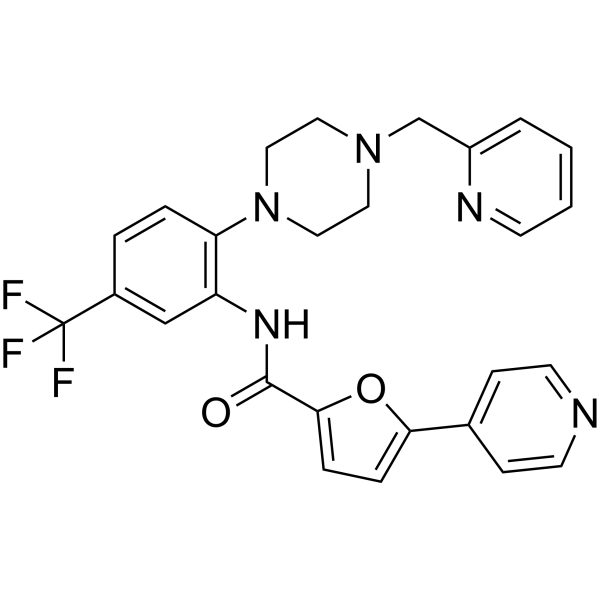
SPHINX31 is a potent and selective SRPK1 inhibitor, with an IC50 of 5.9 nM. SPHINX31 inhibits phosphorylation of serine/arginine-rich splicing factor 1 (SRSF1). SPHINX31 also decreases the mRNA expression of pro-angiogenic VEGF-A165a isoform. SPHINX31 can be used to research neovascular eye disease [1] .
loading...
    loading...
Cat. No.: HY-170935
Research Areas:  

Cancer

SRSF1-IN-1 is a SRSF1 inhibitor. SRSF1-IN-1 inhibits SRSF1 expression, thereby modulating the splicing of Bcl-x pre-mRNA. SRSF1-IN-1 inhibits the proliferation of various cancer cells. SRSF1-IN-1 induces apoptosis in gastric cancer cells, reduces Bcl-xl expression, and upregulates cleaved PARP and caspase 3. SRSF1-IN-1 induces autophagy and promotes cell death. SRSF1-IN-1 exhibits anti-tumor activity in a mouse gastric cancer xenograft model. SRSF1-IN-1 can be used for the research of various cancers including liver cancer, gastric cancer, breast cancer, colon cancer, glioma, and melanoma [1].
loading...
    loading...
Cat. No.: HY-P5960
Synonyms: PTBP1 α3-helix derived peptide P6 TFA
Target:  

DNA/RNA Synthesis

Research Areas:  

Cancer

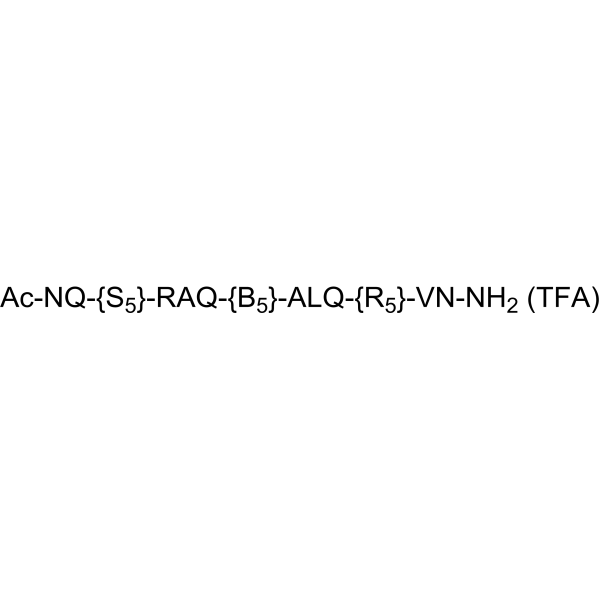
PTBP1-RNA-binding inhibitor (PTBP1 α3-helix derived peptide) P6 TFA is a cell-permeable PTBP1 inhibitor. PTBP1-RNA-binding inhibitor P6 TFA binds to the α3 helix binding site of the PTBP1 RRM1 domain, and disrupts the synergistic RNA-binding effect of the RRM1 and RRM2 domains of PTBP1. PTBP1-RNA-binding inhibitor P6 (TFA) regulates the regulatory pattern of PTBP1-related alternative splicing events, and thus exhibits anticancer potential [1].
loading...
    loading...
Cat. No.: HY-RS13790
Research Areas:  

Others

SRSF1 Human Pre-designed siRNA Set A contains three designed siRNAs for SRSF1 gene (Human), as well as a negative control, a positive control, and a FAM-labeled negative control.

loading...
    loading...
Cat. No.: HY-RS23624
Research Areas:  

Others

Srsf1 Rat Pre-designed siRNA Set A contains three designed siRNAs for Srsf1 gene (Rat), as well as a negative control, a positive control, and a FAM-labeled negative control.

loading...
    loading...
Cat. No.: HY-RS17174
Research Areas:  

Others

Srsf1 Mouse Pre-designed siRNA Set A contains three designed siRNAs for Srsf1 gene (Mouse), as well as a negative control, a positive control, and a FAM-labeled negative control.

loading...
    loading...
Cat. No.: HY-125201
CAS No.: 2252153-37-8
Target:  

CDK

Research Areas:  

Inflammation/Immunology

Indazole 1 is a potent CDC2-like kinase 2 (CLK2) inhibitor (IC50=12.3 nM). Indazole 1 inhibits the phosphorylation of SR proteins (e.g., SRSF1, SRSF3) and modulates alternative splicing of Wnt signaling-related genes. Indazole 1 is promising for research of osteoarthritis [1].
loading...
    loading...
Cat. No.: HY-E70660
Target:  

CDK

Research Areas:  

Cancer

CDK13/CycK Recombinant Human Active Protein Kinase is a RNA polymerase II C-terminal domain kinases. CDK13 interacts with the splicing factor SRSF1 and to regulate alternative splicing of HIV [1].
loading...
    loading...
Cat. No.: HY-P700524
Purity:  ≥ 95%, as determined by reducing SDS-PAGE.
Synonyms: Alternative-splicing factor 1; ASF-1Splicing factor; arginine/serine-rich 1pre-mRNA-splicing factor SF2; P33 subunit
Species:  
Source:  
loading...
    loading...
Cat. No.: HY-183831
CAS No.: 3034312-19-8
Research Areas:  

Cancer

GPS167 is a CLK kinase inhibitor that potently and selectively inhibits recombinant human CLK1, CLK2 and CLK4. By inhibiting CLK-mediated phosphorylation of SRSF10, GPS167 upregulates the protein-binding ability of CLK1 and CLK4 with SRSF10, downregulates oncogenic BCLAF1-L and upregulates tumor-suppressive BCLAF1-S, regulates alternative splicing of genes such as MDM2 and MDM4, stabilizes p53 protein and induces DNA damage, ultimately triggering tumor cell apoptosis. GPS167 can block the epithelial-mesenchymal transition process of tumors, activate intracellular double-stranded RNA-mediated antiviral immune responses, and produce synergistic cytotoxicity when combined with microtubule-targeting drugs. GPS167 can be used in research related to various cancers including colorectal cancer [1] .
loading...
    loading...

