5 Results for "

ST-IN-1

" in MedChemExpress (MCE) Product Catalog:
Products (5)

5 Results for "ST-IN-1" in MCE Product Catalog:

Cat. No.: HY-169084
Target:  

Glycosyltransferase

Research Areas:  

Cancer

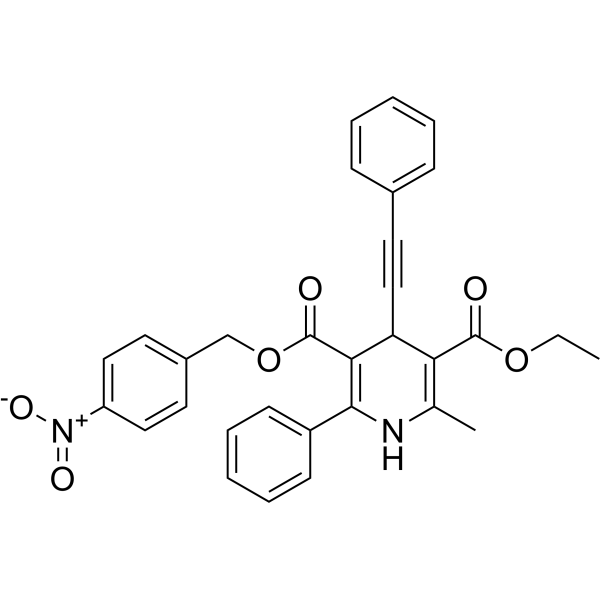
ST-IN-1 (compound (R)-1) is a selective ST inhibitor (Ki=70 nM, rat a-2,6-ST; Ki=19 nM, hST6GAL1) with antitumor activity. ST-IN-1 inhibits tumor growth and metastasis by delipidating the surface of tumor cells [1].
loading...
    loading...
Cat. No.: HY-103174
CAS No.: 192053-05-7
Purity:  ≥99.0%
Target:  

Adenosine Receptor

Research Areas:  

Cardiovascular Disease

MRS1334 is a potent and selective human adenosine A3 receptor antagonist with Kis of 2.69 nM, >100 nM, >100 nM for hA3, rA1, rA2A, respectively. MRS1334 blocks the protective effect of Cl-IB-MECA leading to significant bradycardia and elevated ST segment . MRS1334 is a click chemistry reagent, it contains an Alkyne group and can undergo copper-catalyzed azide-alkyne cycloaddition (CuAAc) with molecules containing Azide groups.
loading...
    loading...
Cat. No.: HY-173415
Research Areas:  

Cancer

E3 Ligase Ligand-linker Conjugate 177 is an E3 ligase ligand-linker conjugate. E3 Ligase Ligand-linker Conjugate 177 can be used to synthesize STING PROTAC degrader ST9 .
loading...
    loading...
Cat. No.: HY-174607
Target:  

mRNA

Research Areas:  

Inflammation/Immunology

Human IL33 mRNA encodes the human interleukin 33 (IL33) protein, a cytokine that binds to the IL1RL1/ST2 receptor. IL33 is involved in the maturation of Th2 cells and the activation of mast cells, basophils, eosinophils and natural killer cells.
loading...
    loading...
Cat. No.: HY-P11298
CAS No.: 2120397-85-3
d-T101 peptide, a human hormone-peptide, is a T1/ST2 receptor ligand. d-T101 peptide binds to the T1/ST2 receptor and activates caspases 8, 9 and 3 mediated apoptosis, together with activation of JNKinase and p38 MAPKinase. d-T101 peptide also changes Golgi structural with function loss and downregulation of the endoplasmic reticulum (ER) stress repair mechanism. d-T101 peptide has immunostimulatory and anticancer activity, selectively induces apoptosis in proliferating cancer cells and increases IL-2 and IFN-γ expression as well as the recruitment of NK cells and M1 macrophages to the tumor site [1] .
loading...
    loading...

