
7 Results for "

alginolyticus

" in MedChemExpress (MCE) Product Catalog:
Products (7)

7 Results for "alginolyticus" in MCE Product Catalog:

1
1 Cited Publications
Cat. No.: HY-120504
CAS No.: 1202-66-0
Purity:  98.90%
Target:  

Bacterial

Research Areas:  

Infection Cancer

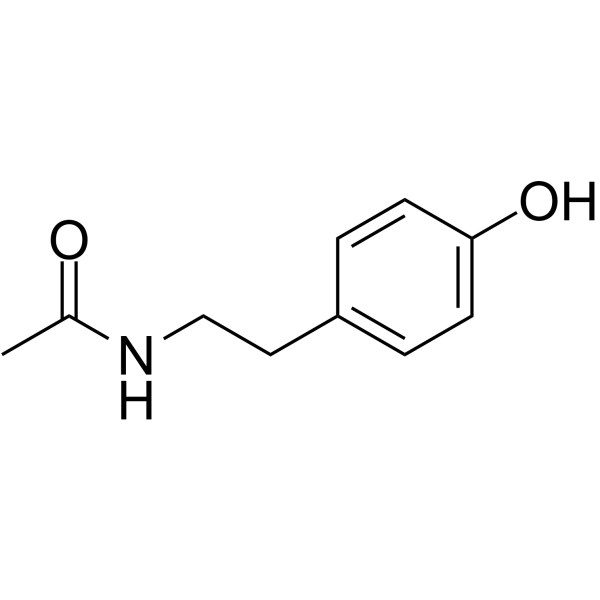
N-Acetyltyramine is a quorum-sensing inhibitor (QSI) compound produced by V. alginolyticus M3-10. N-Acetyltyramine is capable of inhibiting the QS of C. violaceum ATCC 12472. N-acetyltyramine reverses resistance in Doxorubicin-resistant leukemia P388 cells .
loading...
    loading...
Cat. No.: HY-123087
CAS No.: 172670-99-4
Synonyms: N-(3-oxodecanoyl)-homoserine lactone
Target:  

Bacterial

Research Areas:  

Infection

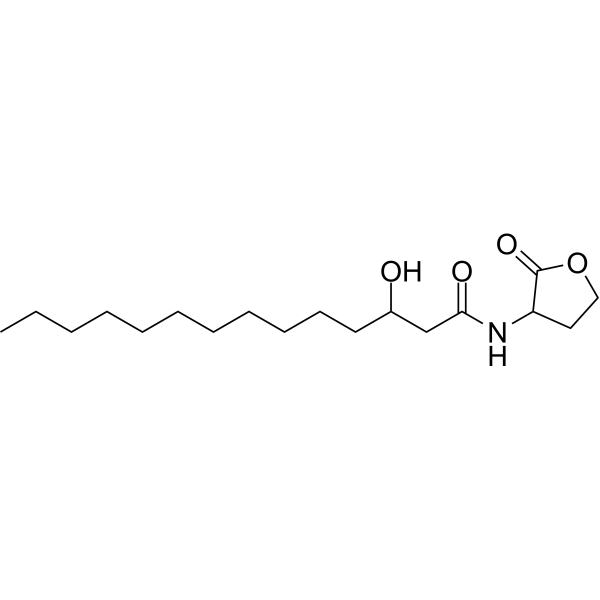
N-(3-Hydroxytetradecanoyl)-DL-homoserine lactone (N-(3-oxodecanoyl)-homoserine lactone) is a member of N-Acyl homoserine lactone (AHL) from V. alginolyticus strains. N-(3-Hydroxytetradecanoyl)-DL-homoserine lactone is used for biofilm formation and has antibacterial activity .
loading...
    loading...
Cat. No.: HY-P5697
CAS No.: 2026639-29-0
Target:  

Bacterial

Research Areas:  

Infection

Tilapia piscidin 3 is an antimicrobial peptide with antibacterial activity against gram-positive and -negative bacteria (MIC: 2.44, 2.44, 9.78, 19.55, 0.61 μg/mL for V. vulnificus 204, V. alginolyticus, S. agalactiae 819, E. faecalis BCRC 10066, S. agalactiae BCRC 10787). Tilapia piscidin 3 has hemolytic activity in fish red blood cells .
loading...
    loading...
Cat. No.: HY-P11040
Target:  

Bacterial Antibiotic

Research Areas:  

Infection

Peptide P2.2, a non-ribosomal peptide, is an antimicrobial peptide. Peptide P2.2 has potent antibacterial activity with MIC50s of 4 and 32 μM for V. parahaemolyticus and V. alginolyticus, respectively. Peptide P2.2 increases synergistic antibacterial effects with antibiotics (such as Ofloxacin (HY-B0125) and Linezolid (HY-10394)) with negligible hemolytic activity. Peptide P2.2 disrupts bacterial membranes and increases permeability by modulating proteins involved in the type VI and III secretion systems. Peptide P2.2 can be used for bacterial infections research .
loading...
    loading...
Cat. No.: HY-182310
Target:  

Bacterial

Research Areas:  

Infection

Antibacterial agent 333, Tryptanthrin (HY-N6607) derivative, is a antibacterial agent with antibacterial activity against Vibrio parahaemolyticus (MIC50 = 8 μg/mL) and Vibrio alginolyticus (MIC50 = 16 μg/mL). Antibacterial agent 333 inhibits biofilm formation and maturation. Antibacterial agent 333 exhibits activity against drug-resistant Vibrio strains. Antibacterial agent 333 lacks cytotoxicity toward mammalian cells and has no hemolytic activity. Antibacterial agent 333 can be used for the research of infection .
loading...
    loading...
Cat. No.: HY-180812
Target:  

Bacterial

Research Areas:  

Infection

Antibacterial agent 312 (Compound 8c) is a highly effective antibacterial agent that can effectively damage the integrity of bacterial membranes and enhance membrane permeability. Antibacterial agent 312 exhibits MIC values against Vibrio parahaemolyticus and Vibrio alginolyticus of 6 and 16 μg/mL respectively. Antibacterial agent 312 has bactericidal activity against Vibrio parahaemolyticus and can effectively inhibit the formation of biofilms. Antibacterial agent 312 demonstrates excellent biological safety and can be used for research on the infection of the aquatic pathogen Vibrio parahaemolyticus .
loading...
    loading...
Cat. No.: HY-N19182
CAS No.: 2798054-19-8
Target:  

Others

LL-D253g is a chromanone (phomoxanthone derivative) isolated from the coral symbiotic fungus Parengyodontium album sp. SCSIO 40430, and it shows no activity against bacteria .
loading...
    loading...

