9 Results for "

chromatid aberrations

" in MedChemExpress (MCE) Product Catalog:
Products (9)

9 Results for "chromatid aberrations" in MCE Product Catalog:

1
1 Cited Publications
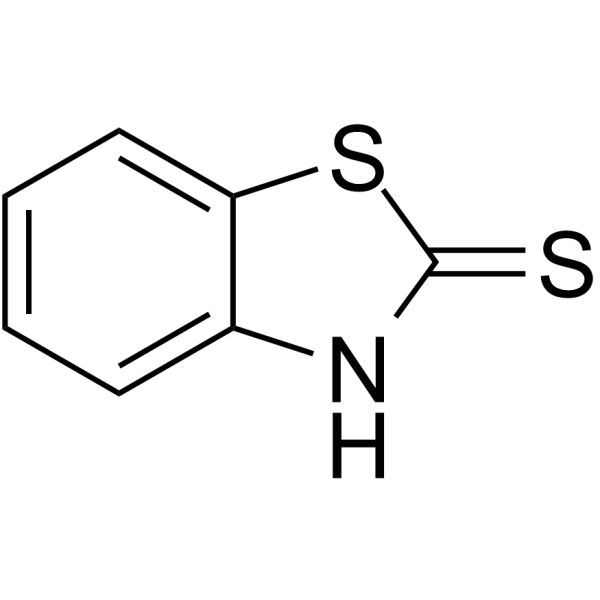
Cat. No.: HY-W017113
CAS No.: 149-30-4
2-Mercaptobenzothiazole is an activator of the aryl hydrocarbon receptor (AhR) , inhibiting thyroid hormone synthesis and dopamine beta-hydroxylase activity . 2-Mercaptobenzothiazole promotes bladder cancer cell invasion by altering the conformation of the AhR ligand binding domain (LBD), activating AhR transcription, and upregulating the mRNA and protein expression of target genes CYP1A1 and CYP1B1 . 2-Mercaptobenzothiazole inhibits thyroid peroxidase (TPO) with an IC50 value of 11.5 μM, induces histological changes such as follicular cell hypertrophy in Xenopus laevis tadpoles, delaying metamorphosis . 2-Mercaptobenzothiazole increases chromosomal aberrations and sister chromatid exchanges (SCEs) in Chinese hamster ovary (CHO) cells, and enhances carcinogenicity in F344/N rats . 2-Mercaptobenzothiazole inhibits norepinephrine synthesis in mice and completely blocks the conversion of exogenous dopamine to norepinephrine in rat cardiomyocytes .
loading...
    loading...
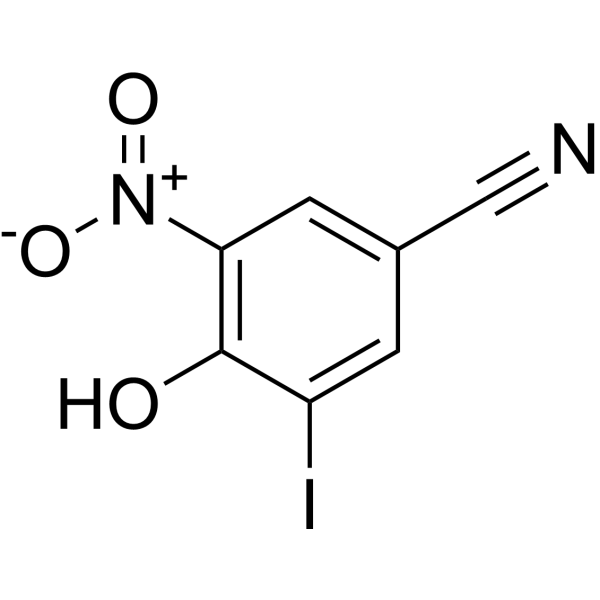
Cat. No.: HY-W049875
CAS No.: 1689-89-0
Nitroxynil is a broad-spectrum veterinary anthelmintic and a substrate of ABCG2. Nitroxynil inhibits ATP production by uncoupling the oxidative phosphorylation process of mitochondria, thereby disrupting the parasite body covering, impairing its motility, and ultimately inducing parasite death. Nitroxynil induces chromosomal aberrations, sister chromatid exchanges and abnormal sperm morphology, and interferes with spermatogenesis. Nitroxynil is widely applicable to studies on fascioliasis, myiasis, Haemonchus spp. infections, and Oestrus ovis infections .
loading...
    loading...
Cat. No.: HY-135243
CAS No.: 7264-21-3
Target:  

DNA/RNA Synthesis

Research Areas:  

Cancer

Ypenyl is a cytostatic. Ypenyl hydrochloride, belonging to the alkylating agent class, exhibits clear genotoxicity and cell cycle disruption properties. Ypenyl induces chromosomal aberrations in broad bean root tip meristem cells and leads to a decrease in the mitotic index. Ypenyl may be used in cancer research .
loading...
    loading...
Cat. No.: HY-105578A
CAS No.: 21791-39-9
Synonyms: MA 1143 hydrochloride
Target:  

Endogenous Metabolite

Research Areas:  

Inflammation/Immunology

Letimide hydrochloride (MA 1143 hydrochloride) is an analgesic with potent analgesic activity. Letimide hydrochloride has shown cytogenetic effects on human lymphocytes in in vitro experiments. Letimide hydrochloride did not exhibit significant chromosomal aberrations or sister chromatid exchanges in in vivo studies in mouse bone marrow cells. Teratogenic studies conducted on mice with Letimide hydrochloride also did not show obvious effects on inducing congenital malformations .
loading...
    loading...
Cat. No.: HY-182682
CAS No.: 5977-35-5
Synonyms: NSC-146171
Research Areas:  

Cancer

IOB-82 is a bifunctional alkylating agent. IOB‑82 induces marked nuclear and cytoplasmic alterations, elicits severe chromatid and chromosome aberrations, and remodels chromosome ploidy. IOB-82 exerts dose-dependent radiomimetic effects and preferentially cytotoxic to large A-type rat ascites cells. IOB-82 can be applied in the research of melanoma‑derived tumors and leukemia .
loading...
    loading...
Cat. No.: HY-122145
CAS No.: 6860-12-4
Target:  

DNA/RNA Synthesis

Research Areas:  

Cancer

Ypenyl hydrochloride is a cytostatic. Ypenyl hydrochloride, belonging to the alkylating agent class, exhibits clear genotoxicity and cell cycle disruption properties. Ypenyl hydrochloride induces chromosomal aberrations in broad bean root tip meristem cells and leads to a decrease in the mitotic index. Ypenyl hydrochloride may be used in cancer research .
loading...
    loading...
Cat. No.: HY-N18080
CAS No.: 508-59-8
Parthenin is a pseudoguaianolide-type sesquiterpene lactone present in Parthenium hysterophorus L. Parthenin induces chromosomal aberrations, mainly chromatid breaks, in human peripheral blood lymphocytes. Parthenin exhibits toxicity against Salmonella typhimurium and Escherichia coli strains, with reduced toxicity in the presence of a metabolic activation system (S9). Parthenin acts as an antifeedant against the 6th instar larvae of the tobacco cutworm (Spodoptera litura). Parthenin shows insecticidal activity against adult cowpea weevils (Callosobruchus maculatus). Parthenin inhibits seed germination and seedling growth of sicklepod (Cassia tora). Parthenin possesses nematicidal activity against the 2nd instar larvae of the southern root-knot nematode (Meloidogyne incognita). Parthenin serves as a research agent for studies related to cancer, malaria, amoebiasis, inflammatory diseases, and bacterial infections .
loading...
    loading...
Cat. No.: HY-13551C
CAS No.: 80277-14-1
Synonyms: m-AMSA isethionate; Acridinyl anisidide isethionate
Amsacrine isethionate (m-AMSA isethionate) is a Topoisomerase II inhibitor. Amsacrine isethionate intercalates into DNA. Amsacrine isethionate induces Ca 2+-mediated inactivation of ERK, and also downregulates AKT, promoting MCL1 downregulation mediated by GSK3β via reducing the phosphorylation level of GSK3β. Amsacrine isethionate induces Apoptosis by activating Caspase-9 and Caspase-3. Amsacrine isethionate blocks HERG potassium channels in the open/inactivated state. Amsacrine isethionate induces chromosomal aberrations and sister chromatid exchanges, and inhibits the synthesis of RNA and DNA. Amsacrine isethionate exhibits anti-leukemic activity. Amsacrine isethionate causes cardiac repolarization disorders, QT interval prolongation, ventricular arrhythmias, and increases the risk of sudden cardiac death. Amsacrine isethionate can be used in research related to acute myeloid leukemia, lymphoma and progressive malignancies .
loading...
    loading...
Cat. No.: HY-13551D
CAS No.: 80277-11-8
Synonyms: m-AMSA lactate; Acridinyl anisidide lactate
Amsacrine lactate (m-AMSA lactate) is a Topoisomerase II inhibitor. Amsacrine lactate intercalates into DNA. Amsacrine lactate induces Ca 2+-mediated inactivation of ERK, and also downregulates AKT, promoting MCL1 downregulation mediated by GSK3β via reducing the phosphorylation level of GSK3β. Amsacrine lactate induces Apoptosis by activating Caspase-9 and Caspase-3. Amsacrine lactate blocks HERG potassium channels in the open/inactivated state. Amsacrine lactate induces chromosomal aberrations and sister chromatid exchanges, and inhibits the synthesis of RNA and DNA. Amsacrine lactate exhibits anti-leukemic activity. Amsacrine lactate causes cardiac repolarization disorders, QT interval prolongation, ventricular arrhythmias, and increases the risk of sudden cardiac death. Amsacrine lactate can be used in research related to acute myeloid leukemia, lymphoma and progressive malignancies .
loading...
    loading...

