



Nitroxynil

Based on 1 Customer Validation
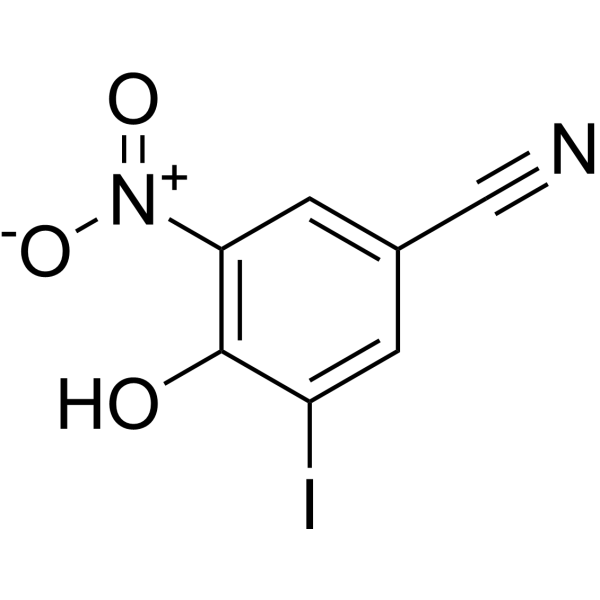
Nitroxynil is a broad-spectrum veterinary anthelmintic and a substrate of ABCG2. Nitroxynil inhibits ATP production by uncoupling the oxidative phosphorylation process of mitochondria, thereby disrupting the parasite body covering, impairing its motility, and ultimately inducing parasite death. Nitroxynil induces chromosomal aberrations, sister chromatid exchanges and abnormal sperm morphology, and interferes with spermatogenesis. Nitroxynil is widely applicable to studies on fascioliasis, myiasis, Haemonchus spp. infections, and Oestrus ovis infections.
Nur für Forschungszwecke. Wir verkaufen nicht an Patienten.
- Reinheit : 98.92%
- CAS. Nr.: 1689-89-0
- Formel: C7H3IN2O3
- Molecular Weight:290.02
-
Speicherung:
4°C, protect from light, stored under nitrogen
* In solvent : -80°C, 6 months; -20°C, 1 month (protect from light, stored under nitrogen)

To place orders, for customer services and technical support, please contact: MedChemExpress USA
Tel: 609-228-6898 E-mail: [email protected] [email protected]


-
 Biologische Aktivität
-
Chemical Information
-
Lösungsmittel & Löslichkeit
- Protokoll
- Reinheit & Dokumentation
- Verweise
-
 Help & FAQs


-

HY-W049875R
Nitroxynil (Standard)Fasciolicide -
HY-17598
RafoxanideAnthelmintic Agent -
HY-17598R
Rafoxanide (Standard)Anthelmintic Agent -

HY-W015837
PhthalonitrilePhthalocyanine Precursor -
HY-W015052
DiphenylacetonitrileBiochemical Reagent -

HY-20138
2-Fluoro-5-formylbenzonitrileDrug Intermediate -

HY-W017920
4-(2-Bromoethyl)benzonitrilePROTAC Linker -

HY-79638
4-(2-Bromoacetyl)benzonitrile -

HY-W015722
2-(4-Ethynylphenyl)acetonitrilePROTAC Linker -

HY-W095821
2-(2-Chloroethoxy)acetonitrilePROTAC Linker -
![4'-Methyl-[1,1'-biphenyl]-2-carbonitrile (Standard)](https://file.medchemexpress.com/product_pic/hy-w015048r.gif)
HY-W015048R
4'-Methyl-[1,1'-biphenyl]-2-carbonitrile (Standard) -

HY-W102596
1-(2-Hydroxyethyl)piperidine-4-carbonitrilePROTAC Linker
Alle Parasite Isoform-spezifische Produkte anzeigen
More

Biologische Aktivität
Beschreibung
In Vitro
Nitroxynil is metabolized via hydrolysis and nitroreduction in rat liver cytosol in vitro, forming multiple identifiable metabolites including some with flukicidal activity[2].
MedChemExpress (MCE) has not independently confirmed the accuracy of these methods. They are for reference only.
In Vivo
Nitroxynil (10-15 mg/kg; s.c.) is highly effective against adult and late immature Fasciola spp. in cattle and camelids, with residual anti-reinfestation activity for several weeks[2].
Nitroxynil (10-20 mg/kg; s.c.) is effective against Parafilaria bovicola in cattle and camelids[2].
Nitroxynil (10-20 mg/kg; s.c.) is effective against nasal myiasis caused by Oestrus ovis in sheep and goats[2].
Nitroxynil (7-12.5 mg/kg; s.c.) is effective against Hemonchus contortus in sheep and goats, with residual anti-reinfestation activity for several weeks[2].
Nitroxynil (7-12.5 mg/kg; s.c.) is effective against blood-sucking gastrointestinal roundworms in cattle and camelids, with residual anti-reinfestation activity for several weeks[2].
Nitroxynil (10-40 mg/kg; i.p.; single dose or daily for 5 days) exhibits dose-dependent clastogenic effects on male Swiss mice somatic cells (significantly increasing chromosomal aberrations at all tested single doses[3].
MedChemExpress (MCE) has not independently confirmed the accuracy of these methods. They are for reference only.
-
Animal Model:FVB/N (male, 8-17 weeks, wild-type and Abcg2−/−)[1]
-
Dosage:10 mg/kg
-
Administration:s.c.; single dose
-
Result:Showed significantly higher plasma concentrations in Abcg2−/− mice compared to wild-type mice at 0.5, 6, 24, 48, and 96 hours post-administration.
Reached a 1.8-fold higher plasma area under the concentration-time curve (AUC) in Abcg2−/− mice than wild-type mice (3528.0 µg·h/mL vs. 1922.1 µg·h/mL, p = 0.01).
Exhibited 1.4-fold higher levels in small intestine, 1.7-fold higher accumulation in spleen, and 1.6-fold higher concentration in testis of Abcg2−/− mice compared to wild-type mice at 24 hours post-administration (p = 0.01, p = 0.001, p = 0.02 respectively).
Had concentrations in liver, small intestine, and testis of wild-type mice below the limit of quantification (LOQ) at 96 hours post-administration, while levels in Abcg2−/− mice were 0.7 µg/g (liver), 0.5 µg/g (small intestine), and 1.1 µg/g (testis); showed 3.5 µg/g in kidney of Abcg2−/− mice vs. 0.9 µg/g in wild-type mice (p < 0.001).
-
Animal Model:Swiss mice (male, 12 weeks old, 25-30 g)[3]
-
Dosage:10-40 mg/kg (single dose; somatic cell assays, spermatocyte assays); 10-40 mg/kg (daily for 5 days; sperm-shape assays)
-
Administration:i.p.; single dose; 24 hours post-dose (somatic cell assays, spermatocyte assays); i.p.; daily for 5 days; 35 days post-first dose (sperm-shape assays)
-
Result:Increased metaphases with chromosomal aberrations (including gaps) to 8.2% at 10 mg/kg, 10% at 20 mg/kg, 10.8% at 30 mg/kg, and 11.4% at 40 mg/kg single dose (all p<0.05 or p<0.01 vs control).
Increased metaphases with chromosomal aberrations (excluding gaps) to 4.8% at 10 mg/kg, 5.6% at 20 mg/kg, 6.2% at 30 mg/kg, and 6.2% at 40 mg/kg single dose (all p<0.05 or p<0.01 vs control).
Induced 3.90 SCEs/cell at 10 mg/kg, 4.37 SCEs/cell at 20 mg/kg, 5.61 SCEs/cell at 30 mg/kg (all non-significant vs control), and 5.79 SCEs/cell at 40 mg/kg single dose (p<0.05 vs control).
Increased spermatocyte metaphases with chromosomal aberrations to 9.2% at 10 mg/kg, 10.4% at 20 mg/kg, 12.2% at 30 mg/kg, and 12.4% at 40 mg/kg single dose (all p<0.05 or p<0.01 vs control).
Induced 2.96% abnormal sperm at 10 mg/kg, 4.26% abnormal sperm at 20 mg/kg (both non-significant vs control), and 6.58% abnormal sperm at 30 mg/kg, 7.02% abnormal sperm at 40 mg/kg repeated dose (both p<0.01 vs control).


Chemical Information
-
CAS. Nr. 1689-89-0
-
Appearance Solid
-
Molecular Weight 290.02
-
Formel C7H3IN2O3
-
Color Off-white to light yellow
-
SMILES
N#CC1=CC([N+]([O-])=O)=C(O)C(I)=C1
-
Versand
Room temperature in continental US; may vary elsewhere.
-
Speicherung
4°C, protect from light, stored under nitrogen
* In solvent : -80°C, 6 months; -20°C, 1 month (protect from light, stored under nitrogen)


Lösungsmittel & Löslichkeit
In Vitro:
DMSO : 100 mg/mL (344.80 mM; Need ultrasonic; Hygroscopic DMSO has a significant impact on the solubility of product, please use newly opened DMSO)
Please refer to the solubility information to select the appropriate solvent. Once prepared, please aliquot and store the solution to prevent product inactivation from repeated freeze-thaw cycles.
Storage method and period of stock solution: -80°C, 6 months; -20°C, 1 month (protect from light, stored under nitrogen). When stored at -80°C, please use it within 6 months. When stored at -20°C, please use it within 1 month.
Please refer to the solubility information to select the appropriate solvent. Once prepared, please aliquot and store the solution to prevent product inactivation from repeated freeze-thaw cycles.
Storage method and period of stock solution: -80°C, 6 months; -20°C, 1 month (protect from light, stored under nitrogen). When stored at -80°C, please use it within 6 months. When stored at -20°C, please use it within 1 month.
Konzentration (Stammlösung) × Volumen (Stammlösung) = Konzentration (Ziellösung) × Volumen (Ziellösung)
In Vivo:
Select the appropriate dissolution method based on your experimental animal and administration route.
- For the following dissolution methods, please ensure to first prepare a clear stock solution using an In Vitro approach and then sequentially add co-solvents:
- To ensure reliable experimental results, the clarified stock solution can be appropriately stored based on storage conditions. As for the working solution for In Vivo experiments, it is recommended to prepare freshly and use it on the same day.
- The percentages shown for the solvents indicate their volumetric ratio in the final prepared solution. If precipitation or phase separation occurs during preparation, heat and/or sonication can be used to aid dissolution.
Add each solvent one by one: 10% DMSO 40% PEG300 5% Tween-80 45% Saline
Solubility: ≥ 2.5 mg/mL (8.62 mM); Clear solution
This protocol yields a clear solution of ≥ 2.5 mg/mL (saturation unknown).
Taking 1 mL working solution as an example, add 100 μL DMSO stock solution (25.0 mg/mL) to 400 μL PEG300, and mix evenly; then add 50 μL Tween-80 and mix evenly; then add 450 μL Saline to adjust the volume to 1 mL.
Preparation of Saline: Dissolve 0.9 g sodium chloride in ddH₂O and dilute to 100 mL to obtain a clear Saline solution.
In Vivo Dissolution Calculator
Please enter the basic information of animal experiments:
-
-
-
-
Recommended: Prepare an additional quantity of animals to account for potential losses during experiments.
Please enter your animal formula composition:
-
%DMSO +
Recommended: Keep the proportion of DMSO in working solution below 2% if your animal is weak.
-
%+
-
+%Tween-80 + +
-
%Saline +
The co-solvents required include: DMSO, . All of co-solvents are available by MedChemExpress (MCE). , Tween 80. All of co-solvents are available by MedChemExpress (MCE).
Working solution concentration: 0.22 mg/mL
Method for preparing stock solution: mg drug dissolved in μL DMSO. Stock solution concentration: mg/mL. * In solvent : -80°C, 6 months; -20°C, 1 month (protect from light, stored under nitrogen)
1. Take μL DMSO stock solution;
2. Add μL .
μL , mix evenly;
3. Then add μL Tween 80, mix evenly;
4. Then add μL
Please ensure that the stock solution in the first step is dissolved to a clear state, and add co-solvents in sequence. You can use ultrasonic heating (ultrasonic cleaner, recommended frequency 20-40 kHz), vortexing, etc. to assist dissolution.


Reinheit & Dokumentation
-
Data Sheet (281 KB)
-
SDS (624 KB)
- English - EN (624 KB)
- Français - FR (624 KB)
- Deutsch - DE (624 KB)
- Norwegian - NO (624 KB)
- Español - ES (624 KB)
- Swedish - SV (624 KB)
- Italian - IT (624 KB)
- Korean - KR (624 KB)
- Portuguese - PT (624 KB)
-
Handling Instructions (2659 KB)
Verweise


Complete Stock Solution Preparation Table
Please refer to the solubility information to select the appropriate solvent. Once prepared, please aliquot and store the solution to prevent product inactivation from repeated freeze-thaw cycles.
Storage method and period of stock solution: -80°C, 6 months; -20°C, 1 month (protect from light, stored under nitrogen). When stored at -80°C, please use it within 6 months. When stored at -20°C, please use it within 1 month.
| Optional Solvent | Concentration Solvent Mass | 1 mg | 5 mg | 10 mg | 25 mg |
|---|---|---|---|---|---|
| DMSO | 1 mM | 3.4480 mL | 17.2402 mL | 34.4804 mL | 86.2010 mL |
| 5 mM | 0.6896 mL | 3.4480 mL | 6.8961 mL | 17.2402 mL | |
| 10 mM | 0.3448 mL | 1.7240 mL | 3.4480 mL | 8.6201 mL | |
| 15 mM | 0.2299 mL | 1.1493 mL | 2.2987 mL | 5.7467 mL | |
| 20 mM | 0.1724 mL | 0.8620 mL | 1.7240 mL | 4.3100 mL | |
| 25 mM | 0.1379 mL | 0.6896 mL | 1.3792 mL | 3.4480 mL | |
| 30 mM | 0.1149 mL | 0.5747 mL | 1.1493 mL | 2.8734 mL | |
| 40 mM | 0.0862 mL | 0.4310 mL | 0.8620 mL | 2.1550 mL | |
| 50 mM | 0.0690 mL | 0.3448 mL | 0.6896 mL | 1.7240 mL | |
| 60 mM | 0.0575 mL | 0.2873 mL | 0.5747 mL | 1.4367 mL | |
| 80 mM | 0.0431 mL | 0.2155 mL | 0.4310 mL | 1.0775 mL | |
| 100 mM | 0.0345 mL | 0.1724 mL | 0.3448 mL | 0.8620 mL |


Nitroxynil Related Classifications
HY-W049875 Related Classifications
 Powered by Bioz