
12 Results for "

competitive binding assay

" in MedChemExpress (MCE) Product Catalog:
Products (12)

12 Results for "competitive binding assay" in MCE Product Catalog:

7
7 Cited Publications
Cat. No.: HY-15682
CAS No.: 71441-28-6
Purity:  99.85%
Synonyms: Ro 13-7410; Arotinoid acid; AGN191183
Research Areas:  

Cancer

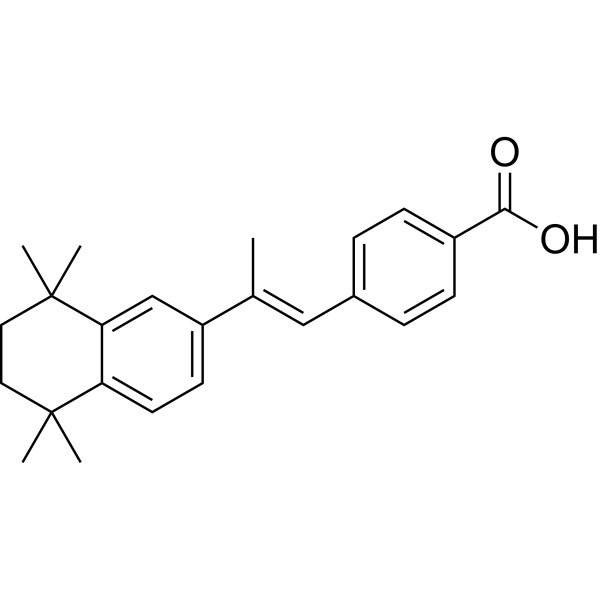
TTNPB is a highly potent RAR agonist. Competitive binding assays using human RARs yield IC50s of α=5.1 nM, β= 4.5 nM, and γ=9.3 nM, respectively.
loading...
    loading...
Cat. No.: HY-120959
CAS No.: 73025-02-2
Purity:  98.45%
Research Areas:  

Infection

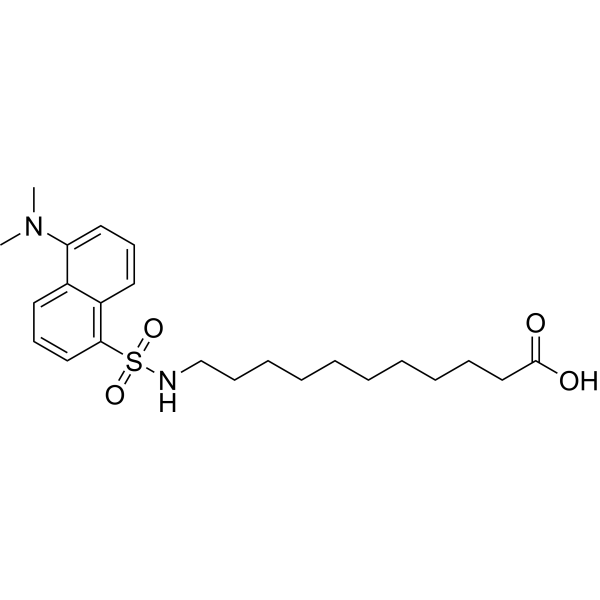
DAUDA is a fluorescent fatty acid analog probe, with Kd values of 0.63 μM, 0.82 μM, and 0.66 μM against subtypes/mutants of Schistosoma mansoni Sm14 fatty acid-binding protein, respectively. DAUDA binds to Sm14 fatty acid-binding protein variants, enters their non-polar binding pockets and alters fluorescence emission properties. DAUDA serves as a tracer in competitive binding assays with natural fatty acids to evaluate the fatty acid-binding capacity of Sm14 protein variants. DAUDA is applicable to the research of schistosomiasis .
loading...
    loading...
Cat. No.: HY-119366
CAS No.: 2068119-11-7
Purity:  99.31%
Target:  

ROR

Research Areas:  

Inflammation/Immunology

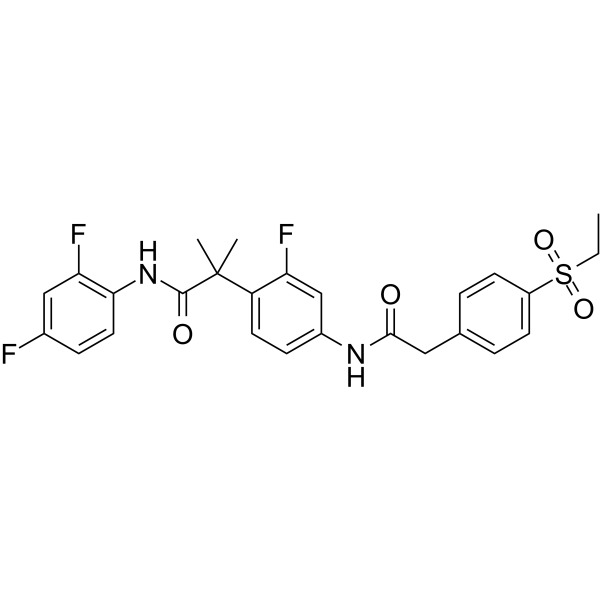
S18-000003 is a potent, selective and orally active inhibitor of retinoic acid receptor-related orphan receptor-gamma-t (RORγt), with an IC50 of <30 nM towards human RORγt in competitive binding assays. S18-000003 shows selectivity for RORγt over other ROR family members (IC50>10 μM). S18-000003 can be used for the research of psoriasis with low risk of thymic aberrations .
loading...
    loading...
Cat. No.: HY-128466
CAS No.: 151009-85-7
Purity:  ≥95.0%
N-Biotinyl-L-cysteine is a biotinylated biochemical assay reagent, which is used to detect avidin and biotin through a competitive binding reaction .
loading...
    loading...
Cat. No.: HY-P4863
CAS No.: 1678415-18-3
Target:  

CGRP Receptor

Biotinyl-Amylin (human) is a biotin-labeled derivative of Amylin, amide, human (HY-P1070). Biotinyl-Amylin (human) acts as a competitive agonist for the Calcitonin Receptor (CTR) and for the Amylin receptors (AMY1, AMY2, and AMY3) formed by the association of CTR with RAMP1/2/3. By mimicking endogenous human amylin, Biotinyl-Amylin (human) binds to and activates CTR and AMY receptors, thereby initiating downstream signaling pathways involving cAMP, CREB, and ERK1/2, while retaining high-affinity receptor binding and activation capabilities. Biotinyl-Amylin (human) is primarily utilized in studies investigating the metabolic regulatory mechanisms underlying obesity and diabetes; it is also applicable to pharmacological research, receptor localization studies, and ligand-binding assays related to Amylin receptors in the context of Alzheimer's disease .
loading...
    loading...
Cat. No.: HY-15682R
CAS No.: 71441-28-6
Synonyms: Ro 13-7410 (Standard); Arotinoid acid (Standard); AGN191183 (Standard)
Research Areas:  

Cancer

TTNPB (Standard) is the analytical standard of TTNPB. This product is intended for research and analytical applications. TTNPB is a highly potent RAR agonist. Competitive binding assays using human RARs yield IC50s of α=5.1 nM, β= 4.5 nM, and γ=9.3 nM, respectively.
loading...
    loading...
Cat. No.: HY-10275
CAS No.: 433937-74-7
Synonyms: AR-H067637
Target:  

Thrombin

Research Areas:  

Cardiovascular Disease

Atecegatran (AR-H067637) is an orally active competitive thrombin inhibitor with a Ki of 2-4 nM. AR-H067637 inhibits platelet activation and aggregation by blocking thrombin binding to fibrin and thrombomodulin. Atecegatran demonstrates significant anticoagulant effects in various plasma coagulation assays, with an IC50 ranging from 93 to 220 nM. Atecegatran can be used in research related to thromboembolic disorders .
loading...
    loading...
Cat. No.: HY-118156
CAS No.: 155238-60-1
Target:  

Others

Research Areas:  

Others

L-699333 is a 5-lipoxygenase (5-LO) inhibitor belonging to the thieno[2,3,4-cd]indole class. This compound has a 2-ethoxybutyric acid side chain and is a potent inhibitor of the biosynthesis of 5-HPETE and LTB4 produced from human 5-LO, with ICm values of 22 nM, 7 nM, and 3.8 pM for human neutrophils and whole blood, respectively. L-699333 has shown anti-inflammatory and antiasthmatic effects in a variety of animal models, including rat pleurisy models, antigen-induced wheezing models, and awake macaque and sheep asthma models. Its inhibition of 5-LO is highly selective, with higher ICm values or stronger competitive inhibition in FLAP binding assays compared to inhibition of human 15-LO, porcine 12-LO, and ram epididymal cyclooxygenase. The racemic enantiomer 14g of L-699333 is the most potent enantiomer to date, with inhibitory effects similar to those of the known MK-0591, which has been shown in clinical trials to inhibit the biochemical effects of LTB4 biosynthesis in vitro and LTE4 excretion in urine.
loading...
    loading...
Cat. No.: HY-189014
CAS No.: 524924-75-2
Target:  

mGluR Drug Intermediate

Research Areas:  

Neurological Disease

Methoxymethyl-MTEP is a selective, high-affinity mGluR5 antagonist. Methoxymethyl-MTEP can serve as a radiotracer ligand, readily entering the brain and providing mGluR5-specific signal in gray matter regions. Methoxymethyl-MTEP exhibits a Kd = 20 nM as measured by saturation binding assays in rat brain cell membranes, and an IC50 = 30 nM in competitive binding assays. Methoxymethyl-MTEP can be used for research on diseases related to the glutamatergic nervous system, such as excitotoxicity and schizophrenia .
loading...
    loading...
Cat. No.: HY-183439
CAS No.: 2365116-48-7
Target:  

PROTACs FKBP

Research Areas:  

Cancer

dTAG-Fluorescein is a dTAG-class PROTAC conjugated with fluorescein. dTAG-Fluorescein is applicable to homogeneous time-resolved fluorescence (HTRF) competitive displacement binding assays to detect binding affinity with His-FKBP12 F36V. dTAG-Fluorescein can recruit VHL or CRBN E3 ligase complexes, thereby specifically driving the selective degradation of FKBP12 F36V-tagged proteins, with very limited activity against FKBP12 WT and IKZF1 .
loading...
    loading...
Cat. No.: HY-DY2032
Research Areas:  

Others

Methyl Green Staining Solution (Chloroform-Extracted, 1%) is a basic dye stock solution with differential nucleic acid binding activity that distinguishes double-stranded DNA from RNA, and it can be used for assays related to nucleic acid distribution and DNA localization. Methyl Green Staining Solution (Chloroform-Extracted, 1%) functions by competitively binding to the phosphate groups of nucleic acids and stably binds to intact double-stranded DNA; RNA within the oocyte-specific ribonucleoprotein complex specifically binds to this dye, and RNase completely blocks this binding reaction. The nucleic acid recognition of Methyl Green Staining Solution (Chloroform-Extracted, 1%) depends on the size of the dye cation and the intact double-helical structure of DNA .
loading...
    loading...
Cat. No.: HY-P11932
Research Areas:  

Cancer

FGLP21 is a polypeptide targeting FGL1. FGLP21 has a simulated binding affinity of -9.56 kcal/mol for FGL1, and inhibits the binding of 68Ga-NODA-FGLP21 to FGL1 in a competitive binding assay using FGL1-positive Huh7 cells, with an IC50 of 101.0 nM. FGLP21 preferentially binds to FGL1-positive Huh7 cells, and excess unlabeled FGLP21 can significantly block the uptake of 68Ga-NODA-FGLP21 in Huh7 xenograft tumors. FGLP21 can be used for FGL1-targeted tumor imaging and immune checkpoint research .
loading...
    loading...
  • 1

