Search Result
Results for "
copper nanoparticle
" in MedChemExpress (MCE) Product Catalog:
9
Biochemical Assay Reagents
1
Isotope-Labeled Compounds
| Cat. No. |
Product Name |
Target |
Research Areas |
Chemical Structure |
-
- HY-B1306
-
|
p-Aminohippuric acid
|
Others
|
Neurological Disease
Metabolic Disease
|
|
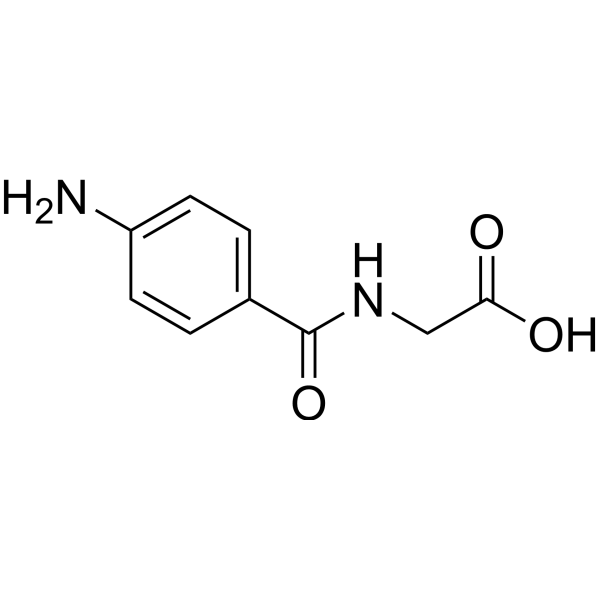
4-Aminohippuric acid (p-Aminohippuric acid) is a coordination ligand for metal ions (such as Cu 2+, Fe 3+, Hg 2+) and a functionalization reagent for nanomaterials. 4-Aminohippuric acid can coordinate with metal ions or modify the surface of materials such as carbon nanotubes and gold nanoparticles through amino and carboxyl groups. 4-Aminohippuric acid can form stable complexes with metal ions or participate in the synthesis of nanomaterials as a reducing agent/stabilizer, enriching metal ions or giving nanoparticles peroxidase-mimicking activity. 4-Aminohippuric acid can be used to construct highly sensitive electrochemical sensors or colorimetric sensors to detect and quantitatively analyze heavy metal ions such as copper, iron, and mercury in environmental water samples and biological samples. 4-Aminohippuric acid may also be a biomarker for attention-deficit/hyperactivity disorder (ADHD) .
|
-
-
- HY-W440832
-
|
|
Liposome
|
Infection
|
|
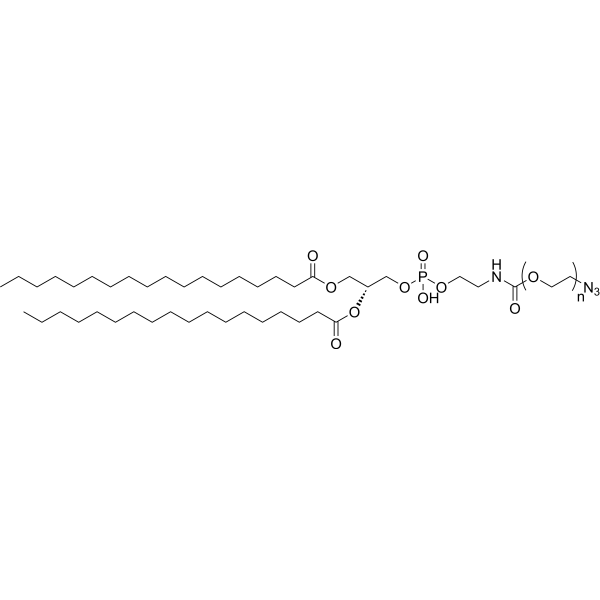
DSPE-PEG2000-azide is an azide containing lipid that can be used to form micelles as nanoparticles for drug delivery . DSPE-PEG2000-azide is a click chemistry reagent, it contains an Azide group and can undergo copper-catalyzed azide-alkyne cycloaddition reaction (CuAAc) with molecules containing Alkyne groups. It can also undergo strain-promoted alkyne-azide cycloaddition (SPAAC) reactions with molecules containing DBCO or BCN groups.
|
-
-
- HY-W800703
-
|
|
Fluorescent Dye
|
Others
|
|
Alexa Fluor 594 azide is an azide-modified fluorescent dye and also a FRET acceptor reactant. Owing to its negligible direct absorption under 488 nm excitation light, excellent photostability, and the ability of its azide group to participate in the CuAAC reaction, Alexa Fluor 594 azide can be paired with a donor dye for single-molecule imaging via TIRFM, thereby enabling the visual monitoring of CuNP-catalyzed click reactions .
|
-
-
- HY-W011060
-
|
4,7,13,16,21,24-Hexaoxa-1,10-diazabicyclo[8.8.8]hexacosane
|
Biochemical Assay Reagents
|
Others
|
|
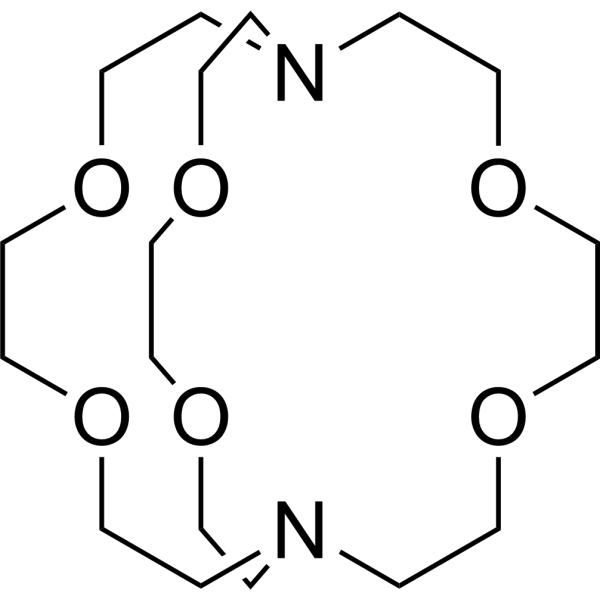
Cryptand 2.2.2 (4,7,13,16,21,24-Hexaoxa-1,10-diazabicyclo[8.8.8]hexacosane) is a metal ion chelator. Cryptand 2.2.2 forms stable mononuclear, protonated and dinuclear complexes with copper (II) ions; forms protonated complexes with hydrogen ions; and also forms stable complexes with Zn 2+, Co 2+, Ni 2+, Cd 2+, Hg 2+ and Pb 2+ ions. Cryptand 2.2.2 can be used for the preparation of nanoparticles, transition metal compounds, etc.
|
-
-
- HY-155788
-
|
|
Biochemical Assay Reagents
|
Others
|
|
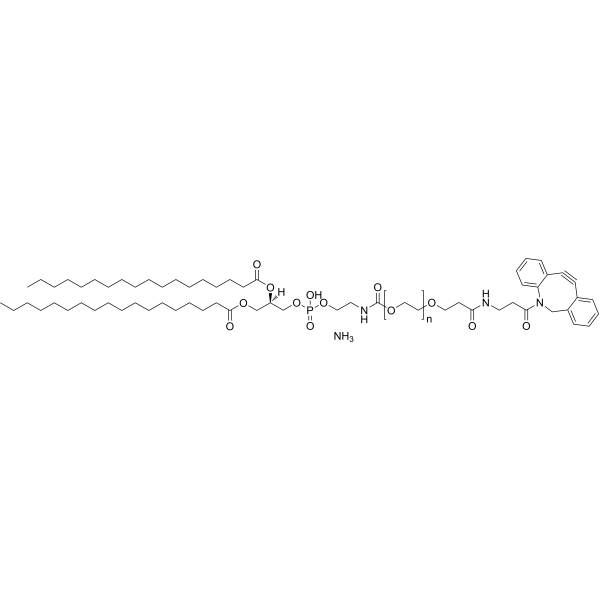
DSPE-PEG-DBCO ammonium is the ammonium salt form of DSPE-PEG-DBCO. DSPE-PEG-DBCO ammonium is utilized in copper-free click chemistry through SPAAC conjugation with an azido-functionalized peptide ligand. DSPE-PEG-DBCO ammonium is applied in drug-delivery and nanoparticle research .
|
-
-
- HY-132141
-
|
5-Propargylamino-dUTP
|
DNA/RNA Synthesis
|
Others
|
|
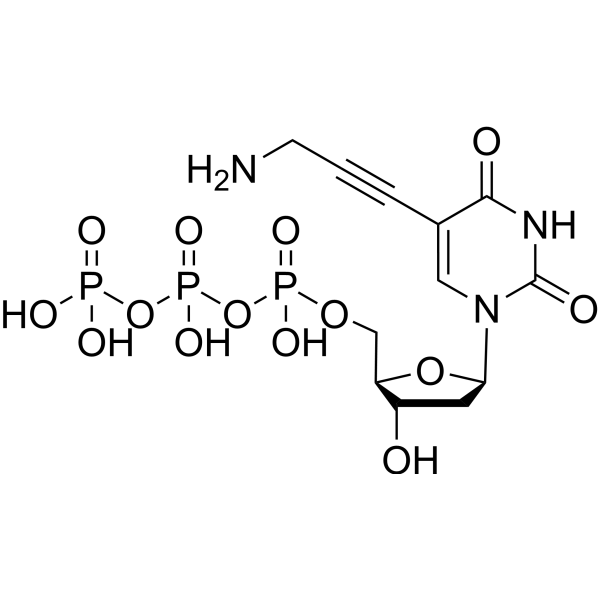
5-PA-dUTP (5-Propargylamino-dUTP) is a C5-modified nucleotide and can be incorporated into DNA nanoparticles (DNPs) for photosensitizer delivery . 5-PA-dUTP is a click chemistry reagent, it contains an Alkyne group and can undergo copper-catalyzed azide-alkyne cycloaddition (CuAAc) with molecules containing Azide groups.
|
-
-
- HY-B1306R
-
|
p-Aminohippuric acid (Standard)
|
Reference Standards
Biochemical Assay Reagents
|
Neurological Disease
Metabolic Disease
|
|
4-Aminohippuric acid (p-Aminohippuric acid) (Standard) is the analytical standard of 4-Aminohippuric acid (HY-B1306). This product is intended for research and analytical applications. 4-Aminohippuric acid (p-Aminohippuric acid) is a coordination ligand for metal ions (such as Cu 2+, Fe 3+, Hg 2+) and a functionalization reagent for nanomaterials. 4-Aminohippuric acid can coordinate with metal ions or modify the surface of materials such as carbon nanotubes and gold nanoparticles through amino and carboxyl groups. 4-Aminohippuric acid can form stable complexes with metal ions or participate in the synthesis of nanomaterials as a reducing agent/stabilizer, enriching metal ions or giving nanoparticles peroxidase-mimicking activity. 4-Aminohippuric acid can be used to construct highly sensitive electrochemical sensors or colorimetric sensors to detect and quantitatively analyze heavy metal ions such as copper, iron, and mercury in environmental water samples and biological samples. 4-Aminohippuric acid may also be a biomarker for attention-deficit/hyperactivity disorder (ADHD) .
|
-
-
- HY-B1306S
-
|
p-Aminohippuric acid-d4
|
Biochemical Assay Reagents
|
Neurological Disease
Metabolic Disease
|
|
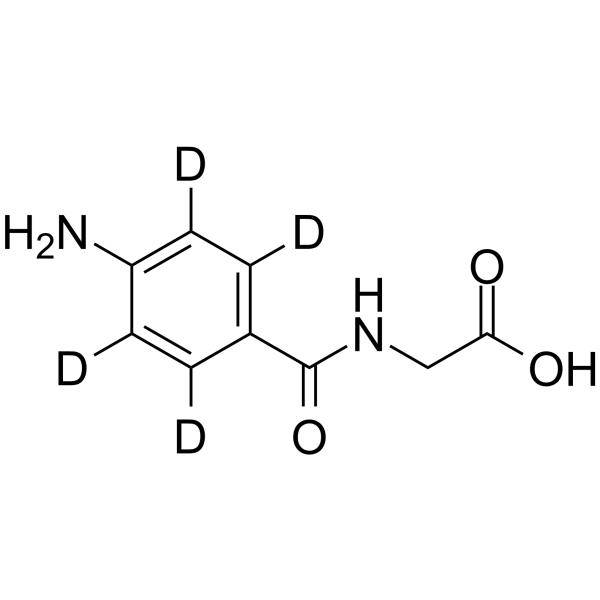
4-Aminohippuric acid-d4 (p-Aminohippuric acid-d4) is the deuterium labeled 4-Aminohippuric acid (HY-B1306). 4-Aminohippuric acid (p-Aminohippuric acid) is a coordination ligand for metal ions (such as Cu 2+, Fe 3+, Hg 2+) and a functionalization reagent for nanomaterials. 4-Aminohippuric acid can coordinate with metal ions or modify the surface of materials such as carbon nanotubes and gold nanoparticles through amino and carboxyl groups. 4-Aminohippuric acid can form stable complexes with metal ions or participate in the synthesis of nanomaterials as a reducing agent/stabilizer, enriching metal ions or giving nanoparticles peroxidase-mimicking activity. 4-Aminohippuric acid can be used to construct highly sensitive electrochemical sensors or colorimetric sensors to detect and quantitatively analyze heavy metal ions such as copper, iron, and mercury in environmental water samples and biological samples. 4-Aminohippuric acid may also be a biomarker for attention-deficit/hyperactivity disorder (ADHD) .
|
-
-
- HY-W440926
-
|
|
Liposome
|
Others
|
|
Stearic acid-PEG1000-NHS is a cyclooctyne containing phospholipid PEG polymer. The polymer can self-assemble spontaneously in water to form micelles/lipid bilayer. It can be used to prepare nanoparticles or liposomes as drug carrier in targeted drug delivery system. The DBCO can react with azide molecule via copper free click chemistry to form a stable triazole bond.
|
-
-
- HY-174945
-
|
DSPE-PEG3-N3
|
Biochemical Assay Reagents
|
Others
|
|
DSPE-PEG3-azide (DSPE-PEG3-N3) is an azide containing lipid that can be used to form micelles as nanoparticles for drug delivery. DSPE-PEG3-azide is a click chemistry reagent, it contains an Azide group and can undergo copper-catalyzed azide-alkyne cycloaddition reaction (CuAAc) with molecules containing Alkyne groups. It can also undergo strain-promoted alkyne-azide cycloaddition (SPAAC) reactions with molecules containing DBCO or BCN groups .
|
-
-
- HY-174945A
-
|
DSPE-PEG1-N3
|
Biochemical Assay Reagents
|
Others
|
|
DSPE-PEG1-azide (DSPE-PEG1-N3) is an azide containing lipid that can be used to form micelles as nanoparticles for drug delivery. DSPE-PEG1-azide is a click chemistry reagent, it contains an Azide group and can undergo copper-catalyzed azide-alkyne cycloaddition reaction (CuAAc) with molecules containing Alkyne groups. It can also undergo strain-promoted alkyne-azide cycloaddition (SPAAC) reactions with molecules containing DBCO or BCN groups .
|
-
-
- HY-W440903
-
|
|
Biochemical Assay Reagents
|
Others
|
|
DSPE-PEG5000-IA is a cyclooctyne containing phospholipid PEG polymer. The polymer can self-assemble spontaneously in water to form micelles/lipid bilayer. It can be used to prepare nanoparticles or liposomes as drug carrier in targeted drug delivery system. The DBCO can react with azide molecule via copper free click chemistry to form a stable triazole bond.
|
-
-
- HY-173606
-
|
|
Liposome
|
Others
|
|
DSPE-PEG2000-Azide ammonium is an azide containing lipid that can be used to form micelles as nanoparticles for drug delivery . DSPE-PEG2000-Azide ammonium is a click chemistry reagent, it contains an Azide group and can undergo copper-catalyzed azide-alkyne cycloaddition reaction (CuAAc) with molecules containing Alkyne groups. It can also undergo strain-promoted alkyne-azide cycloaddition (SPAAC) reactions with molecules containing DBCO or BCN groups.
|
-
-
- HY-174945B
-
|
DSPE-PEG8-N3
|
Biochemical Assay Reagents
|
Others
|
|
DSPE-PEG8-azide (DSPE-PEG8-N3) is an azide containing lipid that can be used to form micelles as nanoparticles for drug delivery. DSPE-PEG8-azide is a click chemistry reagent, it contains an Azide group and can undergo copper-catalyzed azide-alkyne cycloaddition reaction (CuAAc) with molecules containing Alkyne groups. It can also undergo strain-promoted alkyne-azide cycloaddition (SPAAC) reactions with molecules containing DBCO or BCN groups .
|
-
-
- HY-185693
-
|
|
Biochemical Assay Reagents
|
Others
|
|
DBCO2-PEG24 is a non-targeting bivalent DBCO-functionalized shielding agent with a PEG24 spacer, which can be used as a surface shielding control. DBCO2-PEG24 binds to the surface of lipid oligomer-modified siRNA lipopolymer nanoparticles via copper-free click reaction (SPAAC) .
|
-
| Cat. No. |
Product Name |
Type |
-
- HY-W440832
-
|
|
Biochemical Assay Reagents
|
|
DSPE-PEG2000-azide is an azide containing lipid that can be used to form micelles as nanoparticles for drug delivery . DSPE-PEG2000-azide is a click chemistry reagent, it contains an Azide group and can undergo copper-catalyzed azide-alkyne cycloaddition reaction (CuAAc) with molecules containing Alkyne groups. It can also undergo strain-promoted alkyne-azide cycloaddition (SPAAC) reactions with molecules containing DBCO or BCN groups.
|
-
- HY-W011060
-
|
4,7,13,16,21,24-Hexaoxa-1,10-diazabicyclo[8.8.8]hexacosane
|
Biochemical Assay Reagents
|
|
Cryptand 2.2.2 (4,7,13,16,21,24-Hexaoxa-1,10-diazabicyclo[8.8.8]hexacosane) is a metal ion chelator. Cryptand 2.2.2 forms stable mononuclear, protonated and dinuclear complexes with copper (II) ions; forms protonated complexes with hydrogen ions; and also forms stable complexes with Zn 2+, Co 2+, Ni 2+, Cd 2+, Hg 2+ and Pb 2+ ions. Cryptand 2.2.2 can be used for the preparation of nanoparticles, transition metal compounds, etc.
|
-
- HY-132141
-
|
5-Propargylamino-dUTP
|
Biochemical Assay Reagents
|
|
5-PA-dUTP (5-Propargylamino-dUTP) is a C5-modified nucleotide and can be incorporated into DNA nanoparticles (DNPs) for photosensitizer delivery . 5-PA-dUTP is a click chemistry reagent, it contains an Alkyne group and can undergo copper-catalyzed azide-alkyne cycloaddition (CuAAc) with molecules containing Azide groups.
|
-
- HY-W440926
-
|
|
Biochemical Assay Reagents
|
|
Stearic acid-PEG1000-NHS is a cyclooctyne containing phospholipid PEG polymer. The polymer can self-assemble spontaneously in water to form micelles/lipid bilayer. It can be used to prepare nanoparticles or liposomes as drug carrier in targeted drug delivery system. The DBCO can react with azide molecule via copper free click chemistry to form a stable triazole bond.
|
-
- HY-174945
-
|
DSPE-PEG3-N3
|
Biochemical Assay Reagents
|
|
DSPE-PEG3-azide (DSPE-PEG3-N3) is an azide containing lipid that can be used to form micelles as nanoparticles for drug delivery. DSPE-PEG3-azide is a click chemistry reagent, it contains an Azide group and can undergo copper-catalyzed azide-alkyne cycloaddition reaction (CuAAc) with molecules containing Alkyne groups. It can also undergo strain-promoted alkyne-azide cycloaddition (SPAAC) reactions with molecules containing DBCO or BCN groups .
|
-
- HY-174945A
-
|
DSPE-PEG1-N3
|
Biochemical Assay Reagents
|
|
DSPE-PEG1-azide (DSPE-PEG1-N3) is an azide containing lipid that can be used to form micelles as nanoparticles for drug delivery. DSPE-PEG1-azide is a click chemistry reagent, it contains an Azide group and can undergo copper-catalyzed azide-alkyne cycloaddition reaction (CuAAc) with molecules containing Alkyne groups. It can also undergo strain-promoted alkyne-azide cycloaddition (SPAAC) reactions with molecules containing DBCO or BCN groups .
|
-
- HY-W440903
-
|
|
Biochemical Assay Reagents
|
|
DSPE-PEG5000-IA is a cyclooctyne containing phospholipid PEG polymer. The polymer can self-assemble spontaneously in water to form micelles/lipid bilayer. It can be used to prepare nanoparticles or liposomes as drug carrier in targeted drug delivery system. The DBCO can react with azide molecule via copper free click chemistry to form a stable triazole bond.
|
-
- HY-173606
-
|
|
Biochemical Assay Reagents
|
|
DSPE-PEG2000-Azide ammonium is an azide containing lipid that can be used to form micelles as nanoparticles for drug delivery . DSPE-PEG2000-Azide ammonium is a click chemistry reagent, it contains an Azide group and can undergo copper-catalyzed azide-alkyne cycloaddition reaction (CuAAc) with molecules containing Alkyne groups. It can also undergo strain-promoted alkyne-azide cycloaddition (SPAAC) reactions with molecules containing DBCO or BCN groups.
|
-
- HY-174945B
-
|
DSPE-PEG8-N3
|
Biochemical Assay Reagents
|
|
DSPE-PEG8-azide (DSPE-PEG8-N3) is an azide containing lipid that can be used to form micelles as nanoparticles for drug delivery. DSPE-PEG8-azide is a click chemistry reagent, it contains an Azide group and can undergo copper-catalyzed azide-alkyne cycloaddition reaction (CuAAc) with molecules containing Alkyne groups. It can also undergo strain-promoted alkyne-azide cycloaddition (SPAAC) reactions with molecules containing DBCO or BCN groups .
|
| Cat. No. |
Product Name |
Category |
Target |
Chemical Structure |
-
- HY-B1306
-
|
p-Aminohippuric acid
|
Classification of Application Fields
Ketones, Aldehydes, Acids
Other Diseases
Endogenous metabolite
Disease Research Fields
Source Classification
|
Others
|
|
4-Aminohippuric acid (p-Aminohippuric acid) is a coordination ligand for metal ions (such as Cu 2+, Fe 3+, Hg 2+) and a functionalization reagent for nanomaterials. 4-Aminohippuric acid can coordinate with metal ions or modify the surface of materials such as carbon nanotubes and gold nanoparticles through amino and carboxyl groups. 4-Aminohippuric acid can form stable complexes with metal ions or participate in the synthesis of nanomaterials as a reducing agent/stabilizer, enriching metal ions or giving nanoparticles peroxidase-mimicking activity. 4-Aminohippuric acid can be used to construct highly sensitive electrochemical sensors or colorimetric sensors to detect and quantitatively analyze heavy metal ions such as copper, iron, and mercury in environmental water samples and biological samples. 4-Aminohippuric acid may also be a biomarker for attention-deficit/hyperactivity disorder (ADHD) .
|
-
-
- HY-B1306R
-
|
p-Aminohippuric acid (Standard)
|
Structural Classification
Ketones, Aldehydes, Acids
Endogenous metabolite
Source Classification
|
Reference Standards
Biochemical Assay Reagents
|
|
4-Aminohippuric acid (p-Aminohippuric acid) (Standard) is the analytical standard of 4-Aminohippuric acid (HY-B1306). This product is intended for research and analytical applications. 4-Aminohippuric acid (p-Aminohippuric acid) is a coordination ligand for metal ions (such as Cu 2+, Fe 3+, Hg 2+) and a functionalization reagent for nanomaterials. 4-Aminohippuric acid can coordinate with metal ions or modify the surface of materials such as carbon nanotubes and gold nanoparticles through amino and carboxyl groups. 4-Aminohippuric acid can form stable complexes with metal ions or participate in the synthesis of nanomaterials as a reducing agent/stabilizer, enriching metal ions or giving nanoparticles peroxidase-mimicking activity. 4-Aminohippuric acid can be used to construct highly sensitive electrochemical sensors or colorimetric sensors to detect and quantitatively analyze heavy metal ions such as copper, iron, and mercury in environmental water samples and biological samples. 4-Aminohippuric acid may also be a biomarker for attention-deficit/hyperactivity disorder (ADHD) .
|
-
| Cat. No. |
Product Name |
Chemical Structure |
-
- HY-B1306S
-
|
|
|
4-Aminohippuric acid-d4 (p-Aminohippuric acid-d4) is the deuterium labeled 4-Aminohippuric acid (HY-B1306). 4-Aminohippuric acid (p-Aminohippuric acid) is a coordination ligand for metal ions (such as Cu 2+, Fe 3+, Hg 2+) and a functionalization reagent for nanomaterials. 4-Aminohippuric acid can coordinate with metal ions or modify the surface of materials such as carbon nanotubes and gold nanoparticles through amino and carboxyl groups. 4-Aminohippuric acid can form stable complexes with metal ions or participate in the synthesis of nanomaterials as a reducing agent/stabilizer, enriching metal ions or giving nanoparticles peroxidase-mimicking activity. 4-Aminohippuric acid can be used to construct highly sensitive electrochemical sensors or colorimetric sensors to detect and quantitatively analyze heavy metal ions such as copper, iron, and mercury in environmental water samples and biological samples. 4-Aminohippuric acid may also be a biomarker for attention-deficit/hyperactivity disorder (ADHD) .
|
-
| Cat. No. |
Product Name |
|
Classification |
-
- HY-W440832
-
|
|
|
Azide
|
|
DSPE-PEG2000-azide is an azide containing lipid that can be used to form micelles as nanoparticles for drug delivery . DSPE-PEG2000-azide is a click chemistry reagent, it contains an Azide group and can undergo copper-catalyzed azide-alkyne cycloaddition reaction (CuAAc) with molecules containing Alkyne groups. It can also undergo strain-promoted alkyne-azide cycloaddition (SPAAC) reactions with molecules containing DBCO or BCN groups.
|
-
- HY-W800703
-
|
|
|
Azide
|
|
Alexa Fluor 594 azide is an azide-modified fluorescent dye and also a FRET acceptor reactant. Owing to its negligible direct absorption under 488 nm excitation light, excellent photostability, and the ability of its azide group to participate in the CuAAC reaction, Alexa Fluor 594 azide can be paired with a donor dye for single-molecule imaging via TIRFM, thereby enabling the visual monitoring of CuNP-catalyzed click reactions .
|
-
- HY-155788
-
|
|
|
DBCO
|
|
DSPE-PEG-DBCO ammonium is the ammonium salt form of DSPE-PEG-DBCO. DSPE-PEG-DBCO ammonium is utilized in copper-free click chemistry through SPAAC conjugation with an azido-functionalized peptide ligand. DSPE-PEG-DBCO ammonium is applied in drug-delivery and nanoparticle research .
|
-
- HY-174945
-
|
DSPE-PEG3-N3
|
|
Azide
|
|
DSPE-PEG3-azide (DSPE-PEG3-N3) is an azide containing lipid that can be used to form micelles as nanoparticles for drug delivery. DSPE-PEG3-azide is a click chemistry reagent, it contains an Azide group and can undergo copper-catalyzed azide-alkyne cycloaddition reaction (CuAAc) with molecules containing Alkyne groups. It can also undergo strain-promoted alkyne-azide cycloaddition (SPAAC) reactions with molecules containing DBCO or BCN groups .
|
-
- HY-174945A
-
|
DSPE-PEG1-N3
|
|
Azide
|
|
DSPE-PEG1-azide (DSPE-PEG1-N3) is an azide containing lipid that can be used to form micelles as nanoparticles for drug delivery. DSPE-PEG1-azide is a click chemistry reagent, it contains an Azide group and can undergo copper-catalyzed azide-alkyne cycloaddition reaction (CuAAc) with molecules containing Alkyne groups. It can also undergo strain-promoted alkyne-azide cycloaddition (SPAAC) reactions with molecules containing DBCO or BCN groups .
|
| Cat. No. |
Product Name |
|
Classification |
-
- HY-W440832
-
|
|
|
Pegylated Lipids
|
|
DSPE-PEG2000-azide is an azide containing lipid that can be used to form micelles as nanoparticles for drug delivery . DSPE-PEG2000-azide is a click chemistry reagent, it contains an Azide group and can undergo copper-catalyzed azide-alkyne cycloaddition reaction (CuAAc) with molecules containing Alkyne groups. It can also undergo strain-promoted alkyne-azide cycloaddition (SPAAC) reactions with molecules containing DBCO or BCN groups.
|
-
- HY-132141
-
|
5-Propargylamino-dUTP
|
|
Nucleotide Analogs
|
|
5-PA-dUTP (5-Propargylamino-dUTP) is a C5-modified nucleotide and can be incorporated into DNA nanoparticles (DNPs) for photosensitizer delivery . 5-PA-dUTP is a click chemistry reagent, it contains an Alkyne group and can undergo copper-catalyzed azide-alkyne cycloaddition (CuAAc) with molecules containing Azide groups.
|
-
- HY-W440926
-
|
|
|
Pegylated Lipids
|
|
Stearic acid-PEG1000-NHS is a cyclooctyne containing phospholipid PEG polymer. The polymer can self-assemble spontaneously in water to form micelles/lipid bilayer. It can be used to prepare nanoparticles or liposomes as drug carrier in targeted drug delivery system. The DBCO can react with azide molecule via copper free click chemistry to form a stable triazole bond.
|
-
- HY-W440903
-
|
|
|
Pegylated Lipids
|
|
DSPE-PEG5000-IA is a cyclooctyne containing phospholipid PEG polymer. The polymer can self-assemble spontaneously in water to form micelles/lipid bilayer. It can be used to prepare nanoparticles or liposomes as drug carrier in targeted drug delivery system. The DBCO can react with azide molecule via copper free click chemistry to form a stable triazole bond.
|
Your information is safe with us. * Required Fields.
Inquiry Information
- Product Name:
- Cat. No.:
- Quantity:
- MCE Japan Authorized Agent:

