



4-Aminohippuric acid
Based on 4 publication(s) in Google Scholar
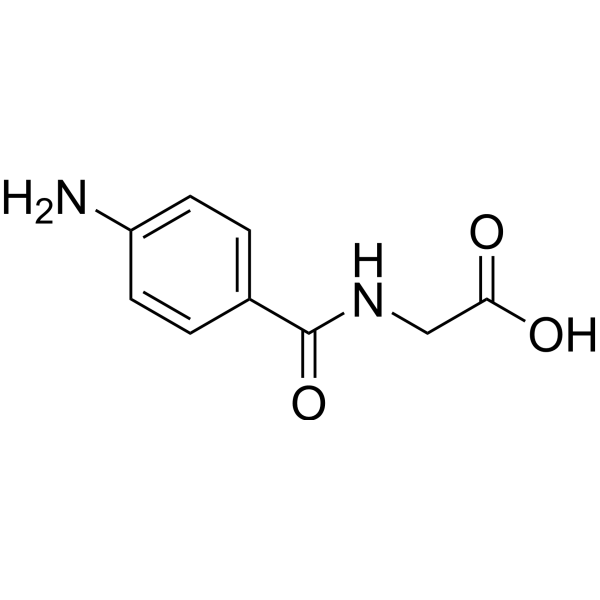
4-Aminohippuric acid (p-Aminohippuric acid) is a coordination ligand for metal ions (such as Cu2+, Fe3+, Hg2+) and a functionalization reagent for nanomaterials. 4-Aminohippuric acid can coordinate with metal ions or modify the surface of materials such as carbon nanotubes and gold nanoparticles through amino and carboxyl groups. 4-Aminohippuric acid can form stable complexes with metal ions or participate in the synthesis of nanomaterials as a reducing agent/stabilizer, enriching metal ions or giving nanoparticles peroxidase-mimicking activity. 4-Aminohippuric acid can be used to construct highly sensitive electrochemical sensors or colorimetric sensors to detect and quantitatively analyze heavy metal ions such as copper, iron, and mercury in environmental water samples and biological samples. 4-Aminohippuric acid may also be a biomarker for attention-deficit/hyperactivity disorder (ADHD).
For research use only. We do not sell to patients.
- Purity : 99.84%
- CAS No.: 61-78-9
- Formula: C9H10N2O3
- Molecular Weight:194.19
-
Storage:Powder -20°C, 3 years , 4°C, 2 years ; In solvent -80°C, 2 years , -20°C, 1 year

To place orders, for customer services and technical support, please contact: MedChemExpress USA
Tel: 609-228-6898 E-mail: [email protected] [email protected]


-
 Biological Activity
-
Chemical Information
-
Solvent & Solubility
- Purity & Documentation
- References
-
 Help & FAQs




Publications Citing Use of MedChemExpress (MCE) 4-Aminohippuric acid
More

Biological Activity
Description
Cellular Effect
|
Cell Line

|
Type | Value | Description | References |
|---|---|---|---|---|
| CHO | IC50 |
8.8 μM
Compound: P-aminohippuric acid
|
TP_TRANSPORTER: inhibition of 6-Carboxyfluorescein uptake in OAT1-expressing CHO cells
TP_TRANSPORTER: inhibition of 6-Carboxyfluorescein uptake in OAT1-expressing CHO cells
|
[PMID: 10929807] |
| S2 | IC50 |
127 μM
Compound: P-aminohippuric acid
|
TP_TRANSPORTER: inhibition of Urate uptake (Urate: 300 uM) in OAT1-expressing S2 cells
TP_TRANSPORTER: inhibition of Urate uptake (Urate: 300 uM) in OAT1-expressing S2 cells
|
[PMID: 12472777] |
In Vitro
1. Electrochemical sensor experiment:
4-Aminohippuric acid (10 mg/mL; 3 h) was covalently coupled to multi-walled carbon nanotubes (MWNTs) in the presence of 1-ethyl-3-(3-dimethylaminopropyl) carbodiimide (EDC) and N-hydroxysuccinimide (NHS). After modification of glassy carbon electrode, it was used for anodic stripping voltammetry to detect Cu2+ with a linear detection range of 1.0-230.0 μg/L and a detection limit as low as 0.4 μg/L[1].
2. Nanoparticle synthesis and colorimetric detection experiments:
4-Aminohippuric acid (0.5 mM; 1 h) was used as a reducing agent and stabilizer to synthesize gold nanoparticles (4-AHA@AuNPs) at pH 6.5-6.8 and 70°C. The nanoparticles have peroxidase mimetic activity and the linear detection ranges for Fe3+ and Hg2+ are 5-50 ppb and 5-200 ppb, respectively, with detection limits of 4.0 ppb and 2.5 ppb, respectively[2].
3. Plasma metabolism experiment:
4-Aminohippuric acid is differentially expressed in the plasma of attention-deficit/hyperactivity disorder (ADHD) models, and the level of 4-Aminohippuric acid is higher than that of the control group. The plasma concentration of 4-Aminohippuric acid can be used as a biomarker to identify ADHD and reflect the disease state, and its level is significantly correlated with the clinical symptoms of ADHD[3].
MedChemExpress (MCE) has not independently confirmed the accuracy of these methods. They are for reference only.


Chemical Information
-
CAS No. 61-78-9
-
Appearance Solid
-
Molecular Weight 194.19
-
Formula C9H10N2O3
-
Color Off-white to light brown
-
SMILES
O=C(O)CNC(C1=CC=C(N)C=C1)=O
-
Synonyms
p-Aminohippuric acid
-
Shipping
Room temperature in continental US; may vary elsewhere.
-
Storage
Powder -20°C 3 years 4°C 2 years In solvent -80°C 2 years -20°C 1 year


Publications (4)
-
Journal Impact Factor
-
Most Recent
-
Acta Pharmacol Sin
Species differences in the hepatobiliary disposition of morphine-6-glucuronide mediated by hepatic transporters in rats and humans. [Abstract]2025 Sep 15. PMID: 40954191 -
Acta Pharmacol Sin
Sulfation predominates the pharmacokinetics, metabolism, and excretion of forsythin in humans: major enzymes and transporters identified. [Abstract]2021 Feb;42(2):311-322. PMID: 32860005 -
ACS Omega
Identification of New Modulators and Inhibitors of Palmitoyl-Protein Thioesterase 1 for CLN1 Batten Disease and Cancer. [Abstract]2024 Feb 28;9(10):11870-11882. PMID: 38496939 -
Environ Sci Pollut Res Int
2018 Feb;25(4):3765-3774. PMID: 29168138


Solvent & Solubility
In Vitro:
DMSO : 50 mg/mL (257.48 mM; Need ultrasonic; Hygroscopic DMSO has a significant impact on the solubility of product, please use newly opened DMSO)
H2O : ≥ 1.7 mg/mL (8.75 mM)
* "≥" means soluble, but saturation unknown.
Please refer to the solubility information to select the appropriate solvent. Once prepared, please aliquot and store the solution to prevent product inactivation from repeated freeze-thaw cycles.
Storage method and period of stock solution: -80°C, 2 years; -20°C, 1 year. When stored at -80°C, please use it within 2 years. When stored at -20°C, please use it within 1 year.
* Note: If you choose water as the stock solution, please dilute it to the working solution, then filter and sterilize it with a 0.22 μm filter before use.
Please refer to the solubility information to select the appropriate solvent. Once prepared, please aliquot and store the solution to prevent product inactivation from repeated freeze-thaw cycles.
Storage method and period of stock solution: -80°C, 2 years; -20°C, 1 year. When stored at -80°C, please use it within 2 years. When stored at -20°C, please use it within 1 year.
* Note: If you choose water as the stock solution, please dilute it to the working solution, then filter and sterilize it with a 0.22 μm filter before use.
Concentration (start) × Volume (start) = Concentration (final) × Volume (final)
In Vivo:
Select the appropriate dissolution method based on your experimental animal and administration route.
- For the following dissolution methods, please ensure to first prepare a clear stock solution using an In Vitro approach and then sequentially add co-solvents:
- To ensure reliable experimental results, the clarified stock solution can be appropriately stored based on storage conditions. As for the working solution for In Vivo experiments, it is recommended to prepare freshly and use it on the same day.
- The percentages shown for the solvents indicate their volumetric ratio in the final prepared solution. If precipitation or phase separation occurs during preparation, heat and/or sonication can be used to aid dissolution.
Add each solvent one by one: 10% DMSO 40% PEG300 5% Tween-80 45% Saline
Solubility: ≥ 2.5 mg/mL (12.87 mM); Clear solution
This protocol yields a clear solution of ≥ 2.5 mg/mL (saturation unknown).
Taking 1 mL working solution as an example, add 100 μL DMSO stock solution (25.0 mg/mL) to 400 μL PEG300, and mix evenly; then add 50 μL Tween-80 and mix evenly; then add 450 μL Saline to adjust the volume to 1 mL.
Preparation of Saline: Dissolve 0.9 g sodium chloride in ddH₂O and dilute to 100 mL to obtain a clear Saline solution.
Add each solvent one by one: 10% DMSO 90% (20% SBE-β-CD in Saline)
Solubility: ≥ 2.5 mg/mL (12.87 mM); Clear solution
This protocol yields a clear solution of ≥ 2.5 mg/mL (saturation unknown).
Taking 1 mL working solution as an example, add 100 μL DMSO stock solution (25.0 mg/mL) to 900 μL 20% SBE-β-CD in Saline, and mix evenly.
Preparation of 20% SBE-β-CD in Saline (4°C, storage for one week): 2 g SBE-β-CD powder is dissolved in 10 mL Saline, completely dissolve until clear.
For the following dissolution methods, please prepare the working solution directly:
It is recommended to prepare fresh solutions and use them promptly within a short period of time.
The percentages shown for the solvents indicate their volumetric ratio in the final prepared solution. If precipitation or phase separation occurs during preparation, heat and/or sonication can be used to aid dissolution.
Add each solvent one by one: PBS
Solubility: 14.29 mg/mL (73.59 mM); Clear solution; Need ultrasonic and warming and heat to 60°C
In Vivo Dissolution Calculator
Please enter the basic information of animal experiments:
-
-
-
-
Recommended: Prepare an additional quantity of animals to account for potential losses during experiments.
Please enter your animal formula composition:
-
%DMSO +
Recommended: Keep the proportion of DMSO in working solution below 2% if your animal is weak.
-
%+
-
+%Tween-80 + +
-
%Saline +
The co-solvents required include: DMSO, . All of co-solvents are available by MedChemExpress (MCE). , Tween 80. All of co-solvents are available by MedChemExpress (MCE).
Working solution concentration: 0.22 mg/mL
Method for preparing stock solution: mg drug dissolved in μL DMSO. Stock solution concentration: mg/mL.
1. Take μL DMSO stock solution;
2. Add μL .
μL , mix evenly;
3. Then add μL Tween 80, mix evenly;
4. Then add μL
Please ensure that the stock solution in the first step is dissolved to a clear state, and add co-solvents in sequence. You can use ultrasonic heating (ultrasonic cleaner, recommended frequency 20-40 kHz), vortexing, etc. to assist dissolution.


Purity & Documentation
-
Data Sheet (288 KB)
-
SDS (393 KB)
- English - EN (393 KB)
- Français - FR (393 KB)
- Deutsch - DE (393 KB)
- Norwegian - NO (393 KB)
- Español - ES (393 KB)
- Swedish - SV (393 KB)
- Italian - IT (393 KB)
- Korean - KR (393 KB)
- Portuguese - PT (393 KB)
-
Handling Instructions (2659 KB)
References
[1]. Rastogi L, et al. Intrinsic peroxidase-like activity of 4-amino hippuric acid reduced/stabilized gold nanoparticles and its application in the selective determination of mercury and iron in ground water. Spectrochim Acta A Mol Biomol Spectrosc. 2020 Mar 5;228:117805. [Content Brief]
[3]. Wang LJ, et al. Novel plasma metabolite markers of attention-deficit/hyperactivity disorder identified using high-performance chemical isotope labelling-based liquid chromatography-mass spectrometry. World J Biol Psychiatry. 2021 Feb;22(2):139-148. [Content Brief]


Complete Stock Solution Preparation Table
Please refer to the solubility information to select the appropriate solvent. Once prepared, please aliquot and store the solution to prevent product inactivation from repeated freeze-thaw cycles.
Storage method and period of stock solution: -80°C, 2 years; -20°C, 1 year. When stored at -80°C, please use it within 2 years. When stored at -20°C, please use it within 1 year.
| Optional Solvent | Concentration Solvent Mass | 1 mg | 5 mg | 10 mg | 25 mg |
|---|---|---|---|---|---|
| H2O / DMSO | 1 mM | 5.1496 mL | 25.7480 mL | 51.4960 mL | 128.7399 mL |
| 5 mM | 1.0299 mL | 5.1496 mL | 10.2992 mL | 25.7480 mL | |
| DMSO | 10 mM | 0.5150 mL | 2.5748 mL | 5.1496 mL | 12.8740 mL |
| 15 mM | 0.3433 mL | 1.7165 mL | 3.4331 mL | 8.5827 mL | |
| 20 mM | 0.2575 mL | 1.2874 mL | 2.5748 mL | 6.4370 mL | |
| 25 mM | 0.2060 mL | 1.0299 mL | 2.0598 mL | 5.1496 mL | |
| 30 mM | 0.1717 mL | 0.8583 mL | 1.7165 mL | 4.2913 mL | |
| 40 mM | 0.1287 mL | 0.6437 mL | 1.2874 mL | 3.2185 mL | |
| 50 mM | 0.1030 mL | 0.5150 mL | 1.0299 mL | 2.5748 mL | |
| 60 mM | 0.0858 mL | 0.4291 mL | 0.8583 mL | 2.1457 mL | |
| 80 mM | 0.0644 mL | 0.3218 mL | 0.6437 mL | 1.6092 mL | |
| 100 mM | 0.0515 mL | 0.2575 mL | 0.5150 mL | 1.2874 mL |
* Note: If you choose water as the stock solution, please dilute it to the working solution, then filter and sterilize it with a 0.22 μm filter before use.


4-Aminohippuric acid Related Classifications
HY-B1306 Related Classifications
 Powered by Bioz