

11 Results for "

ecology

" in MedChemExpress (MCE) Product Catalog:
Products (11)

11 Results for "ecology" in MCE Product Catalog:

1
1 Cited Publications
Cat. No.: HY-W089845
CAS No.: 629-94-7
Heneicosane is a royal-specific pheromone of insects (such as subterranean termites) and is an identification signal for queens and kings in termites. Heneicosane mediates royal recognition and the maintenance of social division of labor by being sensed by worker ants and triggering vibrations and antennal behaviors. Heneicosane can exert anti-inflammatory, analgesic and antipyretic activities by inhibiting the release of inflammatory mediators (such as prostaglandins and cytokines). At the same time, Heneicosane can also inhibit the mycelial growth of aflatoxin-producing fungi and inhibit the production of aflatoxin. Heneicosane can be used in insect chemical ecology research to analyze the regulatory mechanism of termite social behavior, and is also a potential target for new anti-inflammatory drugs .
loading...
    loading...
Cat. No.: HY-W017141S
CAS No.: 588732-63-2
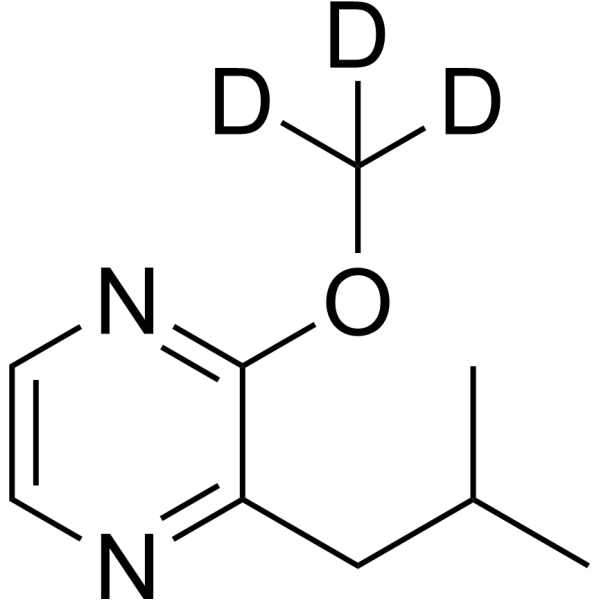
2-Isobutyl-3-methoxypyrazine-d3 is the deuterium labeled 2-Isobutyl-3-methoxypyrazine. 2-Isobutyl-3-methoxypyrazine is a male-specific aggregation pheromone released by the Portuguese leaf beetle Labidostomis lusitanica. 2-Isobutyl-3-methoxypyrazine induces dose-dependent electroantennographic responses in the antennae of both male and female Labidostomis lusitanica, with the overall response intensity of females being higher than that of males. 2-Isobutyl-3-methoxypyrazine induces positive chemotactic behavior, and exerts a repellent effect on male Labidostomis lusitanica at high doses. 2-Isobutyl-3-methoxypyrazine can be used in insect ecology research .
loading...
    loading...
Cat. No.: HY-W017141
CAS No.: 24683-00-9
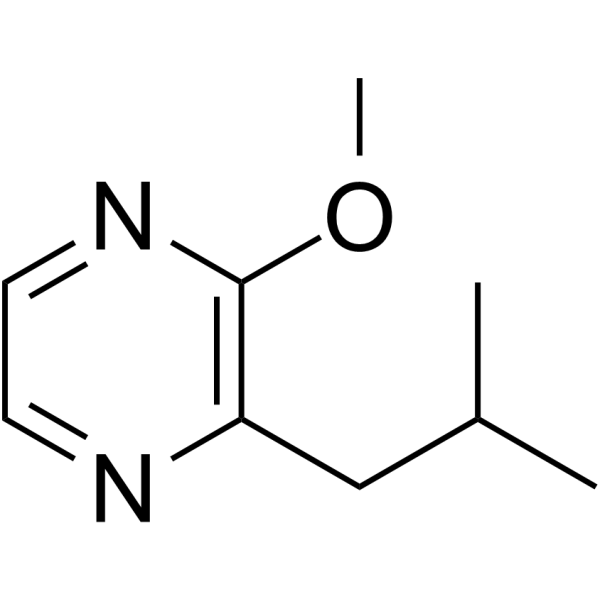
2-Isobutyl-3-methoxypyrazine is a male-specific aggregation pheromone released by the Portuguese leaf beetle Labidostomis lusitanica. 2-Isobutyl-3-methoxypyrazine induces dose-dependent electroantennographic responses in the antennae of both male and female Labidostomis lusitanica, with the overall response intensity of females being higher than that of males. 2-Isobutyl-3-methoxypyrazine induces positive chemotactic behavior, and exerts a repellent effect on male Labidostomis lusitanica at high doses. 2-Isobutyl-3-methoxypyrazine can be used in insect ecology research .
loading...
    loading...
Cat. No.: HY-W979008
CAS No.: 24041-60-9
Research Areas:  

Others

(+)-Isopinocampheol is an oxygenated monoterpenoid that is important in the chemical ecology of bark beetles .
loading...
    loading...
Cat. No.: HY-N7234
CAS No.: 114066-51-2
Target:  

Others

Research Areas:  

Others

Sarasinoside C1 is a 30-norlanostane saponin isolated from the sea sponge Melophlus sarasinorum collected from Kimbe Bay, Papua New Guinea. Sarasinoside C1 has potential roles in marine ecology and pharmacological applications .
loading...
    loading...
Cat. No.: HY-W089845R
CAS No.: 629-94-7
Heneicosane (Standard) is the analytical standard of Heneicosane (HY-W089845). This product is intended for research and analytical applications. Heneicosane is a royal-specific pheromone of insects (such as subterranean termites) and is an identification signal for queens and kings in termites. Heneicosane mediates royal recognition and the maintenance of social division of labor by being sensed by worker ants and triggering vibrations and antennal behaviors. Heneicosane can exert anti-inflammatory, analgesic and antipyretic activities by inhibiting the release of inflammatory mediators (such as prostaglandins and cytokines). At the same time, Heneicosane can also inhibit the mycelial growth of aflatoxin-producing fungi and inhibit the production of aflatoxin. Heneicosane can be used in insect chemical ecology research to analyze the regulatory mechanism of termite social behavior, and is also a potential target for new anti-inflammatory drugs .
loading...
    loading...
Cat. No.: HY-W089845S
CAS No.: 39756-37-1
Heneicosane-d44 is the deuterium labeled Heneicosane (HY-W089845). Heneicosane is a royal-specific pheromone of insects (such as subterranean termites) and is an identification signal for queens and kings in termites. Heneicosane mediates royal recognition and the maintenance of social division of labor by being sensed by worker ants and triggering vibrations and antennal behaviors. Heneicosane can exert anti-inflammatory, analgesic and antipyretic activities by inhibiting the release of inflammatory mediators (such as prostaglandins and cytokines). At the same time, Heneicosane can also inhibit the mycelial growth of aflatoxin-producing fungi and inhibit the production of aflatoxin. Heneicosane can be used in insect chemical ecology research to analyze the regulatory mechanism of termite social behavior, and is also a potential target for new anti-inflammatory drugs .
loading...
    loading...
Cat. No.: HY-W017141R
CAS No.: 24683-00-9
2-Isobutyl-3-methoxypyrazine (Standard) is the analytical standard of 2-Isobutyl-3-methoxypyrazine. This product is intended for research and analytical applications. 2-Isobutyl-3-methoxypyrazine is a male-specific aggregation pheromone released by the Portuguese leaf beetle Labidostomis lusitanica. 2-Isobutyl-3-methoxypyrazine induces dose-dependent electroantennographic responses in the antennae of both male and female Labidostomis lusitanica, with the overall response intensity of females being higher than that of males. 2-Isobutyl-3-methoxypyrazine induces positive chemotactic behavior, and exerts a repellent effect on male Labidostomis lusitanica at high doses. 2-Isobutyl-3-methoxypyrazine can be used in insect ecology research .
loading...
    loading...
Cat. No.: HY-W017141S1
CAS No.: 3028868-76-7
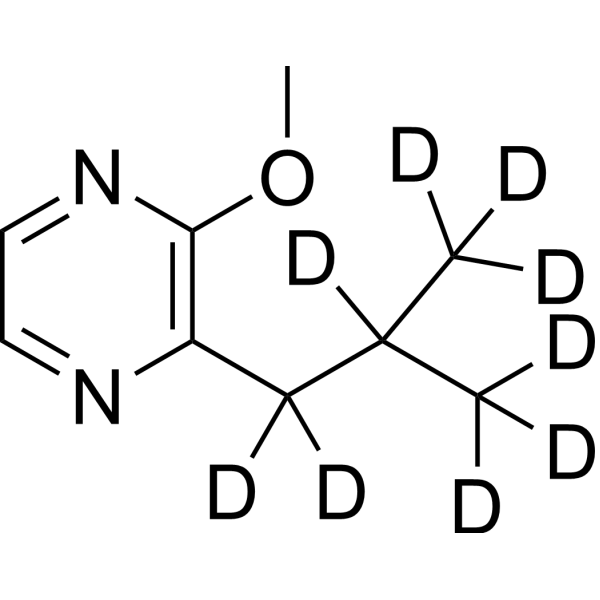
2-Isobutyl-3-methoxypyrazine-d9 is deuterated labeled 2-Isobutyl-3-methoxypyrazine (HY-W017141). 2-Isobutyl-3-methoxypyrazine is a male-specific aggregation pheromone released by the Portuguese leaf beetle Labidostomis lusitanica. 2-Isobutyl-3-methoxypyrazine induces dose-dependent electroantennographic responses in the antennae of both male and female Labidostomis lusitanica, with the overall response intensity of females being higher than that of males. 2-Isobutyl-3-methoxypyrazine induces positive chemotactic behavior, and exerts a repellent effect on male Labidostomis lusitanica at high doses. 2-Isobutyl-3-methoxypyrazine can be used in insect ecology research .
loading...
    loading...
Cat. No.: HY-180505
CAS No.: 171902-06-0
Target:  

Endogenous Metabolite

Research Areas:  

Endocrinology

(3E,5E,7E,9E)-5.7-Diethyl-9-methyl-3,5.7,9-tetracontatriene (Compound 9) is an insect pheromone (male C. dimidiatus) .
loading...
    loading...
Cat. No.: HY-W741097
CAS No.: 58594-45-9
Research Areas:  

Infection

(Z)-13-Octadecenal is a component of attractants. When used in combination with (Z)-11-octadecenal, (Z)-11-octadecen-1-ol, (Z)-13-octadecen-1-ol, and a mixture of Scirpophaga incertulas, (Z)-13-Octadecenal can trap insects .
loading...
    loading...
  • 1

