1. Search Result
Search Result
Results for "

glass

" in MedChemExpress (MCE) Product Catalog:

45

Inhibitors & Agonists

2

Fluorescent Dyes

35

Biochemical Assay Reagents

2

Peptides

2

Natural
Products

Cat. No. Product Name Target Research Areas Chemical Structure
  • HY-W040203

    Biochemical Assay Reagents Others
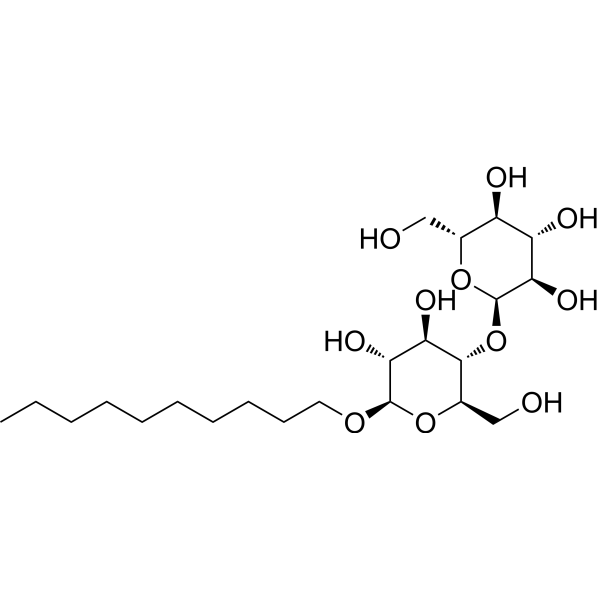
    Decyl β-D-maltopyranoside is an epithelial permeability enhancer. Decyl β-D-maltopyranoside regulates the paracellular transport pathway and increases the permeability of molecules and proteins transported via the paracellular route. Decyl β-D-maltopyranoside enhances the transepithelial paracellular permeability of EPO across cell monolayers .
    Decyl β-D-maltopyranoside
  • HY-W392100A

    PCL-diol (MW 530)

    Biochemical Assay Reagents Fungal Infection
    Polycaprolactone diol (MW 530) (PCL-diol (MW 530)) is a poly (ε-caprolactone) diol with an average molecular weight of 530 g·mol −1, which serves as a monomer for biodegradable network elastic polyesters. Network polyester films undergo enzymatic hydrolysis by Rhizopus delemar lipase .
    Polycaprolactone diol (MW 530)
  • HY-NP161

    MAP

    Biochemical Assay Reagents Others
    Mussel Adhesive Protein (MAP) is a mussel-derived mucin. Mussel Adhesive Protein can be formulated into a waterproof, eco-safe adhesive that bonds materials such as glass, plastic, metal and wood to bones or teeth, biological organisms, and other chemicals or molecules .
    Mussel Adhesive Protein
  • HY-W250126

    Poly(ethylene-co-vinyl acetate)

    Environmental Pollutants Biochemical Assay Reagents Others
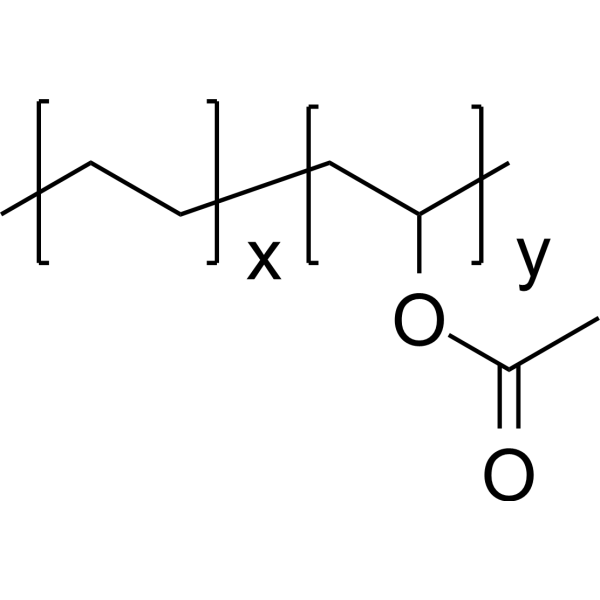
    Ethylene-vinyl acetate copolymer (Poly(ethylene-co-vinyl acetate)) is an encapsulant. Ethylene-vinyl acetate copolymer is cross-linked by a thermally activated reaction with peroxides. Ethylene-vinyl acetate copolymer can be used for encapsulation of photovoltaic modules .
    Ethylene-vinyl acetate copolymer
  • HY-W1123939C

    Biochemical Assay Reagents Others
    Silane-PEG5000-COOH can be used to modify proteins, peptides and other materials with active groups. The carboxyl group (-COOH) can easily form a stable amide bond with the amino group, and can also form an ester bond with the hydroxyl group. Silane-functionalized PEG (Silane-PEG-X) can be used to modify glass, silicon, etc .
    Silane-PEG5000-COOH
  • HY-136436A

    Drug Metabolite Parasite Infection Inflammation/Immunology
    Ternidazole is a nitroimidazole Antibiotic with anti-pathogenic microbial activity. Ternidazole kills and inhibits the visible growth of Clostridium perfringens type A in vitro. Ternidazole helps improve the therapeutic efficacy against bacterial vaginosis, candidal vaginitis and mixed vaginitis. Ternidazole effectively alleviates chronic alcoholism. Ternidazole can be used in research related to vaginitis, pathogenic microbial infections and chronic alcoholism .
    Ternidazole
  • HY-174955B

    Biochemical Assay Reagents Others
    mPEG5000-Silane is a PEG derivative containing silane that can be used to modify glass, silicon or other surfaces by reacting the hydroxyl groups with ethoxy (methoxy) silane .
    mPEG5000-Silane
  • HY-174955A

    Biochemical Assay Reagents Others
    mPEG2000-Silane is a PEG derivative containing silane that can be used to modify glass, silicon or other surfaces by reacting the hydroxyl groups with ethoxy (methoxy) silane .
    mPEG2000-Silane
  • HY-W888515

    Biochemical Assay Reagents Others
    mPEG-PCL is a biodegradable, biocompatible, and semi-crystalline copolymer having a very low glass transition temperature. mPEG-PCL can be used as synthetic material for biomedical and drug delivery .
    mPEG-PCL
  • HY-125830

    Biochemical Assay Reagents Others
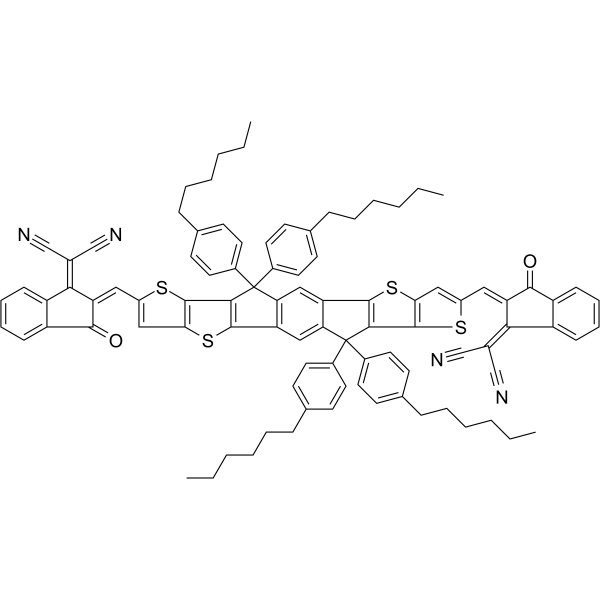
    ITIC, non-fullerene acceptor, is an indacenodithienothiophene-based postfullerene electron acceptor, crystallizes in a profoundly different way as compared to fullerenes. ITIC has a superior thermal stability and undergoes a glass-crystal transition considerably below its high Tg of 180 °C.
    ITIC
  • HY-D1545

    Acid Violet 9

    Fluorescent Dye Others
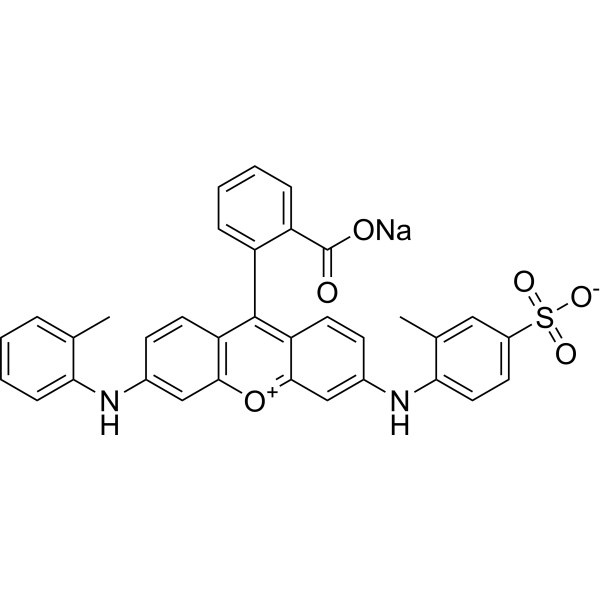
    Violamine R (Acid Violet 9) is a potent fluorophore. Violamine R shows environment and temperature-dependent photoluminescence (PL) intermittency in poly(vinyl alcohol) (PVOH) and potassium acid phthalate (KAP). Violamine R can be used to measure the temperatures spanning the glass-transition temperature (Tg) of the polymer host by the fluorescence intermittency or blinking in poly(vinyl alcohol) (PVA) .
    Violamine R
  • HY-W034392

    Biochemical Assay Reagents Endogenous Metabolite Others
    Stewart-Grubbs catalyst is an effective catalyst for the cross-metathesis of olefins with a large number of allylic substituents. In addition, ChemBeads are chemically coated glass beads that improve flowability and chemical homogeneity, making them ideal for automated solid dispensing and high-throughput experiments. Notably, the manufacture of ChemBeads does not require additional chemicals or surfactants, allowing for precise dispensing of sub-milligram amounts of catalyst.
    Stewart-Grubbs catalyst
  • HY-174970D

    Silane-PEG3400-azide

    Biochemical Assay Reagents Others
    Silane-PEG3400-N3 (Silane-PEG3400-azide) is a PEG derivative composed of silane, PEG units, and azide groups, which can be used to modify glass, silicon, or other surfaces by reacting hydroxyl groups with ethoxy (methoxy) silanes. Silane-PEG3400-N3 contains an azide group and can undergo copper-catalyzed azide-alkyne cycloaddition (CuAAc) with molecules containing alkyne groups. It can also undergo ring strain-driven alkyne-azide cycloaddition (SPAAC) with molecules containing DBCO or BCN groups .
    Silane-PEG3400-N3
  • HY-173249

    Biochemical Assay Reagents Others
    Poly-L-lysine, succinylated (MW >50000) is a cationic polymer that can be used to fix cells on glass substrates or negatively charged substrates, and succinylation modification can be used for subsequent coupling.
    Poly-L-lysine,succinylated (MW >50000)
  • HY-174955

    Biochemical Assay Reagents Others
    mPEG1000-Silane is a PEG derivative containing silane that can be used to modify glass, silicon or other surfaces by reacting the hydroxyl groups with ethoxy (methoxy) silane .
    mPEG1000-Silane
  • HY-174971C

    Biochemical Assay Reagents Others
    4-Arm-PEG20000-Silane is a silane-modified PEG derivative that can be used to modify glass, silicon or other surfaces by reacting hydroxyl groups with ethoxy (methoxy) silane. PEG can inhibit nonspecific surface binding .
    4-Arm-PEG20000-Silane
  • HY-174958B

    Biochemical Assay Reagents Others
    6-Arm-PEG1000-Silane is a silane-modified PEG derivative that can be used to modify glass, silicon or other surfaces by reacting hydroxyl groups with ethoxy (methoxy) silane. PEG can inhibit nonspecific surface binding .
    6-Arm-PEG1000-Silane
  • HY-174958A

    Biochemical Assay Reagents Others
    6-Arm-PEG600-Silane is a silane-modified PEG derivative that can be used to modify glass, silicon or other surfaces by reacting hydroxyl groups with ethoxy (methoxy) silane. PEG can inhibit nonspecific surface binding .
    6-Arm-PEG600-Silane
  • HY-173241

    Fluorescent Dye Others
    Poly-L-lysine-Ahx-FITC (MW 15000-30000) is a cationic polymer, which is a polylysine modified with FITC (HY-66019). Poly-L-lysine-Ahx-FITC (MW 15000-30000) is used to fix cells on glass substrates or negatively charged substrates for subsequent labeling and localization experiments.
    Poly-L-lysine-Ahx-FITC (MW 15000-30000)
  • HY-173241A

    Fluorescent Dye Others
    Poly-L-lysine-Ahx-FITC (MW 30000-70000) is a cationic polymer, which is a polylysine modified with FITC (HY-66019). Poly-L-lysine-Ahx-FITC (MW 30000-70000) is used to fix cells on glass substrates or negatively charged substrates for subsequent labeling and localization experiments.
    Poly-L-lysine-Ahx-FITC (MW 30000-70000)
  • HY-W1123939

    Biochemical Assay Reagents Others
    Silane-PEG-COOH (MW 1000) can be used to modify proteins, peptides and other materials with active groups. The carboxyl group (-COOH) can easily form a stable amide bond with the amino group, and can also form an ester bond with the hydroxyl group. Silane-functionalized PEG (Silane-PEG-X) can be used to modify glass, silicon, etc .
    Silane-PEG-COOH (MW 1000)
  • HY-174969

    Biochemical Assay Reagents Others
    Alkyne-PEG1000-Silane is a PEG derivative composed of silane, PEG, and alkynyl groups. Alkyne-PEG1000-Silane is a click chemistry reagent. It contains an Alkyne group, which can undergo copper-catalyzed azide-alkyne cycloaddition reaction (CuAAc) with molecules containing an Azide group. The Silane group enables Alkyne-PEG1000-Silane to modify surfaces such as glass and silicon .
    Alkyne-PEG1000-Silane
  • HY-174970C

    Silane-PEG2000-azide

    Biochemical Assay Reagents Others
    Silane-PEG2000-N3 (Silane-PEG2000-azide) is a PEG derivative composed of silane, PEG units, and azide groups, which can be used to modify glass, silicon, or other surfaces by reacting hydroxyl groups with ethoxy (methoxy) silanes. Silane-PEG2000-N3 contains an azide group and can undergo copper-catalyzed azide-alkyne cycloaddition (CuAAc) with molecules containing alkyne groups. It can also undergo ring strain-driven alkyne-azide cycloaddition (SPAAC) with molecules containing DBCO or BCN groups .
    Silane-PEG2000-N3
  • HY-174970H

    Silane-PEG10000-azide

    Biochemical Assay Reagents Others
    Silane-PEG10000-N3 (Silane-PEG10000-azide) is a PEG derivative composed of silane, PEG units, and azide groups, which can be used to modify glass, silicon, or other surfaces by reacting hydroxyl groups with ethoxy (methoxy) silanes. Silane-PEG10000-N3 contains an azide group and can undergo copper-catalyzed azide-alkyne cycloaddition (CuAAc) with molecules containing alkyne groups. It can also undergo ring strain-driven alkyne-azide cycloaddition (SPAAC) with molecules containing DBCO or BCN groups .
    Silane-PEG10000-N3
  • HY-174970B

    Silane-PEG1000-azide

    Biochemical Assay Reagents Others
    Silane-PEG1000-N3 (Silane-PEG1000-azide) is a PEG derivative composed of silane, PEG units, and azide groups, which can be used to modify glass, silicon, or other surfaces by reacting hydroxyl groups with ethoxy (methoxy) silanes. Silane-PEG1000-N3 contains an azide group and can undergo copper-catalyzed azide-alkyne cycloaddition (CuAAc) with molecules containing alkyne groups. It can also undergo ring strain-driven alkyne-azide cycloaddition (SPAAC) with molecules containing DBCO or BCN groups .
    Silane-PEG1000-N3
  • HY-W010736A

    Biochemical Assay Reagents Others
    1,2-Dipalmitoyl-rac-glycerol is a diacylglycerol containing palmitic acid at the sn-1 and sn-2 positions (Cat. No. 10006627). It is found in a variety of vegetable oils, including palm, soybean, canola, and corn. 1 \n 1,2-Dipalmitoyl-rac-glycerol MaxSpec Standard is a quantitative grade standard of 1,2-dipalmitoyl-rac-glycerol prepared for mass spectrometry and related applications requiring quantitative reproducibility . The solution has been prepared gravimetrically and contained in argon-sealed deactivated glass ampoules. Concentrations were verified by comparison to independently prepared calibration standards. This 1,2-dipalmitoyl-rac-glycerol MaxSpec Standard is guaranteed to meet specifications for identity, purity, stability, and concentration and is supplied with a batch-specific Certificate of Analysis. Ongoing stability testing is performed to ensure concentrations remain accurate throughout the shelf life of the product. Note: Add more solution to the vial than listed. Therefore, accurate volume measurements are necessary to prepare calibration standards. Follow recommended storage and handling conditions to maintain product quality.
    1,2-Dipalmitoyl-rac-glycerol
  • HY-174971A

    Biochemical Assay Reagents Others
    4-Arm-PEG5000-Silane is a silane-modified PEG derivative that can be used to modify glass, silicon or other surfaces by reacting hydroxyl groups with ethoxy (methoxy) silane. PEG can inhibit nonspecific surface binding .
    4-Arm-PEG5000-Silane
  • HY-174971

    Biochemical Assay Reagents Others
    4-Arm-PEG2000-Silane is a silane-modified PEG derivative that can be used to modify glass, silicon or other surfaces by reacting hydroxyl groups with ethoxy (methoxy) silane. PEG can inhibit nonspecific surface binding .
    4-Arm-PEG2000-Silane
  • HY-174958E

    Biochemical Assay Reagents Others
    6-Arm-PEG5000-Silane is a silane-modified PEG derivative that can be used to modify glass, silicon or other surfaces by reacting hydroxyl groups with ethoxy (methoxy) silane. PEG can inhibit nonspecific surface binding .
    6-Arm-PEG5000-Silane
  • HY-174958

    Biochemical Assay Reagents Others
    6-Arm-PEG400-Silane is a silane-modified PEG derivative that can be used to modify glass, silicon or other surfaces by reacting hydroxyl groups with ethoxy (methoxy) silane. PEG can inhibit nonspecific surface binding .
    6-Arm-PEG400-Silane
  • HY-174971B

    Biochemical Assay Reagents Others
    4-Arm-PEG10000-Silane is a silane-modified PEG derivative that can be used to modify glass, silicon or other surfaces by reacting hydroxyl groups with ethoxy (methoxy) silane. PEG can inhibit nonspecific surface binding .
    4-Arm-PEG10000-Silane
  • HY-174958C

    Biochemical Assay Reagents Others
    6-Arm-PEG2000-Silane is a silane-modified PEG derivative that can be used to modify glass, silicon or other surfaces by reacting hydroxyl groups with ethoxy (methoxy) silane. PEG can inhibit nonspecific surface binding .
    6-Arm-PEG2000-Silane
  • HY-174958D

    Biochemical Assay Reagents Others
    6-Arm-PEG3400-Silane is a silane-modified PEG derivative that can be used to modify glass, silicon or other surfaces by reacting hydroxyl groups with ethoxy (methoxy) silane. PEG can inhibit nonspecific surface binding .
    6-Arm-PEG3400-Silane
  • HY-174958H

    Biochemical Assay Reagents Others
    6-Arm-PEG10000-Silane is a silane-modified PEG derivative that can be used to modify glass, silicon or other surfaces by reacting hydroxyl groups with ethoxy (methoxy) silane. PEG can inhibit nonspecific surface binding .
    6-Arm-PEG10000-Silane
  • HY-P11867

    Wnt β-catenin Others
    UM206_L is a linear Wnt fragment peptide derived from conserved Wnt3a/Wnt5a sequences, inactive in soluble form but capable of activating canonical Wnt/β-catenin signaling when conjugated to magnetic nanoparticles and exposed to a high-gradient, time-varying magnetic field or immobilized on glass surfaces .
    UM206_L
  • HY-W1123939B

    Biochemical Assay Reagents Others
    Silane-PEG3400-COOH can be used to modify proteins, peptides and other materials with active groups. The carboxyl group (-COOH) can easily form a stable amide bond with the amino group, and can also form an ester bond with the hydroxyl group. Silane-functionalized PEG (Silane-PEG-X) can be used to modify glass, silicon, etc .
    Silane-PEG3400-COOH
  • HY-P11867A

    Wnt β-catenin Others
    UM206_C is a circular Wnt fragment peptide derived from conserved Wnt3a/Wnt5a sequences, inactive in soluble form but capable of activating canonical Wnt/β-catenin signaling when conjugated to magnetic nanoparticles and exposed to a high-gradient, time-varying magnetic field or immobilized on glass surfaces .
    UM206_C
  • HY-174969C

    Biochemical Assay Reagents Others
    Alkyne-PEG5000-Silane is a PEG derivative composed of silane, PEG, and alkynyl groups. Alkyne-PEG5000-Silane is a click chemistry reagent. It contains an Alkyne group, which can undergo copper-catalyzed azide-alkyne cycloaddition reaction (CuAAc) with molecules containing an Azide group. The Silane group enables Alkyne-PEG5000-Silane to modify surfaces such as glass and silicon .
    Alkyne-PEG5000-Silane
  • HY-174969A

    Biochemical Assay Reagents Others
    Alkyne-PEG2000-Silane is a PEG derivative composed of silane, PEG, and alkynyl groups. Alkyne-PEG2000-Silane is a click chemistry reagent. It contains an Alkyne group, which can undergo copper-catalyzed azide-alkyne cycloaddition reaction (CuAAc) with molecules containing an Azide group. The Silane group enables Alkyne-PEG2000-Silane to modify surfaces such as glass and silicon .
    Alkyne-PEG2000-Silane
  • HY-174969B

    Biochemical Assay Reagents Others
    Alkyne-PEG3400-Silane is a PEG derivative composed of silane, PEG, and alkynyl groups. Alkyne-PEG3400-Silane is a click chemistry reagent. It contains an Alkyne group, which can undergo copper-catalyzed azide-alkyne cycloaddition reaction (CuAAc) with molecules containing an Azide group. The Silane group enables Alkyne-PEG3400-Silane to modify surfaces such as glass and silicon .
    Alkyne-PEG3400-Silane
  • HY-W010790

    Bacterial Fungal Infection
    Dimethyloctadecyl[3-(trimethoxysilyl) propyl]ammonium chloride is a quaternary ammonium silane monomer-based disinfectant/antimicrobial agent. Dimethyloctadecylammonium chloride exhibits bactericidal activity against Gram-positive and Gram-negative bacteria, as well as fungicidal activity against Candida albicans in solution; it can form a hydrophobic glass coating that displays bactericidal activity against Gram-positive and Gram-negative bacteria but has limited fungicidal activity against Candida albicans .
    Dimethyloctadecyl[3-(trimethoxysilyl)propyl]ammonium chloride
  • HY-174970E

    Silane-PEG5000-azide

    Biochemical Assay Reagents Others
    Silane-PEG5000-N3 (Silane-PEG5000-azide) is a PEG derivative composed of silane, PEG units, and azide groups, which can be used to modify glass, silicon, or other surfaces by reacting hydroxyl groups with ethoxy (methoxy) silanes. Silane-PEG5000-N3 contains an azide group and can undergo copper-catalyzed azide-alkyne cycloaddition (CuAAc) with molecules containing alkyne groups. It can also undergo ring strain-driven alkyne-azide cycloaddition (SPAAC) with molecules containing DBCO or BCN groups .
    Silane-PEG5000-N3
  • HY-N11732

    Drug Derivative Inflammation/Immunology
    O-Demethylrotenone is a rotenone (HY-B1756) derivative and a photodegradation product of rotenone that induces acute intraperitoneal toxicity. The acute intraperitoneal LD50 of O-Demethylrotenone in Mus musculus is 8.0 mg/kg .
    O-Demethylrotenone
  • HY-D3252

    Fluorescent Dye Others
    IR 650 maleimide is a near-infrared fluorescent dye. It should be noted that IR 650 maleimide‘s fluorescence stability is poor, with less than 16% of the fluorescence signal retained after the expansion microscopy experimental procedure .
    IR 650 maleimide
  • HY-W736861

    iGluR Neurological Disease
    N-Phthaloylglutamic acid is a partial agonist NMDA receptor with a Ki of 13 μM targeting Glu binding-site .
    N-Phthaloylglutamic acid

Inquiry Online

Your information is safe with us. * Required Fields.

Salutation


Country or Region *

Applicant Name *


Organization Name *

Department *


Email Address *


Product Name *

Cat. No.


Requested quantity *

Phone Number *


Remarks

Inquiry Online

Inquiry Information

Product Name:
Cat. No.:
Quantity:
MCE Japan Authorized Agent:

