
9 Results for "

graphene oxide

" in MedChemExpress (MCE) Product Catalog:
Products (9)

9 Results for "graphene oxide" in MCE Product Catalog:

1
1 Cited Publications
Cat. No.: HY-W013151
CAS No.: 114932-60-4
Research Areas:  

Others

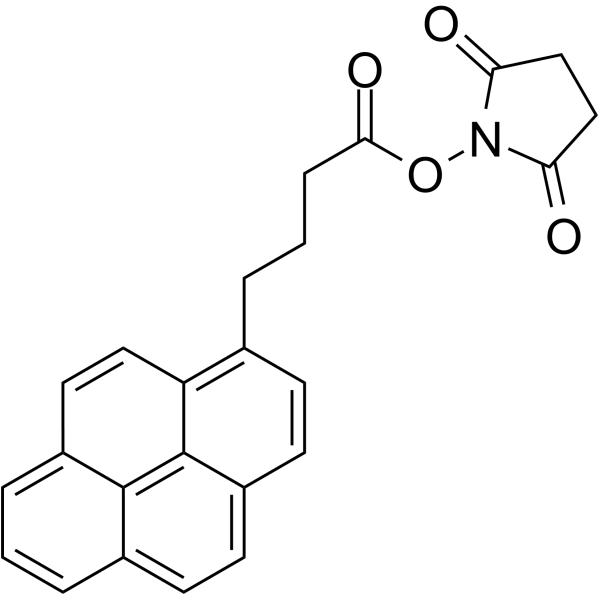
1-Pyrenebutyric acid N-hydroxysuccinimide ester (PANHS) is a linker and interface coupling agent that can be used to prepare electrochemical biosensors. 1-Pyrenebutyric acid N-hydroxysuccinimide ester immobilizes SARS-CoV-2 spike antibodies on graphene sheets. 1-Pyrenebutyric acid N-hydroxysuccinimide ester is often used as an activation reagent for carboxylic acids in organic chemistry or biochemistry .
loading...
    loading...
Cat. No.: HY-W115786
CAS No.: 1332-58-7
Kaolin is a family of kaolinitic clays, which is found in the earth's crust. Kaolin alleviates the toxicity of graphene oxide for mammalian cells. Kaolin can be utilized in industrial, cosmetic and medical fields, excipient .
loading...
    loading...
Cat. No.: HY-W015695
CAS No.: 137-00-8
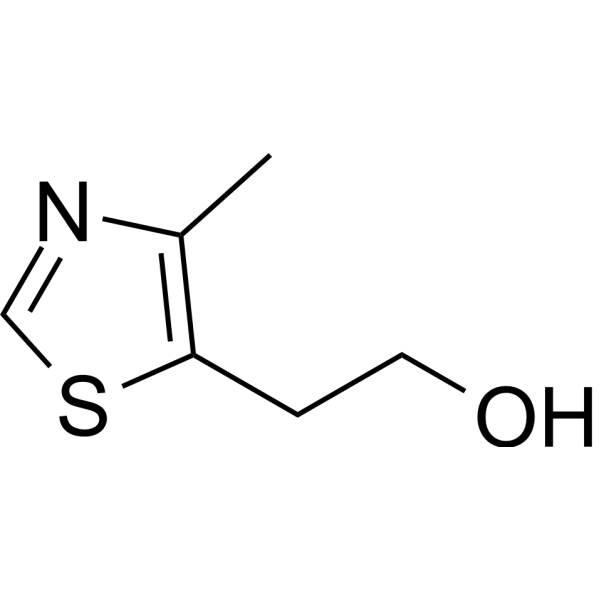
4-Methyl-5-thiazoleethanol is a natural sulfur-containing flavor compound with the aroma of beef and nuts. In addition, the composite material prepared by modifying graphene oxide with 4-Methyl-5-thiazoleethanol through a one-step esterification reaction can selectively adsorb copper ions (Cu 2+) in aqueous solutions .
loading...
    loading...
Cat. No.: HY-W009641
CAS No.: 24463-15-8
Synonyms: PyM; 1-HMP
Research Areas:  

Others

1-Pyrenemethanol is an organic compound that can be used to prepare graphene films with excellent thermal conductivity, flexibility and mechanical properties. 1-Pyrenemethanol binds to graphene oxide sheets through hydrogen bonds and π-π interactions to form GO-PyM films, increasing the dispersion and stability of the material .
loading...
    loading...
Cat. No.: HY-W243303C
CAS No.: 9003-01-4
Poly (acrylic acid) (MW 4000000) is an anionic polyacrylic acid. Poly (acrylic acid) (MW 4000000) acts as a corrosion inhibitor and surface stabilizer. Poly (acrylic acid) (MW 4000000) serves as a biomaterial or organic compound for life science research .
loading...
    loading...
Cat. No.: HY-W009169
CAS No.: 2421-28-5
Synonyms: BTDA
Target:  

Drug Intermediate

Research Areas:  

Others

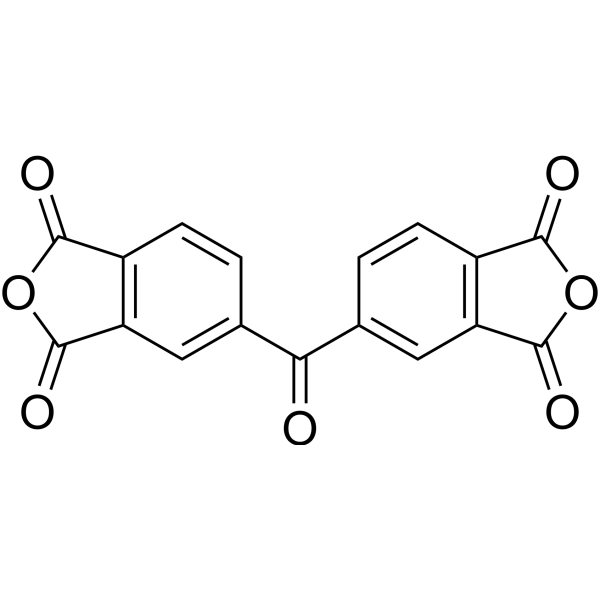
Benzophenonetetracarboxylic dianhydride is widely used in the synthesis of high-performance polyimides and other polymer materials. Benzophenonetetracarboxylic dianhydride reacts with various diamine compounds to form oligoimide chains. These oligimide chains can modify graphene oxide (Go) and enhance its properties .
loading...
    loading...
Cat. No.: HY-W739372
CAS No.: 25704-18-1
Research Areas:  

Others

Poly (sodium 4-styrenesulfonate) is an anionic cation-exchange polyelectrolyte and metal ion binding/retention agent. It selectively retains Cr III and Fe II under pH 1 conditions, and its retention effect on all tested metal ions is enhanced under higher pH conditions. Poly (sodium 4-styrenesulfonate) inhibits nanosheet aggregation through edge-face interactions between aromatic rings and the graphite surface, thereby stabilizing the dispersion of reduced graphene oxide nanosheets. When incorporated into the mixed Nafion coating of bismuth film electrodes, Poly (sodium 4-styrenesulfonate) improves the reproducibility, stability, sensitivity, and anti-fouling capability for trace metal detection .
loading...
    loading...
Cat. No.: HY-119516
CAS No.: 1491-41-4
Research Areas:  

Others

Naftalofos is a phosphate compound that can be used to prepare glassy carbon electrodes modified with modified reduced graphene oxide/chitosan composites. Naftalofos sensors can be used in the detection of food and environmental samples .
loading...
    loading...
Cat. No.: HY-W749394
CAS No.: 2707945-47-7
4-Methyl-5-thiazoleethanol- 13C3 is the 13C-labeled 4-Methyl-5-thiazoleethanol (HY-W015695). 4-Methyl-5-thiazoleethanol is a natural sulfur-containing flavor compound with the aroma of beef and nuts. In addition, the composite material prepared by modifying graphene oxide with 4-Methyl-5-thiazoleethanol through a one-step esterification reaction can selectively adsorb copper ions (Cu2+) in aqueous solutions .
loading...
    loading...

