11 Results for "

hydrophobic modification

" in MedChemExpress (MCE) Product Catalog:
Products (11)

11 Results for "hydrophobic modification" in MCE Product Catalog:

Cat. No.: HY-Y1353
CAS No.: 24424-99-5
Research Areas:  

Others Metabolic Disease

Di-tert-butyl dicarbonate (tBOC) is a covalent modification agent for hydroxyl groups (-OH) on the chitosan molecular chain. Di-tert-butyl dicarbonate selectively modifies chitosan and stabilizes the material structure through hydrophobic encapsulation. Di-tert-butyl dicarbonate reacts with the -OH groups of chitosan to form a hydrophobic layer, and in conjunction with triethylamine (TEA), removes trifluoroacetic acid (TFA) salts produced during the electrospinning process, preserving the nanofiber structure and high porosity of the membrane, and improving the material's cytocompatibility and mineralization-promoting ability. Di-tert-butyl dicarbonate can be used in research in the field of guided bone regeneration (GBR) .
loading...
    loading...
Cat. No.: HY-N4031
CAS No.: 82375-29-9
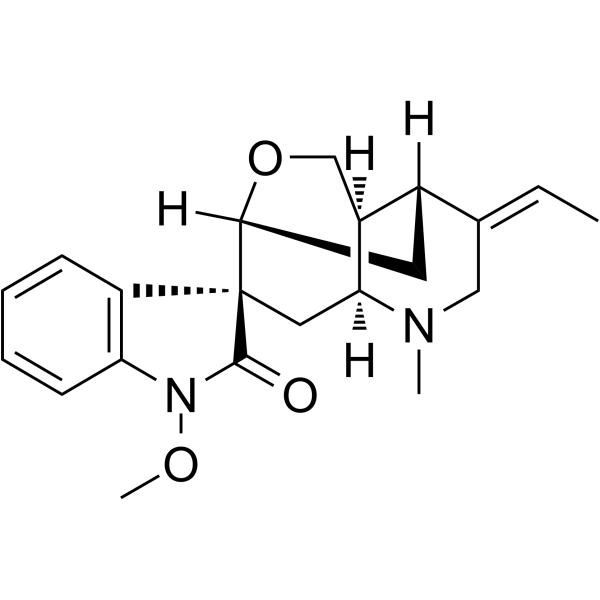
Humantenine is a highly toxic indole alkaloid from Gelsemium elegans (Gardn. & Champ.) Benth. that binds to RNA m6A modification regulatory proteins (ALKBH5, METTL). Humantenine stably binds via hydrogen bonding and hydrophobic interactions and disrupts the m6A methylation level of target genes, thereby impairing the expression of intestinal epithelial cell tight junction and cytoskeleton-related genes, causing intestinal barrier dysfunction and significant intestinal cytotoxicity. The intraperitoneal injection LD50 values of Humantenine are <1 mg/kg in mice, 1.2 mg/kg in male rats and 1.5 mg/kg in female rats, respectively. Species differences exist in the metabolism of Humantenine in human, porcine, goat and rat liver microsomes, and demethylation, dehydrogenation and oxidation occur in liver microsomes .
loading...
    loading...
Cat. No.: HY-108299
CAS No.: 338-83-0
Purity:  ≥98.0%
Synonyms: Perfluorotripropylamine; FTPA; Tris(perfluoropropyl)amine
Perfluamine (Perfluorotripropylamine), a hydrophobic carrier fluid, is used in the surface modification of droplet polymeric microfluidic devices. Perfluamine has a role as a blood substitute .
loading...
    loading...
Cat. No.: HY-W142140
CAS No.: 2566-32-7
Synonyms: N-Methylvaline
Research Areas:  

Others

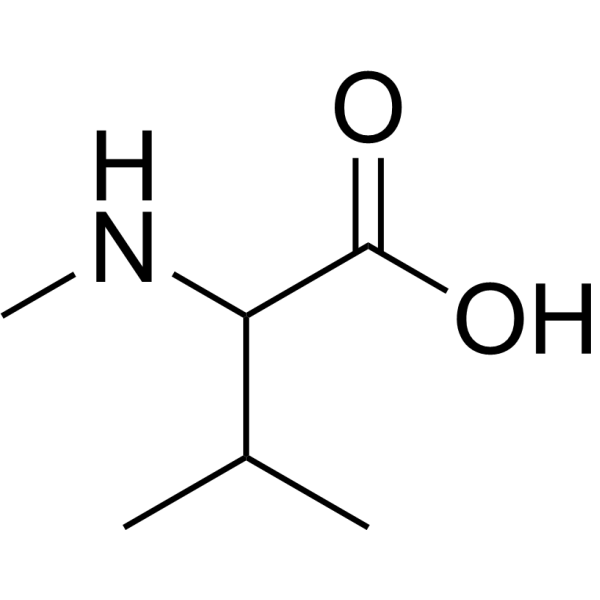
N-Methyl-DL-valine is a valine derivant, is metabolized to cysteine, alanine, tyrosine, tryptophan, citric acid, and succinic acid in the sprout. N-Methyl-DL-valine involves in the modification of monomethyl auristatin F (MMAF), an anti-tubulin agent, makes it hydrophobic functionalization and increases cell permeability .
loading...
    loading...
Cat. No.: HY-W142140A
Synonyms: N-Methylvaline hydrochloride
Research Areas:  

Cancer

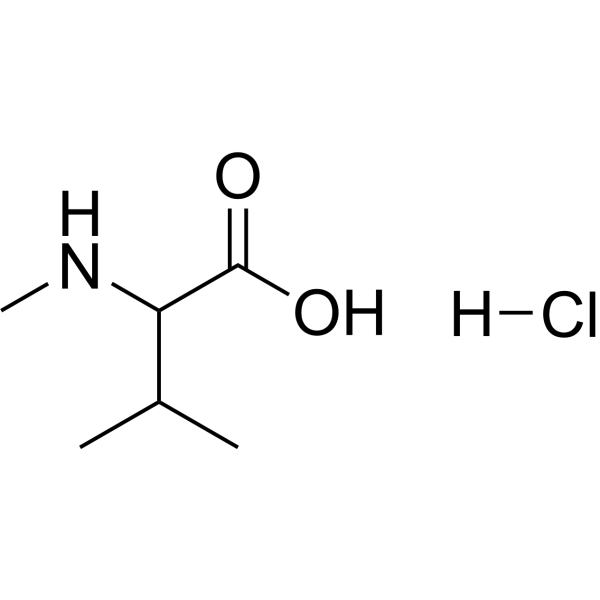
N-Methyl-DL-valine (N-Methylvaline) hydrochloride is a valine derivant, is metabolized to cysteine, alanine, tyrosine, tryptophan, citric acid, and succinic acid in the sprout. N-Methyl-DL-valine hydrochloride involves in the modification of monomethyl auristatin F (MMAF), an anti-tubulin agent, makes it hydrophobic functionalization and increases cell permeability .
loading...
    loading...
Cat. No.: HY-108299R
CAS No.: 338-83-0
Synonyms: Perfluorotripropylamine (Standard); FTPA (Standard); Tris(perfluoropropyl)amine (Standard)
Perfluamine (Standard) is the analytical standard of Perfluamine (HY-108299). This product is intended for research and analytical applications. Perfluamine (Perfluorotripropylamine), a hydrophobic carrier fluid, is used in the surface modification of droplet polymeric microfluidic devices. Perfluamine has a role as a blood substitute .
loading...
    loading...
Cat. No.: HY-185907
CAS No.: 1772522-17-4
Research Areas:  

Others

5'-Octyltocopherol C8 CE Phosphoramidite is a tocopherol-based phosphoramidite modification monomer for solid-phase oligonucleotide synthesis, which can introduce an octyltocopherol modification group with a C8 spacer arm at the 5'-end of oligonucleotides. 5'-Octyltocopherol C8 CE Phosphoramidite can be used to prepare DNA or RNA with hydrophobic tocopherol terminal modifications. 5'-Octyltocopherol C8 CE Phosphoramidite is applicable to studies related to oligonucleotide chemical synthesis, nucleic acid hydrophobic modification, and nucleic acid conjugate construction.
loading...
    loading...
Cat. No.: HY-185910
Research Areas:  

Others

Palmitamido-C7 CE-Phosphoramidite is a long-chain esterified phosphoramidite monomer used for solid-phase oligonucleotide synthesis. Palmitamido-C7 CE-Phosphoramidite is formed by linking palmitamido to the active end of 2-cyanoethyl phosphoramidite via a C7 alkyl spacer arm. Palmitamido-C7 CE-Phosphoramidite can be used as a building block for nucleic acid chemical modification to synthesize ester-coupled oligonucleotides.
loading...
    loading...
Cat. No.: HY-W1061406
CAS No.: 161029-24-9
Research Areas:  

Others

Spacer-C2 Phosphoramidite is a C2 spacer phosphoramidite modifier for oligonucleotide synthesis that introduces a hydrophobic two-carbon spacer internally or at the 5′ end of an oligonucleotide. Spacer-C2 Phosphoramidite increases the distance between an oligonucleotide and a modifier, thereby reducing interactions between the modifier and the oligonucleotide sequence, and can be used for oligonucleotide modification and labeling research.
loading...
    loading...
Cat. No.: HY-185404
Target:  

Drug Intermediate

Research Areas:  

Others

DSPE-PEG8-OH is a monodisperse lipid-polyethylene glycol conjugate featuring a hydrophobic 1,2-distearoyl-sn-glycero-3-phosphoethanolamine (DSPE) anchor, an 8-unit discrete (PEG8) spacer, and a terminal hydroxyl (-OH) group. DSPE-PEG8-OH is primarily used in liposome formulation, nanoparticle surface modification, and targeted drug delivery systems.
loading...
    loading...
Cat. No.: HY-L942
1,631 compounds

Unlike highly conserved orthosteric sites, allosteric sites exhibit low conservation, high hydrophobicity, weak polarity, confined geometry, and dynamic cryptic properties. Rather than rigid keyhole-like cavities, they typically appear as flexible grooves, subunit interface clefts, or shallow depressions formed by protein conformational changes.

Based on the dynamic, hydrophobic, and elongated nature of allosteric pockets, MCE has carried out targeted fragment modification and screening under strict physicochemical criteria: MW 120–280 Da, HBD ≤ 2, HBA ≤ 3, PSA 30–80 Ų, rotatable bonds ≤ 2, cLogP 1–3.5. High 3D diversity was further ensured by PMI analysis, yielding fragments with excellent shape complementarity to allosteric pockets.

This library contains 1,800 structurally diverse, drug-like fragments, this library supports allosteric drug development and pocket optimization. It significantly improves screening hit rates and enables efficient, precise early-stage R&D of allosteric drugs.

  • 1

