



Humantenine

Based on 1 Customer Validation
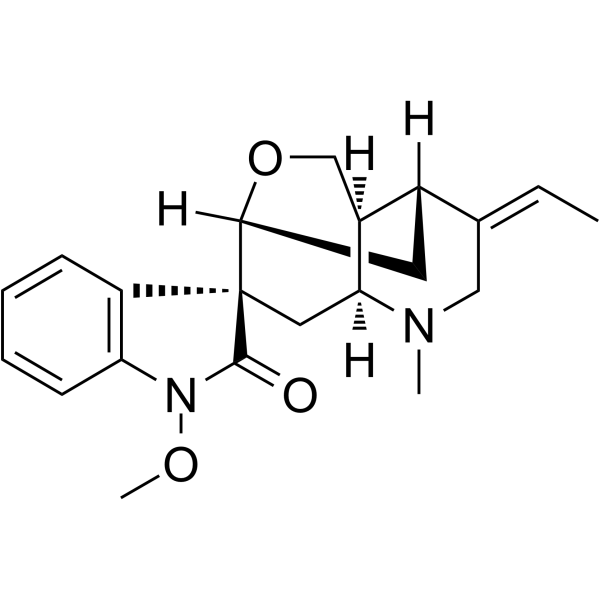
Humantenine is a highly toxic indole alkaloid from Gelsemium elegans (Gardn. & Champ.) Benth. that binds to RNA m6A modification regulatory proteins (ALKBH5, METTL). Humantenine stably binds via hydrogen bonding and hydrophobic interactions and disrupts the m6A methylation level of target genes, thereby impairing the expression of intestinal epithelial cell tight junction and cytoskeleton-related genes, causing intestinal barrier dysfunction and significant intestinal cytotoxicity. The intraperitoneal injection LD50 values of Humantenine are <1 mg/kg in mice, 1.2 mg/kg in male rats and 1.5 mg/kg in female rats, respectively. Species differences exist in the metabolism of Humantenine in human, porcine, goat and rat liver microsomes, and demethylation, dehydrogenation and oxidation occur in liver microsomes.
Nos produits utilisent uniquement pour la recherche. Nous ne vendons pas aux patients.
- Pureté : 98%
- CAS No.: 82375-29-9
- Formule: C21H26N2O3
- Masse moléculaire:354.44
-
Stockage:
-20°C, protect from light
* In solvent : -80°C, 6 months; -20°C, 1 month (protect from light)

To place orders, for customer services and technical support, please contact: MedChemExpress USA
Tel: 609-228-6898 E-mail: [email protected] [email protected]


-
 Activité biologique
-
Chemical Information
- Protocole
- Pureté et documentation
- Références
-
 Help & FAQs




Activité biologique
Description
Cellular Effect
|
Cell Line

|
Type | Value | Description | References |
|---|---|---|---|---|
| A-431 | EC50 |
>100 μM
Compound: humantenine
|
Cytotoxicity against human A431 cells after 48 hrs by trypan blue test
Cytotoxicity against human A431 cells after 48 hrs by trypan blue test
|
[PMID: 16643063] |
In Vitro
Humantenine (400 μM; 48 h) induces concurrent alterations in m6A modification and expression of mRNA for 1401 genes in the human colon cancer cell line HCT116, leading to the enrichment of KEGG and GO annotation terms related to actin cytoskeleton, tight junctions and adherens junctions, differential expression of 11 RNA m6A methylation regulators, and dysregulated m6A methylation levels of target genes[1].
Humantenine (10 mM; 1 h) undergoes metabolism via 5 pathways in human liver microsomes, with demethylation as the major metabolic pathway, producing 9 distinct metabolites with specific semi-quantitative peak intensities[2].
MedChemExpress (MCE) has not independently confirmed the accuracy of these methods. They are for reference only.
-
Cell Line:HCT116 (human colon cancer cell line)
-
Concentration:400 μM
-
Incubation Time:48 h
-
Result:Background: 94,863 m6A peaks containing transcripts of 13,577 genes in humantenine group, and found 4516 differential m6A-modified mRNAs and 3430 differentially expressed mRNAs, with 1401 genes overlapping between them.
KEGG and GO annotation terms for actin cytoskeleton, tight junctions, and adherens junctions were significantly enriched in these overlapping genes.
11 kinds of RNA m6A methylation regulators showed differential expression, including 4 writers, 6 readers and 1 eraser.
The m6A methylation levels of target genes related to tight junctions, adherens junctions and actin cytoskeleton regulation were disordered.
The m6A methylation level of IQGAP3 mRNA transcripts was decreased, and the mRNA stability and expression level of IQGAP3 were reduced.
Parmacokinetics
| Species | Dose | Route | AUC0-t | AUC0-∞ | MRT0-t | MRT0-∞ | T1/2 | Vz | Clearance (CL) | Cmax |
|---|---|---|---|---|---|---|---|---|---|---|
| Rat[3] | 0.1 mg/kg | i.v. | 14.7 ± 3.7 ng·h/mL | 14.0 ± 3.7 ng·h/mL | 1.2 ± 0.1 h | 1.2 ± 0.1 h | 1.5 ± 0.3 h | 15.9 ± 4.9 L/kg | 7.6 ± 2.3 L/h/kg | 11.5 ± 3.6 ng/mL |
In Vivo
Humantenine (0.1 g/kg, dose converted from total Gelsemium elegans powder; administered via oral gavage; single dose) reaches the peak time at 0.083 h in female SD rats, with an elimination half-life as long as 29.03 h, exhibiting pharmacokinetic characteristics of rapid absorption and slow elimination [4].
MedChemExpress (MCE) has not independently confirmed the accuracy of these methods. They are for reference only.
-
Animal Model:Sprague-Dawley (male, 200-220 g)[3]
-
Dosage:0.1 mg/kg
-
Administration:i.v.; single dose
-
Result:Achieved AUC(0-t) = 14.7 ± 3.7 ng/mL*h.
Achieved AUC(0-∞) = 14.0 ± 3.7 ng/mL*h.
Achieved MRT(0-t) = 1.2 ± 0.1 h.
Achieved MRT(0-∞) = 1.2 ± 0.1 h.
Achieved t1/2z = 1.5 ± 0.3 h.
Achieved Vz = 15.9 ± 4.9 L/kg.
Achieved CLz/F = 7.6 ± 2.3 L/h/kg.
Achieved Cmax = 11.5 ± 3.6 ng/mL.


Chemical Information
-
CAS No. 82375-29-9
-
Appearance Solid
-
Masse moléculaire 354.44
-
Formule C21H26N2O3
-
Color White to off-white
-
SMILES
O=C1N(C2=C(C=CC=C2)[C@@]13[C@@]4([H])C[C@]5([H])[C@@](CO4)([H])[C@](N(C/C5=C\C)C)([H])C3)OC
-
Structure Classification
-
Livraison
Room temperature in continental US; may vary elsewhere.
-
Stockage
-20°C, protect from light
* In solvent : -80°C, 6 months; -20°C, 1 month (protect from light)


Pureté et documentation
-
Fiche technique (278 KB)
-
SDS (251 KB)
- English - EN (251 KB)
- Français - FR (251 KB)
- Deutsch - DE (251 KB)
- Norwegian - NO (251 KB)
- Español - ES (251 KB)
- Swedish - SV (251 KB)
- Italian - IT (251 KB)
- Korean - KR (251 KB)
- Portuguese - PT (251 KB)
-
Instruction de manipulation (2659 KB)
Références
[1]. Wu Y, et al. Effect of Humantenine on mRNA m6A Modification and Expression in Human Colon Cancer Cell Line HCT116. Genes (Basel). 2022 Apr 27;13(5):781. [Content Brief]
[2]. Huang SJ, et al. In vitro Metabolism of Humantenine in Liver Microsomes from Human, Pig, Goat and Rat. Curr Drug Metab. 2021;22(10):795-7801. [Content Brief]
[3]. Shen X, et al. Toxicokinetics of 11 Gelsemium Alkaloids in Rats by UPLC-MS/MS. Biomed Res Int. 2020 Jul 15;2020:8247270. [Content Brief]

Calculators
Concentration (start) × Volume (start) = Concentration (final) × Volume (final)


Humantenine Related Classifications
HY-N4031 Related Classifications
 Powered by Bioz