1. Search Result
Search Result
Pathways Recommended: Neuronal Signaling Stem Cell/Wnt
Results for "

primary neuronal stem

" in MedChemExpress (MCE) Product Catalog:
Cat. No. Product Name Target Research Areas Chemical Structure
  • HY-B0603

    Smo Glucocorticoid Receptor Infection Inflammation/Immunology Endocrinology
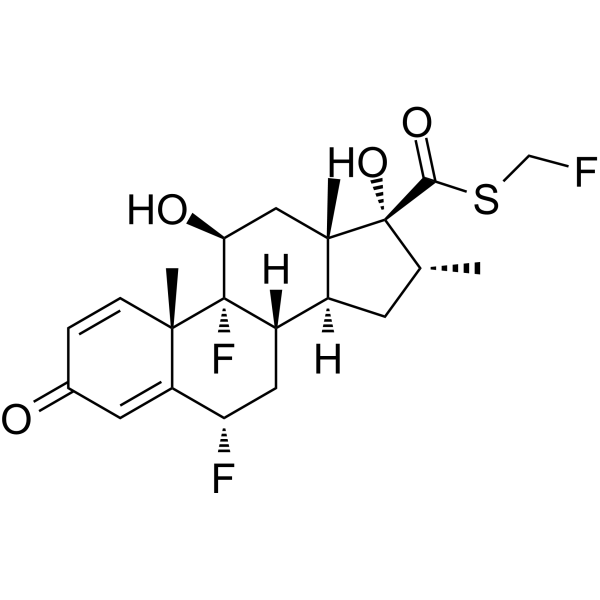
    Fluticasone is an inhaled corticosteroid used for respiratory research. Fluticasone is a Smo agonist with an IC50 value of 99 nM. Fluticasone activates Hedgehog signaling and promotes the proliferation of primary neuronal stem or precursor cells .
    Fluticasone
  • HY-174216

    DNA/RNA Synthesis Oxidative Phosphorylation Mitochondrial Metabolism Neurological Disease Metabolic Disease
    PZL-A is a activator of mitochondrial DNA (mtDNA) synthesis. PZL-A restores wild-type-like activity to mutant forms of polymerase γ (POLγ) with AC50 s of 160 and 20 nM for A467T and G848S. PZL-A activates mtDNA synthesis in cells, enhancing biogenesis of the oxidative phosphorylation machinery and cellular respiration. PZL-A is promising for relieving POLG disease and other severe conditions linked to depletion of mtDNA .
    PZL-A
  • HY-B0603R

    Reference Standards Smo Glucocorticoid Receptor Infection Inflammation/Immunology Endocrinology
    Fluticasone (Standard) is the analytical standard of Fluticasone. This product is intended for research and analytical applications. Fluticasone is an inhaled corticosteroid used for respiratory research. Fluticasone is a Smo agonist with an IC50 value of 99 nM. Fluticasone activates Hedgehog signaling and promotes the proliferation of primary neuronal stem or precursor cells .
    Fluticasone (Standard)
  • HY-101349

    Dopamine Receptor Apoptosis Autophagy PDGFR ERK mTOR Neurological Disease Cancer
    L 741742 is a highly selective and brain-penetrant D4 dopamine receptor antagonist, with Ki values of 3.5 nM, 770 nM and >1700 nM for human D4, D3 and D2 receptors, respectively. L 741742 suppresses PDGFRβ, ERK1/2, and mTOR signaling pathways, and impairs autophagic flux while disrupting lysosomal function.L 741742 induces G0/G1 cell-cycle arrest and apoptosis, promotes neuronal differentiation of normal human neural stem cells, selectively inhibits growth and clonogenic potential of glioblastoma neural stem cells and primary glioblastoma tumor cells, exerts synergistic effects with Temozolomide (TMZ) (HY-17364) against glioblastoma neural stem cells in vitro, and inhibits glioblastoma neural stem cell xenograft growth in immunocompromised mice. L 741742 can be used for the research of schizophrenia and glioblastoma .
    L 741742
  • HY-101349A

    Dopamine Receptor Apoptosis Autophagy PDGFR ERK mTOR Neurological Disease Cancer
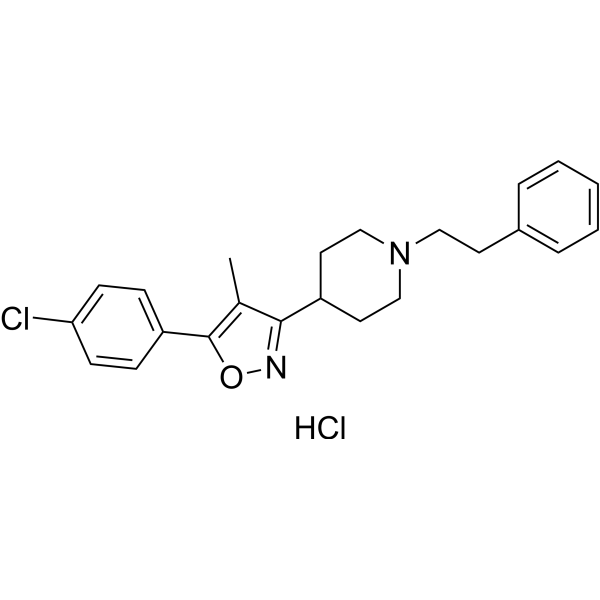
    L 741742 hydrochloride is a highly selective and brain-penetrant D4 dopamine receptor antagonist, with Ki values of 3.5 nM, 770 nM and >1700 nM for human D4, D3 and D2 receptors, respectively. L 741742 hydrochloride suppresses PDGFRβ, ERK1/2, and mTOR signaling pathways, and impairs autophagic flux while disrupting lysosomal function.L 741742 hydrochloride induces G0/G1 cell-cycle arrest and apoptosis, promotes neuronal differentiation of normal human neural stem cells, selectively inhibits growth and clonogenic potential of glioblastoma neural stem cells and primary glioblastoma tumor cells, exerts synergistic effects with Temozolomide (TMZ) (HY-17364) against glioblastoma neural stem cells in vitro, and inhibits glioblastoma neural stem cell xenograft growth in immunocompromised mice. L 741742 hydrochloride can be used for the research of schizophrenia and glioblastoma .
    L 741742 hydrochloride
  • HY-W133907

    Environmental Pollutants Biochemical Assay Reagents Others
    Tetrakis (hydroxymethyl) phosphonium sulfate is a protein crosslinker and hydrogel modifier. Tetrakis (hydroxymethyl) phosphonium sulfate covalently binds to primary and secondary amines of amino acids or proteins via a Mannich-type reaction, thereby constructing stable crosslinking bonds between protein molecules. Tetrakis (hydroxymethyl) phosphonium sulfate not only regulates the gelation time and storage modulus of recombinant elastin-like protein hydrogels, but also exhibits excellent cytocompatibility, and supports the differentiation and growth of embryonic stem cells and neural cells in a three-dimensional encapsulation environment. Tetrakis (hydroxymethyl) phosphonium sulfate is suitable for protein-based hydrogel systems, especially for applications related to cell encapsulation .
    Tetrakis(hydroxymethyl)phosphonium sulfate

Inquiry Online

Your information is safe with us. * Required Fields.

Salutation


Country or Region *

Applicant Name *


Organization Name *

Department *


Email Address *


Product Name *

Cat. No.


Requested quantity *

Phone Number *


Remarks

Inquiry Online

Inquiry Information

Product Name:
Cat. No.:
Quantity:
MCE Japan Authorized Agent:

