1. Search Result
Search Result
Results for "

serotonin biosynthesis

" in MedChemExpress (MCE) Product Catalog:

8

Inhibitors & Agonists

1

Peptides

2

Isotope-Labeled Compounds

Cat. No. Product Name Target Research Areas Chemical Structure
  • HY-B1368
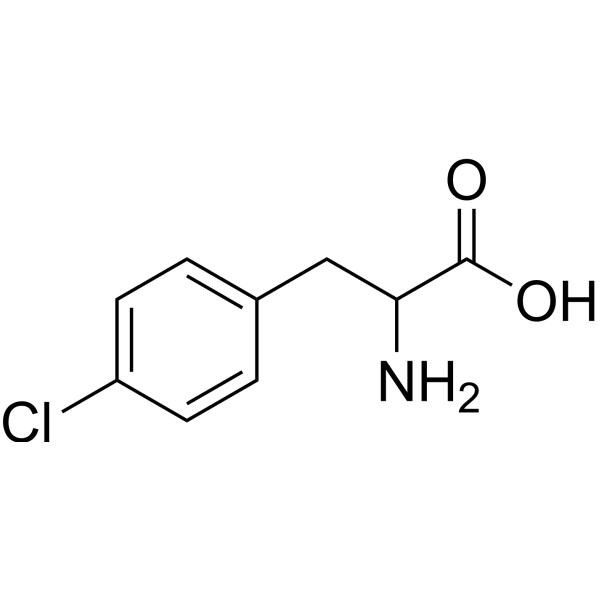
    Fenclonine
    20+ Cited Publications

    4-Chloro-DL-phenylalanine; PCPA; CP-10188

    Tryptophan Hydroxylase Neurological Disease Cancer
    Fenclonine is a selective and irreversible tryptophan hydroxylase inhibitor, which is a rate-limiting enzyme in the biosynthesis of serotonin. Fenclonine can be used in carcinoid syndrome research .
    Fenclonine
  • HY-W019599

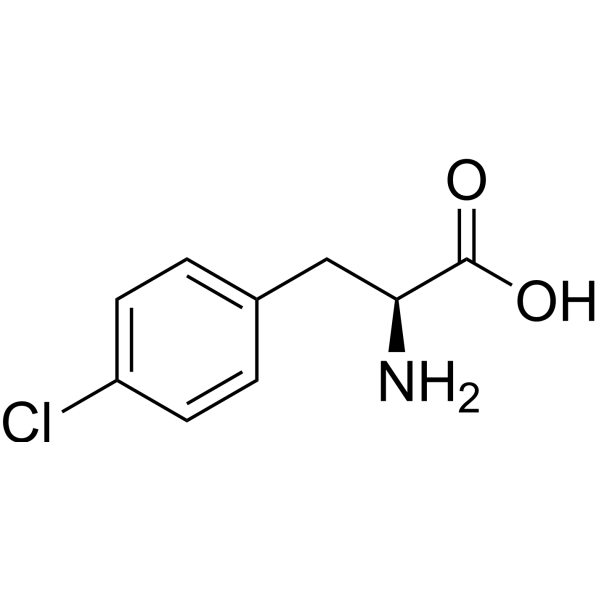
    L-PCPA

    5-HT Receptor Tryptophan Hydroxylase Neurological Disease
    4-Chloro-L-phenylalanine (L-PCPA) is a tryptophan hydroxylase inhibitor targeting TPH1 and TPH2, with the activity of blocking serotonin biosynthesis. 4-Chloro-L-phenylalanine reduces the levels of serotonin and its metabolites in the brain without impairing the survival of serotonergic neurons. 4-Chloro-L-phenylalanine enhances anhedonic, depression-like and anxiety-like behaviors in mice with depleted noradrenergic and dopaminergic neurons. 4-Chloro-L-phenylalanine acts as a decarboxylation substrate for aromatic L-amino acid decarboxylase from Bacillus atrophaeus. 4-Chloro-L-phenylalanine can be used in studies related to Parkinson's disease .
    4-Chloro-L-phenylalanine
  • HY-W772850
    Fenclonine hydrochloride
    20+ Cited Publications

    4-Chloro-DL-phenylalanine hydrochloride; PCPA hydrochloride; CP-10188 hydrochloride

    Tryptophan Hydroxylase Neurological Disease Cancer
    Fenclonine hydrochloride is a selective and irreversible tryptophan hydroxylase inhibitor, which is a rate-limiting enzyme in the biosynthesis of serotonin. Fenclonine hydrochloride can be used in carcinoid syndrome research .
    Fenclonine hydrochloride
  • HY-113154

    VLA

    Endogenous Metabolite Others
    Vanillactic acid (VLA) is a relevant biomarker associated with Aromatic L-amino acid decarboxylase (AADC) deficiency. AADC deficiency is a primary neurotransmitter defect of the biosynthesis of catecholamines and serotonin .
    Vanillactic acid
  • HY-B1368R

    4-Chloro-DL-phenylalanine (Standard); PCPA (Standard); CP-10188 (Standard)

    Tryptophan Hydroxylase Reference Standards Neurological Disease Cancer
    Fenclonine (Standard) is the analytical standard of Fenclonine. This product is intended for research and analytical applications. Fenclonine is a selective and irreversible tryptophan hydroxylase inhibitor, which is a rate-limiting enzyme in the biosynthesis of serotonin. Fenclonine can be used in carcinoid syndrome research .
    Fenclonine (Standard)
  • HY-W777360

    Isotope-Labeled Compounds Adrenergic Receptor Monoamine Oxidase nAChR Opioid Receptor Imidazoline Receptor GABA Receptor Neurological Disease Inflammation/Immunology
    Harman- 13C2, 15N is 13C and 15N labeled Harmane. Harmane is a benzodiazepine receptor inhibitor (IC50=7 μM), with IC50 values for mACh, Opioid Receptor, MAO-A/B, and α2-adrenergic receptor of 24 μM, 2.8 μM, 0.5 μM, 5 μM, and 18 μM, respectively. Harmane also inhibits haloperidol and serotonin, with IC50 values of 163 μM and 101 μM, respectively. Harmane inhibits the I1 imidazoline receptor (IC50=30 nM) to reduce blood pressure and has antidepressant, anti-anxiety, anticonvulsant, and analgesic effects. Harmane inhibits dopamine biosynthesis by decreasing tyrosine hydroxylase (TH) activity and enhancing L-DOPA-induced cytotoxicity in PC12 cells. Additionally, Harmane can increase the mutagenic effect induced by 2-acetylaminofluorene (AAF) .
    Harman-13C2,15N
  • HY-182727

    Monoamine Oxidase Drug Metabolite Metabolic Disease
    MDL 72392 is a selective irreversible monoamine oxidase A (MAO-A) inhibitor. MDL 72392 inhibits MAO-A. MDL 72392 is formed by decarboxylation of the bioprecursor amino acid MDL 72394 via aromatic L-amino acid decarboxylase. MDL 72392 can be used in melatonin biosynthesis research .
    MDL 72392
  • HY-W700834

    Isotope-Labeled Compounds Neurological Disease Inflammation/Immunology
    Harman-d3 is deuterium labeled Harmane. Harmane is a benzodiazepine receptor inhibitor (IC50=7 μM), with IC50 values for mACh, Opioid Receptor, MAO-A/B, and α2-adrenergic receptor of 24 μM, 2.8 μM, 0.5 μM, 5 μM, and 18 μM, respectively. Harmane also inhibits haloperidol and serotonin, with IC50 values of 163 μM and 101 μM, respectively. Harmane inhibits the I1 imidazoline receptor (IC50=30 nM) to reduce blood pressure and has antidepressant, anti-anxiety, anticonvulsant, and analgesic effects. Harmane inhibits dopamine biosynthesis by decreasing tyrosine hydroxylase (TH) activity and enhancing L-DOPA-induced cytotoxicity in PC12 cells. Additionally, Harmane can increase the mutagenic effect induced by 2-acetylaminofluorene (AAF) .
    Harman-d3

Inquiry Online

Your information is safe with us. * Required Fields.

Salutation


Country or Region *

Applicant Name *


Organization Name *

Department *


Email Address *


Product Name *

Cat. No.


Requested quantity *

Phone Number *


Remarks

Inquiry Online

Inquiry Information

Product Name:
Cat. No.:
Quantity:
MCE Japan Authorized Agent:

