



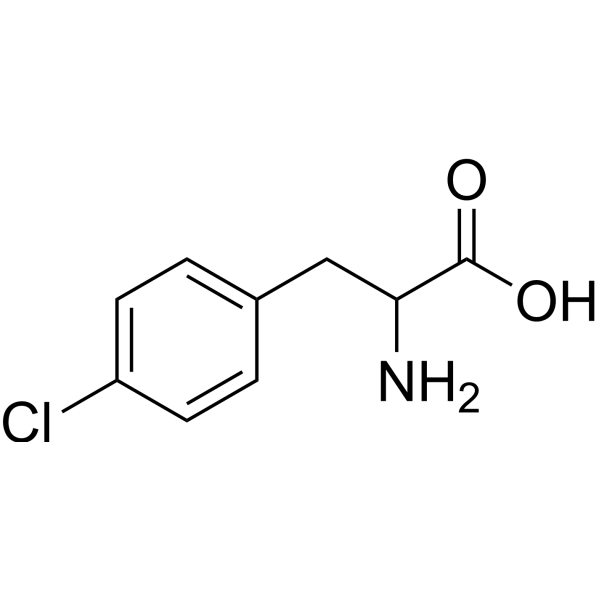
Fenclonine
Based on 27 publication(s) in Google Scholar
Fenclonine is a selective and irreversible tryptophan hydroxylase inhibitor, which is a rate-limiting enzyme in the biosynthesis of serotonin. Fenclonine can be used in carcinoid syndrome research.
For research use only. We do not sell to patients.
- Purity : 99.98%
- CAS No.: 7424-00-2
- Formula: C9H10ClNO2
- Molecular Weight:199.64
-
Storage:Powder -20°C, 3 years , 4°C, 2 years ; In solvent -80°C, 2 years , -20°C, 1 year

To place orders, for customer services and technical support, please contact: MedChemExpress USA
Tel: 609-228-6898 E-mail: [email protected] [email protected]


-
 Biological Activity
-
Chemical Information
-
Solvent & Solubility
- Purity & Documentation
- References
-
 Help & FAQs



Publications Citing Use of MedChemExpress (MCE) Fenclonine
More- Cell. 2025 Dec 24;188(26):7481-7494.e16. [Abstract]
- Nat Cancer. 2026 May;7(5):754-772. [Abstract]
- Adv Sci (Weinh). 2025 Aug;12(29):e2405850. [Abstract]
- Small. 2026 Mar;22(14):e11914. [Abstract]
- Small. 2026 Jan 21:e06988. [Abstract]
- Food Chem. 2022 Dec 9;407:135172. [Abstract]
- Food Chem. 2021 Mar 1:339:127864. [Abstract]
- Food Chem X. 2024 Jun 27:23:101595. [Abstract]
- Food Res Int. 2025 Feb:203:115808. [Abstract]
- Food Res Int. 2024 Apr:181:114094. [Abstract]
- Food Res Int. 2022 Dec;162(Pt B):112088. [Abstract]
- Anal Chem. 2025 Sep 23;97(37):20484-20492. [Abstract]
- Lwt-Food Sci Technol. 21 July 2022, 113791.
- LWT-FOOD SCI TECHNOL . 2021, 110963.
- J Agric Food Chem. 2022 Dec 14;70(49):15602-15613. [Abstract]
- J Agric Food Chem. 2022 May 11;70(18):5701-5714. [Abstract]
- J Agric Food Chem. 2019 Oct 30;67(43):12084-12093. [Abstract]
- J Agric Food Chem. 2019 May 15;67(19):5423-5436. [Abstract]
- Neurobiol Dis. 2026 May 25:226:107459. [Abstract]
- EMBO Rep. 2024 Feb;25(2):570-592. [Abstract]
- Foods. 2024 Jan 26;13(3):398. [Abstract]
- J Proteome Res. 2023 Sep 1;22(9):2936-2949. [Abstract]
- J Pharm Pharmacol. 2020 Sep;72(9):1256-1268. [Abstract]
- SSRN. 2026 Apr 13.
- SSRN. 2026 Jan 8.
- SSRN. 2025 Dec 5.
- SSRN. 2025 Feb 13.
 Customer Validation & Images

-
Cell Imaging/Staining
-
In Vivo Efficacy Study
-
In Vivo Efficacy Study
-
WB
-
IF


Biological Activity
Description
In Vivo
-
Animal Model:Wistar albino rats of either sex and weighing between 80 and 100 g[2]
-
Dosage:100 mg/kg
-
Administration:Intraperitoneal injection; 100 mg/kg; once daily; 3 days
-
Result:Inhibited the antinociceptive activity of Morphine by 41.5%.
-
Animal Model:Male Swiss mice (22–25 g)[3]
-
Dosage:300 mg/kg
-
Administration:Intraperitoneal injection; 300 mg/kg; once daily; 3 days
-
Result:Inhibited the effects of Paracetamol in depression-like and compulsion-like behavior.
Induced Disease Models
Please do not refer to only one article to determine the experimental conditions. It is recommended to determine the optimal experimental conditions (animal strain, age, dosage, frequency and cycle, detection time and indicators, etc.) through preliminary experiments before the formal experiment.
Fenclonine can be used in animal modeling to create insomnia models[4].
Administration: 300 mg/kg • i.p. • once daily for 3 days
MedChemExpress (MCE) has not independently confirmed the accuracy of these methods. They are for reference only.


Chemical Information
-
CAS No. 7424-00-2
-
Appearance Solid
-
Molecular Weight 199.64
-
Formula C9H10ClNO2
-
Color White to off-white
-
SMILES
NC(CC1=CC=C(Cl)C=C1)C(O)=O
-
Synonyms
4-Chloro-DL-phenylalanine; PCPA; CP-10188
-
Shipping
Room temperature in continental US; may vary elsewhere.
-
Storage
Powder -20°C 3 years 4°C 2 years In solvent -80°C 2 years -20°C 1 year


Publications (27)
-
Journal Impact Factor
-
Most Recent
-
Cell
Gut-to-brain signaling restricts dietary protein intake during recovery from catabolic states. [Abstract]2025 Dec 24;188(26):7481-7494.e16. PMID: 41192423 -
Nat Cancer
Leptomeningeal metastatic cancer cells induce a permissive choroid plexus vasculature through extracellular-vesicle-derived 5-HIAA signaling. [Abstract]2026 May;7(5):754-772. PMID: 41933185 -
Adv Sci (Weinh)
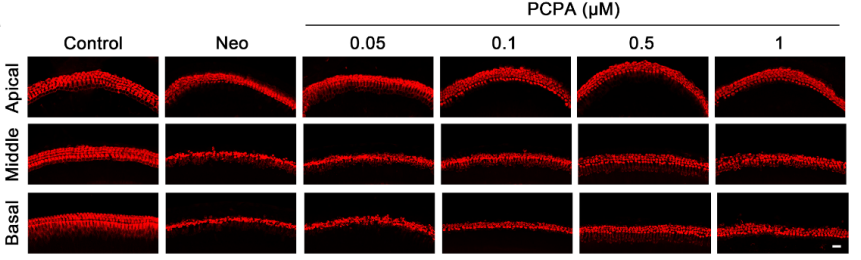
Lycium barbarum Glycopeptide Alleviates Neomycin-Induced Ototoxicity by Inhibiting Tryptophan Hydroxylase-Mediated Serotonin Biosynthesis. [Abstract]2025 Aug;12(29):e2405850. PMID: 40135846
Fenclonine purchased from MedChemExpress. Usage Cited in: Adv Sci (Weinh). 2025 Aug;12(29):e2405850. [Abstract]
Fenclonine (PCPA; 0.05, 0.1, 0.5, 1 μM; 24 h) at 0.5 µm effectively reduced the hair cell injury caused by neomycin in the basal and middle turns of the cultured explants. Immunostaining of hair cells with Myosin 7a in cultured explants.
-
Small
Acupuncture Mechanics, Stimulation, and Cellular Serotonin Detection by a Magneto-Responsive Nanomesh Sensor. [Abstract]2026 Mar;22(14):e11914. PMID: 41537659 -
Small
A Balloon Electrochemical Sensor for Conformal Interfacing With Intestinal Wall and Real-Time Monitoring of Serotonin Release. [Abstract]2026 Jan 21:e06988. PMID: 41563114 -
Food Chem
Improving flavor of summer Keemun black tea by solid-state fermentation using Cordyceps militaris revealed by LC/MS-based metabolomics and GC/MS analysis. [Abstract]2022 Dec 9;407:135172. PMID: 36508871 -
Food Chem
Detection and quantification of flavoalkaloids in different tea cultivars and during tea processing using UPLC-TOF-MS/MS. [Abstract]2021 Mar 1:339:127864. PMID: 32858385 -
Food Chem X
Investigation of the quality of Lu'an Guapian tea during Grain Rain period by sensory evaluation, objective quantitative indexes and metabolomics. [Abstract]2024 Jun 27:23:101595. PMID: 39071934 -
Food Res Int
Microbial and chemical diversity analysis reveals greater heterogeneity of Liubao tea than ripen Pu-erh tea. [Abstract]2025 Feb:203:115808. PMID: 40022336 -
Food Res Int
Rolling forms the diversities of small molecular nonvolatile metabolite profile and consequently shapes the bacterial community structure for Keemun black tea. [Abstract]2024 Apr:181:114094. PMID: 38448096 -
Food Res Int
Evaluation of the effects of solar withering on nonvolatile compounds in white tea through metabolomics and transcriptomics. [Abstract]2022 Dec;162(Pt B):112088. PMID: 36461396 -
Anal Chem
Stretchable Sensor-Integrated Microfluidic Chip for Monitoring Fatty Acid-Enhanced Serotonin Release from the Intestinal Epithelium. [Abstract]2025 Sep 23;97(37):20484-20492. PMID: 40920399 -
-
-
J Agric Food Chem
Effects of Microbial Action and Moist-Heat Action on the Nonvolatile Components of Pu-Erh Tea, as Revealed by Metabolomics. [Abstract]2022 Dec 14;70(49):15602-15613. PMID: 36441948 -
J Agric Food Chem
Microbial and Nonvolatile Chemical Diversities of Chinese Dark Teas Are Differed by Latitude and Pile Fermentation. [Abstract]2022 May 11;70(18):5701-5714. PMID: 35502792 -
J Agric Food Chem
Metabolomics Based on UHPLC-Orbitrap-MS and Global Natural Product Social Molecular Networking Reveals Effects of Time Scale and Environment of Storage on the Metabolites and Taste Quality of Raw Pu-erh Tea. [Abstract]2019 Oct 30;67(43):12084-12093. PMID: 31560531 -
J Agric Food Chem
Impact of Six Typical Processing Methods on the Chemical Composition of Tea Leaves Using a Single Camellia sinensis Cultivar, Longjing 43. [Abstract]2019 May 15;67(19):5423-5436. PMID: 30403138 -
Neurobiol Dis
ROS-HIF1α-driven glycolytic reprogramming sustains ATP production in Huntington's disease. [Abstract]2026 May 25:226:107459. PMID: 42190991 -
EMBO Rep
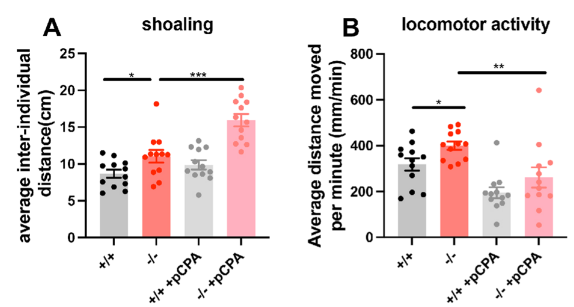
2024 Feb;25(2):570-592. PMID: 38253686
Fenclonine purchased from MedChemExpress. Usage Cited in: EMBO Rep. 2024 Feb;25(2):570-592. [Abstract]
Fenclonine (pCPA; 2 mg/L; 72 h) treatment 2-mpf WT and nomo1 deficiency zebrafish significantly rescued the overactive locomotor behavior of nomo1−/−.
-
Foods
2024 Jan 26;13(3):398. PMID: 38338533 -
J Proteome Res
The Combination of Quantitative Proteomics and Systems Genetics Analysis Reveals that PTN Is Associated with Sleep-Loss-Induced Cognitive Impairment. [Abstract]2023 Sep 1;22(9):2936-2949. PMID: 37611228
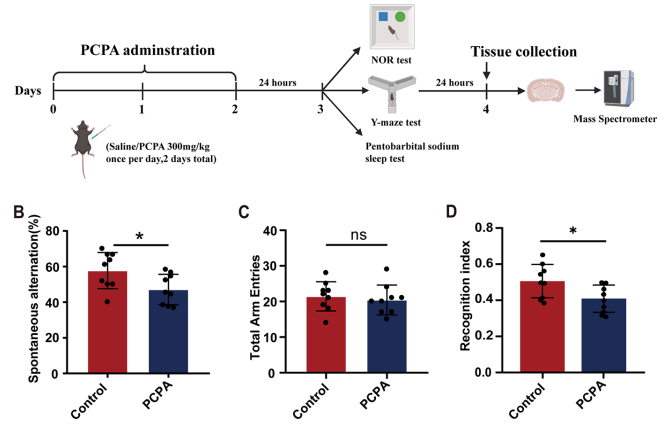
Fenclonine purchased from MedChemExpress. Usage Cited in: J Proteome Res. 2023 Sep 1;22(9):2936-2949. [Abstract]
Fenclonine (PCPA; 300 mg/kg; IP; once a day between 8:00 and 9:00 a.m. for 2 consecutive days) in Eight week old male C57BL/6J mice presented a significant decrease in spontaneous alternation in the Y-maze test (Figure 1B), whereas no difference in total arm entries (Figure 1C). For the NOR test, the recognition index of PCPA mice was significantly reduced (Figure 1D), demonstrating an impaired cognitive function.
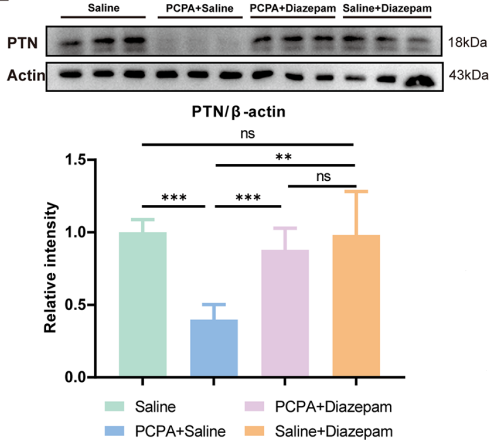
Fenclonine purchased from MedChemExpress. Usage Cited in: J Proteome Res. 2023 Sep 1;22(9):2936-2949. [Abstract]
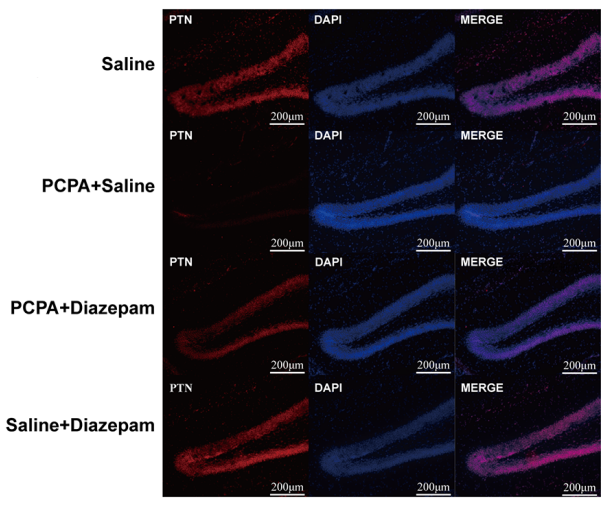
Fenclonine (PCPA; 300 mg/kg; IP; once a day between 8:00 and 9:00 a.m. for 2 consecutive days; saline plus diazepam group and PCPA plus diazepam group received an intragastrical administration of diazepam (3 mg/kg) 26–28 h after the first PCPA injection for 2 consecutive days) in Eight week old male C57BL/6J mice showd Ptn expression in the PCPA plus diazepam group was significantly upregulated in the dentate gyrus (DG) in the hippocampus. Western blots showing Ptn expression in the hippocampus from saline, PCPA + saline, PCPA + diazepam, and saline + diazepam-treated mice.
Fenclonine purchased from MedChemExpress. Usage Cited in: J Proteome Res. 2023 Sep 1;22(9):2936-2949. [Abstract]
Fenclonine (PCPA; 300 mg/kg; IP; once a day between 8:00 and 9:00 a.m. for 2 consecutive days; saline plus diazepam group and PCPA plus diazepam group received an intragastrical administration of diazepam (3 mg/kg) 26–28 h after the first PCPA injection for 2 consecutive days) in Eight week old male C57BL/6J mice showd Ptn expression in the PCPA plus diazepam group was significantly upregulated in the dentate gyrus (DG) in the hippocampus. Representative confocal images of Ptn (red) and DAPI (blue) expression in the hippocampus from saline + saline, PCPA + saline, PCPA + diazepam, and saline + diazepam-treated mice.
Fenclonine purchased from MedChemExpress. Usage Cited in: J Proteome Res. 2023 Sep 1;22(9):2936-2949. [Abstract]
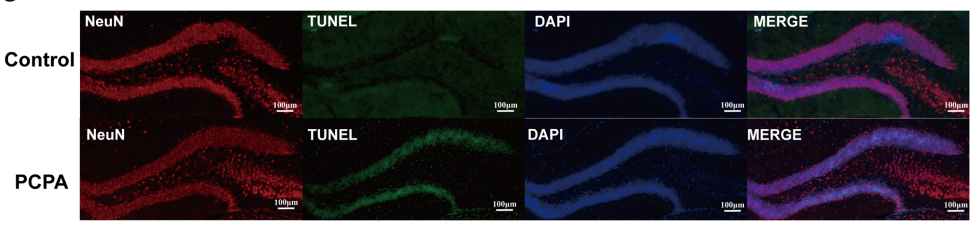
Fenclonine (PCPA; 300 mg/kg; IP; once a day between 8:00 and 9:00 a.m. for 2 consecutive days; saline plus diazepam group and PCPA plus diazepam group received an intragastrical administration of diazepam (3 mg/kg) 26–28 h after the first PCPA injection for 2 consecutive days) in Eight week old male C57BL/6J mice showd a significant increase in the rate of TUNEL-positive cells in the PCPA group, indicating the neuronal apoptosis. Representative confocal images of NeuN (red)-TUNEL (green) and DAPI (blue) expression in the hippocampus from control and PCPA groups.
-
J Pharm Pharmacol
Metabolomics coupled with integrative pharmacology reveals the therapeutic effect of l-borneolum against cerebral ischaemia in rats. [Abstract]2020 Sep;72(9):1256-1268. PMID: 32496584 -
-
-
-


Solvent & Solubility
In Vitro:
1 M NaOH : 150 mg/mL (751.35 mM; Need ultrasonic)
DMSO : 100 mg/mL (500.90 mM; ultrasonic and adjust pH to 2 with HCl; Hygroscopic DMSO has a significant impact on the solubility of product, please use newly opened DMSO)
H2O : 4 mg/mL (20.04 mM; ultrasonic and warming and heat to 60°C)
Please refer to the solubility information to select the appropriate solvent. Once prepared, please aliquot and store the solution to prevent product inactivation from repeated freeze-thaw cycles.
Storage method and period of stock solution: -80°C, 2 years; -20°C, 1 year. When stored at -80°C, please use it within 2 years. When stored at -20°C, please use it within 1 year.
* Note: If you choose water as the stock solution, please dilute it to the working solution, then filter and sterilize it with a 0.22 μm filter before use.
Please refer to the solubility information to select the appropriate solvent. Once prepared, please aliquot and store the solution to prevent product inactivation from repeated freeze-thaw cycles.
Storage method and period of stock solution: -80°C, 2 years; -20°C, 1 year. When stored at -80°C, please use it within 2 years. When stored at -20°C, please use it within 1 year.
* Note: If you choose water as the stock solution, please dilute it to the working solution, then filter and sterilize it with a 0.22 μm filter before use.
Concentration (start) × Volume (start) = Concentration (final) × Volume (final)
In Vivo:
Select the appropriate dissolution method based on your experimental animal and administration route.
- For the following dissolution methods, please ensure to first prepare a clear stock solution using an In Vitro approach and then sequentially add co-solvents:
- To ensure reliable experimental results, the clarified stock solution can be appropriately stored based on storage conditions. As for the working solution for In Vivo experiments, it is recommended to prepare freshly and use it on the same day.
- The percentages shown for the solvents indicate their volumetric ratio in the final prepared solution. If precipitation or phase separation occurs during preparation, heat and/or sonication can be used to aid dissolution.
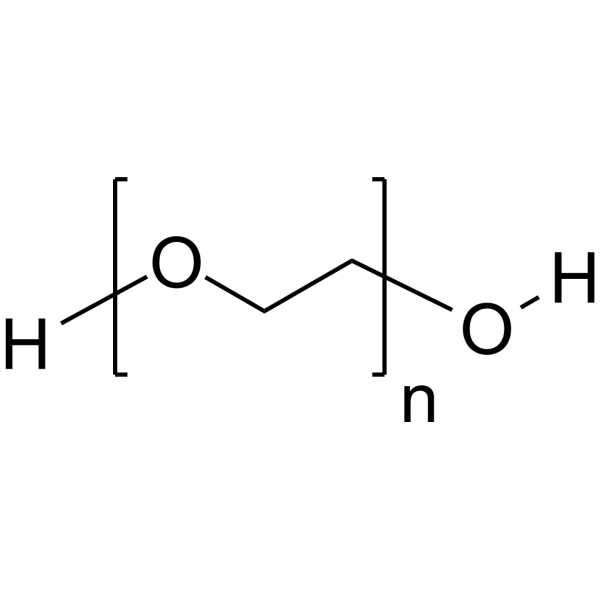
Add each solvent one by one: 10% DMSO 40% PEG300 5% Tween-80 45% Saline
Solubility: ≥ 2.5 mg/mL (12.52 mM); Clear solution
This protocol yields a clear solution of ≥ 2.5 mg/mL (saturation unknown).
Taking 1 mL working solution as an example, add 100 μL DMSO stock solution (25.0 mg/mL) to 400 μL PEG300, and mix evenly; then add 50 μL Tween-80 and mix evenly; then add 450 μL Saline to adjust the volume to 1 mL.
Preparation of Saline: Dissolve 0.9 g sodium chloride in ddH₂O and dilute to 100 mL to obtain a clear Saline solution.
Add each solvent one by one: 10% DMSO 90% (20% SBE-β-CD in Saline)
Solubility: ≥ 2.5 mg/mL (12.52 mM); Clear solution
This protocol yields a clear solution of ≥ 2.5 mg/mL (saturation unknown).
Taking 1 mL working solution as an example, add 100 μL DMSO stock solution (25.0 mg/mL) to 900 μL 20% SBE-β-CD in Saline, and mix evenly.
Preparation of 20% SBE-β-CD in Saline (4°C, storage for one week): 2 g SBE-β-CD powder is dissolved in 10 mL Saline, completely dissolve until clear.
For the following dissolution methods, please prepare the working solution directly:
It is recommended to prepare fresh solutions and use them promptly within a short period of time.
The percentages shown for the solvents indicate their volumetric ratio in the final prepared solution. If precipitation or phase separation occurs during preparation, heat and/or sonication can be used to aid dissolution.
In Vivo Dissolution Calculator
Please enter the basic information of animal experiments:
-
-
-
-
Recommended: Prepare an additional quantity of animals to account for potential losses during experiments.
Please enter your animal formula composition:
-
%DMSO +
Recommended: Keep the proportion of DMSO in working solution below 2% if your animal is weak.
-
%+
-
+%Tween-80 + +
-
%Saline +
The co-solvents required include: DMSO, . All of co-solvents are available by MedChemExpress (MCE). , Tween 80. All of co-solvents are available by MedChemExpress (MCE).
Working solution concentration: 0.22 mg/mL
Method for preparing stock solution: mg drug dissolved in μL DMSO. Stock solution concentration: mg/mL.
1. Take μL DMSO stock solution;
2. Add μL .
μL , mix evenly;
3. Then add μL Tween 80, mix evenly;
4. Then add μL
Please ensure that the stock solution in the first step is dissolved to a clear state, and add co-solvents in sequence. You can use ultrasonic heating (ultrasonic cleaner, recommended frequency 20-40 kHz), vortexing, etc. to assist dissolution.


Purity & Documentation
-
Data Sheet (277 KB)
-
SDS (480 KB)
- English - EN (480 KB)
- Français - FR (480 KB)
- Deutsch - DE (480 KB)
- Norwegian - NO (480 KB)
- Español - ES (480 KB)
- Swedish - SV (480 KB)
- Italian - IT (480 KB)
- Korean - KR (480 KB)
- Portuguese - PT (480 KB)
-
Handling Instructions (2659 KB)
References
[1]. M Jouvet. Sleep and serotonin: an unfinished story. Neuropsychopharmacology. 1999 Aug;21(2 Suppl):24S-27S. [Content Brief]
[2]. A K Sanyal, et al. Prostaglandins: antinociceptive effect of prostaglandin E1 in the rat. Clin Exp Pharmacol Physiol. 1977 May-Jun;4(3):247-55. [Content Brief]
[3]. Shyamshree S S Manna, et al. Paracetamol potentiates the antidepressant-like and anticompulsive-like effects of fluoxetine. Behav Pharmacol. 2015 Apr;26(3):268-81. [Content Brief]
[4]. Zheng Y, et al. In silico Analysis and Experimental Validation of Lignan Extracts from Kadsura longipedunculata for Potential 5-HT1AR Agonists. PLoS One. 2015 Jun 15;10(6):e0130055. [Content Brief]


Complete Stock Solution Preparation Table
Please refer to the solubility information to select the appropriate solvent. Once prepared, please aliquot and store the solution to prevent product inactivation from repeated freeze-thaw cycles.
Storage method and period of stock solution: -80°C, 2 years; -20°C, 1 year. When stored at -80°C, please use it within 2 years. When stored at -20°C, please use it within 1 year.
| Optional Solvent | Concentration Solvent Mass | 1 mg | 5 mg | 10 mg | 25 mg |
|---|---|---|---|---|---|
| H2O / DMSO / 1 M NaOH | 1 mM | 5.0090 mL | 25.0451 mL | 50.0902 mL | 125.2254 mL |
| 5 mM | 1.0018 mL | 5.0090 mL | 10.0180 mL | 25.0451 mL | |
| 10 mM | 0.5009 mL | 2.5045 mL | 5.0090 mL | 12.5225 mL | |
| 15 mM | 0.3339 mL | 1.6697 mL | 3.3393 mL | 8.3484 mL | |
| 20 mM | 0.2505 mL | 1.2523 mL | 2.5045 mL | 6.2613 mL | |
| DMSO / 1 M NaOH | 25 mM | 0.2004 mL | 1.0018 mL | 2.0036 mL | 5.0090 mL |
| 30 mM | 0.1670 mL | 0.8348 mL | 1.6697 mL | 4.1742 mL | |
| 40 mM | 0.1252 mL | 0.6261 mL | 1.2523 mL | 3.1306 mL | |
| 50 mM | 0.1002 mL | 0.5009 mL | 1.0018 mL | 2.5045 mL | |
| 60 mM | 0.0835 mL | 0.4174 mL | 0.8348 mL | 2.0871 mL | |
| 80 mM | 0.0626 mL | 0.3131 mL | 0.6261 mL | 1.5653 mL | |
| 100 mM | 0.0501 mL | 0.2505 mL | 0.5009 mL | 1.2523 mL |
* Note: If you choose water as the stock solution, please dilute it to the working solution, then filter and sterilize it with a 0.22 μm filter before use.


Fenclonine Related Classifications
HY-B1368 Related Classifications
 Powered by Bioz