



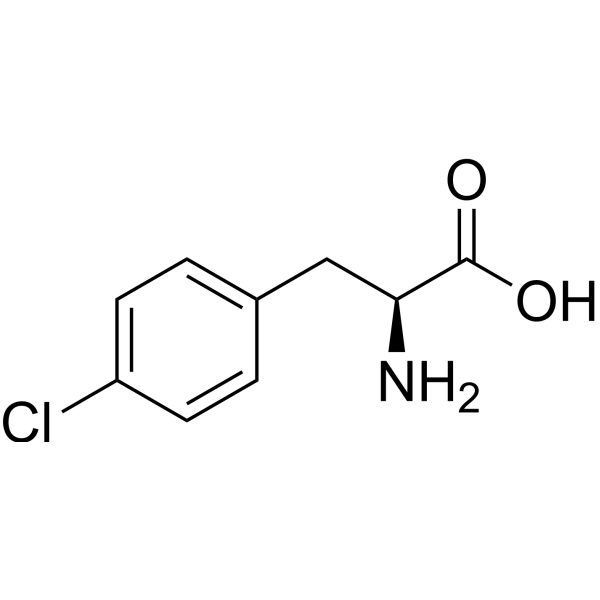
4-Chloro-L-phenylalanine

Based on 1 Customer Validation
4-Chloro-L-phenylalanine (L-PCPA) is a tryptophan hydroxylase inhibitor targeting TPH1 and TPH2, with the activity of blocking serotonin biosynthesis. 4-Chloro-L-phenylalanine reduces the levels of serotonin and its metabolites in the brain without impairing the survival of serotonergic neurons. 4-Chloro-L-phenylalanine enhances anhedonic, depression-like and anxiety-like behaviors in mice with depleted noradrenergic and dopaminergic neurons. 4-Chloro-L-phenylalanine acts as a decarboxylation substrate for aromatic L-amino acid decarboxylase from Bacillus atrophaeus. 4-Chloro-L-phenylalanine can be used in studies related to Parkinson's disease.
For research use only. We do not sell to patients.
- Purity : 98.19%
- CAS No.: 14173-39-8
- Formula: C9H10ClNO2
- Molecular Weight:199.64
-
Storage:Powder -20°C, 3 years , 4°C, 2 years ; In solvent -80°C, 6 months , -20°C, 1 month

To place orders, for customer services and technical support, please contact: MedChemExpress USA
Tel: 609-228-6898 E-mail: [email protected] [email protected]


-
 Biological Activity
-
Chemical Information
-
Solvent & Solubility
- Purity & Documentation
- References
-
 Help & FAQs



All 5-HT Receptor Isoforms
More

Biological Activity
Description
In Vitro
4-Chloro-L-phenylalanine (5 mM) is catalyzed for decarboxylation by purified AADC-BA from Bacillus atrophaeus[3].
MedChemExpress (MCE) has not independently confirmed the accuracy of these methods. They are for reference only.
In Vivo
4-Chloro-L-phenylalanine (150 mg/kg/d; i.p.; daily; 3 consecutive days) reverses enhanced serotonin signaling-induced intestinal mucosal growth and enteric neuroplasticity in SERTKO and WT-SSRI mice, while only reducing villus height without affecting other parameters in WT mice[2].
MedChemExpress (MCE) has not independently confirmed the accuracy of these methods. They are for reference only.
-
Animal Model:C57BL/6 (male, 8 weeks of age)[1]
-
Dosage:300 mg/kg
-
Administration:i.p.; once daily; 3 consecutive days
-
Result:Reduced frontal cortex 5-HT levels by 53% and 5-HIAA levels by 73% compared to saline controls; decreased the 5-HIAA/5-HT ratio by 42%.
Reduced hippocampus 5-HT levels by 57% and 5-HIAA levels by 76% compared to saline controls; decreased the 5-HIAA/5-HT ratio by 46%.
Did not significantly change the number of serotonin transporter-immunoreactive (SERT-ir) neurons in the dorsal raphe nucleus compared to saline controls.
Significantly increased immobility time in both the forced swim test and tail suspension test.
Did not alter locomotor activity, sucrose preference, anxiety-related behavior, or spatial learning/memory compared to saline controls.


Chemical Information
-
CAS No. 14173-39-8
-
Appearance Solid
-
Molecular Weight 199.64
-
Formula C9H10ClNO2
-
Color White to off-white
-
Synonyms
L-PCPA
-
Shipping
Room temperature in continental US; may vary elsewhere.
-
Storage
Powder -20°C 3 years 4°C 2 years In solvent -80°C 6 months -20°C 1 month


Solvent & Solubility
In Vitro:
H2O : 10.29 mg/mL (51.54 mM; Need ultrasonic)
Please refer to the solubility information to select the appropriate solvent. Once prepared, please aliquot and store the solution to prevent product inactivation from repeated freeze-thaw cycles.
Storage method and period of stock solution: -80°C, 6 months; -20°C, 1 month. When stored at -80°C, please use it within 6 months. When stored at -20°C, please use it within 1 month.
* Note: If you choose water as the stock solution, please dilute it to the working solution, then filter and sterilize it with a 0.22 μm filter before use.
Please refer to the solubility information to select the appropriate solvent. Once prepared, please aliquot and store the solution to prevent product inactivation from repeated freeze-thaw cycles.
Storage method and period of stock solution: -80°C, 6 months; -20°C, 1 month. When stored at -80°C, please use it within 6 months. When stored at -20°C, please use it within 1 month.
* Note: If you choose water as the stock solution, please dilute it to the working solution, then filter and sterilize it with a 0.22 μm filter before use.
Concentration (start) × Volume (start) = Concentration (final) × Volume (final)


Purity & Documentation
-
Data Sheet (273 KB)
-
SDS (480 KB)
- English - EN (480 KB)
- Français - FR (480 KB)
- Deutsch - DE (480 KB)
- Norwegian - NO (480 KB)
- Español - ES (480 KB)
- Swedish - SV (480 KB)
- Italian - IT (480 KB)
- Korean - KR (480 KB)
- Portuguese - PT (480 KB)
-
Handling Instructions (2659 KB)
References
[1]. Li Y, et al. Investigation of Behavioral Dysfunctions Induced by Monoamine Depletions in a Mouse Model of Parkinson's Disease. Front Cell Neurosci. 2018;12:241. Published 2018 Aug 8. [Content Brief]
[2]. Greig CJ, et al. Enhanced serotonin signaling increases intestinal neuroplasticity. J Surg Res. 2016;206(1):151-158. [Content Brief]
[3]. Choi Y, et al. Biochemical characterization and synthetic application of aromatic L-amino acid decarboxylase from Bacillus atrophaeus. Appl Microbiol Biotechnol. 2021;105(7):2775-2785. [Content Brief]


Complete Stock Solution Preparation Table
Please refer to the solubility information to select the appropriate solvent. Once prepared, please aliquot and store the solution to prevent product inactivation from repeated freeze-thaw cycles.
Storage method and period of stock solution: -80°C, 6 months; -20°C, 1 month. When stored at -80°C, please use it within 6 months. When stored at -20°C, please use it within 1 month.
| Optional Solvent | Concentration Solvent Mass | 1 mg | 5 mg | 10 mg | 25 mg |
|---|---|---|---|---|---|
| H2O | 1 mM | 5.0090 mL | 25.0451 mL | 50.0902 mL | 125.2254 mL |
| 5 mM | 1.0018 mL | 5.0090 mL | 10.0180 mL | 25.0451 mL | |
| 10 mM | 0.5009 mL | 2.5045 mL | 5.0090 mL | 12.5225 mL | |
| 15 mM | 0.3339 mL | 1.6697 mL | 3.3393 mL | 8.3484 mL | |
| 20 mM | 0.2505 mL | 1.2523 mL | 2.5045 mL | 6.2613 mL | |
| 25 mM | 0.2004 mL | 1.0018 mL | 2.0036 mL | 5.0090 mL | |
| 30 mM | 0.1670 mL | 0.8348 mL | 1.6697 mL | 4.1742 mL | |
| 40 mM | 0.1252 mL | 0.6261 mL | 1.2523 mL | 3.1306 mL | |
| 50 mM | 0.1002 mL | 0.5009 mL | 1.0018 mL | 2.5045 mL |
* Note: If you choose water as the stock solution, please dilute it to the working solution, then filter and sterilize it with a 0.22 μm filter before use.


4-Chloro-L-phenylalanine Related Classifications
HY-W019599 Related Classifications
 Powered by Bioz