Search Result
Results for "
silane
" in MedChemExpress (MCE) Product Catalog:
41
Biochemical Assay Reagents
2
Isotope-Labeled Compounds
| Cat. No. |
Product Name |
Target |
Research Areas |
Chemical Structure |
-
- HY-W442186
-
|
Methyl-phenyl-chlorosilane
|
Biochemical Assay Reagents
|
Others
|
|
Chloro(methyl)(phenyl)silane (Methyl-phenyl-chlorosilane) is a silicon hydride. Chloro(methyl)(phenyl)silane undergoes an addition reaction with long-chain unsaturated fatty acid esters .
|
-
-
- HY-W105426
-
|
[3-(Methacryloyloxy)propyl]trimethoxysilane
|
Biochemical Assay Reagents
|
Others
|
|
3-(Trimethoxysilyl)propyl methacrylate is a reactive monomer and silane coupling agent with C=C and O-C=O functional groups, acting as a surface modifier and anti-agglomeration agent. 3-(Trimethoxysilyl)propyl methacrylate can be used to prepare nanoparticles .
|
-
-
- HY-Y0147
-
|
|
Biochemical Assay Reagents
|
Others
|
|
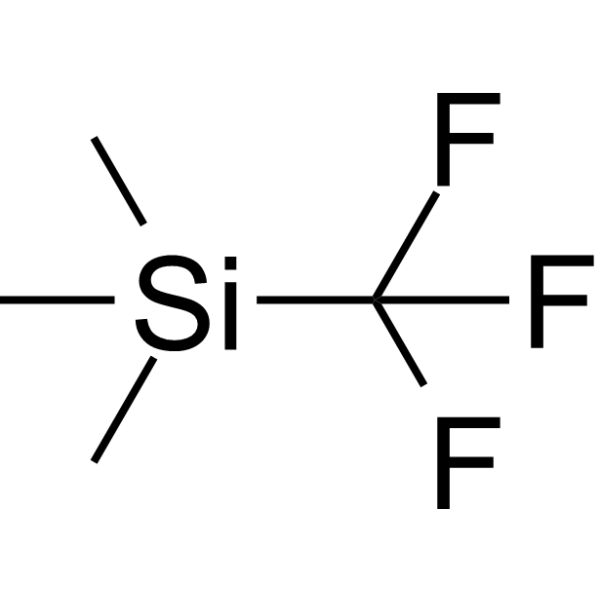
Trimethylsilyl(trifluoromethyl)silane is a biochemical reagent that can be used as a biological material or organic compound for life science related research.
|
-
-
- HY-W008525
-
|
|
Biochemical Assay Reagents
|
Others
|
|
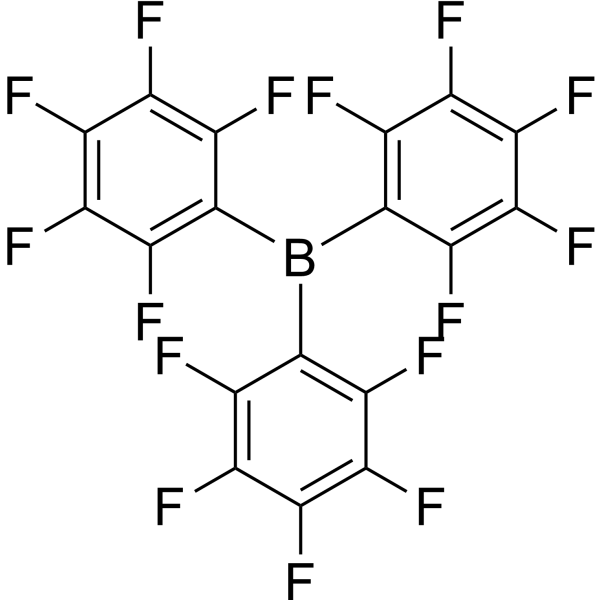
Tris (perfluorophenyl) borane is a biochemical reagent that can be used as a biomaterial or organic compound for life science-related research .
|
-
-
- HY-W102303
-
|
|
PROTAC Linkers
|
Cancer
|
|
(E)-tert-Butyldimethyl((3-(4,4,5,5-tetramethyl-1,3,2-dioxaborolan-2-yl)allyl)oxy)silane is a PROTAC linker that can be used in the synthesis of PROTACs.
|
-
-
- HY-W1123939C
-
|
|
Biochemical Assay Reagents
|
Others
|
|
Silane-PEG5000-COOH can be used to modify proteins, peptides and other materials with active groups. The carboxyl group (-COOH) can easily form a stable amide bond with the amino group, and can also form an ester bond with the hydroxyl group. Silane-functionalized PEG (Silane-PEG-X) can be used to modify glass, silicon, etc .
|
-
-
- HY-W102301
-
|
|
PROTAC Linkers
|
Cancer
|
|
(E)-tert-Butyldimethyl((4-(4,4,5,5-tetramethyl-1,3,2-dioxaborolan-2-yl)but-3-en-1-yl)oxy)silane is a PROTAC linker that can be used in the synthesis of PROTACs.
|
-
-
- HY-W036410
-
|
3-Aminopropyltrimethoxysilane
|
Environmental Pollutants
Biochemical Assay Reagents
|
Others
|
|
Aminopropyltrimethoxysilane (APTMS) is a silane coupling agent. Aminopropyltrimethoxysilane couples with Tosylcellulose. Aminopropyltrimethoxysilane improves the thermal stability of the material. Aminopropyltrimethoxysilane can be used in the preparation of GNBP substrates .
|
-
-
- HY-91018
-
|
N-[3-(Trimethoxysilyl)propyl]-N,N,N-trimethylammonium chloride, 50% in methanol
|
Biochemical Assay Reagents
|
Others
|
|
Trimethyl[3-(trimethoxysilyl)propyl]ammonium (N-[3-(Trimethoxysilyl)propyl]-N,N,N-trimethylammonium) chloride (50% in methanol) is a functional organic silane coupling agent and quaternary ammonium salt cationic functional monomer, which can be used for functionalizing mesoporous silica with electrochemical modified electrodes or surface chemical modification .
|
-
-
- HY-174955B
-
|
|
Biochemical Assay Reagents
|
Others
|
|
mPEG5000-Silane is a PEG derivative containing silane that can be used to modify glass, silicon or other surfaces by reacting the hydroxyl groups with ethoxy (methoxy) silane .
|
-
-
- HY-174955A
-
|
|
Biochemical Assay Reagents
|
Others
|
|
mPEG2000-Silane is a PEG derivative containing silane that can be used to modify glass, silicon or other surfaces by reacting the hydroxyl groups with ethoxy (methoxy) silane .
|
-
-
- HY-174970D
-
|
silane-PEG3400-azide
|
Biochemical Assay Reagents
|
Others
|
|
Silane-PEG3400-N3 (Silane-PEG3400-azide) is a PEG derivative composed of silane, PEG units, and azide groups, which can be used to modify glass, silicon, or other surfaces by reacting hydroxyl groups with ethoxy (methoxy) silanes. Silane-PEG3400-N3 contains an azide group and can undergo copper-catalyzed azide-alkyne cycloaddition (CuAAc) with molecules containing alkyne groups. It can also undergo ring strain-driven alkyne-azide cycloaddition (SPAAC) with molecules containing DBCO or BCN groups .
|
-
-
- HY-W1052262B
-
|
|
Biochemical Assay Reagents
|
Others
|
|
Silane-PEG5000-Mal is a PEG derivative that can be used to modify proteins, peptides and other materials. Silane-PEG5000-Mal can be used for peptide modification and drug delivery .
|
-
-
- HY-27980
-
|
|
Drug Intermediate
|
Others
|
|
Trimethoxy(4-phenylbutyl)silane is a drug intermediate for synthesis of various active compounds.
|
-
-
- HY-75016
-
Silane,[[(1a,3b,5E,7E,22E)-9,10-secoergosta-5,7,10(19),22-tetraene-1,3-diyl]bis(oxy)]bis[(1,1-dimethylethyl)dimethyl-
|
Drug Intermediate
|
Others
|
|
Silane,[[(1a,3b,5E,7E,22E)-9,10-secoergosta-5,7,10(19),22-tetraene-1,3-diyl]bis(oxy)]bis[(1,1-dimethylethyl)dimethyl- is a drug intermediate for synthesis of various active compounds.
|
-
-
- HY-W688571
-
-
-
- HY-174955
-
|
|
Biochemical Assay Reagents
|
Others
|
|
mPEG1000-Silane is a PEG derivative containing silane that can be used to modify glass, silicon or other surfaces by reacting the hydroxyl groups with ethoxy (methoxy) silane .
|
-
-
- HY-174969
-
|
|
Biochemical Assay Reagents
|
Others
|
|
Alkyne-PEG1000-Silane is a PEG derivative composed of silane, PEG, and alkynyl groups. Alkyne-PEG1000-Silane is a click chemistry reagent. It contains an Alkyne group, which can undergo copper-catalyzed azide-alkyne cycloaddition reaction (CuAAc) with molecules containing an Azide group. The Silane group enables Alkyne-PEG1000-Silane to modify surfaces such as glass and silicon .
|
-
-
- HY-174970C
-
|
silane-PEG2000-azide
|
Biochemical Assay Reagents
|
Others
|
|
Silane-PEG2000-N3 (Silane-PEG2000-azide) is a PEG derivative composed of silane, PEG units, and azide groups, which can be used to modify glass, silicon, or other surfaces by reacting hydroxyl groups with ethoxy (methoxy) silanes. Silane-PEG2000-N3 contains an azide group and can undergo copper-catalyzed azide-alkyne cycloaddition (CuAAc) with molecules containing alkyne groups. It can also undergo ring strain-driven alkyne-azide cycloaddition (SPAAC) with molecules containing DBCO or BCN groups .
|
-
-
- HY-174970H
-
|
silane-PEG10000-azide
|
Biochemical Assay Reagents
|
Others
|
|
Silane-PEG10000-N3 (Silane-PEG10000-azide) is a PEG derivative composed of silane, PEG units, and azide groups, which can be used to modify glass, silicon, or other surfaces by reacting hydroxyl groups with ethoxy (methoxy) silanes. Silane-PEG10000-N3 contains an azide group and can undergo copper-catalyzed azide-alkyne cycloaddition (CuAAc) with molecules containing alkyne groups. It can also undergo ring strain-driven alkyne-azide cycloaddition (SPAAC) with molecules containing DBCO or BCN groups .
|
-
-
- HY-174970B
-
|
silane-PEG1000-azide
|
Biochemical Assay Reagents
|
Others
|
|
Silane-PEG1000-N3 (Silane-PEG1000-azide) is a PEG derivative composed of silane, PEG units, and azide groups, which can be used to modify glass, silicon, or other surfaces by reacting hydroxyl groups with ethoxy (methoxy) silanes. Silane-PEG1000-N3 contains an azide group and can undergo copper-catalyzed azide-alkyne cycloaddition (CuAAc) with molecules containing alkyne groups. It can also undergo ring strain-driven alkyne-azide cycloaddition (SPAAC) with molecules containing DBCO or BCN groups .
|
-
-
- HY-174971C
-
|
|
Biochemical Assay Reagents
|
Others
|
|
4-Arm-PEG20000-Silane is a silane-modified PEG derivative that can be used to modify glass, silicon or other surfaces by reacting hydroxyl groups with ethoxy (methoxy) silane. PEG can inhibit nonspecific surface binding .
|
-
-
- HY-174958B
-
|
|
Biochemical Assay Reagents
|
Others
|
|
6-Arm-PEG1000-Silane is a silane-modified PEG derivative that can be used to modify glass, silicon or other surfaces by reacting hydroxyl groups with ethoxy (methoxy) silane. PEG can inhibit nonspecific surface binding .
|
-
-
- HY-174958A
-
|
|
Biochemical Assay Reagents
|
Others
|
|
6-Arm-PEG600-Silane is a silane-modified PEG derivative that can be used to modify glass, silicon or other surfaces by reacting hydroxyl groups with ethoxy (methoxy) silane. PEG can inhibit nonspecific surface binding .
|
-
-
- HY-138419
-
|
|
PROTAC Linkers
|
Cancer
|
|
Biotin-PEG6-Silane is a PEG-based PROTAC linker that can be used in the synthesis of PROTACs .
|
-
-
- HY-138420
-
|
|
PROTAC Linkers
|
Cancer
|
|
m-PEG7-Silane is a PEG-based PROTAC linker that can be used in the synthesis of PROTACs .
|
-
-
- HY-W1052262D
-
|
|
Biochemical Assay Reagents
|
Others
|
|
Silane-PEG1000-Mal is a PEG derivative that can be used to modify proteins, peptides and other materials. Silane-PEG1000-Mal can be used for peptide modification and drug delivery .
|
-
-
- HY-W1052262
-
|
|
Biochemical Assay Reagents
|
Others
|
|
Silane-PEG2000-Mal is a PEG derivative that can be used to modify proteins, peptides and other materials. Silane-PEG2000-Mal can be used for peptide modification and drug delivery .
|
-
-
- HY-W1123939
-
|
|
Biochemical Assay Reagents
|
Others
|
|
Silane-PEG-COOH (MW 1000) can be used to modify proteins, peptides and other materials with active groups. The carboxyl group (-COOH) can easily form a stable amide bond with the amino group, and can also form an ester bond with the hydroxyl group. Silane-functionalized PEG (Silane-PEG-X) can be used to modify glass, silicon, etc .
|
-
-
- HY-W100443S
-
|
Trimethylptolylsilane-d3
|
Isotope-Labeled Compounds
|
Others
|
|
Trimethyl(p-tolyl)silane-d3 (Trimethylptolylsilane-d3) is the deuterium labeled Trimethyl(p-tolyl)silane (HY-W440454) .
|
-
-
- HY-W266417
-
|
|
PROTAC Linkers
|
Cancer
|
|
Tert-butyl-dimethyl-pent-4-ynoxy-silane is a PROTAC linker that can be used in the synthesis of PROTACs.
|
-
-
- HY-W726304
-
-
-
- HY-157382
-
|
|
Cholinesterase (ChE)
Amyloid-β
MMP
|
Neurological Disease
|
|
AChE-IN-51 (compound 8C) is an orally active, non-competitive inhibitor of AChE and BChE (IC50: 84 nM, 97 nM). It also inhibits MMP-2 and amyloid Aβ1-42 aggregates (IC50: 724 nM, 302 nM). AChE-IN-51 has low cytotoxicity and in silico predicted blood-brain barrier permeability. Can be used for research on diseases such as Alzheimer's disease (AD) .
|
-
-
- HY-W440952
-
|
|
Biochemical Assay Reagents
|
Others
|
|
Stearic acid-PEG5000-Mal enables surface modification of various substrate through reaction between hydroxyl and ethoxyl silane. The polymer can be used for click chemistry with alkyne containing molecule.
|
-
-
- HY-W440950
-
|
|
Liposome
|
Others
|
|
Stearic acid-PEG2000-Mal enables surface modification of various substrate through reaction between hydroxyl and ethoxyl silane. The polymer can be used for click chemistry with alkyne containing molecule.
|
-
-
- HY-174969A
-
|
|
Biochemical Assay Reagents
|
Others
|
|
Alkyne-PEG2000-Silane is a PEG derivative composed of silane, PEG, and alkynyl groups. Alkyne-PEG2000-Silane is a click chemistry reagent. It contains an Alkyne group, which can undergo copper-catalyzed azide-alkyne cycloaddition reaction (CuAAc) with molecules containing an Azide group. The Silane group enables Alkyne-PEG2000-Silane to modify surfaces such as glass and silicon .
|
-
-
- HY-174969B
-
|
|
Biochemical Assay Reagents
|
Others
|
|
Alkyne-PEG3400-Silane is a PEG derivative composed of silane, PEG, and alkynyl groups. Alkyne-PEG3400-Silane is a click chemistry reagent. It contains an Alkyne group, which can undergo copper-catalyzed azide-alkyne cycloaddition reaction (CuAAc) with molecules containing an Azide group. The Silane group enables Alkyne-PEG3400-Silane to modify surfaces such as glass and silicon .
|
-
-
- HY-174969C
-
|
|
Biochemical Assay Reagents
|
Others
|
|
Alkyne-PEG5000-Silane is a PEG derivative composed of silane, PEG, and alkynyl groups. Alkyne-PEG5000-Silane is a click chemistry reagent. It contains an Alkyne group, which can undergo copper-catalyzed azide-alkyne cycloaddition reaction (CuAAc) with molecules containing an Azide group. The Silane group enables Alkyne-PEG5000-Silane to modify surfaces such as glass and silicon .
|
-
-
- HY-W1123942C
-
-
-
- HY-W1123942A
-
-
-
- HY-W1123942B
-
-
-
- HY-174970E
-
|
silane-PEG5000-azide
|
Biochemical Assay Reagents
|
Others
|
|
Silane-PEG5000-N3 (Silane-PEG5000-azide) is a PEG derivative composed of silane, PEG units, and azide groups, which can be used to modify glass, silicon, or other surfaces by reacting hydroxyl groups with ethoxy (methoxy) silanes. Silane-PEG5000-N3 contains an azide group and can undergo copper-catalyzed azide-alkyne cycloaddition (CuAAc) with molecules containing alkyne groups. It can also undergo ring strain-driven alkyne-azide cycloaddition (SPAAC) with molecules containing DBCO or BCN groups .
|
-
-
- HY-174971A
-
|
|
Biochemical Assay Reagents
|
Others
|
|
4-Arm-PEG5000-Silane is a silane-modified PEG derivative that can be used to modify glass, silicon or other surfaces by reacting hydroxyl groups with ethoxy (methoxy) silane. PEG can inhibit nonspecific surface binding .
|
-
-
- HY-174971
-
|
|
Biochemical Assay Reagents
|
Others
|
|
4-Arm-PEG2000-Silane is a silane-modified PEG derivative that can be used to modify glass, silicon or other surfaces by reacting hydroxyl groups with ethoxy (methoxy) silane. PEG can inhibit nonspecific surface binding .
|
-
-
- HY-174958
-
|
|
Biochemical Assay Reagents
|
Others
|
|
6-Arm-PEG400-Silane is a silane-modified PEG derivative that can be used to modify glass, silicon or other surfaces by reacting hydroxyl groups with ethoxy (methoxy) silane. PEG can inhibit nonspecific surface binding .
|
-
-
- HY-174971B
-
|
|
Biochemical Assay Reagents
|
Others
|
|
4-Arm-PEG10000-Silane is a silane-modified PEG derivative that can be used to modify glass, silicon or other surfaces by reacting hydroxyl groups with ethoxy (methoxy) silane. PEG can inhibit nonspecific surface binding .
|
-
-
- HY-174958D
-
|
|
Biochemical Assay Reagents
|
Others
|
|
6-Arm-PEG3400-Silane is a silane-modified PEG derivative that can be used to modify glass, silicon or other surfaces by reacting hydroxyl groups with ethoxy (methoxy) silane. PEG can inhibit nonspecific surface binding .
|
-
-
- HY-174958C
-
|
|
Biochemical Assay Reagents
|
Others
|
|
6-Arm-PEG2000-Silane is a silane-modified PEG derivative that can be used to modify glass, silicon or other surfaces by reacting hydroxyl groups with ethoxy (methoxy) silane. PEG can inhibit nonspecific surface binding .
|
-
-
- HY-174958E
-
|
|
Biochemical Assay Reagents
|
Others
|
|
6-Arm-PEG5000-Silane is a silane-modified PEG derivative that can be used to modify glass, silicon or other surfaces by reacting hydroxyl groups with ethoxy (methoxy) silane. PEG can inhibit nonspecific surface binding .
|
-
-
- HY-174958H
-
|
|
Biochemical Assay Reagents
|
Others
|
|
6-Arm-PEG10000-Silane is a silane-modified PEG derivative that can be used to modify glass, silicon or other surfaces by reacting hydroxyl groups with ethoxy (methoxy) silane. PEG can inhibit nonspecific surface binding .
|
-
- HY-W998835
-
|
|
MOFs
|
Others
|
|
Methoxytris(perfluorophenyl)silane is a metal-organic framework (MOF).
|
-
- HY-W1123939B
-
|
|
Biochemical Assay Reagents
|
Others
|
|
Silane-PEG3400-COOH can be used to modify proteins, peptides and other materials with active groups. The carboxyl group (-COOH) can easily form a stable amide bond with the amino group, and can also form an ester bond with the hydroxyl group. Silane-functionalized PEG (Silane-PEG-X) can be used to modify glass, silicon, etc .
|
-
- HY-W1052262A
-
|
|
Biochemical Assay Reagents
|
Others
|
|
Silane-PEG3400-Mal is a PEG derivative that can be used to modify proteins, peptides and other materials. Silane-PEG3400-Mal can be used for peptide modification and drug delivery .
|
-
- HY-W1052262C
-
|
|
Biochemical Assay Reagents
|
Others
|
|
Silane-PEG10000-Mal is a PEG derivative that can be used to modify proteins, peptides and other materials. Silane-PEG10000-Mal can be used for peptide modification and drug delivery .
|
-
- HY-W543749
-
|
|
MOFs
|
Others
|
|
Tetrakis(4-(diphenylphosphaneyl)phenyl)silane is a metal-organic framework (MOF).
|
-
- HY-W074862
-
|
Tetrakis(4-carboxyphenyl)silane
|
MOFs
|
Others
|
|
4,4',4'',4'''-Silanetetrayltetrabenzoic acid (Tetrakis(4-carboxyphenyl)silane) is a metal-organic framework (MOF).
|
-
- HY-W654567
-
|
|
Biochemical Assay Reagents
Bacterial
|
Infection
|
|
N,N-Dimethyl-N-(3-(trimethoxysilyl)propyl)tetradecan-1-aminium chloride is a cationic surfactant of the silylated quaternary ammonium salt type, possessing dual functions of antibacterial activity and silane coupling. N,N-Dimethyl-N-(3-(trimethoxysilyl)propyl)tetradecan-1-aminium chloride can be used as a cationic silane coupling agent, antibacterial surface treatment agent, and disinfectant.
|
-
- HY-W570678
-
|
|
PROTAC Linkers
|
Cancer
|
|
tert-Butyldimethyl(2-(prop-2-yn-1-yloxy)ethoxy)silane is a PROTAC linker that can be used in the synthesis of PROTACs.
|
-
- HY-W094827
-
|
Triethoxy-[4-(4-triethoxysilylphenyl)phenyl]silane
|
MOFs
|
Others
|
|
4,4'-Bis(triethoxysilyl)-1,1'-biphenyl (Triethoxy-[4-(4-triethoxysilylphenyl)phenyl]silane) is a metal-organic framework (MOF).
|
-
- HY-W396413
-
|
|
Biochemical Assay Reagents
|
Others
|
|
4-Chlorobutoxy(trimethyl)silane is a silane compound with a terminal cholorine. The cholorine (Cl) is a good leaving group for nucleophilic substitution reactions. The trimethylsilane is commonly used for surface modifications.
|
-
- HY-W440949
-
|
|
Biochemical Assay Reagents
|
Others
|
|
Stearic acid-PEG1000-Mal enables surface modification of various substrate through reaction between hydroxyl and ethoxyl silane. The polymer can be used for click chemistry with alkyne containing molecule.
|
-
- HY-W440951
-
|
|
Biochemical Assay Reagents
|
Others
|
|
Stearic acid-PEG3400-Mal enables surface modification of various substrate through reaction between hydroxyl and ethoxyl silane. The polymer can be used for click chemistry with alkyne containing molecule.
|
-
- HY-W348170
-
|
|
Biochemical Assay Reagents
|
Others
|
|
tert-Butyl((5-iodopentyl)oxy)dimethylsilane is a silane compound with a terminal iodine group. The trimethylsilane is commonly used for surface modifications. The iodine (I) is a very good leaving group for nucleophilic substitution reactions.
|
-
- HY-W598193
-
|
|
Biochemical Assay Reagents
|
Others
|
|
[(5-Azidopentyl)oxy](tert-butyl)dimethylsilane is a silane compound with a terminal azide group. The trimethylsilane is commonly used for surface modifications. The terminal azide (N3) group can react with alkyne, BCN, DBCO via Click Chemistry.
|
-
- HY-W013518R
-
|
Methylbis(trimethylsilyloxy)silane (Standard)
|
Reference Standards
|
|
|
1,1,1,3,5,5,5-Heptamethyltrisiloxane (Standard) is the analytical standard of 1,1,1,3,5,5,5-Heptamethyltrisiloxane. This product is intended for research and analytical applications.
|
-
- HY-W010790
-
|
|
Bacterial
Fungal
|
Infection
|
|
Dimethyloctadecyl[3-(trimethoxysilyl) propyl]ammonium chloride is a quaternary ammonium silane monomer-based disinfectant/antimicrobial agent. Dimethyloctadecylammonium chloride exhibits bactericidal activity against Gram-positive and Gram-negative bacteria, as well as fungicidal activity against Candida albicans in solution; it can form a hydrophobic glass coating that displays bactericidal activity against Gram-positive and Gram-negative bacteria but has limited fungicidal activity against Candida albicans .
|
-
| Cat. No. |
Product Name |
Type |
-
- HY-W442186
-
|
Methyl-phenyl-chlorosilane
|
Biochemical Assay Reagents
|
|
Chloro(methyl)(phenyl)silane (Methyl-phenyl-chlorosilane) is a silicon hydride. Chloro(methyl)(phenyl)silane undergoes an addition reaction with long-chain unsaturated fatty acid esters .
|
-
- HY-W105426
-
|
[3-(Methacryloyloxy)propyl]trimethoxysilane
|
Biochemical Assay Reagents
|
|
3-(Trimethoxysilyl)propyl methacrylate is a reactive monomer and silane coupling agent with C=C and O-C=O functional groups, acting as a surface modifier and anti-agglomeration agent. 3-(Trimethoxysilyl)propyl methacrylate can be used to prepare nanoparticles .
|
-
- HY-W008525
-
|
|
Biochemical Assay Reagents
|
|
Tris (perfluorophenyl) borane is a biochemical reagent that can be used as a biomaterial or organic compound for life science-related research .
|
-
- HY-W1123939C
-
|
|
Biochemical Assay Reagents
|
|
Silane-PEG5000-COOH can be used to modify proteins, peptides and other materials with active groups. The carboxyl group (-COOH) can easily form a stable amide bond with the amino group, and can also form an ester bond with the hydroxyl group. Silane-functionalized PEG (Silane-PEG-X) can be used to modify glass, silicon, etc .
|
-
- HY-W036410
-
|
3-Aminopropyltrimethoxysilane
|
Biochemical Assay Reagents
|
|
Aminopropyltrimethoxysilane (APTMS) is a silane coupling agent. Aminopropyltrimethoxysilane couples with Tosylcellulose. Aminopropyltrimethoxysilane improves the thermal stability of the material. Aminopropyltrimethoxysilane can be used in the preparation of GNBP substrates .
|
-
- HY-91018
-
|
N-[3-(Trimethoxysilyl)propyl]-N,N,N-trimethylammonium chloride, 50% in methanol
|
Biochemical Assay Reagents
|
|
Trimethyl[3-(trimethoxysilyl)propyl]ammonium (N-[3-(Trimethoxysilyl)propyl]-N,N,N-trimethylammonium) chloride (50% in methanol) is a functional organic silane coupling agent and quaternary ammonium salt cationic functional monomer, which can be used for functionalizing mesoporous silica with electrochemical modified electrodes or surface chemical modification .
|
-
- HY-174955B
-
|
|
Biochemical Assay Reagents
|
|
mPEG5000-Silane is a PEG derivative containing silane that can be used to modify glass, silicon or other surfaces by reacting the hydroxyl groups with ethoxy (methoxy) silane .
|
-
- HY-174955A
-
|
|
Biochemical Assay Reagents
|
|
mPEG2000-Silane is a PEG derivative containing silane that can be used to modify glass, silicon or other surfaces by reacting the hydroxyl groups with ethoxy (methoxy) silane .
|
-
- HY-174970D
-
|
silane-PEG3400-azide
|
Biochemical Assay Reagents
|
|
Silane-PEG3400-N3 (Silane-PEG3400-azide) is a PEG derivative composed of silane, PEG units, and azide groups, which can be used to modify glass, silicon, or other surfaces by reacting hydroxyl groups with ethoxy (methoxy) silanes. Silane-PEG3400-N3 contains an azide group and can undergo copper-catalyzed azide-alkyne cycloaddition (CuAAc) with molecules containing alkyne groups. It can also undergo ring strain-driven alkyne-azide cycloaddition (SPAAC) with molecules containing DBCO or BCN groups .
|
-
- HY-W1052262B
-
|
|
Biochemical Assay Reagents
|
|
Silane-PEG5000-Mal is a PEG derivative that can be used to modify proteins, peptides and other materials. Silane-PEG5000-Mal can be used for peptide modification and drug delivery .
|
-
- HY-174955
-
|
|
Biochemical Assay Reagents
|
|
mPEG1000-Silane is a PEG derivative containing silane that can be used to modify glass, silicon or other surfaces by reacting the hydroxyl groups with ethoxy (methoxy) silane .
|
-
- HY-174969
-
|
|
Biochemical Assay Reagents
|
|
Alkyne-PEG1000-Silane is a PEG derivative composed of silane, PEG, and alkynyl groups. Alkyne-PEG1000-Silane is a click chemistry reagent. It contains an Alkyne group, which can undergo copper-catalyzed azide-alkyne cycloaddition reaction (CuAAc) with molecules containing an Azide group. The Silane group enables Alkyne-PEG1000-Silane to modify surfaces such as glass and silicon .
|
-
- HY-174970C
-
|
silane-PEG2000-azide
|
Biochemical Assay Reagents
|
|
Silane-PEG2000-N3 (Silane-PEG2000-azide) is a PEG derivative composed of silane, PEG units, and azide groups, which can be used to modify glass, silicon, or other surfaces by reacting hydroxyl groups with ethoxy (methoxy) silanes. Silane-PEG2000-N3 contains an azide group and can undergo copper-catalyzed azide-alkyne cycloaddition (CuAAc) with molecules containing alkyne groups. It can also undergo ring strain-driven alkyne-azide cycloaddition (SPAAC) with molecules containing DBCO or BCN groups .
|
-
- HY-174970H
-
|
silane-PEG10000-azide
|
Biochemical Assay Reagents
|
|
Silane-PEG10000-N3 (Silane-PEG10000-azide) is a PEG derivative composed of silane, PEG units, and azide groups, which can be used to modify glass, silicon, or other surfaces by reacting hydroxyl groups with ethoxy (methoxy) silanes. Silane-PEG10000-N3 contains an azide group and can undergo copper-catalyzed azide-alkyne cycloaddition (CuAAc) with molecules containing alkyne groups. It can also undergo ring strain-driven alkyne-azide cycloaddition (SPAAC) with molecules containing DBCO or BCN groups .
|
-
- HY-174970B
-
|
silane-PEG1000-azide
|
Biochemical Assay Reagents
|
|
Silane-PEG1000-N3 (Silane-PEG1000-azide) is a PEG derivative composed of silane, PEG units, and azide groups, which can be used to modify glass, silicon, or other surfaces by reacting hydroxyl groups with ethoxy (methoxy) silanes. Silane-PEG1000-N3 contains an azide group and can undergo copper-catalyzed azide-alkyne cycloaddition (CuAAc) with molecules containing alkyne groups. It can also undergo ring strain-driven alkyne-azide cycloaddition (SPAAC) with molecules containing DBCO or BCN groups .
|
-
- HY-174971C
-
|
|
Biochemical Assay Reagents
|
|
4-Arm-PEG20000-Silane is a silane-modified PEG derivative that can be used to modify glass, silicon or other surfaces by reacting hydroxyl groups with ethoxy (methoxy) silane. PEG can inhibit nonspecific surface binding .
|
-
- HY-174958B
-
|
|
Biochemical Assay Reagents
|
|
6-Arm-PEG1000-Silane is a silane-modified PEG derivative that can be used to modify glass, silicon or other surfaces by reacting hydroxyl groups with ethoxy (methoxy) silane. PEG can inhibit nonspecific surface binding .
|
-
- HY-174958A
-
|
|
Biochemical Assay Reagents
|
|
6-Arm-PEG600-Silane is a silane-modified PEG derivative that can be used to modify glass, silicon or other surfaces by reacting hydroxyl groups with ethoxy (methoxy) silane. PEG can inhibit nonspecific surface binding .
|
-
- HY-W1052262D
-
|
|
Biochemical Assay Reagents
|
|
Silane-PEG1000-Mal is a PEG derivative that can be used to modify proteins, peptides and other materials. Silane-PEG1000-Mal can be used for peptide modification and drug delivery .
|
-
- HY-W1052262
-
|
|
Biochemical Assay Reagents
|
|
Silane-PEG2000-Mal is a PEG derivative that can be used to modify proteins, peptides and other materials. Silane-PEG2000-Mal can be used for peptide modification and drug delivery .
|
-
- HY-W1123939
-
|
|
Biochemical Assay Reagents
|
|
Silane-PEG-COOH (MW 1000) can be used to modify proteins, peptides and other materials with active groups. The carboxyl group (-COOH) can easily form a stable amide bond with the amino group, and can also form an ester bond with the hydroxyl group. Silane-functionalized PEG (Silane-PEG-X) can be used to modify glass, silicon, etc .
|
-
- HY-W440952
-
|
|
Biochemical Assay Reagents
|
|
Stearic acid-PEG5000-Mal enables surface modification of various substrate through reaction between hydroxyl and ethoxyl silane. The polymer can be used for click chemistry with alkyne containing molecule.
|
-
- HY-174969A
-
|
|
Biochemical Assay Reagents
|
|
Alkyne-PEG2000-Silane is a PEG derivative composed of silane, PEG, and alkynyl groups. Alkyne-PEG2000-Silane is a click chemistry reagent. It contains an Alkyne group, which can undergo copper-catalyzed azide-alkyne cycloaddition reaction (CuAAc) with molecules containing an Azide group. The Silane group enables Alkyne-PEG2000-Silane to modify surfaces such as glass and silicon .
|
-
- HY-174969B
-
|
|
Biochemical Assay Reagents
|
|
Alkyne-PEG3400-Silane is a PEG derivative composed of silane, PEG, and alkynyl groups. Alkyne-PEG3400-Silane is a click chemistry reagent. It contains an Alkyne group, which can undergo copper-catalyzed azide-alkyne cycloaddition reaction (CuAAc) with molecules containing an Azide group. The Silane group enables Alkyne-PEG3400-Silane to modify surfaces such as glass and silicon .
|
-
- HY-174969C
-
|
|
Biochemical Assay Reagents
|
|
Alkyne-PEG5000-Silane is a PEG derivative composed of silane, PEG, and alkynyl groups. Alkyne-PEG5000-Silane is a click chemistry reagent. It contains an Alkyne group, which can undergo copper-catalyzed azide-alkyne cycloaddition reaction (CuAAc) with molecules containing an Azide group. The Silane group enables Alkyne-PEG5000-Silane to modify surfaces such as glass and silicon .
|
-
- HY-W1123942C
-
|
|
Biochemical Assay Reagents
|
|
DSPE-PEG5000-Silane is a multifunctional biomaterial that combines phospholipid DSPE, PEG and silane for drug delivery .
|
-
- HY-W1123942B
-
|
|
Biochemical Assay Reagents
|
|
DSPE-PEG3400-Silane is a multifunctional biomaterial that combines phospholipid DSPE, PEG and silane for drug delivery .
|
-
- HY-174970E
-
|
silane-PEG5000-azide
|
Biochemical Assay Reagents
|
|
Silane-PEG5000-N3 (Silane-PEG5000-azide) is a PEG derivative composed of silane, PEG units, and azide groups, which can be used to modify glass, silicon, or other surfaces by reacting hydroxyl groups with ethoxy (methoxy) silanes. Silane-PEG5000-N3 contains an azide group and can undergo copper-catalyzed azide-alkyne cycloaddition (CuAAc) with molecules containing alkyne groups. It can also undergo ring strain-driven alkyne-azide cycloaddition (SPAAC) with molecules containing DBCO or BCN groups .
|
-
- HY-174971A
-
|
|
Biochemical Assay Reagents
|
|
4-Arm-PEG5000-Silane is a silane-modified PEG derivative that can be used to modify glass, silicon or other surfaces by reacting hydroxyl groups with ethoxy (methoxy) silane. PEG can inhibit nonspecific surface binding .
|
-
- HY-174971
-
|
|
Biochemical Assay Reagents
|
|
4-Arm-PEG2000-Silane is a silane-modified PEG derivative that can be used to modify glass, silicon or other surfaces by reacting hydroxyl groups with ethoxy (methoxy) silane. PEG can inhibit nonspecific surface binding .
|
-
- HY-174958
-
|
|
Biochemical Assay Reagents
|
|
6-Arm-PEG400-Silane is a silane-modified PEG derivative that can be used to modify glass, silicon or other surfaces by reacting hydroxyl groups with ethoxy (methoxy) silane. PEG can inhibit nonspecific surface binding .
|
-
- HY-174971B
-
|
|
Biochemical Assay Reagents
|
|
4-Arm-PEG10000-Silane is a silane-modified PEG derivative that can be used to modify glass, silicon or other surfaces by reacting hydroxyl groups with ethoxy (methoxy) silane. PEG can inhibit nonspecific surface binding .
|
-
- HY-174958D
-
|
|
Biochemical Assay Reagents
|
|
6-Arm-PEG3400-Silane is a silane-modified PEG derivative that can be used to modify glass, silicon or other surfaces by reacting hydroxyl groups with ethoxy (methoxy) silane. PEG can inhibit nonspecific surface binding .
|
-
- HY-174958C
-
|
|
Biochemical Assay Reagents
|
|
6-Arm-PEG2000-Silane is a silane-modified PEG derivative that can be used to modify glass, silicon or other surfaces by reacting hydroxyl groups with ethoxy (methoxy) silane. PEG can inhibit nonspecific surface binding .
|
-
- HY-174958E
-
|
|
Biochemical Assay Reagents
|
|
6-Arm-PEG5000-Silane is a silane-modified PEG derivative that can be used to modify glass, silicon or other surfaces by reacting hydroxyl groups with ethoxy (methoxy) silane. PEG can inhibit nonspecific surface binding .
|
-
- HY-174958H
-
|
|
Biochemical Assay Reagents
|
|
6-Arm-PEG10000-Silane is a silane-modified PEG derivative that can be used to modify glass, silicon or other surfaces by reacting hydroxyl groups with ethoxy (methoxy) silane. PEG can inhibit nonspecific surface binding .
|
-
- HY-W1123939B
-
|
|
Biochemical Assay Reagents
|
|
Silane-PEG3400-COOH can be used to modify proteins, peptides and other materials with active groups. The carboxyl group (-COOH) can easily form a stable amide bond with the amino group, and can also form an ester bond with the hydroxyl group. Silane-functionalized PEG (Silane-PEG-X) can be used to modify glass, silicon, etc .
|
-
- HY-W1052262A
-
|
|
Biochemical Assay Reagents
|
|
Silane-PEG3400-Mal is a PEG derivative that can be used to modify proteins, peptides and other materials. Silane-PEG3400-Mal can be used for peptide modification and drug delivery .
|
-
- HY-W1052262C
-
|
|
Biochemical Assay Reagents
|
|
Silane-PEG10000-Mal is a PEG derivative that can be used to modify proteins, peptides and other materials. Silane-PEG10000-Mal can be used for peptide modification and drug delivery .
|
-
- HY-W440949
-
|
|
Biochemical Assay Reagents
|
|
Stearic acid-PEG1000-Mal enables surface modification of various substrate through reaction between hydroxyl and ethoxyl silane. The polymer can be used for click chemistry with alkyne containing molecule.
|
-
- HY-W440951
-
|
|
Biochemical Assay Reagents
|
|
Stearic acid-PEG3400-Mal enables surface modification of various substrate through reaction between hydroxyl and ethoxyl silane. The polymer can be used for click chemistry with alkyne containing molecule.
|
| Cat. No. |
Product Name |
Chemical Structure |
-
- HY-W100443S
-
|
|
|
Trimethyl(p-tolyl)silane-d3 (Trimethylptolylsilane-d3) is the deuterium labeled Trimethyl(p-tolyl)silane (HY-W440454) .
|
-
-
- HY-W726304
-
|
|
|
Dimethyldichlorosilane is useful in the synthesis of silanes and siloxanes .
|
-
| Cat. No. |
Product Name |
|
Classification |
-
- HY-W598193
-
|
|
|
Azide
|
|
[(5-Azidopentyl)oxy](tert-butyl)dimethylsilane is a silane compound with a terminal azide group. The trimethylsilane is commonly used for surface modifications. The terminal azide (N3) group can react with alkyne, BCN, DBCO via Click Chemistry.
|
| Cat. No. |
Product Name |
|
Classification |
-
- HY-W440952
-
|
|
|
Pegylated Lipids
|
|
Stearic acid-PEG5000-Mal enables surface modification of various substrate through reaction between hydroxyl and ethoxyl silane. The polymer can be used for click chemistry with alkyne containing molecule.
|
-
- HY-W440950
-
|
|
|
Pegylated Lipids
|
|
Stearic acid-PEG2000-Mal enables surface modification of various substrate through reaction between hydroxyl and ethoxyl silane. The polymer can be used for click chemistry with alkyne containing molecule.
|
-
- HY-W440949
-
|
|
|
Pegylated Lipids
|
|
Stearic acid-PEG1000-Mal enables surface modification of various substrate through reaction between hydroxyl and ethoxyl silane. The polymer can be used for click chemistry with alkyne containing molecule.
|
-
- HY-W440951
-
|
|
|
Pegylated Lipids
|
|
Stearic acid-PEG3400-Mal enables surface modification of various substrate through reaction between hydroxyl and ethoxyl silane. The polymer can be used for click chemistry with alkyne containing molecule.
|
Your information is safe with us. * Required Fields.
Inquiry Information
- Product Name:
- Cat. No.:
- Quantity:
- MCE Japan Authorized Agent:

