



Tigapotide
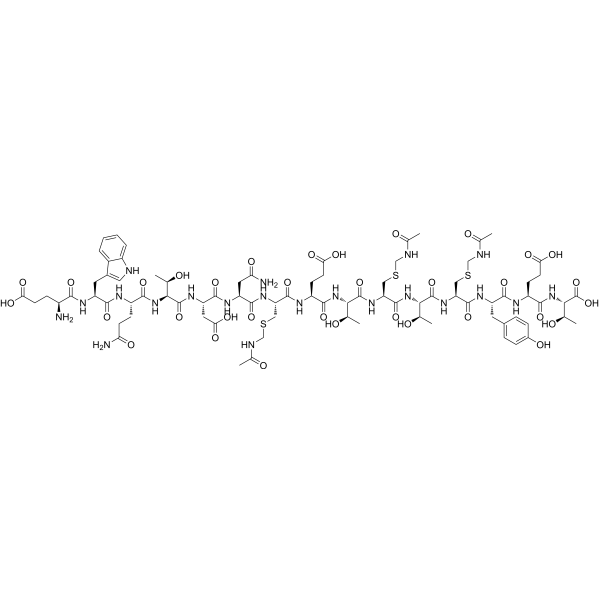
Tigapotide (PCK-3145) is a synthetic 15-mer peptide derived from prostate-secretory protein, and acts as an antineoplastic agent. Tigapotide inhibits tumor growth, experimental bone metastasis, and malignancy-associated hypocalcemia. Tigapotide induces apoptosis in prostate cancer cells and tumors, and suppresses the growth of prostate cancer cells. Tigapotide inhibits the production of parathyroid hormone-related protein (PTHrP) in tumors and plasma. Tigapotide reduces plasma calcium levels in hypercalcemic tumor-bearing rats. Tigapotide is applicable for the research of prostate cancer and malignancy-associated hypercalcemia.
For research use only. We do not sell to patients.
- CAS No.: 848084-83-3
- Formula: C82H121N21O33S3
- Molecular Weight:2025.15
-
Storage:
Please store the product under the recommended conditions in the Certificate of Analysis.

To place orders, for customer services and technical support, please contact: MedChemExpress USA
Tel: 609-228-6898 E-mail: [email protected] [email protected]


-
 Biological Activity
-
Chemical Information
- Protocols
- Purity & Documentation
- References
-
 Help & FAQs




Biological Activity
Description
In Vitro
Tigapotide causes dose-dependent inhibition of MatLyLu-PTHrP prostate cancer cell growth in in vitro[2].
Tigapotide induces apoptosis in MatLyLu-PTHrP prostate cancer cells in vitro[2].
MedChemExpress (MCE) has not independently confirmed the accuracy of these methods. They are for reference only.
In Vivo
MedChemExpress (MCE) has not independently confirmed the accuracy of these methods. They are for reference only.
-
Animal Model:Copenhagen rats (male, inoculated s.c. into the right flank with MatLyLu-PTHrP cells)[2]
-
Dosage:1.0 μg/kg/day; 10 μg/kg/day; 100 μg/kg/day
-
Administration:s.c.; daily; up to 15 days
-
Result:Caused a dose-dependent inhibition of MatLyLu-PTHrP tumor growth, with statistically significant tumor volume reductions at 10.0 μg/kg/day and 100.0 μg/kg/day compared to vehicle controls at Day 14 and Day 16.
Reduced tumoral PTHrP production in a dose-dependent manner, with the highest dose producing the most pronounced effect.
Reduced plasma PTHrP levels in a dose-dependent manner, with statistically significant reductions at 10.0 μg/kg/day and 100.0 μg/kg/day compared to vehicle controls, with levels falling to ~60 pmol equivalents/l and ~45 pmol equivalents/l, respectively.
Reduced plasma calcium levels in a dose-dependent manner, with statistically significant reductions at 10.0 μg/kg/day and 100.0 μg/kg/day compared to vehicle controls, with levels falling to ~4.0 mmol/l and ~3.6 mmol/l, respectively.
Induced tumor cell apoptosis as measured by DNA fragmentation and TUNEL assay.
Significantly delayed the development of hind-limb paralysis compared to vehicle controls, with a higher percentage of non-paralyzed animals remaining at Days 14, 15, and 16.
Exhibited a significant decrease in tumor burden in the lumbar vertebrae compared to vehicle controls.
Was more effective at delaying the development of skeletal metastases than equimolar concentrations of PSP-94.
- Detection of Apoptosis
- TUNEL staining for apoptotic DNA fragmentation
- Annexin V plus membrane-impermeant dye apoptosis staining
- Research Protocol for Endocrine Diseases
- Patient-Derived Xenograft (PDX)
- Patient-Derived Orthotopic Xenograft (PDOX)
- Apoptosis Solutions
- Intracardiac/Intra-Arterial Metastasis Xenograft
- Subcutaneous Cell-Line-Derived Xenograft
- Orthotopic Cell-Line Xenograft
Clinical Trial
| NCT Number | Sponsor | Condition | Start Date |
Phase

|
|---|---|---|---|---|
| NCT01329991 | 2011-05 | PHASE1 |


Chemical Information
-
CAS No. 848084-83-3
-
Molecular Weight 2025.15
-
Formula C82H121N21O33S3
-
Synonyms
PCK-3145
-
Sequence
Glu-Trp-Gln-Thr-Asp-Asn-{Cys(Acm)}-Glu-Thr-{Cys(Acm)}-Thr-{Cys(Acm)}-Tyr-Glu-Thr
-
Sequence Shortening
EWQTDN-{Cys(Acm)}-ET-{Cys(Acm)}-T-{Cys(Acm)}-YET
-
Shipping
Room temperature in continental US; may vary elsewhere.
-
Storage
Please store the product under the recommended conditions in the Certificate of Analysis.


Purity & Documentation
References
[1]. Pippa, N., et al. Advanced nanocarriers for an antitumor peptide. J Nanopart Res 15, 2062 (2013).
[2]. Shukeir N, et al. Prostate secretory protein of 94 amino acids (PSP-94) and its peptide (PCK3145) as potential therapeutic modalities for prostate cancer. Anticancer Drugs. 2005;16(10):1045-1051. [Content Brief]

Calculators
Concentration (start) × Volume (start) = Concentration (final) × Volume (final)


Tigapotide Related Classifications
HY-16498 Related Classifications
 Powered by Bioz
Keywords
- Tigapotide
- 848084-83-3
- PCK-3145
- PCK3145
- PCK 3145
- Apoptosis
- PTHR
- hypercalcemia of malignancy
- parathyroid hormone-related protein
- male Copenhagen rats
- hypercalcemic tumor-bearing rats
- prostate cancer
- prostate cancer cells
- hormone-refractory prostate cancer
- prostate secretory protein
- skeletal metastases
- MatLyLu-PTHrP prostate cancer cells
- Inhibitor
- inhibitor
- inhibit