



Ceanothic acid

Based on 1 Customer Validation
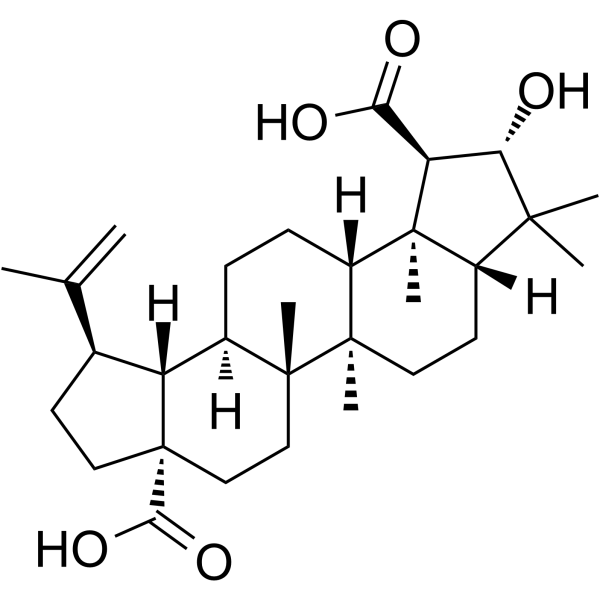
Ceanothic acid (Emmolic acid) is an orally active pentacyclic triterpenoid. Ceanothic acid inhibits the growth of various oral bacteria, including Streptococcus mutans, Actinomyces viscosus, Porphyromonas gingivalis, and Prevotella intermedia. Ceanothic acid scavenges DPPH and H2O2 free radicals. Ceanothic acid inhibits acetic acid (HY-Y0319)-induced writhing response, xylene-induced ear swelling, and carrageenan-induced paw swelling in mice. Ceanothic acid can be used in research related to oral bacterial infections, ovarian cancer, liver cancer, and liver injury.
For research use only. We do not sell to patients.
- Purity : 98.0%
- CAS No.: 21302-79-4
- Formula: C30H46O5
- Molecular Weight:486.68
-
Storage:Powder -20°C, 3 years , 4°C, 2 years ; In solvent -80°C, 6 months , -20°C, 1 month

To place orders, for customer services and technical support, please contact: MedChemExpress USA
Tel: 609-228-6898 E-mail: [email protected] [email protected]


-
 Biological Activity
-
Chemical Information
- Protocols
- Purity & Documentation
- References
-
 Help & FAQs




Biological Activity
Description
Cellular Effect
|
Cell Line

|
Type | Value | Description | References |
|---|---|---|---|---|
| C3H 10T1/2 | IC50 |
>200 μM
Compound: 5
|
Cytotoxicity against mouse C3H10T1/2 cells after 24 hrs by fluorometric microculture cytotoxicity assay
Cytotoxicity against mouse C3H10T1/2 cells after 24 hrs by fluorometric microculture cytotoxicity assay
|
[PMID: 18842418] |
| DU-145 | IC50 |
>200 μM
Compound: 5
|
Cytotoxicity against human DU145 cells after 24 hrs by fluorometric microculture cytotoxicity assay
Cytotoxicity against human DU145 cells after 24 hrs by fluorometric microculture cytotoxicity assay
|
[PMID: 18842418] |
| HaCaT | IC50 |
>200 μM
Compound: 5
|
Inhibition of GLI1-mediated transcriptional activity in human HaCaT cells by luciferase based reporter gene assay
Inhibition of GLI1-mediated transcriptional activity in human HaCaT cells by luciferase based reporter gene assay
|
[PMID: 18842418] |
| HepG2 | IC50 |
>10 μM
Compound: 19
|
Cytotoxicity against human HepG2 cells assessed as reduction in cell viability measured after 48 hrs by MTT assay
Cytotoxicity against human HepG2 cells assessed as reduction in cell viability measured after 48 hrs by MTT assay
|
[PMID: 27617953] |
| PANC-1 | IC50 |
195 μM
Compound: 5
|
Cytotoxicity against human PANC1 after 24 hrs by fluorometric microculture cytotoxicity assay
Cytotoxicity against human PANC1 after 24 hrs by fluorometric microculture cytotoxicity assay
|
[PMID: 18842418] |
| Raji | IC50 |
400 molar ratio
Compound: 2, CA
|
Inhibition of TPA-induced EBV-early antigen activation in human Raji cells assessed as EA induction after 48 hrs relative to TPA
Inhibition of TPA-induced EBV-early antigen activation in human Raji cells assessed as EA induction after 48 hrs relative to TPA
|
[PMID: 19481937] |
In Vitro
Ceanothic acid (42-250 μg/mL; 48 hours) inhibits the growth of Actinomyces viscosus, Porphyromonas gingivalis, Prevotella intermedia, and Streptococcus mutans with MIC values of 42 μg/mL, 62 μg/mL, 62 μg/mL, and 250 μg/mL, respectively[1].
Ceanothic acid (20-100 μg/mL; 30 min) exhibits dose-dependent DPPH free radical scavenging activity, with 14.1% activity at 20 μg/mL and 52.8% activity at 100 μg/mL in a cell-free assay[2].
Ceanothic acid (48 h) inhibits OVCAR-3, HeLa, and FS-5 cells with the cell survival of 68%, 65%, and 81%, respectively[3].
MedChemExpress (MCE) has not independently confirmed the accuracy of these methods. They are for reference only.
In Vivo
Ceanothic acid (25-50 mg/kg; p.o.; single dose) exhibits statistically significant anti-inflammatory activity against Xylene-induced ear edema, with 51.33% inhibition at 50 mg/kg (p.o.) in BALB/c mice[2].
Ceanothic acid (25-50 mg/kg; i.p.; single dose) exhibits statistically significant anti-inflammatory activity against carrageenan-induced paw edema, with 33.3% inhibition at 50 mg/kg (i.p.) in BALB/c mice 5 hours post-carrageenan injection[2].
Ceanothic acid (25-50 mg/kg; p.o.; daily; 7 days) exhibits statistically significant hepatoprotective activity against CCl4 (HY-Y0298)-induced liver injury in BALB/c mice, with more pronounced effects at 50 mg/kg including partial restoration of serum biomarkers, reduction of lipid peroxidation, and improvement of histopathological liver damage[2].
MedChemExpress (MCE) has not independently confirmed the accuracy of these methods. They are for reference only.
-
Animal Model:BALB/c (either sex, 20-30 g)[2]
-
Dosage:25 mg/kg; 50 mg/kg
-
Administration:p.o.; single dose
-
Result:Inhibited acetic acid-induced writhing by a statistically significant level at 25 mg/kg.
Inhibited Acetic acid-induced writhing by 64.28% at 50 mg/kg.
-
Animal Model:BALB/c (either sex, 20-30 g)[2]
-
Dosage:25 mg/kg; 50 mg/kg
-
Administration:p.o.; single dose
-
Result:Exhibited 34% inhibitory activity against xylene-induced ear edema at 25 mg/kg.
Exhibited 51.33% inhibitory activity against xylene-induced ear edema at 50 mg/kg.
-
Animal Model:BALB/c (20-25 g)[2]
-
Dosage:25 mg/kg; 50 mg/kg
-
Administration:i.p.; single dose
-
Result:Exhibited 13.7% inhibition of carrageenan-induced paw edema at 25 mg/kg 5 hours post-carrageenan injection.
Exhibited 33.3% inhibition of carrageenan-induced paw edema at 50 mg/kg 5 hours post-carrageenan injection.
-
Animal Model:BALB/c (either sex, 20-30 g, carbon tetrachloride-induced liver injury)[2]
-
Dosage:25 mg/kg; 50 mg/kg
-
Administration:p.o.; daily; 7 days
-
Result:Significantly reduced CCl4-induced elevations in serum alanine transaminase (ALT) and alkaline phosphatase (ALP) levels, partially restored serum total protein (TP) levels, and reduced total bilirubin (TB) levels at 25 mg/kg and 50 mg/kg.
Did not significantly improve CCl4-reduced catalase (CAT) and superoxide dismutase (SOD) activity, but reduced CCl4-induced elevation of malondialdehyde (MDA) levels at 25 mg/kg and 50 mg/kg.
Did not significantly reduce CCl4-prolonged phenobarbital-induced sleeping time at 25 mg/kg; produced a small, non-significant reduction in sleeping time at 50 mg/kg.
Caused a 0.99% loss in body weight at 25 mg/kg, and a 0.65% gain in body weight at 50 mg/kg; reduced hepatic index from 8.8% (CCl4-only group) to 7.4% at 25 mg/kg and 6.5% at 50 mg/kg.
Reduced CCl4-induced centrilobular necrosis, piecemeal necrosis, and lymphocyte infiltration to mild levels, with mild sinusoidal congestion at 25 mg/kg; eliminated centrilobular and piecemeal necrosis, reduced lymphocyte infiltration to mild levels, and left mild sinusoidal congestion at 50 mg/kg.


Chemical Information
-
CAS No. 21302-79-4
-
Appearance Solid
-
Molecular Weight 486.68
-
Formula C30H46O5
-
Color White to off-white
-
SMILES
C[C@@]12[C@]3([H])[C@]([C@]4([C@]([C@]5([H])[C@](C(O)=O)(CC[C@H]5C(C)=C)CC4)([H])CC3)C)(CC[C@@]1([H])C(C)(C)[C@@H](O)[C@@H]2C(O)=O)C
-
Synonyms
Emmolic acid
-
Structure Classification
-
Initial Source
-
Shipping
Room temperature in continental US; may vary elsewhere.
-
Storage
Powder -20°C 3 years 4°C 2 years In solvent -80°C 6 months -20°C 1 month


Purity & Documentation
-
Data Sheet (286 KB)
-
SDS (252 KB)
- English - EN (252 KB)
- Français - FR (252 KB)
- Deutsch - DE (252 KB)
- Norwegian - NO (252 KB)
- Español - ES (252 KB)
- Swedish - SV (252 KB)
- Italian - IT (252 KB)
- Korean - KR (252 KB)
- Portuguese - PT (252 KB)
-
Handling Instructions (2659 KB)
References
[1]. Li XC, et al. Antimicrobial compounds from Ceanothus americanus against oral pathogens. Phytochemistry. 1997;46(1):97-102. [Content Brief]
[2]. Abdullah, et al. Antioxidant, antinociceptive, anti-inflammatory, and hepatoprotective activities of pentacyclic triterpenes isolated from Ziziphus oxyphylla Edgew. Drug Chem Toxicol. 2022 Jul;45(4):1796-1807. [Content Brief]
[3]. Lee SS, et al. Preparation and cytotoxic effect of ceanothic acid derivatives. J Nat Prod. 1998 Nov;61(11):1343-7. [Content Brief]

Calculators
Concentration (start) × Volume (start) = Concentration (final) × Volume (final)


Ceanothic acid Related Classifications
HY-N3558 Related Classifications
 Powered by Bioz