26 Results for "

Cholera_toxin

" in MedChemExpress (MCE) Product Catalog:
Products (26)

26 Results for "Cholera_toxin" in MCE Product Catalog:

13
13 Publications Verification
Cat. No.: HY-156131
CAS No.: 53179-11-6
Synonyms: ADL 2-1294
Loperamide (ADL 2-1294) is selective and orally active μ opioid receptor agonist with Ki valuess of 3, 48 and 1156 nM against μ, δ and κ opioid receptor, respectively. Loperamide produces antinociception and antihyperalgesia. Loperamide exhibits peripheral selectivity, enhancing fluid, electrolyte, and glucose absorption, reversing PGE2 (HY-101952)- and Cholera toxin (HY-P1446)-induced intestinal secretion, and reducing intestinal motility. Loperamide can be used for the researches of inflammatory pain and protracted diarrhoea .
loading...
    loading...
1
1 Cited Publications
Cat. No.: HY-112624I
CAS No.: 9004-54-0
Synonyms: Dextran 3; Dextran D3; Dextran T3(MW 2400-3600)
Dextran T3 (Dextran 3; Dextran T3(MW 2400-3600)) is a neural tracer and intestinal permeability probe that can move anterogradely and retrogradely in neuronal axons by passive diffusion. Dextran T3 (MW 3,000) is able to permeate across the intestinal epithelial cell membrane in the presence of cholera toxin-induced cytoskeletal disturbance. Dextran T3 (MW 3,000) is used as a fluorescent marker to rapidly label developing neurons (such as Xenopus retinal ganglion cells) and to assess intestinal barrier function. It can be used to study axonal transport in neuroanatomy and permeability changes in intestinal pathophysiology. The Dextran series of compounds are also natural polysaccharide drug carriers that can be connected to drugs through covalent bonding methods such as ester bonds, amide bonds or click chemistry, or self-assembled to form carriers such as nanoparticles and hydrogels. Dextran is biodegradable and biocompatible, and can achieve targeted delivery and controlled release of drugs. Dextran derivatives can prolong the half-life of drugs, increase local concentrations, and reduce the activity of immune clearance .
loading...
    loading...
1
1 Cited Publications
Cat. No.: HY-129040A
CAS No.: 87862-25-7
Purity:  99.78%
Synonyms: MIBG sulfate; Iobenguane sulfate
Target:  

Adrenergic Receptor

Research Areas:  

Cancer

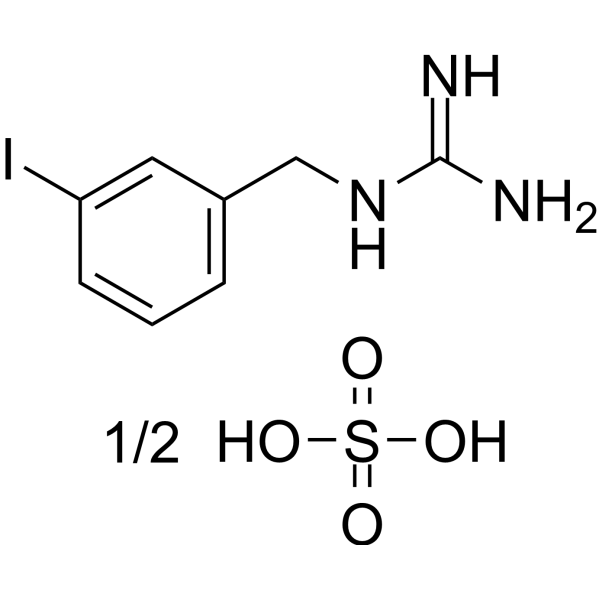
m-Iodobenzylguanidine sulfate (MIBG sulfate) is an analogue of the neurotransmitter norepinephrine with antitumor activity. Radioiodinated m-Iodobenzylguanidine sulfate is clinically used as a tumor-targeted radiopharmaceutical in the diagnosis and treatment of adrenergic tumors. m-Iodobenzylguanidine sulfate is a high-affinity substrate for cholera toxin that interferes with cellular mono(ADP-ribosylation) .
loading...
    loading...
Cat. No.: HY-P3394
CAS No.: 131096-89-4
Synonyms: CTB, from vibrio cholerae
Cholera toxin B subunit, from vibrio cholerae (CTB, from vibrio cholerae) is non-toxic to cells and possesses no intrinsic adenylate cyclase activity. Cholera toxin B subunit, from vibrio cholerae attaches to cells by binding to ganglioside GM1.8 CTB has been shown to be a good label for microglial cells (due to the enrichment of ganglioside GM1 on their cell surface), but not for oligodendrocytes or astrocytes. Cholera toxin B subunit, from vibrio cholerae has been reported to be an excellent tracer for the study of axonal transport using immunohistochemical methods. Cholera toxin B subunit, from vibrio cholerae has been widely used as a marker of membrane lipid rafts .
loading...
    loading...
Cat. No.: HY-P10529
CAS No.: 247185-97-3
Target:  

Trk Receptor

Research Areas:  

Infection

Ganglioside GM1-binding peptide p3 is a synthetic peptide that can specifically bind to the pentasaccharide part of GM1 ganglioside. The dynamic transformation of Ganglioside GM1-binding peptide p3 may play an important role in the function of GM1 as a multiple receptor, such as in the classical pathway of cholera toxin infection. Ganglioside GM1-binding peptide p3 can be used to study the interaction between GM1 and its ligands .
loading...
    loading...
Cat. No.: HY-401913
CAS No.: 345288-49-5
Research Areas:  

Infection Cancer

Endo CNTinh-03 is inhibitor for the elevation of cAMP and cGMP induced by agonist, such as G protein-coupled receptors, adenylate cyclase, and guanylate cyclase (IC50 is 4 μM). Endo CNTinh-03 inhibits cholera toxin- and Escherichia coli (STa) toxin- induced CFTR chloride current, ameliorates secretory diarrhea in mouse models, and prevents cyst growth in polycystic kidney disease model .
loading...
    loading...
Cat. No.: HY-N10511
CAS No.: 67063-78-9
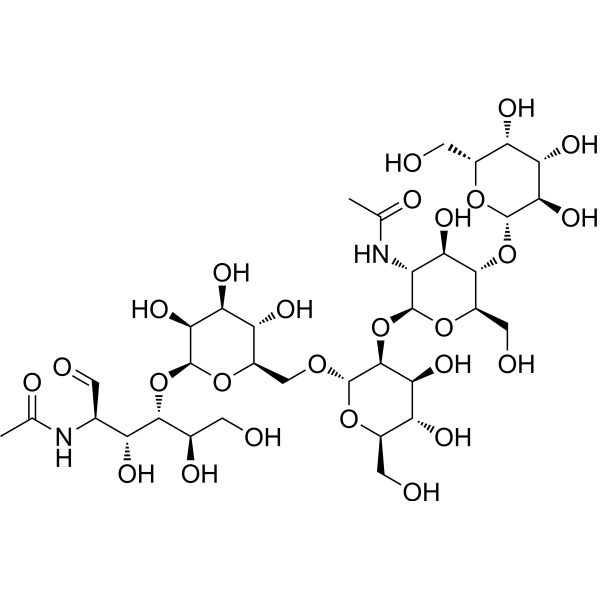
GM1a Ganglioside oligosaccharide is a semisynthetic form of ganglioside GM1. Ganglioside GM1 is the natural receptor for cholera toxin and plays an important role not only in general growth regulation but also in the coupling of hormone-induced responses .
loading...
    loading...
Cat. No.: HY-P3394M
Synonyms: CTB-Biotin
Cholera toxin B subunit-Biotin (CTB-Biotin) is a biological probe formed by the covalent conjugation of the non-toxic cholera toxin B subunit pentamer (CTB) with the Biotin. The CTB component exhibits high affinity for GM1 gangliosides, making the probe suitable for applications such as neuronal tracing, membrane dynamics studies, and multicolor imaging.
loading...
    loading...
Cat. No.: HY-P3394O
Synonyms: CTB-HRP
Cholera toxin B subunit-HRP (CTB-HRP) is a biological probe formed by the covalent conjugation of the non-toxic cholera toxin B subunit pentamer (CTB) with the HRP. The CTB component exhibits high affinity for GM1 gangliosides, making the probe suitable for applications such as neuronal tracing, membrane dynamics studies, and multicolor imaging.
loading...
    loading...
Cat. No.: HY-P3394N
Synonyms: CTB-Rhodamine
Cholera toxin B subunit-Rhodamine (CTB-Rhodamine) is a biological probe formed by the covalent conjugation of the non-toxic cholera toxin B subunit pentamer (CTB) with the Rhodamine fluorescent dye. The CTB component exhibits high affinity for GM1 gangliosides, making the probe suitable for applications such as neuronal tracing, membrane dynamics studies, and multicolor imaging (Ex/Em = 544/576 nm).
loading...
    loading...
Cat. No.: HY-P3394P
Synonyms: CTB-Fluorescein
Cholera toxin B subunit-Fluorescein (CTB-Fluorescein) is a biological probe formed by the covalent conjugation of the non-toxic cholera toxin B subunit pentamer (CTB) with the Fluorescein fluorescent dye. The CTB component exhibits high affinity for GM1 gangliosides, making the probe suitable for applications such as neuronal tracing, membrane dynamics studies, and multicolor imaging (Ex/Em = 405/435 nm).
loading...
    loading...
Cat. No.: HY-P3394A
Synonyms: CTB-AF350
Cholera toxin B subunit-AF350 (CTB-AF350) is a biological probe formed by the covalent conjugation of the non-toxic cholera toxin B subunit pentamer (CTB) with the AF350 fluorescent dye. The CTB component exhibits high affinity for GM1 gangliosides, making the probe suitable for applications such as neuronal tracing, membrane dynamics studies, and multicolor imaging (Ex/Em = 346/445 nm).
loading...
    loading...
Cat. No.: HY-P3394B
Synonyms: CTB-AF405
Cholera toxin B subunit-AF405 (CTB-AF405) is a biological probe formed by the covalent conjugation of the non-toxic cholera toxin B subunit pentamer (CTB) with the AF405 fluorescent dye. The CTB component exhibits high affinity for GM1 gangliosides, making the probe suitable for applications such as neuronal tracing, membrane dynamics studies, and multicolor imaging (Ex/Em = 405/435 nm).
loading...
    loading...
Cat. No.: HY-P3394C
Synonyms: CTB-AF488
Cholera toxin B subunit-AF488 (CTB-AF488) is a biological probe formed by the covalent conjugation of the non-toxic cholera toxin B subunit pentamer (CTB) with the AF488 fluorescent dye. The CTB component exhibits high affinity for GM1 gangliosides, making the probe suitable for applications such as neuronal tracing, membrane dynamics studies, and multicolor imaging (Ex/Em = 470/520 nm).
loading...
    loading...
Cat. No.: HY-P3394D
Synonyms: CTB-AF568
Cholera toxin B subunit-AF568 (CTB-AF568) is a biological probe formed by the covalent conjugation of the non-toxic cholera toxin B subunit pentamer (CTB) with the AF568 fluorescent dye. The CTB component exhibits high affinity for GM1 gangliosides, making the probe suitable for applications such as neuronal tracing, membrane dynamics studies, and multicolor imaging (Ex/Em = 579/603 nm).
loading...
    loading...
Cat. No.: HY-P3394E
Synonyms: CTB-AF594
Cholera toxin B subunit-AF594 (CTB-AF594) is a biological probe formed by the covalent conjugation of the non-toxic cholera toxin B subunit pentamer (CTB) with the AF594 fluorescent dye. The CTB component exhibits high affinity for GM1 gangliosides, making the probe suitable for applications such as neuronal tracing, membrane dynamics studies, and multicolor imaging (Ex/Em = 590/617 nm).
loading...
    loading...
Cat. No.: HY-P3394H
Synonyms: CTB-AF647
Cholera toxin B subunit-AF647 (CTB-AF647) is a biological probe formed by the covalent conjugation of the non-toxic cholera toxin B subunit pentamer (CTB) with the AF647 fluorescent dye. The CTB component exhibits high affinity for GM1 gangliosides, making the probe suitable for applications such as neuronal tracing, membrane dynamics studies, and multicolor imaging (Ex/Em = 650/665 nm).
loading...
    loading...
Cat. No.: HY-P3394I
Synonyms: CTB-AF680
Cholera toxin B subunit-AF680 (CTB-AF680) is a biological probe formed by the covalent conjugation of the non-toxic cholera toxin B subunit pentamer (CTB) with the AF680 fluorescent dye. The CTB component exhibits high affinity for GM1 gangliosides, making the probe suitable for applications such as neuronal tracing, membrane dynamics studies, and multicolor imaging (Ex/Em = 684/707 nm).
loading...
    loading...
Cat. No.: HY-P3394J
Synonyms: CTB-Cy3
Cholera toxin B subunit-Cy3 (CTB-Cy3) is a biological probe formed by the covalent conjugation of the non-toxic cholera toxin B subunit pentamer (CTB) with the Cy3 fluorescent dye. The CTB component exhibits high affinity for GM1 gangliosides, making the probe suitable for applications such as neuronal tracing, membrane dynamics studies, and multicolor imaging (Ex/Em = 554/568 nm).
loading...
    loading...
Cat. No.: HY-P3394K
Synonyms: CTB-Cy5
Cholera toxin B subunit-Cy5 (CTB-Cy5) is a biological probe formed by the covalent conjugation of the non-toxic cholera toxin B subunit pentamer (CTB) with the Cy5 fluorescent dye. The CTB component exhibits high affinity for GM1 gangliosides, making the probe suitable for applications such as neuronal tracing, membrane dynamics studies, and multicolor imaging (Ex/Em = 646/664 nm).
loading...
    loading...

