



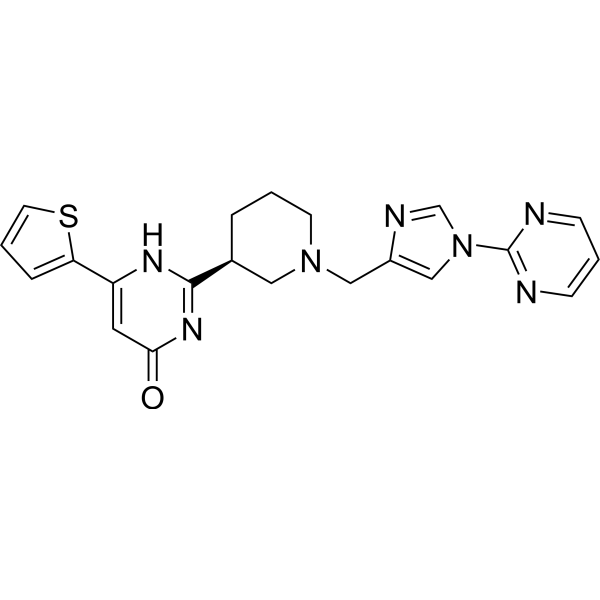
Ribocil-C
Based on 1 publication(s) in Google Scholar
Ribocil-C is a highly selective inhibitor of bacterial riboflavin riboswitches.
For research use only. We do not sell to patients.
- Purity : 99.69%
- CAS No.: 1825355-56-3
- Formula: C21H21N7OS
- Molecular Weight:419.50
-
Storage:Powder -20°C, 3 years , 4°C, 2 years ; In solvent -80°C, 2 years , -20°C, 1 year

To place orders, for customer services and technical support, please contact: MedChemExpress USA
Tel: 609-228-6898 E-mail: [email protected] [email protected]


-
 Biological Activity
-
Chemical Information
-
Solvent & Solubility
- Purity & Documentation
- References
-
 Help & FAQs


Publications Citing Use of MedChemExpress (MCE) Ribocil-C
More

Biological Activity
Description
IC50 & Target
Bacterial riboflavin riboswitches[1]
In Vitro
Ribocil-C is a highly selective inhibitor of the flavin mononucleotide (FMN) riboswitch that controls expression of de novo riboflavin (RF, vitamin B2) biosynthesis in Escherichia coli. Ribocil-C specifically inhibits dual FMN riboswitches, separately controlling RF biosynthesis and uptake processes essential for Staphylococcus aureus growth and pathogenesis[1]. Ribocil-C is a small-molecule synthetic mimic of FMN that binds the FMN riboswitch of multiple GN bacteria, including Escherichia coli, Pseudomonas aeruginosa, and Acinetobacter baumannii, to inhibit ribB expression, RF synthesis, and consequently arrest bacterial growth[1][2].
MedChemExpress (MCE) has not independently confirmed the accuracy of these methods. They are for reference only. .
In Vivo
MedChemExpress (MCE) has not independently confirmed the accuracy of these methods. They are for reference only.


Chemical Information
-
CAS No. 1825355-56-3
-
Appearance Solid
-
Molecular Weight 419.50
-
Formula C21H21N7OS
-
Color White to off-white
-
SMILES
O=C1C=C(C2=CC=CS2)NC([C@H]3CCCN(CC4=CN(C5=NC=CC=N5)C=N4)C3)=N1
-
Shipping
Room temperature in continental US; may vary elsewhere.
-
Storage
Powder -20°C 3 years 4°C 2 years In solvent -80°C 2 years -20°C 1 year


Publications (1)
-
Journal Impact Factor
-
Most Recent
-
Nucleic Acids Res
Transcriptional pause extension benefits the stand-by rather than catch-up Rho-dependent termination. [Abstract]2023 Apr 11;51(6):2778-2789. PMID: 36762473


Solvent & Solubility
In Vitro:
DMSO : 110 mg/mL (262.22 mM; Need ultrasonic; Hygroscopic DMSO has a significant impact on the solubility of product, please use newly opened DMSO)
Please refer to the solubility information to select the appropriate solvent. Once prepared, please aliquot and store the solution to prevent product inactivation from repeated freeze-thaw cycles.
Storage method and period of stock solution: -80°C, 2 years; -20°C, 1 year. When stored at -80°C, please use it within 2 years. When stored at -20°C, please use it within 1 year.
Please refer to the solubility information to select the appropriate solvent. Once prepared, please aliquot and store the solution to prevent product inactivation from repeated freeze-thaw cycles.
Storage method and period of stock solution: -80°C, 2 years; -20°C, 1 year. When stored at -80°C, please use it within 2 years. When stored at -20°C, please use it within 1 year.
Concentration (start) × Volume (start) = Concentration (final) × Volume (final)
In Vivo:
Select the appropriate dissolution method based on your experimental animal and administration route.
- For the following dissolution methods, please ensure to first prepare a clear stock solution using an In Vitro approach and then sequentially add co-solvents:
- To ensure reliable experimental results, the clarified stock solution can be appropriately stored based on storage conditions. As for the working solution for In Vivo experiments, it is recommended to prepare freshly and use it on the same day.
- The percentages shown for the solvents indicate their volumetric ratio in the final prepared solution. If precipitation or phase separation occurs during preparation, heat and/or sonication can be used to aid dissolution.
Add each solvent one by one: 10% DMSO 40% PEG300 5% Tween-80 45% Saline
Solubility: ≥ 2.75 mg/mL (6.56 mM); Clear solution
This protocol yields a clear solution of ≥ 2.75 mg/mL (saturation unknown).
Taking 1 mL working solution as an example, add 100 μL DMSO stock solution (27.5 mg/mL) to 400 μL PEG300, and mix evenly; then add 50 μL Tween-80 and mix evenly; then add 450 μL Saline to adjust the volume to 1 mL.
Preparation of Saline: Dissolve 0.9 g sodium chloride in ddH₂O and dilute to 100 mL to obtain a clear Saline solution.
In Vivo Dissolution Calculator
Please enter the basic information of animal experiments:
-
-
-
-
Recommended: Prepare an additional quantity of animals to account for potential losses during experiments.
Please enter your animal formula composition:
-
%DMSO +
Recommended: Keep the proportion of DMSO in working solution below 2% if your animal is weak.
-
%+
-
+%Tween-80 + +
-
%Saline +
The co-solvents required include: DMSO, . All of co-solvents are available by MedChemExpress (MCE). , Tween 80. All of co-solvents are available by MedChemExpress (MCE).
Working solution concentration: 0.22 mg/mL
Method for preparing stock solution: mg drug dissolved in μL DMSO. Stock solution concentration: mg/mL.
1. Take μL DMSO stock solution;
2. Add μL .
μL , mix evenly;
3. Then add μL Tween 80, mix evenly;
4. Then add μL
Please ensure that the stock solution in the first step is dissolved to a clear state, and add co-solvents in sequence. You can use ultrasonic heating (ultrasonic cleaner, recommended frequency 20-40 kHz), vortexing, etc. to assist dissolution.


Purity & Documentation
-
Data Sheet (274 KB)
-
SDS (393 KB)
- English - EN (393 KB)
- Français - FR (393 KB)
- Deutsch - DE (393 KB)
- Norwegian - NO (393 KB)
- Español - ES (393 KB)
- Swedish - SV (393 KB)
- Italian - IT (393 KB)
- Korean - KR (393 KB)
- Portuguese - PT (393 KB)
-
Handling Instructions (2659 KB)
References
[1]. Wang H, et al. Dual-Targeting Small-Molecule Inhibitors of the Staphylococcus aureus FMN Riboswitch DisruptRiboflavin Homeostasis in an Infectious Setting. Cell Chem Biol. 2017 May 18;24(5):576-588. [Content Brief]
[2]. Howe JA, et al. Selective small-molecule inhibition of an RNA structural element. Nature. 2015 Oct 29;526(7575):672-7. [Content Brief]


Complete Stock Solution Preparation Table
Please refer to the solubility information to select the appropriate solvent. Once prepared, please aliquot and store the solution to prevent product inactivation from repeated freeze-thaw cycles.
Storage method and period of stock solution: -80°C, 2 years; -20°C, 1 year. When stored at -80°C, please use it within 2 years. When stored at -20°C, please use it within 1 year.
| Optional Solvent | Concentration Solvent Mass | 1 mg | 5 mg | 10 mg | 25 mg |
|---|---|---|---|---|---|
| DMSO | 1 mM | 2.3838 mL | 11.9190 mL | 23.8379 mL | 59.5948 mL |
| 5 mM | 0.4768 mL | 2.3838 mL | 4.7676 mL | 11.9190 mL | |
| 10 mM | 0.2384 mL | 1.1919 mL | 2.3838 mL | 5.9595 mL | |
| 15 mM | 0.1589 mL | 0.7946 mL | 1.5892 mL | 3.9730 mL | |
| 20 mM | 0.1192 mL | 0.5959 mL | 1.1919 mL | 2.9797 mL | |
| 25 mM | 0.0954 mL | 0.4768 mL | 0.9535 mL | 2.3838 mL | |
| 30 mM | 0.0795 mL | 0.3973 mL | 0.7946 mL | 1.9865 mL | |
| 40 mM | 0.0596 mL | 0.2980 mL | 0.5959 mL | 1.4899 mL | |
| 50 mM | 0.0477 mL | 0.2384 mL | 0.4768 mL | 1.1919 mL | |
| 60 mM | 0.0397 mL | 0.1986 mL | 0.3973 mL | 0.9932 mL | |
| 80 mM | 0.0298 mL | 0.1490 mL | 0.2980 mL | 0.7449 mL | |
| 100 mM | 0.0238 mL | 0.1192 mL | 0.2384 mL | 0.5959 mL |


Ribocil-C Related Classifications
HY-19488A Related Classifications
 Powered by Bioz