



S-4048
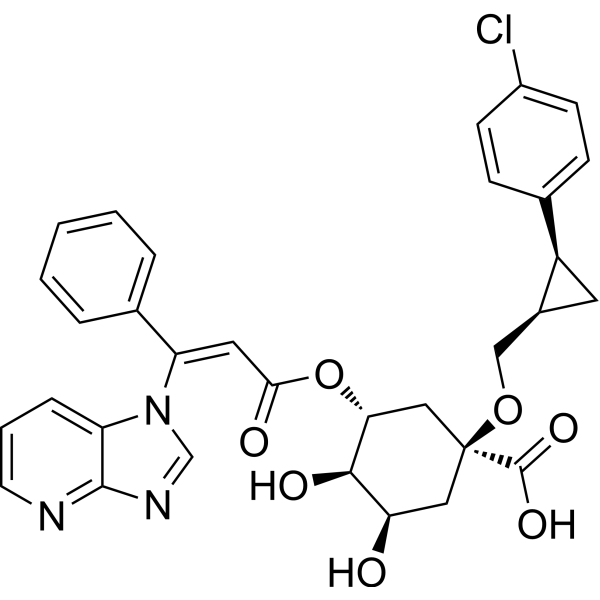
S-4048 is a glucose-6-phosphate translocase modulator and hypoglycemic agent. S-4048 is taken up by hepatocytes via OATP-1 and is rapidly eliminated via the hepatobiliary system in rats. S-4048 blocks glucose-6-phosphate translocase, prevents glucose-6-phosphate from entering the endoplasmic reticulum, and thereby interferes with the glucose-6-phosphatase system (i.e., the final step of hepatic gluconeogenesis and glycogenolysis) to regulate hepatic glucose production. S-4048 completely inhibits glucose production from pyruvate in GLUT2-deficient hepatocytes without affecting the release of cytoplasmic glucose. S-4048 effectively reduces blood glucose levels in rats and has been used in studies related to type 2 diabetes.
For research use only. We do not sell to patients.
- CAS No.: 173534-37-7
- Formula: C32H30ClN3O7
- Molecular Weight:604.05
-
Storage:
Please store the product under the recommended conditions in the Certificate of Analysis.

To place orders, for customer services and technical support, please contact: MedChemExpress USA
Tel: 609-228-6898 E-mail: [email protected] [email protected]


-
 Biological Activity
-
Chemical Information
- Protocols
- Purity & Documentation
- References
-
 Help & FAQs




Biological Activity
Description
IC50 & Target
IC50:9.4 nM for rat microsomes.
In Vitro
S-4048 (10 μM; 30-60 min) does not inhibit the release of cytosolic glucose from GLUT2-/- mouse hepatocytes, indicating this minor glucose release pathway does not require glucose re-entry into the endoplasmic reticulum via glucose-6-phosphate translocase[1].
MedChemExpress (MCE) has not independently confirmed the accuracy of these methods. They are for reference only.
In Vivo
S-4048 (10 mg/kg; i.v. bolus injection) undergoes rapid hepatobiliary elimination in male Wistar rats, with 57% of the 10 mg/kg i.v. bolus dose excreted as parent compound in bile within 30 minutes, driving a high plasma clearance[2].
S-4048 (10-50 mg/kg; i.v. bolus injection) exhibits a short blood glucose lowering effect and comparable hepatobiliary elimination in male mrp-2 deficient GY/TR3 rats relative to Wistar rats[2].
MedChemExpress (MCE) has not independently confirmed the accuracy of these methods. They are for reference only.
-
Animal Model:Wistar (male, 280-360 g, starved for 24 hours prior to experiments)[2]
-
Dosage:50 mg/kg (blood glucose reduction); 30 mg/kg/h (sustained blood glucose reduction)
-
Administration:i.v. bolus injection; i.v. infusion
-
Result:Reduced blood glucose to maximum at 45 minutes, with levels returning to control values within 60 minutes after 50 mg/kg i.v. bolus injection.
Stabilized blood glucose levels at approximately 50% of the control group level after 60 minutes during constant 30 mg/kg/h i.v. infusion.
-
Animal Model:Wistar (male, 280-360 g, starved for 24 hours prior to experiments)[2]
-
Dosage:10 mg/kg
-
Administration:i.v. bolus injection
-
Result:Recovered 57% of the total administered dose as parent compound in bile within the first 30 minutes after administration.
Reached initial plasma concentrations of approximately 14 μmol/l, with a plasma clearance of about 80 mL/min/kg and an estimated half-life of about 10 minutes.
-
Animal Model:GY/TR3 (male, 280-360 g, mrp-2 deficient mutant Wistar strain, starved for 24 hours prior to experiments)[2]
-
Dosage:50 mg/kg (blood glucose study); 10 mg/kg (hepatobiliary elimination study)
-
Administration:i.v. bolus injection
-
Result:Lowered blood glucose with effect lasting as short as in Wistar rats, with levels returning to control values within 60-90 minutes after 50 mg/kg i.v. bolus injection.
Exhibited hepatobiliary elimination profile similar to that in Wistar rats after 10 mg/kg i.v. bolus injection.


Chemical Information
-
CAS No. 173534-37-7
-
Molecular Weight 604.05
-
Formula C32H30ClN3O7
-
SMILES
O=C([C@]1(OC[C@H]2[C@@H](C3=CC=C(Cl)C=C3)C2)C[C@@H](O)[C@@H](O)[C@H](OC(/C=C(N4C=NC5=NC=CC=C54)/C6=CC=CC=C6)=O)C1)O
-
Shipping
Room temperature in continental US; may vary elsewhere.
-
Storage
Please store the product under the recommended conditions in the Certificate of Analysis.


Purity & Documentation
References

Calculators
Concentration (start) × Volume (start) = Concentration (final) × Volume (final)


S-4048 Related Classifications
HY-16443 Related Classifications
 Powered by Bioz