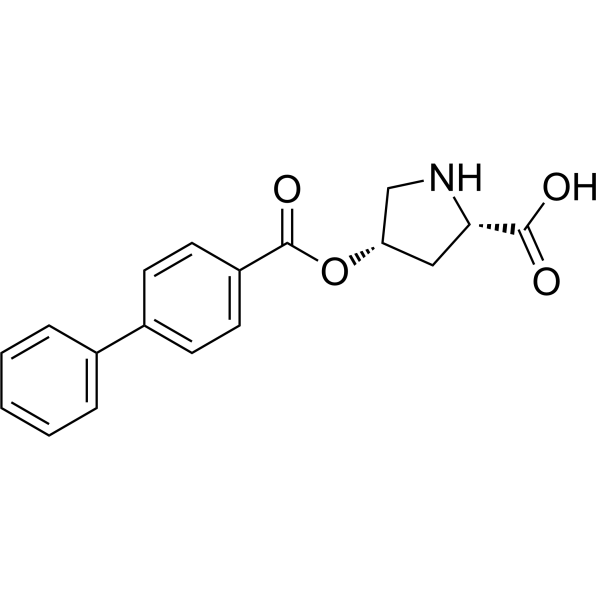
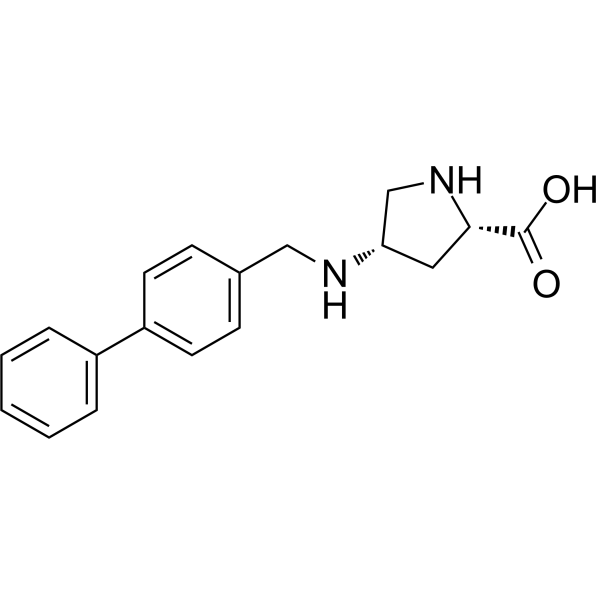
EAAT5
EAAT5 is a retina-enriched excitatory amino acid transporter that binds glutamate and couples transporter activity to a glutamate-gated Cl- conductance[1]. Mechanistically, EAAT5 links synaptic glutamate handling with inhibitory anion current, so glutamate released from photoreceptors and rod bipolar cells can activate local feedback within retinal circuits[2]. In mouse retina, EAAT5 localizes close to glutamatergic release sites, and EAAT5-/- retinae show reduced flicker resolution in multielectrode-array recordings, supporting its role in temporal visual information processing[3]. Compared with related isoforms, EAAT5 differs from high-capacity EAAT1/EAAT2 transporters because high chloride conductance is associated with less effective glutamate removal, whereas EAAT1 and EAAT2 remain major glutamate transporters in retina[2][3]. At rod bipolar terminals, EAAT2 and EAAT5 coexist near release sites, but EAAT5 predominantly regulates temporal resolution at rod bipolar-to-AII amacrine synapses[4]. Heterologous EAAT5 studies describe low-capacity transport and slow anion-channel gating, highlighting a distinction between EAAT5 channel-like behavior and classical glutamate uptake[5]. For experimental applications, TBOA-based pharmacology, EAAT5 knockout retinae, and rapid glutamate uncaging in mouse rods provide practical systems to test EAAT5-dependent glutamate transport, chloride conductance, and synaptic timing[3][6].
References:
- [1]. Arriza JL, et al. Excitatory amino acid transporter 5, a retinal glutamate transporter coupled to a chloride conductance. Proc Natl Acad Sci U S A. 1997 Apr 15;94(8):4155-60. [Content Brief]
- [2]. Lukasiewcz PD, et al. EAAT5 Glutamate Transporter-Mediated Inhibition in the Vertebrate Retina. Front Cell Neurosci. 2021 May 6;15:662859. [Content Brief]
- [3]. Gehlen J, et al. Excitatory Amino Acid Transporter EAAT5 Improves Temporal Resolution in the Retina. eNeuro. 2021 Dec 10;8(6):ENEURO.0406-21.2021. [Content Brief]
- [4]. Tang FS, et al. Glutamate Transporters EAAT2 and EAAT5 Differentially Shape Synaptic Transmission from Rod Bipolar Cell Terminals. eNeuro. 2022 May 18;9(3):ENEURO.0074-22.2022. [Content Brief]
- [5]. Gameiro A, et al. The discovery of slowness: low-capacity transport and slow anion channel gating by the glutamate transporter EAAT5. Biophys J. 2011 Jun 8;100(11):2623-32. [Content Brief]
- [6]. Thoreson WB, et al. EAAT5 glutamate transporter rapidly binds glutamate with micromolar affinity in mouse rods. J Gen Physiol. 2023 Sep 4;155(9):e202313349. [Content Brief]
All Product Categories
-
EAAT5 Related Products (2)
Related Products (2)