



LPAR3
Lysophosphatidic acid receptor 3 (LPAR3) is a G protein-coupled receptor that mediates calcium signaling in epithelial and neuronal cells[1][2]. Mechanistically, LPAR3 activation stimulates intracellular calcium flux via Gq/PLC pathways, regulating chloride secretion at the ocular surface and modulating erythropoietic processes in hematopoietic stem cells[1][2]. In vivo, LPAR3 knockout models in zebrafish exhibit behavioral alterations, including disrupted circadian locomotor activity, reduced aggression, and impaired memory, demonstrating its involvement in neurobehavioral regulation[2]. In disease models, LPAR3 contributes to ocular surface homeostasis, including Cl^- transport in corneal epithelial cells, suggesting potential roles in dry eye and neuropathic pain[1]. Compared with related LPA receptors such as LPAR1 and LPAR5, LPAR3 exhibits distinct tissue expression patterns in ocular, hematopoietic, and neural cells, as well as selective coupling to calcium-dependent signaling rather than exclusively PI3K/AKT or cAMP pathways[1][2][3]. Pharmacologically, LPAR3-selective agonists like 2S-OMPT enhance calcium-dependent chloride secretion in human corneal epithelial cells, providing experimental tools for studying epithelial transport and ocular surface disease mechanisms[1]. Dual LPAR1/LPAR3 antagonists can mitigate LPC/LPA-induced visceral hypersensitivity, highlighting LPAR3 as a target for pain modulation[3]. Collectively, these findings define LPAR3 as a versatile receptor with functional specificity in calcium signaling, neurobehavior, epithelial transport, and sensory modulation.
References:
- [1]. Lindgren ES, et al. Lysophosphatidic acid receptor 3 (LPAR3) regulates ocular surface chloride transport via calcium signaling. Exp Eye Res. 2025 Jun;255:110346. [Content Brief]
- [2]. Lin YN, et al. A Novel Function of the Lysophosphatidic Acid Receptor 3 (LPAR3) Gene in Zebrafish on Modulating Anxiety, Circadian Rhythm Locomotor Activity, and Short-Term Memory. Int J Mol Sci. 2020 Apr 18;21(8):2837. [Content Brief]
- [3]. Pujo J, et al. A1 bacterial lysophosphatidylcholine (LPC) and lysophosphatidic acid (LPA) induce visceral hypersensitivity through transient receptor potential canonical 5 (TRPC5) and lysophosphatidic acid receptor 1 (LPAR1) and 3 (LPAR3) dependent-mechanisms. J Can Assoc Gastroenterol. 2025;8(Supplement_1):i1-i1.
All Product Categories
-
LPAR3 Related Products (4)
Related Products (4)

-
H2L 5765834
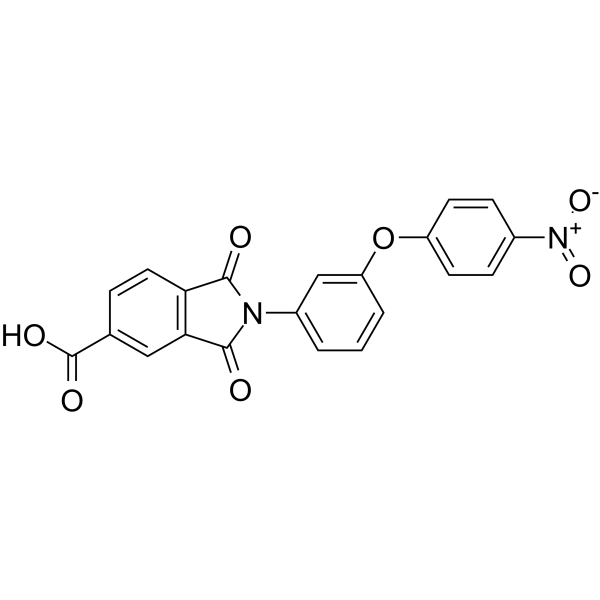 0 ImagesH2L 5765834 is an antagonist of lysophosphatidic acid receptors LPA1, LPA3, and LPA5, with IC50s of 94, 752, and 463 nM respectively.

-
BrP-LPA sodium
 0 ImagesCat. No.: HY-148291CAS No.: 944265-88-7BrP-LPA sodium is a pan-opposite agent for lysophosphatidic acid (LPA). It has antagonistic activity against LPA1 (IC50 = 4520 nM), LPA2 (IC50 = 468 nM), LPA3, and LPA4. BrP-LPA sodium also has partial agonistic activity for LPA5, with its EC50 being 1282 nM. BrP-LPA sodium has ATX inhibitory activity. BrP-LPA sodium effectively inhibits the migration and invasion of breast cancer cells. BrP-LPA sodium achieves tumor regression and anti-angiogenesis in mice breast cancer xenograft model. BrP-LPA sodium can be used for the study of breast cancer.
-
BrP-LPA
 0 ImagesCat. No.: HY-W725737CAS No.: 944313-05-7BrP-LPA is a LPA antagonist/ATX inhibitor. BrP-LPA shows pan-antagonist activity towards LPA1-4 GPCRs. BrP-LPA decreases blood vessel density. BrP-LPA dose-dependently inhibits Lysophosphatidic acid-induced head-dip counts. BrP-LPA exhibits anticancer activity against breast cancer, colon cancer, and lung cancer. BrP-LPA inhibits anxiety-like behavior.



