



STING Antagonist

-
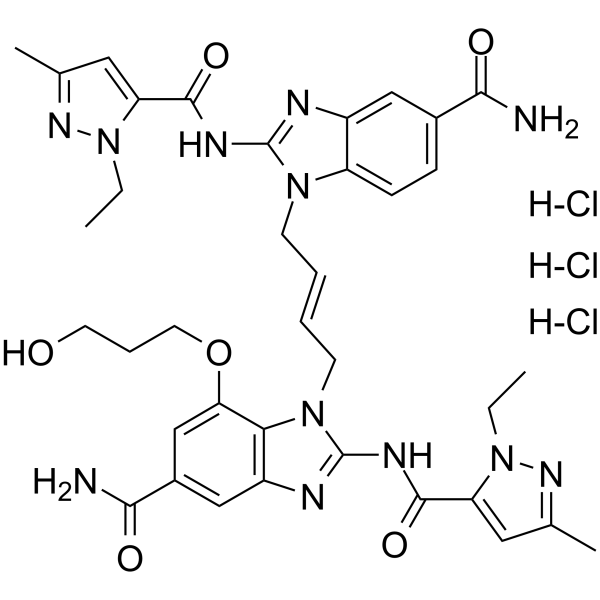
STING agonist-3 trihydrochloride
 0 ImagesCat. No.: HY-103665APurity: 98.45%
STING agonist-3 trihydrochloride, extracted from patent WO2017175147A1 (example 10), is a selective and non-nucleotide small-molecule STING agonist with a pEC50 and pEC50 of 7.5 and 9.5, respectively. STING agonist-3 trihydrochloride has durable anti-tumor effect and tremendous potential to improve treatment of cancer.
-
S-570
 0 ImagesCat. No.: HY-189280CAS No.: 2718206-92-7
-
STING antagonist-3
 0 ImagesCat. No.: HY-185379CAS No.: 3106554-00-8
STING antagonist-3 is a potent STING antagonist with an IC50 of 2.3 nM against human wild-type STING. STING antagonist-3 inhibits human wild-type STING and the gain-of-function STING mutants N154S and V155M. STING antagonist-3 suppresses IFN‑α2a production in stimulated human whole blood. STING antagonist-3 inhibits IP-10 production in activated human dermal microvascular endothelial cells (HMVEC-d). STING antagonist-3 can be used for the research of autoimmune diseases, autoinflammatory diseases, interferonopathies, and fibrotic disorders.
-
UM-203
 0 ImagesCat. No.: HY-180120
UM-203 is a reversible covalent STING antagonist. UM-203 is effective against both mouse and human STING, and in particular, it inhibits the most common human STING R232 variant. UM-203 can inhibit STING oligomerization and reduce phosphorylation of downstream TBK1 and IRF3, thereby blocking the IRF3 and NF-κB-mediated signaling pathways and inhibiting IFNβ and IL-6 secretion. UM-203 can be used for the research of inflammation and immunology, such as systemic lupus erythematosus.
-
UM-232
 0 ImagesCat. No.: HY-184593
UM-232 is a highly selective covalent STING antagonist with an EC50 of 6.20 μM in STING R232-expressing THP-1 cells. UM-232 covalently targets C292 and C309 cysteines of STING, blocks STING oligomerization and inhibits downstream TBK1/IRF3 activation and proinflammatory cytokine transcription. UM-232 has low off-target reactivity and good hepatic stability, serving as a chemical probe for STING-driven autoimmune and inflammatory diseases including Aicardi-Goutières syndrome (AGS), Systemic Lupus Erythematosus (SLE) and Amyotrophic Lateral Sclerosis (ALS).
-
H-151 (Standard)
 0 ImagesCat. No.: HY-112693RCAS No.: 941987-60-6
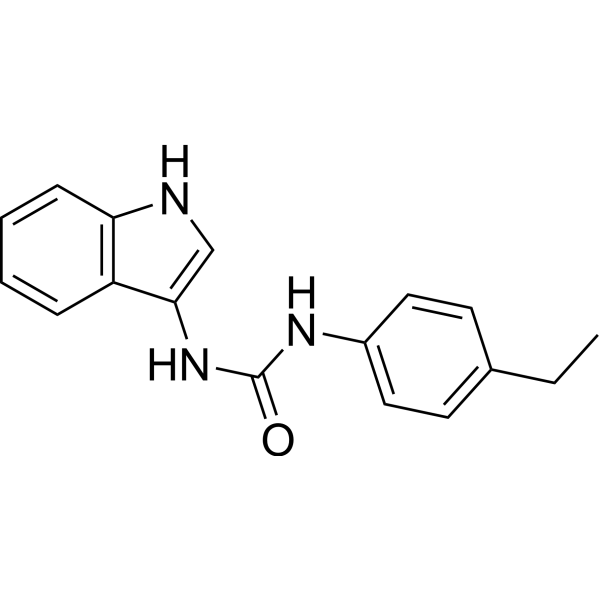
H-151 (Standard) is the analytical standard of H-151 (HY-112693). This product is intended for research and analytical applications. H-151 is a potent, selective and covalent antagonist of STING that has noteworthy inhibitory activity both in cells and in vivo. H-151 reduces TBK1 phosphorylation and suppresses STING palmitoylation. H-151 can be used for the research of autoinflammatory disease.



