



STING agonist-3 trihydrochloride
Based on 10 publication(s) in Google Scholar
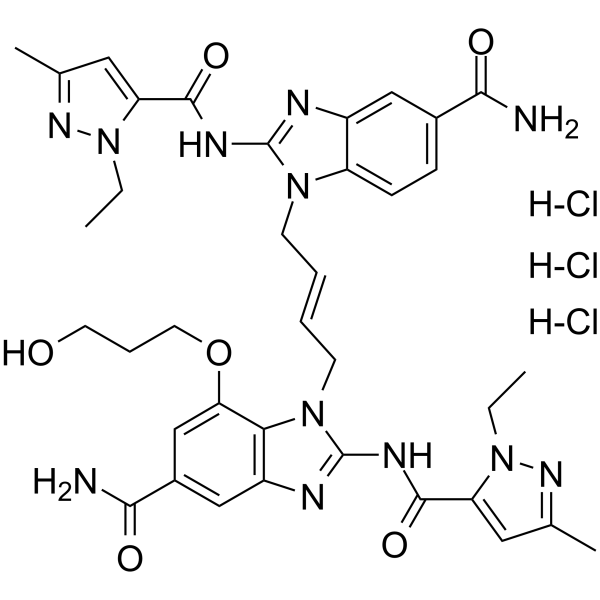
STING agonist-3 trihydrochloride, extracted from patent WO2017175147A1 (example 10), is a selective and non-nucleotide small-molecule STING agonist with a pEC50 and pEC50 of 7.5 and 9.5, respectively. STING agonist-3 trihydrochloride has durable anti-tumor effect and tremendous potential to improve treatment of cancer.
For research use only. We do not sell to patients.
- Purity : 98.45%
- Formula: C37H45Cl3N12O6
- Molecular Weight:860.19
-
Storage:
4°C, protect from light, stored under nitrogen
* In solvent : -80°C, 6 months; -20°C, 1 month (protect from light, stored under nitrogen)

To place orders, for customer services and technical support, please contact: MedChemExpress USA
Tel: 609-228-6898 E-mail: [email protected] [email protected]


-
 Biological Activity
-
Chemical Information
-
Solvent & Solubility
- Purity & Documentation
- References
-
 Help & FAQs


Publications Citing Use of MedChemExpress (MCE) STING agonist-3 trihydrochloride
More- Signal Transduct Target Ther. 2025 Dec 15;10(1):406. [Abstract]
- Signal Transduct Target Ther. 2023 Feb 24;8(1):79. [Abstract]
- Signal Transduct Target Ther. 2021 Mar 15;6(1):123. [Abstract]
- Nature. 2022 Oct;610(7933):761-767. [Abstract]
- Science. 2026 Feb 26;391(6788):eads4405. [Abstract]
- J Clin Invest. 2024 Mar 19;134(10):e176748. [Abstract]
- Cancer Immunol Res. 2023 May 3;11(5):583-599. [Abstract]
- Clin Transl Med. 2020 Nov;10(7):e228. [Abstract]
- Hum Mutat. 2026 May 25:2026:8545428. [Abstract]
- SSRN. 2023 Nov 9.
 Customer Validation & Images

-
WB
-
WB


Biological Activity
Description
IC50 & Target
STING[1]
In Vitro
STING agonist-3 trihydrochloride exhibits a pEC50 value of 7.5 in activation of STING in cells, this assay is determined using a luciferase reporter assay in human embryonic kidney cells (HEK293T) co-transfected with plasmids expressing STING and the enzyme firefly luciferase driven by the interferon stimulated response element promoter[1]. STING agonist-3 trihydrochloride exhibits a pIC50 value of 9.5 in FRET assay. This is a competition binding assay which aims to determine the binding potency of molecules to the C-terminal Domain (CTD) of human STING[1].
MedChemExpress (MCE) has not independently confirmed the accuracy of these methods. They are for reference only.


Chemical Information
-
Appearance Solid
-
Molecular Weight 860.19
-
Formula C37H45Cl3N12O6
-
Color White to off-white
-
SMILES
O=C(N)C1=CC=C(N(C(NC(C2=CC(C)=NN2CC)=O)=N3)C/C=C/CN4C5=C(N=C4NC(C6=CC(C)=NN6CC)=O)C=C(C(N)=O)C=C5OCCCO)C3=C1.Cl.Cl.Cl
-
Shipping
Room temperature in continental US; may vary elsewhere.
-
Storage
4°C, protect from light, stored under nitrogen
* In solvent : -80°C, 6 months; -20°C, 1 month (protect from light, stored under nitrogen)


Publications (10)
-
Journal Impact Factor
-
Most Recent
-
Signal Transduct Target Ther
Selective depletion of tumor-associated SAMHD1 enhances chemotherapeutic efficacy and antitumor immune responses. [Abstract]2025 Dec 15;10(1):406. PMID: 41392286 -
Signal Transduct Target Ther
2023 Feb 24;8(1):79. PMID: 36823147 -
Signal Transduct Target Ther
Unique and complementary suppression of cGAS-STING and RNA sensing- triggered innate immune responses by SARS-CoV-2 proteins. [Abstract]2021 Mar 15;6(1):123. PMID: 33723219 -
Nature
2022 Oct;610(7933):761-767. PMID: 36261523
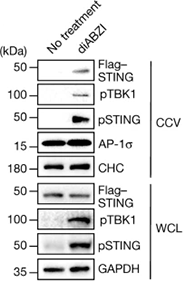
STING agonist-3 trihydrochloride purchased from MedChemExpress. Usage Cited in: Nature. 2022 Oct;610(7933):761-767. [Abstract]
STING and pSTING are enriched in CCVs obtained from STING agonist-3 (diABZI; 2.5 μM; for 2 hours)-stimulated cells, but not in those obtained from unstimulated cells.
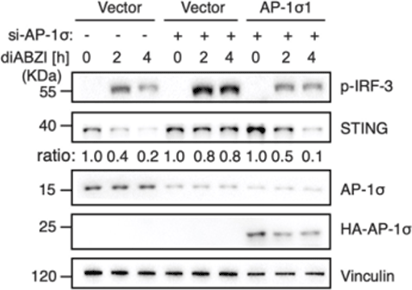
STING agonist-3 trihydrochloride purchased from MedChemExpress. Usage Cited in: Nature. 2022 Oct;610(7933):761-767. [Abstract]
Incubate HeLa cGAS KO cells with NC siRNA or siRNAs targeting AP-1σ1 and AP-1 σ3 for 3 days and reconstitute with empty vector or HA-tagged AP-1σ1 are treated with 2.5 µM diABZI (STING agonist-3) for 0, 2, 4 h before analysis by western blot.
-
Science
2026 Feb 26;391(6788):eads4405. PMID: 41747053 -
J Clin Invest
STING activation reprograms the microenvironment to sensitize NF1-related malignant peripheral nerve sheath tumors for immunotherapy. [Abstract]2024 Mar 19;134(10):e176748. PMID: 38502231 -
Cancer Immunol Res
Discovery of podofilox as a potent cGAMP-STING signaling enhancer with antitumor activity. [Abstract]2023 May 3;11(5):583-599. PMID: 36921097 -
Clin Transl Med
Cytosolic DNA-STING-NLRP3 axis is involved in murine acute lung injury induced by lipopolysaccharide. [Abstract]2020 Nov;10(7):e228. PMID: 33252860 -
Hum Mutat
PLSCR3 Deficiency Triggers mtDNA-Driven cGAS-STING Activation to Potentiate Antitumor Immunity in Colorectal Cancer. [Abstract]2026 May 25:2026:8545428. PMID: 42206267 -


Solvent & Solubility
In Vitro:
DMSO : 100 mg/mL (116.25 mM; Need ultrasonic; Hygroscopic DMSO has a significant impact on the solubility of product, please use newly opened DMSO)
Please refer to the solubility information to select the appropriate solvent. Once prepared, please aliquot and store the solution to prevent product inactivation from repeated freeze-thaw cycles.
Storage method and period of stock solution: -80°C, 6 months; -20°C, 1 month (protect from light, stored under nitrogen). When stored at -80°C, please use it within 6 months. When stored at -20°C, please use it within 1 month.
Please refer to the solubility information to select the appropriate solvent. Once prepared, please aliquot and store the solution to prevent product inactivation from repeated freeze-thaw cycles.
Storage method and period of stock solution: -80°C, 6 months; -20°C, 1 month (protect from light, stored under nitrogen). When stored at -80°C, please use it within 6 months. When stored at -20°C, please use it within 1 month.
Concentration (start) × Volume (start) = Concentration (final) × Volume (final)
In Vivo:
Select the appropriate dissolution method based on your experimental animal and administration route.
- For the following dissolution methods, please ensure to first prepare a clear stock solution using an In Vitro approach and then sequentially add co-solvents:
- To ensure reliable experimental results, the clarified stock solution can be appropriately stored based on storage conditions. As for the working solution for In Vivo experiments, it is recommended to prepare freshly and use it on the same day.
- The percentages shown for the solvents indicate their volumetric ratio in the final prepared solution. If precipitation or phase separation occurs during preparation, heat and/or sonication can be used to aid dissolution.
Add each solvent one by one: 10% DMSO 40% PEG300 5% Tween-80 45% Saline
Solubility: 2 mg/mL (2.33 mM); Clear solution; Need ultrasonic
This protocol yields a clear solution of 2 mg/mL.
Taking 1 mL working solution as an example, add 100 μL DMSO stock solution (20.0 mg/mL) to 400 μL PEG300, and mix evenly; then add 50 μL Tween-80 and mix evenly; then add 450 μL Saline to adjust the volume to 1 mL.
Preparation of Saline: Dissolve 0.9 g sodium chloride in ddH₂O and dilute to 100 mL to obtain a clear Saline solution.
Add each solvent one by one: 10% DMSO 90% (20% SBE-β-CD in Saline)
Solubility: 2 mg/mL (2.33 mM); Clear solution; Need ultrasonic
This protocol yields a clear solution of 2 mg/mL.
Taking 1 mL working solution as an example, add 100 μL DMSO stock solution (20.0 mg/mL) to 900 μL 20% SBE-β-CD in Saline, and mix evenly.
Preparation of 20% SBE-β-CD in Saline (4°C, storage for one week): 2 g SBE-β-CD powder is dissolved in 10 mL Saline, completely dissolve until clear.
In Vivo Dissolution Calculator
Please enter the basic information of animal experiments:
-
-
-
-
Recommended: Prepare an additional quantity of animals to account for potential losses during experiments.
Please enter your animal formula composition:
-
%DMSO +
Recommended: Keep the proportion of DMSO in working solution below 2% if your animal is weak.
-
%+
-
+%Tween-80 + +
-
%Saline +
The co-solvents required include: DMSO, . All of co-solvents are available by MedChemExpress (MCE). , Tween 80. All of co-solvents are available by MedChemExpress (MCE).
Working solution concentration: 0.22 mg/mL
Method for preparing stock solution: mg drug dissolved in μL DMSO. Stock solution concentration: mg/mL. * In solvent : -80°C, 6 months; -20°C, 1 month (protect from light, stored under nitrogen)
1. Take μL DMSO stock solution;
2. Add μL .
μL , mix evenly;
3. Then add μL Tween 80, mix evenly;
4. Then add μL
Please ensure that the stock solution in the first step is dissolved to a clear state, and add co-solvents in sequence. You can use ultrasonic heating (ultrasonic cleaner, recommended frequency 20-40 kHz), vortexing, etc. to assist dissolution.


Purity & Documentation
-
Data Sheet (286 KB)
-
SDS (252 KB)
- English - EN (252 KB)
- Français - FR (252 KB)
- Deutsch - DE (252 KB)
- Norwegian - NO (252 KB)
- Español - ES (252 KB)
- Swedish - SV (252 KB)
- Italian - IT (252 KB)
- Korean - KR (252 KB)
- Portuguese - PT (252 KB)
-
Handling Instructions (2659 KB)
References
[1]. Adam Kenneth, et al. Heterocyclic amides useful as protein modulators.patent WO2017175147A1
[2]. Ramanjulu JM, Pesiridis GS, Yang J, et al. Design of amidobenzimidazole STING receptor agonists with systemic activity [published correction appears in Nature. 2019 Jun;570(7761):E53. doi: 10.1038/s41586-019-1265-5]. Nature. 2018;564(7736):439-443. [Content Brief]


Complete Stock Solution Preparation Table
Please refer to the solubility information to select the appropriate solvent. Once prepared, please aliquot and store the solution to prevent product inactivation from repeated freeze-thaw cycles.
Storage method and period of stock solution: -80°C, 6 months; -20°C, 1 month (protect from light, stored under nitrogen). When stored at -80°C, please use it within 6 months. When stored at -20°C, please use it within 1 month.
| Optional Solvent | Concentration Solvent Mass | 1 mg | 5 mg | 10 mg | 25 mg |
|---|---|---|---|---|---|
| DMSO | 1 mM | 1.1625 mL | 5.8127 mL | 11.6253 mL | 29.0633 mL |
| 5 mM | 0.2325 mL | 1.1625 mL | 2.3251 mL | 5.8127 mL | |
| 10 mM | 0.1163 mL | 0.5813 mL | 1.1625 mL | 2.9063 mL | |
| 15 mM | 0.0775 mL | 0.3875 mL | 0.7750 mL | 1.9376 mL | |
| 20 mM | 0.0581 mL | 0.2906 mL | 0.5813 mL | 1.4532 mL | |
| 25 mM | 0.0465 mL | 0.2325 mL | 0.4650 mL | 1.1625 mL | |
| 30 mM | 0.0388 mL | 0.1938 mL | 0.3875 mL | 0.9688 mL | |
| 40 mM | 0.0291 mL | 0.1453 mL | 0.2906 mL | 0.7266 mL | |
| 50 mM | 0.0233 mL | 0.1163 mL | 0.2325 mL | 0.5813 mL | |
| 60 mM | 0.0194 mL | 0.0969 mL | 0.1938 mL | 0.4844 mL | |
| 80 mM | 0.0145 mL | 0.0727 mL | 0.1453 mL | 0.3633 mL | |
| 100 mM | 0.0116 mL | 0.0581 mL | 0.1163 mL | 0.2906 mL |


STING agonist-3 trihydrochloride Related Classifications
HY-103665A Related Classifications
 Powered by Bioz