



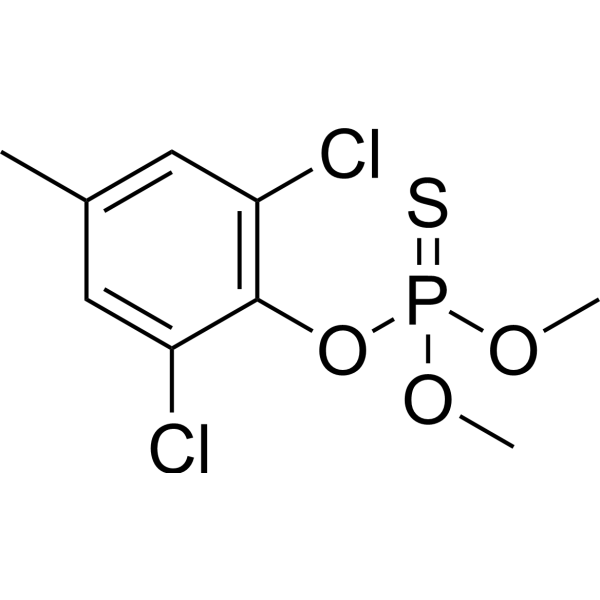
Tolclofos-methyl

Based on 1 Customer Validation
Tolclofos-methyl is an organophosphorus fungicide. Tolclofos-methyl undergoes photoinduced oxidative degradation to form oxo-analog derivatives. Tolclofos-methyl inhibits spore division in fungi and oomycetes, induces cytoplasmic leakage, and interferes with flagellar movement. Tolclofos-methyl is rapidly metabolized and excreted in rodents. Tolclofos-methyl can be used in studies related to fungal infections.
Nur für Forschungszwecke. Wir verkaufen nicht an Patienten.
- Reinheit : 98.52%
- CAS. Nr.: 57018-04-9
- Formel: C9H11Cl2O3PS
- Molecular Weight:301.13
-
Speicherung:Powder -20°C, 3 years , 4°C, 2 years ; In solvent -80°C, 2 years , -20°C, 1 year

To place orders, for customer services and technical support, please contact: MedChemExpress USA
Tel: 609-228-6898 E-mail: [email protected] [email protected]


-
 Biologische Aktivität
-
Chemical Information
-
Lösungsmittel & Löslichkeit
- Reinheit & Dokumentation
- Verweise
-
 Help & FAQs




Biologische Aktivität
Beschreibung
In Vitro
Tolclofos-methyl undergoes rapid photoinduced oxidation on kaolinite clay mineral films; biphasic photoinduced oxidation occurs on montmorillonite mineral films; this photoinduced oxidation is delayed by dehydration of the kaolinite and montmorillonite clay mineral films and the removal of molecular oxygen[1].
Tolclofos-methyl completely inhibits mycelial growth of Rhizoctonia solani, Corticium rolfsii, and Typhula incarnata[2].
Tolclofos-methyl (4 μg/mL; up to 26 hours) completely inhibits sporidial multiplication, alters cellular morphology, and causes cytoplasmic loss in Ustilago maydis sporidia after 26 hours, while allowing partial dry weight increase for several hours[2].
Tolclofos-methyl (1.9-100 μg/mL) inhibits Botrytis cinerea mycelial growth[2].
Tolclofos-methyl (20 μg/mL; 24 hours) causes cytoplasmic leakage via cell bursting in some Botrytis cinerea germinating conidia[2].
Tolclofos-methyl (4-8 μg/mL) rapidly inhibits swimming, induces abnormal flagella movement, triggers encystment, and causes cystospore bursting in Phytophthora capsici zoospores[2].
Tolclofos-methyl (4-8 μg/mL) inhibits swimming, induces circular movement (in Pseudoperonospora cubensis), triggers encystment, and causes cystospore bursting in zoospores of Pseudoperonospora cubensis, Phytophthora infestans, and Plasmopara viticola[2].
MedChemExpress (MCE) has not independently confirmed the accuracy of these methods. They are for reference only.
In Vivo
14C-Tolclofos-methyl (5-50 mg/kg; p.o.; single dose) results in 87.3-90.9% excretion of radiocarbon within 7 days, less than 1% whole-body residue at 7 days with 3,5-dichloro-4-hydroxybenzoic acid and its glycine conjugate as major metabolites in ICR mice[3].
MedChemExpress (MCE) has not independently confirmed the accuracy of these methods. They are for reference only.
-
Animal Model:Sprague-Dawley (male: 5-week-old, ~190 g; female: 5-week-old, ~140 g)[3]
-
Dosage:5 mg/kg
-
Administration:p.o.; single dose
-
Result:Excreted over 87% of radiocarbon via urine, feces and expired air within 7 days, with urine as the primary excretion route.
Retained less than 1% of radioactive substances in the whole body at day 7.
Produced low tissue residues in most tissues, and relatively high residues were detected in hair.
Displayed prominent radioactivity in digestive organs, liver and kidney at early stages, and the radioactivity declined sharply at 24 hours.
Identified 14 metabolites in excreta, and 3,5-dichloro-4-hydroxybenzoic acid was the predominant component.
-
Animal Model:ICR (male: 7-week-old, ~28 g; female: 7-week-old, ~24 g)[3]
-
Dosage:5 mg/kg; 50 mg/kg (for metabolite isolation in male mice)
-
Administration:p.o.; single dose
-
Result:Excreted most radiocarbon via urine, feces and expired air within 7 days, and urine was the major excretion pathway.
Retained less than 1% of the total radioactive dose in the body at day 7.
Detected at least 13 metabolites in excreta.
3,5-dichloro-4-hydroxybenzoic acid and its glycine conjugate were the predominant metabolites.


Chemical Information
-
CAS. Nr. 57018-04-9
-
Appearance Solid
-
Molecular Weight 301.13
-
Formel C9H11Cl2O3PS
-
Color White to off-white
-
SMILES
S=P(OC)(OC1=C(Cl)C=C(C)C=C1Cl)OC
-
Versand
Room temperature in continental US; may vary elsewhere.
-
Speicherung
Powder -20°C 3 years 4°C 2 years In solvent -80°C 2 years -20°C 1 year


Lösungsmittel & Löslichkeit
In Vitro:
DMSO : ≥ 36 mg/mL (119.55 mM; Hygroscopic DMSO has a significant impact on the solubility of product, please use newly opened DMSO)
* "≥" means soluble, but saturation unknown.
Please refer to the solubility information to select the appropriate solvent. Once prepared, please aliquot and store the solution to prevent product inactivation from repeated freeze-thaw cycles.
Storage method and period of stock solution: -80°C, 2 years; -20°C, 1 year. When stored at -80°C, please use it within 2 years. When stored at -20°C, please use it within 1 year.
Please refer to the solubility information to select the appropriate solvent. Once prepared, please aliquot and store the solution to prevent product inactivation from repeated freeze-thaw cycles.
Storage method and period of stock solution: -80°C, 2 years; -20°C, 1 year. When stored at -80°C, please use it within 2 years. When stored at -20°C, please use it within 1 year.
Konzentration (Stammlösung) × Volumen (Stammlösung) = Konzentration (Ziellösung) × Volumen (Ziellösung)


Reinheit & Dokumentation
-
Data Sheet (279 KB)
-
SDS (459 KB)
- English - EN (459 KB)
- Français - FR (459 KB)
- Deutsch - DE (459 KB)
- Norwegian - NO (459 KB)
- Español - ES (459 KB)
- Swedish - SV (459 KB)
- Italian - IT (459 KB)
- Korean - KR (459 KB)
- Portuguese - PT (459 KB)
-
Handling Instructions (2659 KB)
Verweise


Complete Stock Solution Preparation Table
Please refer to the solubility information to select the appropriate solvent. Once prepared, please aliquot and store the solution to prevent product inactivation from repeated freeze-thaw cycles.
Storage method and period of stock solution: -80°C, 2 years; -20°C, 1 year. When stored at -80°C, please use it within 2 years. When stored at -20°C, please use it within 1 year.
| Optional Solvent | Concentration Solvent Mass | 1 mg | 5 mg | 10 mg | 25 mg |
|---|---|---|---|---|---|
| DMSO | 1 mM | 3.3208 mL | 16.6041 mL | 33.2082 mL | 83.0206 mL |
| 5 mM | 0.6642 mL | 3.3208 mL | 6.6416 mL | 16.6041 mL | |
| 10 mM | 0.3321 mL | 1.6604 mL | 3.3208 mL | 8.3021 mL | |
| 15 mM | 0.2214 mL | 1.1069 mL | 2.2139 mL | 5.5347 mL | |
| 20 mM | 0.1660 mL | 0.8302 mL | 1.6604 mL | 4.1510 mL | |
| 25 mM | 0.1328 mL | 0.6642 mL | 1.3283 mL | 3.3208 mL | |
| 30 mM | 0.1107 mL | 0.5535 mL | 1.1069 mL | 2.7674 mL | |
| 40 mM | 0.0830 mL | 0.4151 mL | 0.8302 mL | 2.0755 mL | |
| 50 mM | 0.0664 mL | 0.3321 mL | 0.6642 mL | 1.6604 mL | |
| 60 mM | 0.0553 mL | 0.2767 mL | 0.5535 mL | 1.3837 mL | |
| 80 mM | 0.0415 mL | 0.2076 mL | 0.4151 mL | 1.0378 mL | |
| 100 mM | 0.0332 mL | 0.1660 mL | 0.3321 mL | 0.8302 mL |


Tolclofos-methyl Related Classifications
HY-B2053 Related Classifications
 Powered by Bioz