



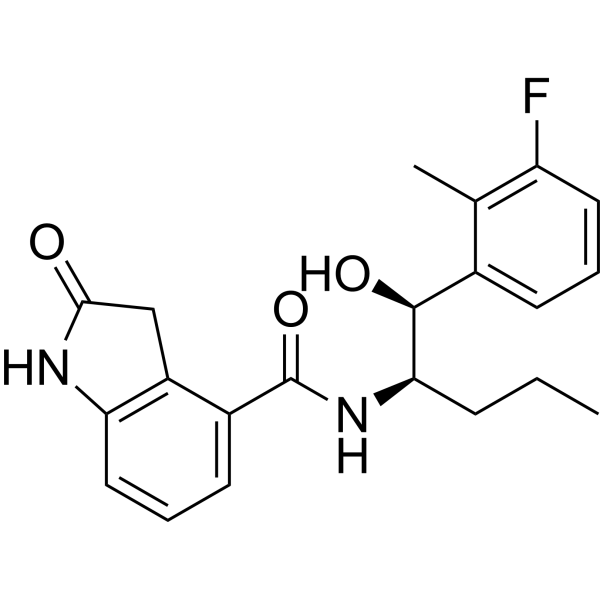
GSK716

Based on 1 Customer Validation
GSK716 (A1AT modulator 1) is an orally active Z α1-antitrypsin (Z-A1AT) inhibitor with a pIC50 of 8.3. GSK716 binds a cryptic Z α1-antitrypsin pocket, stabilizes monomeric folding intermediates, blocks polymerization, and increases monomer secretion. GSK716 acts on select sensitive α1-antitrypsin variants but fails to affect resistant variants. GSK716 can be used for the research of α1-antitrypsin deficiency and α1-antitrypsin deficiency-associated liver disease.
Nos produits utilisent uniquement pour la recherche. Nous ne vendons pas aux patients.
- Pureté : 99.75%
- CAS No.: 2406205-61-4
- Formule: C21H23FN2O3
- Masse moléculaire:370.42
-
Stockage:Powder -20°C, 3 years , 4°C, 2 years ; In solvent -80°C, 6 months , -20°C, 1 month

To place orders, for customer services and technical support, please contact: MedChemExpress USA
Tel: 609-228-6898 E-mail: [email protected] [email protected]


-
 Activité biologique
-
Chemical Information
-
Solvant et solubilité
- Pureté et documentation
- Références
-
 Help & FAQs




Activité biologique
Description
In Vitro
GSK716 (72 h) potently inhibits in vitro polymerisation of plasma-purified Z α1-antitrypsin with a mean pIC50 of 8.3[1].
GSK716 binds selectively to monomeric Z α1-antitrypsin with a mean pKd of 8.5, showing 50-fold lower affinity for wild-type M α1-antitrypsin and no binding to polymeric Z α1-antitrypsin[1].
GSK716 (50 µM) stabilises both Z and wild-type M α1-antitrypsin against heat-induced unfolding, as shown by increased transition midpoint temperatures in a SYPRO Orange thermal stability assay[1].
GSK716 (1:50 to 1:1 molar ratios of GSK716 to protein) corrects misfolding of Z α1-antitrypsin during rapid refolding from urea denaturation, restoring monomeric conformation at stoichiometric and higher concentrations[1].
GSK716 (50 µM) abolishes the protease inhibitory activity of Z and wild-type M α1-antitrypsin but does not interfere with the inhibitory activity of other related serpins[1].
GSK716 completely blocks intracellular polymerisation of Z α1-antitrypsin in CHO-TET-ON-Z-A1AT cells (mean pIC50 6.3) and increases its secretion (mean pEC50 6.2), while restoring ER stress sensitivity to wild-type levels[1].
GSK716 inhibits intracellular polymerisation of Z α1-antitrypsin in ZZ iPSC-derived human hepatocytes (mean pIC50 6.4), increases its secretion by approximately threefold (mean pEC50 6.5), and promotes clearance of pre-existing intracellular polymers[1].
GSK716 (10-100 μM; 48 h) potently inhibits intracellular polymerization and promotes secretion of sensitive AAT variants (including Z AAT) in Hepa 1.6 cells[2].
GSK716 (40 nM (fluorescent derivative for Z-A1AT); 2 μM (fluorescent derivative for M-A1AT); overnight at room temperature, 3 days at 4°C plus 6 hours at room temperature) binds to purified Z-alpha-1-antitrypsin with a high affinity Kd of 1.5 nM, demonstrating 200-fold faster association kinetics with Z-alpha-1-antitrypsin compared to M-alpha-1-antitrypsin[3].
GSK716 (50 μM; heated from 25°C to 95°C at 1°C/min) increases the native state stability of purified M-alpha-1-antitrypsin and Z-alpha-1-antitrypsin against heat-induced unfolding[3].
GSK716 (10 μM; 2-hour pre-incubation, followed by 4-hour heat incubation at 48-65°C) blocks heat-induced polymerisation of purified plasma-derived Z-alpha-1-antitrypsin in vitro[3].
GSK716 (0-50 μM; 4-hour denaturation, 1-hour refolding incubation) promotes the refolding of denatured purified M-alpha-1-antitrypsin and Z-alpha-1-antitrypsin into native, non-polymerised monomers[3].
GSK716 inhibits intracellular Z-alpha-1-antitrypsin polymer formation (pIC50 = 6.4) and increases Z-alpha-1-antitrypsin secretion by approximately 3-fold (pEC50 = 6.5) in iPSC-derived ZZ-alpha-1-antitrypsin hepatocytes[3].
GSK716 (10 μM) restores tunicamycin sensitivity of Z-alpha-1-antitrypsin-expressing CHO-TET-ON-Z-A1AT cells to the level of wild-type M-alpha-1-antitrypsin-expressing cells by abrogating intracellular polymer formation[3].
GSK716 binds to a cryptic site on recombinant Cys232Ser alpha-1-antitrypsin, inducing conformational changes that stabilise the protein and prevent polymerisation[3].
MedChemExpress (MCE) has not independently confirmed the accuracy of these methods. They are for reference only.
In Vivo
GSK716 (10-100 mg/kg; p.o.; three times a day; 3-20 days) dose-dependently increases circulating monomeric Z α1-antitrypsin levels by up to 8-fold in transgenic mice with alpha-1-antitrypsin deficiency, but does not reduce established liver polymer burden within 20 days of dosing[3].
MedChemExpress (MCE) has not independently confirmed the accuracy of these methods. They are for reference only.
-
Animal Model:Hemizygous female Z α1-antitrypsin transgenic mice (13-15 weeks of age)[1]
-
Dosage:10 mg/kg; 30 mg/kg; 100 mg/kg
-
Administration:p.o.; three times a day; 6 days (10, 30 mg/kg); 6, 15, 20 days (100 mg/kg)
-
Result:Resulted in a significant dose-dependent increase in circulating monomeric Z α1-antitrypsin relative to pre-dose levels (10 mg/kg).
Resulted in a larger significant dose-dependent increase in circulating monomeric Z α1-antitrypsin relative to pre-dose levels (30 mg/kg).
Resulted in a mean sevenfold increase in circulating monomeric Z α1-antitrypsin levels after 6 days, a mean sevenfold to eightfold increase after 15 and 21 days, and a fourfold increase in intrahepatic Z α1-antitrypsin monomer levels (100 mg/kg).


Chemical Information
-
CAS No. 2406205-61-4
-
Appearance Solid
-
Masse moléculaire 370.42
-
Formule C21H23FN2O3
-
Color White to off-white
-
SMILES
O=C(C1=CC=CC2=C1CC(N2)=O)N[C@@H]([C@H](C3=CC=CC(F)=C3C)O)CCC
-
Synonyms
A1AT modulator 1
-
Livraison
Room temperature in continental US; may vary elsewhere.
-
Stockage
Powder -20°C 3 years 4°C 2 years In solvent -80°C 6 months -20°C 1 month


Solvant et solubilité
In Vitro:
DMSO : 100 mg/mL (269.96 mM; Need ultrasonic; Hygroscopic DMSO has a significant impact on the solubility of product, please use newly opened DMSO)
Please refer to the solubility information to select the appropriate solvent. Once prepared, please aliquot and store the solution to prevent product inactivation from repeated freeze-thaw cycles.
Storage method and period of stock solution: -80°C, 6 months; -20°C, 1 month. When stored at -80°C, please use it within 6 months. When stored at -20°C, please use it within 1 month.
Please refer to the solubility information to select the appropriate solvent. Once prepared, please aliquot and store the solution to prevent product inactivation from repeated freeze-thaw cycles.
Storage method and period of stock solution: -80°C, 6 months; -20°C, 1 month. When stored at -80°C, please use it within 6 months. When stored at -20°C, please use it within 1 month.
Concentration (start) × Volume (start) = Concentration (final) × Volume (final)
In Vivo:
Select the appropriate dissolution method based on your experimental animal and administration route.
- For the following dissolution methods, please ensure to first prepare a clear stock solution using an In Vitro approach and then sequentially add co-solvents:
- To ensure reliable experimental results, the clarified stock solution can be appropriately stored based on storage conditions. As for the working solution for In Vivo experiments, it is recommended to prepare freshly and use it on the same day.
- The percentages shown for the solvents indicate their volumetric ratio in the final prepared solution. If precipitation or phase separation occurs during preparation, heat and/or sonication can be used to aid dissolution.
Add each solvent one by one: 10% DMSO 40% PEG300 5% Tween-80 45% Saline
Solubility: 2.5 mg/mL (6.75 mM); Clear solution; Need ultrasonic
This protocol yields a clear solution of 2.5 mg/mL.
Taking 1 mL working solution as an example, add 100 μL DMSO stock solution (25.0 mg/mL) to 400 μL PEG300, and mix evenly; then add 50 μL Tween-80 and mix evenly; then add 450 μL Saline to adjust the volume to 1 mL.
Preparation of Saline: Dissolve 0.9 g sodium chloride in ddH₂O and dilute to 100 mL to obtain a clear Saline solution.
Add each solvent one by one: 10% DMSO 90% (20% SBE-β-CD in Saline)
Solubility: 2.5 mg/mL (6.75 mM); Clear solution; Need ultrasonic
This protocol yields a clear solution of 2.5 mg/mL.
Taking 1 mL working solution as an example, add 100 μL DMSO stock solution (25.0 mg/mL) to 900 μL 20% SBE-β-CD in Saline, and mix evenly.
Preparation of 20% SBE-β-CD in Saline (4°C, storage for one week): 2 g SBE-β-CD powder is dissolved in 10 mL Saline, completely dissolve until clear.
In Vivo Dissolution Calculator
Please enter the basic information of animal experiments:
-
-
-
-
Recommended: Prepare an additional quantity of animals to account for potential losses during experiments.
Please enter your animal formula composition:
-
%DMSO +
Recommended: Keep the proportion of DMSO in working solution below 2% if your animal is weak.
-
%+
-
+%Tween-80 + +
-
%Saline +
The co-solvents required include: DMSO, . All of co-solvents are available by MedChemExpress (MCE). , Tween 80. All of co-solvents are available by MedChemExpress (MCE).
Working solution concentration: 0.22 mg/mL
Method for preparing stock solution: mg drug dissolved in μL DMSO. Stock solution concentration: mg/mL.
1. Take μL DMSO stock solution;
2. Add μL .
μL , mix evenly;
3. Then add μL Tween 80, mix evenly;
4. Then add μL
Please ensure that the stock solution in the first step is dissolved to a clear state, and add co-solvents in sequence. You can use ultrasonic heating (ultrasonic cleaner, recommended frequency 20-40 kHz), vortexing, etc. to assist dissolution.


Pureté et documentation
-
Fiche technique (283 KB)
-
SDS (251 KB)
- English - EN (251 KB)
- Français - FR (251 KB)
- Deutsch - DE (251 KB)
- Norwegian - NO (251 KB)
- Español - ES (251 KB)
- Swedish - SV (251 KB)
- Italian - IT (251 KB)
- Korean - KR (251 KB)
- Portuguese - PT (251 KB)
-
Instruction de manipulation (2659 KB)
Références
[1]. Lomas DA, et al. Development of a small molecule that corrects misfolding and increases secretion of Z α1 -antitrypsin. EMBO Mol Med. 2021;13(3):e13167. [Content Brief]
[2]. Ronzoni R, et al. Susceptibility of alpha-1 antitrypsin deficiency variants to polymer-blocking therapy. JCI Insight. 2025;10(15):e194354. Published 2025 Jul 8. [Content Brief]


Complete Stock Solution Preparation Table
Please refer to the solubility information to select the appropriate solvent. Once prepared, please aliquot and store the solution to prevent product inactivation from repeated freeze-thaw cycles.
Storage method and period of stock solution: -80°C, 6 months; -20°C, 1 month. When stored at -80°C, please use it within 6 months. When stored at -20°C, please use it within 1 month.
| Optional Solvent | Concentration Solvent Mass | 1 mg | 5 mg | 10 mg | 25 mg |
|---|---|---|---|---|---|
| DMSO | 1 mM | 2.6996 mL | 13.4982 mL | 26.9964 mL | 67.4910 mL |
| 5 mM | 0.5399 mL | 2.6996 mL | 5.3993 mL | 13.4982 mL | |
| 10 mM | 0.2700 mL | 1.3498 mL | 2.6996 mL | 6.7491 mL | |
| 15 mM | 0.1800 mL | 0.8999 mL | 1.7998 mL | 4.4994 mL | |
| 20 mM | 0.1350 mL | 0.6749 mL | 1.3498 mL | 3.3745 mL | |
| 25 mM | 0.1080 mL | 0.5399 mL | 1.0799 mL | 2.6996 mL | |
| 30 mM | 0.0900 mL | 0.4499 mL | 0.8999 mL | 2.2497 mL | |
| 40 mM | 0.0675 mL | 0.3375 mL | 0.6749 mL | 1.6873 mL | |
| 50 mM | 0.0540 mL | 0.2700 mL | 0.5399 mL | 1.3498 mL | |
| 60 mM | 0.0450 mL | 0.2250 mL | 0.4499 mL | 1.1248 mL | |
| 80 mM | 0.0337 mL | 0.1687 mL | 0.3375 mL | 0.8436 mL | |
| 100 mM | 0.0270 mL | 0.1350 mL | 0.2700 mL | 0.6749 mL |


GSK716 Related Classifications
HY-134858 Related Classifications
 Powered by Bioz
Keywords
- GSK716
- 2406205-61-4
- A1AT modulator 1
- GSK 716
- GSK-716
- Serpin
- Ser/Thr Protease
- CHO-TET-ON-Z-A1AT cells
- recombinant Cys232Ser alpha-1-antitrypsin
- ZZ iPSC-derived human hepatocytes
- α1-antitrypsin deficiency
- transgenic mice
- Z α1-antitrypsin
- serpins
- Hepa 1.6 cells
- α1-antitrypsin deficiency-associated liver disease
- wild-type M α1-antitrypsin
- Inhibitor
- inhibitor
- inhibit