



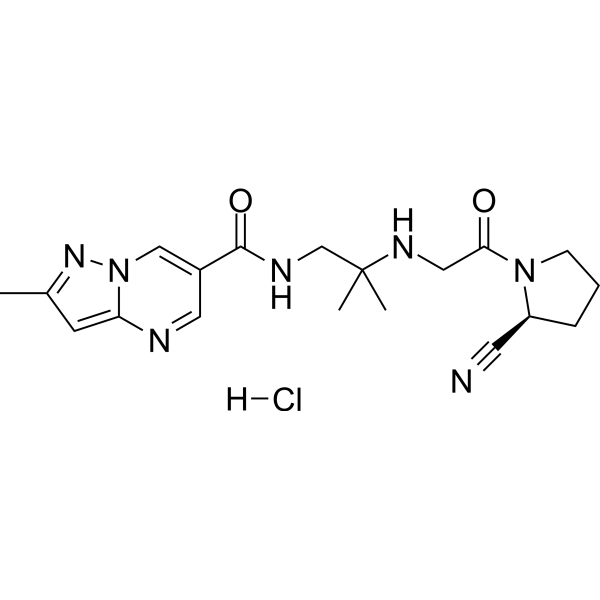
Anagliptin hydrochloride
Based on 3 publication(s) in Google Scholar
Anagliptin (SK-0403) hydrochloride is a highly selective, potent, orally active inhibitor of dipeptidyl peptidase 4 (DPP-4), with an IC50 of 3.8 nM, and less selective at DPP-8 and DDP-9 with IC50s of 68 nM and 60 nM, respectively.
For research use only. We do not sell to patients.
- CAS No.: 1359670-56-6
- Formula: C19H26ClN7O2
- Molecular Weight:419.91
-
Storage:
Please store the product under the recommended conditions in the Certificate of Analysis.

To place orders, for customer services and technical support, please contact: MedChemExpress USA
Tel: 609-228-6898 E-mail: [email protected] [email protected]


-
 Biological Activity
-
Chemical Information
- Protocols
- Purity & Documentation
- References
-
 Help & FAQs


Publications Citing Use of MedChemExpress (MCE) Anagliptin hydrochloride
More

Biological Activity
Description
IC50 & Target
|
DPP-4 3.8 nM (IC50) |
DPP-8 68 nM (IC50) |
DPP-9 60 nM (IC50) |
Cellular Effect
|
Cell Line

|
Type | Value | Description | References |
|---|---|---|---|---|
| HEK293 | IC50 |
>500 μM
Compound: 4a, anagliptin hydrochloride
|
Inhibition of human ERG expressed in HEK293 cells by patch clamp assay
Inhibition of human ERG expressed in HEK293 cells by patch clamp assay
|
[PMID: 22019046] |
| Sf9 | IC50 |
60 nM
Compound: 4a, anagliptin hydrochloride
|
Inhibition of human recombinant DPP-9 expressed in Sf9 cells using H-Gly-Pro-AMC as substrate preincubated for 30 mins before substrate addition measured after 20 mins by fluorescence assay
Inhibition of human recombinant DPP-9 expressed in Sf9 cells using H-Gly-Pro-AMC as substrate preincubated for 30 mins before substrate addition measured after 20 mins by fluorescence assay
|
[PMID: 22019046] |
| Sf9 | IC50 |
68 nM
Compound: 4a, anagliptin hydrochloride
|
Inhibition of human recombinant DPP-8 expressed in Sf9 cells using H-Gly-Pro-AMC as substrate preincubated for 30 mins before substrate addition measured after 20 mins by fluorescence assay
Inhibition of human recombinant DPP-8 expressed in Sf9 cells using H-Gly-Pro-AMC as substrate preincubated for 30 mins before substrate addition measured after 20 mins by fluorescence assay
|
[PMID: 22019046] |
In Vitro
Anagliptin (SK-0403) (0-100 μM; 24 h) attenuates s-DPP-4-induced smooth muscle cells proliferation[2].
Anagliptin (100 μM; 10 min) reduces TNF-α production in cultured monocytes[2].
Anagliptin (0.001-10 μM; 24 h) significantly suppresses sterol regulatory element‐binding protein activity in HepG2 cells (21% decrease)[3].
MedChemExpress (MCE) has not independently confirmed the accuracy of these methods. They are for reference only. Further protocols information, click here.
-
Cell Line:Rat smooth muscle cells (SMC)
-
Concentration:1, 10 and 100 μM
-
Incubation Time:24 h
-
Result:Attenuated s-DPP-4-induced SMC proliferation in a dose-dependent manner. Inhibited LPS-induced ERK phosphorylation and markedly suppressed LPS-induced nuclear translocation of NF-κBp65.
-
Cell Line:Rat smooth muscle cells (SMC)
-
Concentration:100 μM
-
Incubation Time:10 min
-
Result:Blocked the early- but not the late-phase ERK phosphorylation induced by s-DPP-4.
In Vivo
Anagliptin (0.3%; in diet; 4 weeks) exhibits a lipid‐lowering effect in a hyperlipidemic mice model[3].
MedChemExpress (MCE) has not independently confirmed the accuracy of these methods. They are for reference only.
-
Animal Model:Male apoliporotein E (apoE)-deficient mice[2]
-
Dosage:0.3%
-
Administration:In diet, 16 weeks
-
Result:Reduced DPP-4 activity in the plasma as expected and did not affect food consumption or body weight gain. Significantly reduced total cholesterol level, especially VLDL and LDL-C without affecting triglyceride level. Also decreased the α-SMA-positive area within the individual plaque.
-
Animal Model:Male low‐density lipoprotein receptor‐deficient mice (B6.129S7‐Ldlrtm1Her/J)[3]
-
Dosage:0.3%
-
Administration:In diet, 4 weeks
-
Result:Significantly decreased the plasma total cholesterol (14% reduction) and triglyceride levels (27% reduction). Significantly decreased low‐density lipoprotein cholesterol and very low‐density lipoprotein cholesterol. Sterol regulatory element‐binding protein‐2 messenger ribonucleic acid expression level was significantly decreased at night.
-
Animal Model:Male Sprague–Dawley rats and Beagle dogs[1]
-
Dosage:0.2, 0.5, 1 and 10 mg/kg
-
Administration:Oral or intravenous administration (Pharmacokinetic Studies)
-
Result:Selected PK parameters of Anagliptin hydrochloride in rats and dogs[1]
Compound Species CLtot
(l/h/kg)Vdss
(l/h/kg)Cmaxc
(ng/ml)Tmaxc
(h)T1/2
(h)AUC
(ng/h/ml)BA
(%)Anagliptin hydrochloridea Rat 2.00 (iv) 0.68 (iv) 309 (62) (po) 0.8 (2.3) (po) 1.9 (po) 1160 (po) 23 (po) Dog 0.65 (iv) 0.83 (iv) 261 (po) 1.5 (po) 1.0 (po) 824 (po) 100 (po)
aAnagliptin hydrochloride dose in rats, 1 mg/kg, iv (n = 3); 10 mg/kg, po (n = 3). 4a dose in dogs, 0.2 mg/kg, iv (n = 3); 0.5 mg/kg, po (n = 2). cValues in parentheses were obtained at a dose of 3 mg/kg (n = 3).


Chemical Information
-
CAS No. 1359670-56-6
-
Molecular Weight 419.91
-
Formula C19H26ClN7O2
-
SMILES
O=C(C1=CN2C(N=C1)=CC(C)=N2)NCC(C)(NCC(N3[C@H](C#N)CCC3)=O)C.[H]Cl
-
Synonyms
SK-0403 hydrochloride
-
Shipping
Room temperature in continental US; may vary elsewhere.
-
Storage
Please store the product under the recommended conditions in the Certificate of Analysis.


Publications (3)
-
Journal Impact Factor
-
Most Recent
-
Biochem Pharmacol
Identification of a novel metabolite of vildagliptin in humans: Cysteine targets the nitrile moiety to form a thiazoline ring. [Abstract]2018 Oct:156:312-321. PMID: 30172711 -
Mol Med Rep
The effect of anagliptin on intimal hyperplasia of rat carotid artery after balloon injury. [Abstract]2017 Dec;16(6):8003-8010. PMID: 28990108 -
Exp Ther Med
Anagliptin promotes apoptosis in mouse colon carcinoma cells via MCT-4/lactate-mediated intracellular acidosis. [Abstract]2022 Apr;23(4):282. PMID: 35317435

Protocols
-
Cell Cytotoxicity Assay
Cytotoxicity assays are usually based on the assessment of cell membrane damage, which can also be indirectly detected by measuring cell viability. Detection methods include MTT assay, CKK-8 assay, LDH assay and ATP assay, etc.


Purity & Documentation
References
[1]. Kato N, et al. Discovery and pharmacological characterization of N-[2-({2-[(2S)-2-cyanopyrrolidin-1-yl]-2-oxoethyl}amino)-2-methylpropyl]-2-methylpyrazolo[1,5-a]pyrimidine-6-carboxamide hydrochloride (anagliptin hydrochloride salt) as a potent and selective DPP-IV inhibitor. Bioorg Med Chem. 2011 Dec 1;19(23):7221-7. [Content Brief]
[2]. Ervinna N, et al. Anagliptin, a DPP-4 inhibitor, suppresses proliferation of vascular smooth muscles and monocyte inflammatory reaction and attenuates atherosclerosis in male apo E-deficient mice. Endocrinology. 2013 Mar;154(3):1260-70. [Content Brief]
[3]. Yano W, et al. Mechanism of lipid-lowering action of the dipeptidyl peptidase-4 inhibitor, anagliptin, in low-density lipoprotein receptor-deficient mice. J Diabetes Investig. 2017 Mar;8(2):155-160. [Content Brief]

Calculators
Concentration (start) × Volume (start) = Concentration (final) × Volume (final)


Anagliptin hydrochloride Related Classifications
HY-14877A Related Classifications
 Powered by Bioz