



IDH1 Antibody (YA3516)
(Synonyms: PICD, IDH1, Isocitrate dehydrogenase [NADP] cytoplasmic, IDH, Cytosolic NADP-isocitrate dehydrogenase, IDPc, NADP(+)-specific ICDH, Oxalosuccinate decarboxylase)Based on 1 publication(s) in Google Scholar
IDH1 Antibody (YA3516) is a Rabbit-derived and non-conjugated IgG monoclonal antibody, targeting to IDH1.
-
Host:
Rabbit
-
Isotype:
IgG
-
Application:
WB, IHC-P, IP
-
Reactivity :
Human, Mouse, Rat
-
Formulation:
Supplied in Rabbit IgG in 10mM phosphate buffered saline , pH 7.4, 150mM sodium chloride, 0.05% BSA, 0.02% sodium azide and 50% glycerol.
-
Conjugation:
Non-conjugated


To place orders, for customer services and technical support, please contact: MedChemExpress USA
Tel: 609-228-6898 E-mail: [email protected] [email protected]



Publications Citing Use of MedChemExpress (MCE) IDH1 Antibody (YA3516)
More

Applications
| Application |
WB

WB: Western Blot
|
IHC-P
IHC-P: Immunohistochemistry-Paraffin
|
IP
IP: Immunoprecipitation
|
|---|---|---|---|
| Dilution Ratio | 1:500-1:1000 | 1:50-1:100 | 1:20 |


Product Details
IDH1 Antibody (YA3516) is a Rabbit-derived and non-conjugated IgG monoclonal antibody, targeting to IDH1.
-
Host Rabbit

-
Clonality Recombinant,Monoclonal

-
Species ReactivityHuman, Mouse, Rat
-
Observed Molecular WeightObserved band size: 47 kDa
Note: Due to possible protein modifications or aggregation, the molecular weight should be confirmed by actual measurement, and the predicted value is for reference only.

-
Calculated Molecular Weight Predicted band size: 47 kDa

Entrez Gene: 3417 Human ; 15926 Mouse ; 24479 Rat
SwissProt: O75874 Human ; O88844 Mouse ; P41562 Rat
OMIM: 137800 Human
Synthetic peptide corresponding to Human IDH1 aa1-70/414.
Endogenous
Non-conjugated
Unmodified
IgG


Product Properties
-
Appearance
Solution
-
Formulation
Supplied in Rabbit IgG in 10mM phosphate buffered saline , pH 7.4, 150mM sodium chloride, 0.05% BSA, 0.02% sodium azide and 50% glycerol.
-
Concentration
Batch-dependent, Please check the COA for the concentration of each lot. Check Lot Concentration
-
Storage & Stability
Stored at -20°C for 1 year. Avoid repeated freeze / thaw cycles.
-
Shipping
Shipping with blue ice.


Publications (1)
-
Journal Impact Factor
-
Most Recent
-
Phytomedicine
Echinacoside modulates PARP14-GLUD1 axis to mediate energy metabolism reprogramming and mitochondrial function in diminished ovarian reserve. [Abstract]2026 Jun:155:158100. PMID: 41895093


Verification Images
-
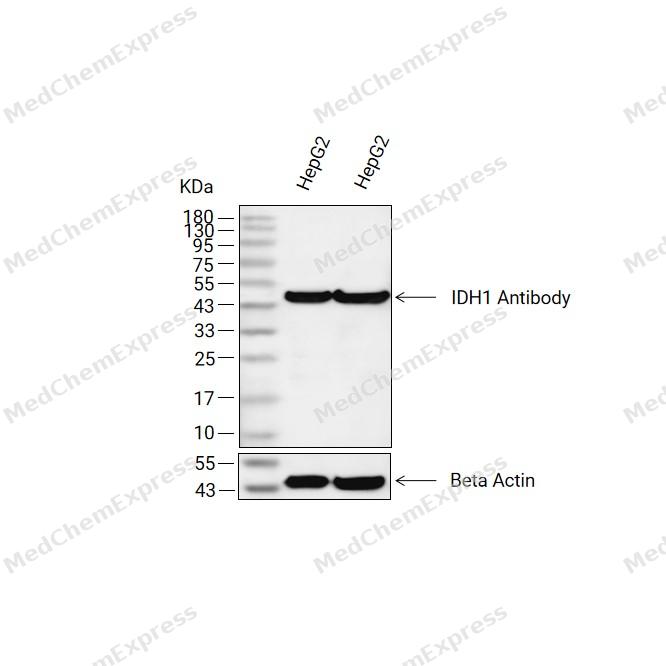 Western blot analysis of extracts from HepG2(lane 2(20ug) and HepG2(lane 3(40ug) using IDH1 Antibody (HY-P80995) Rabbit mAb. Proteins were transferred to a PVDF membrane and blocked with 5% non-fat milk in TBST for 2 hour at room temperature. The primary antibody (1/1000) and Loading control antibody (Beta Actin, HY-P83730, 1/10000) was used in 5% non-fat milk in TBST at 4°C overnight. Goat Anti-Mouse/Rabbit IgG-HRP Secondary Antibody (1/10000) was used for 1 hour at room temperature.
 -
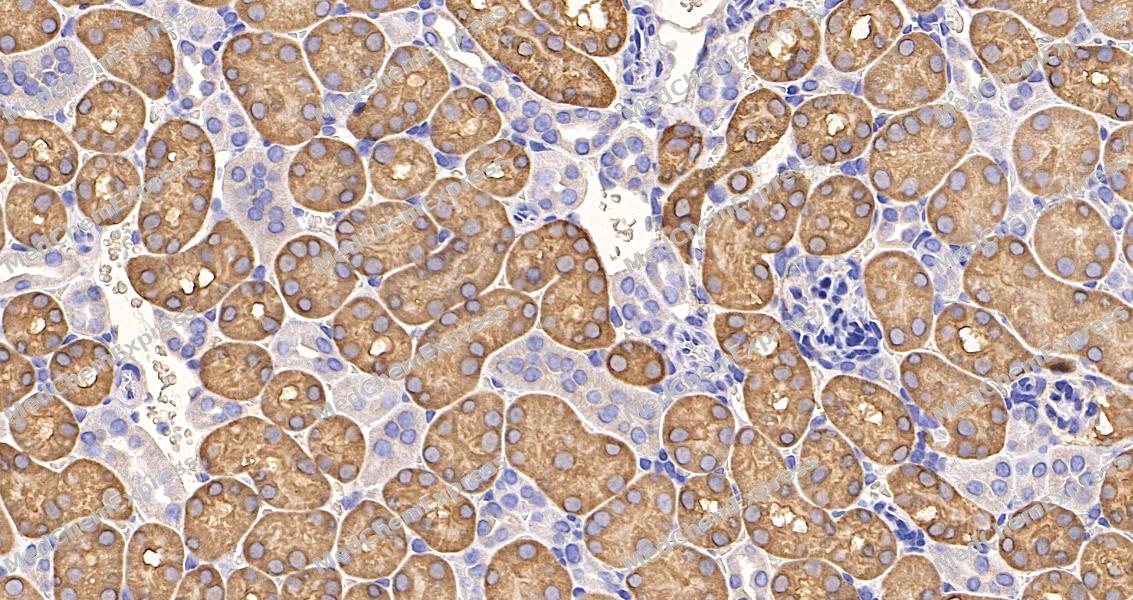 Immunohistochemical analysis of paraffin-embedded mouse kidney tissue using IDH1 Antibody. The section was pre-treated using heat mediated antigen retrieval with sodium citrate buffer (pH 6.0) for 8 minutes. The tissues were blocked in QuickBlock for 20 minutes at room temperature, washed with ddH2O and PBS, and then probed with the primary antibody at 1/100 dilution in 4℃ overnight. The detection was performed using an HRP conjugated compact polymer system. DAB was used as the chromogen. Tissues were counterstained with hematoxylin and mounted with DPX.
 -
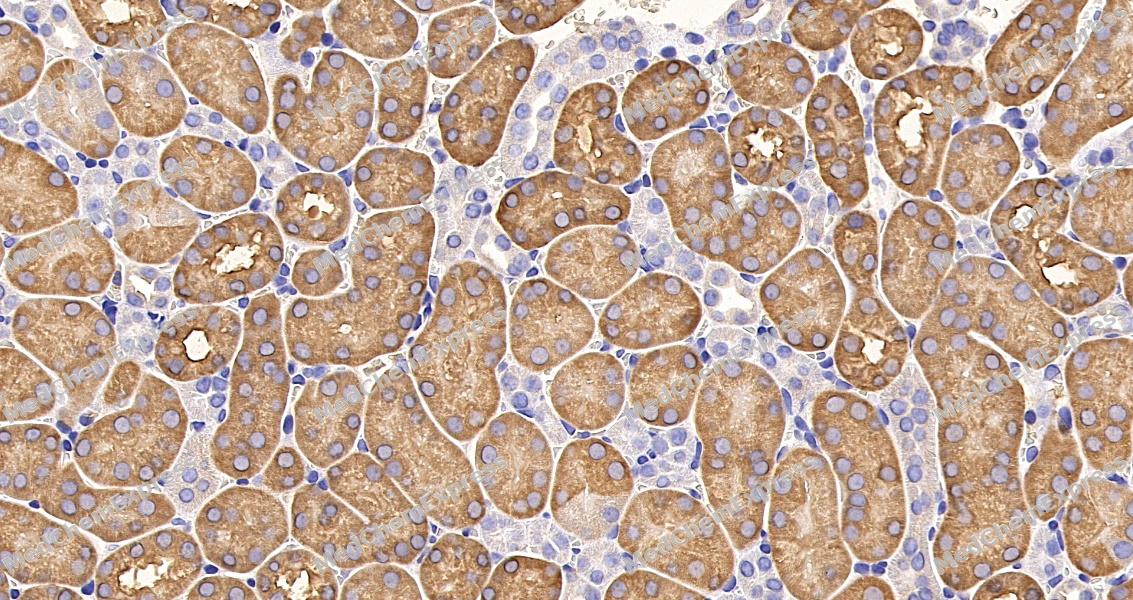 Immunohistochemical analysis of paraffin-embedded mouse kidney tissue using IDH1 Antibody. The section was pre-treated using heat mediated antigen retrieval with sodium citrate buffer (pH 6.0) for 8 minutes. The tissues were blocked in QuickBlock for 20 minutes at room temperature, washed with ddH2O and PBS, and then probed with the primary antibody at 1/100 dilution in 4℃ overnight. The detection was performed using an HRP conjugated compact polymer system. DAB was used as the chromogen. Tissues were counterstained with hematoxylin and mounted with DPX.


Background
-
Function
IDH1 (isocitrate dehydrogenase 1) is a cytosolic and peroxisomal NADP+-dependent enzyme that catalyzes the conversion of isocitrate to α-ketoglutarate (α-KG) while generating NADPH, thereby supporting cellular redox homeostasis and intermediary metabolism[1][2]. Mechanistically, IDH1 contributes to metabolic pathways that regulate oxidative stress responses, biosynthetic processes, and α-KG availability for multiple cellular reactions[1][2]. In cancer biology, IDH1 is notable because recurrent mutations, most commonly affecting residue R132, confer a neomorphic enzymatic activity that converts α-KG into D-2-hydroxyglutarate (D-2HG), an oncometabolite that accumulates in tumor cells[3][2][4]. Elevated D-2HG inhibits α-KG-dependent dioxygenases, resulting in widespread epigenetic alterations and impaired cellular differentiation that contribute to tumor development and progression[2][4][5]. These molecular effects have been extensively studied in glioma and acute myeloid leukemia models, where mutant IDH1 functions as an early driver of tumorigenesis and metabolic reprogramming[4][5][6]. Compared with the related isoform IDH2, which is localized primarily in mitochondria, IDH1 is predominantly cytosolic and peroxisomal, creating distinct subcellular metabolic functions despite sharing similar catalytic chemistry[1][7]. For experimental applications, selective mutant IDH1 inhibitors reduce D-2HG production and promote cellular differentiation in preclinical models, making them valuable tools for investigating IDH1-dependent metabolic and epigenetic mechanisms in cancer research[5][6][8].
-
Subcellular Localization
Cytoplasm, cytosol; Peroxisome
-
Subunit
Homodimer
-
SwissProt ID
-
Synonyms
PICD, IDH1, Isocitrate dehydrogenase [NADP] cytoplasmic, IDH, Cytosolic NADP-isocitrate dehydrogenase, IDPc, NADP(+)-specific ICDH, Oxalosuccinate decarboxylase
Documentation
-
Data Sheet (262 KB)
-
SDS (251 KB)
- English - EN (251 KB)
- Français - FR (251 KB)
- Deutsch - DE (251 KB)
- Norwegian - NO (251 KB)
- Español - ES (251 KB)
- Swedish - SV (251 KB)
- Italian - IT (251 KB)
- Korean - KR (251 KB)
- Portuguese - PT (251 KB)
-
User Guide for Antibodies (1077 KB)
References
[1]. IDH1 gene information from NCBI.
[2]. Alzial G, et al. Wild-type isocitrate dehydrogenase under the spotlight in glioblastoma. Oncogene. 2022 Jan;41(5):613-621. [Content Brief]
[3]. Liu Z, et al. Inhibition of cancer-associated mutant isocitrate dehydrogenases: synthesis, structure-activity relationship, and selective antitumor activity. J Med Chem. 2014 Oct 23;57(20):8307-18. [Content Brief]
[4]. Waitkus MS, et al. Biological Role and Therapeutic Potential of IDH Mutations in Cancer. Cancer Cell. 2018 Aug 13;34(2):186-195. [Content Brief]
[5]. Rohle D, et al. An inhibitor of mutant IDH1 delays growth and promotes differentiation of glioma cells. Science. 2013 May 3;340(6132):626-30. [Content Brief]
[6]. Golub D, et al. Mutant Isocitrate Dehydrogenase Inhibitors as Targeted Cancer Therapeutics. Front Oncol. 2019 May 17;9:417. [Content Brief]
[8]. Popovici-Muller J, et al. Discovery of the First Potent Inhibitors of Mutant IDH1 That Lower Tumor 2-HG in Vivo. ACS Med Chem Lett. 2012 Sep 17;3(10):850-5. [Content Brief]

 Powered by Bioz
