



PGC1 alpha Antibody
(Synonyms: PPARGC1A; LEM6; PGC1; PGC1A; PPARGC1; Peroxisome proliferator-activated receptor gamma coactivator 1-alpha; PGC-1-alpha; PPAR-gamma coactivator 1-alpha; PPARGC-1-alpha; Ligand effect modulator 6)Based on 1 publication(s) in Google Scholar
PGC1 alpha Antibody is a Rabbit-derived and non-conjugated IgG polyclonal antibody, targeting to PGC1 alpha.
-
Host:
Rabbit
-
Isotype:
IgG
-
Application:
WB
-
Reactivity :
Human, Mouse, Rat
-
Formulation:
Supplied in Rabbit IgG in 10mM phosphate buffered saline , pH 7.4, 150mM sodium chloride, 0.05% BSA, 0.02% sodium azide and 50% glycerol.
-
Conjugation:
Non-conjugated


To place orders, for customer services and technical support, please contact: MedChemExpress USA
Tel: 609-228-6898 E-mail: [email protected] [email protected]






Publications Citing Use of MedChemExpress (MCE) PGC1 alpha Antibody
More

Applications
| Application |
WB

WB: Western Blot
|
|---|---|
| Dilution Ratio | 1:500-1:1000 |


Product Details
PGC1 alpha Antibody is a Rabbit-derived and non-conjugated IgG polyclonal antibody, targeting to PGC1 alpha.
-
Host Rabbit

-
Clonality Polyclonal

-
Species ReactivityHuman, Mouse, Rat
-
Observed Molecular WeightObserved band size: 113 kDa
Note: Due to possible protein modifications or aggregation, the molecular weight should be confirmed by actual measurement, and the predicted value is for reference only.

-
Calculated Molecular Weight Predicted band size: 91 kDa

Entrez Gene: 10891 Human ; 19017 Mouse ; 83516 Rat
SwissProt: Q9UBK2 Human ; O70343 Mouse ; Q9QYK2 Rat
OMIM: 604517 Human
Synthetic peptide corresponding to Human PGC1 alpha aa765-798.
Endogenous
affinity purified
Non-conjugated
Unmodified
IgG


Product Properties
-
Appearance
Liquid
-
Formulation
Supplied in Rabbit IgG in 10mM phosphate buffered saline , pH 7.4, 150mM sodium chloride, 0.05% BSA, 0.02% sodium azide and 50% glycerol.
-
Concentration
Batch-dependent, Please check the COA for the concentration of each lot. Check Lot Concentration
-
Storage & Stability
Stored at -20°C for 1 year. Avoid repeated freeze / thaw cycles.
-
Shipping
Shipping with blue ice.


Publications (1)
-
Journal Impact Factor
-
Most Recent


Verification Images
-
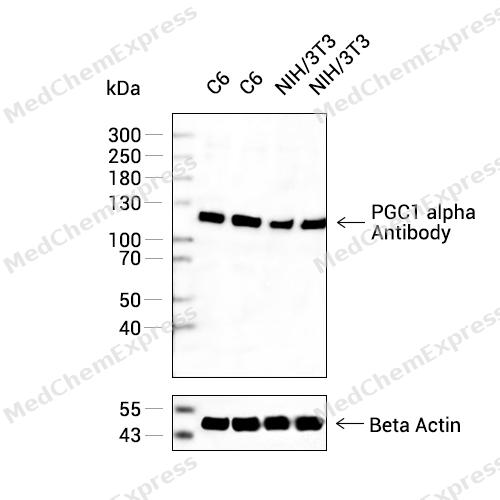 Western blot analysis of extracts from C6(lane 2(20μg) , C6(lane 3(40ug) and NIH/3T3(lane 4(20ug) , NIH/3T3(lane 5(40ug) using PGC1 alpha Antibody (HY-P80783) Rabbit mAb. Proteins were transferred to a PVDF membrane and blocked with 5% non-fat milk in TBST for 2 hour at room temperature. The primary antibody (1/1000) and Loading control antibody (Beta Actin, HY-P80438, 1/10000) was used in 5% non-fat milk in TBST at 4°C overnight. Goat Anti-Mouse/Rabbit IgG-HRP Secondary Antibody (1/10000) was used for 1 hour at room temperature.


Background
-
Function
Transcriptional coactivator for steroid receptors and nuclear receptors (PubMed:10713165, PubMed:20005308, PubMed:21376232, PubMed:28363985, PubMed:32433991). Greatly increases the transcriptional activity of PPARG and thyroid hormone receptor on the uncoupling protein promoter (PubMed:10713165, PubMed:20005308, PubMed:21376232). Can regulate key mitochondrial genes that contribute to the program of adaptive thermogenesis (PubMed:10713165, PubMed:20005308, PubMed:21376232). Plays an essential role in metabolic reprogramming in response to dietary availability through coordination of the expression of a wide array of genes involved in glucose and fatty acid metabolism (PubMed:10713165, PubMed:20005308, PubMed:21376232). Acts as a key regulator of gluconeogenesis: stimulates hepatic gluconeogenesis by increasing the expression of gluconeogenic enzymes, and acting together with FOXO1 to promote the fasting gluconeogenic program (PubMed:16753578, PubMed:23142079). Induces the expression of PERM1 in the skeletal muscle in an ESRRA-dependent manner (PubMed:23836911). Also involved in the integration of the circadian rhythms and energy metabolism (By similarity). Required for oscillatory expression of clock genes, such as BMAL1 and NR1D1, through the coactivation of RORA and RORC, and metabolic genes, such as PDK4 and PEPCK (By similarity)
-
Subcellular Localization
Nucleus; Nucleus, PML body; Nucleus; Cytoplasm; Nucleus; Nucleus; Nucleus, PML body; Nucleus
-
Expression
Tissue_specificity:It is expressed in the heart, skeletal muscle, liver, and kidneys. Expression levels are low in the brain and pancreas, and extremely low in the intestine and white adipose tissue. In skeletal muscle, expression levels are lower in obese individuals than in lean individuals, and fasting can double the expression level in the skeletal muscle of obese individuals.
Induction:Transcription is repressed by ZNF746 which binds to 'insulin response sequences' its promoter -
Isoforms & Post-Translational Modification
Q9UBK2 has 9 isomers: Q9UBK2-1: 91027 Da (predicted); Q9UBK2-2: 30031 Da (predicted); Q9UBK2-3: 91713 Da (predicted); Q9UBK2-4: 89641 Da (predicted); Q9UBK2-5: 31772 Da (predicted); Q9UBK2-6: 30717 Da (predicted); Q9UBK2-7: 14964 Da (predicted); Q9UBK2-8: 33157 Da (predicted); Q9UBK2-9: 77139 Da (predicted).
Phosphorylation by AMPK in skeletal muscle increases activation of its own promoter. Phosphorylated by CLK2;Heavily acetylated by KAT2A/GCN5 under conditions of high nutrients, leading to inactivation of PPARGC1A (PubMed:16753578, PubMed:20005308, PubMed:23142079). Deacetylated by SIRT1 in low nutrients/high NAD conditions, leading to its activation (PubMed:20005308);Ubiquitinated. Ubiquitination by RNF34 induces proteasomal degradation -
Subunit
Homooligomer (PubMed:10713165). Interacts with MYBBP1A; inhibits MYBBP1A transcriptional activation (By similarity). Interacts with PRDM16, LPIN1 and PML (By similarity). Interacts (via LXXLL motif) with RORA and RORC (via AF-2 motif); activates RORA and RORC transcriptional activation (By similarity). Interacts with LRPPRC (PubMed:17050673). Interacts with FOXO1 (By similarity). Interacts with NR5A2 (PubMed:28363985, PubMed:32433991)
-
SwissProt ID
-
Synonyms
PPARGC1A; LEM6; PGC1; PGC1A; PPARGC1; Peroxisome proliferator-activated receptor gamma coactivator 1-alpha; PGC-1-alpha; PPAR-gamma coactivator 1-alpha; PPARGC-1-alpha; Ligand effect modulator 6
-
Research Field
Epigenetics and Nuclear Signaling
Documentation
-
Data Sheet (235 KB)
-
SDS (252 KB)
- English - EN (252 KB)
- Français - FR (252 KB)
- Deutsch - DE (252 KB)
- Norwegian - NO (252 KB)
- Español - ES (252 KB)
- Swedish - SV (252 KB)
- Italian - IT (252 KB)
- Korean - KR (252 KB)
- Portuguese - PT (252 KB)
-
User Guide for Antibodies (1077 KB)

 Powered by Bioz
