



Rad51 Antibody (YA108)
(Synonyms: RAD51A, RECA, RAD51, DNA repair protein RAD51 homolog 1, HsRAD51, hRAD51, RAD51 homolog A)Based on 1 publication(s) in Google Scholar
Rad51 Antibody (YA108) is a Rabbit-derived and non-conjugated IgG monoclonal antibody, targeting to Rad51.
-
Host:
Rabbit
-
Isotype:
IgG
-
Application:
WB, ICC/IF, IHC-P, FC, IP
-
Reactivity :
Human, Mouse, Rat
-
Formulation:
Supplied in 1*TBS (pH7.4), 0.05% BSA and 40% Glycerol. Preservative: 0.05% Sodium Azide.
-
Conjugation:
Non-conjugated


To place orders, for customer services and technical support, please contact: MedChemExpress USA
Tel: 609-228-6898 E-mail: [email protected] [email protected]



Publications Citing Use of MedChemExpress (MCE) Rad51 Antibody (YA108)
More

Applications
| Application |
WB

WB: Western Blot
|
ICC/IF
ICC/IF: Immunocytochemistry/
Immunofluorescence |
IHC-P
IHC-P: Immunohistochemistry-Paraffin
|
FC
FC: Flow Cytometry
|
IP
IP: Immunoprecipitation
|
|---|---|---|---|---|---|
| Dilution Ratio | 1:1000 | 1:50-1:100 | 1:50-1:1000 | 1:50-1:100 | Use at an assay dependent concentration. |


Product Details
Rad51 Antibody (YA108) is a Rabbit-derived and non-conjugated IgG monoclonal antibody, targeting to Rad51.
-
Host Rabbit

-
Clonality Recombinant,Monoclonal

-
Species ReactivityHuman, Mouse, Rat
-
Observed Molecular WeightObserved band size: 37 kDa
Note: Due to possible protein modifications or aggregation, the molecular weight should be confirmed by actual measurement, and the predicted value is for reference only.

-
Calculated Molecular Weight Predicted band size: 37 kDa

Entrez Gene: 5888 Human ; 19361 Mouse ; 499870 Rat
SwissProt: Q06609 Human ; Q08297 Mouse ; B5DF04 Rat
OMIM: 114480 Human
Synthetic peptide corresponding to Human Rad51.AA range:1-50.
Endogenous
Protein A affinity purified.
Non-conjugated
Unmodified
IgG


Product Properties
-
Appearance
Solution
-
Formulation
Supplied in 1*TBS (pH7.4), 0.05% BSA and 40% Glycerol. Preservative: 0.05% Sodium Azide.
-
Concentration
Batch-dependent, Please check the COA for the concentration of each lot. Check Lot Concentration
-
Storage & Stability
Stored at -20°C for 1 year. Avoid repeated freeze / thaw cycles.
-
Shipping
Shipping with blue ice.


Publications (1)
-
Journal Impact Factor
-
Most Recent
-
Biochem Pharmacol
Discovery of Bi-magnolignan as a novel BRD4 inhibitor inducing apoptosis and DNA damage for cancer therapy. [Abstract]2025 May:235:116843. PMID: 40024351


Verification Images
-
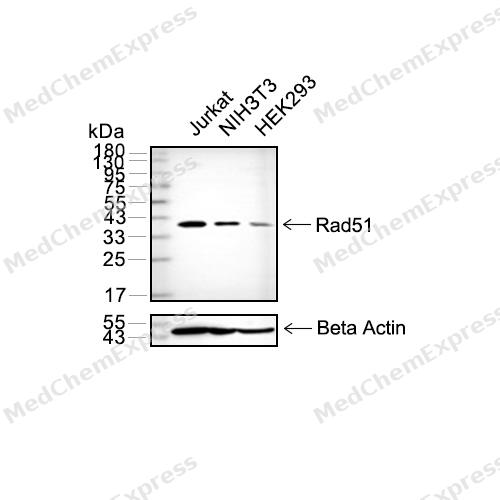 Western blot analysis of extracts from Jurkat (lane 2(20μg),NIH3T3 (lane 3(20μg) and HEK293(lane 4(20μg) using Rad51 (HY-P80297) Rabbit mAb. Proteins were transferred to a PVDF membrane and blocked with 5% non-fat milk in TBST for 2 hour at room temperature. The primary antibody (1/1000) and Loading control antibody (Beta Actin, HY-P80438, 1/10000) was used in 5% non-fat milk in TBST at 4°C overnight. Goat Anti-Mouse IgG-HRP Secondary Antibody (1/10000) was used for 1 hour at room temperature.
 -
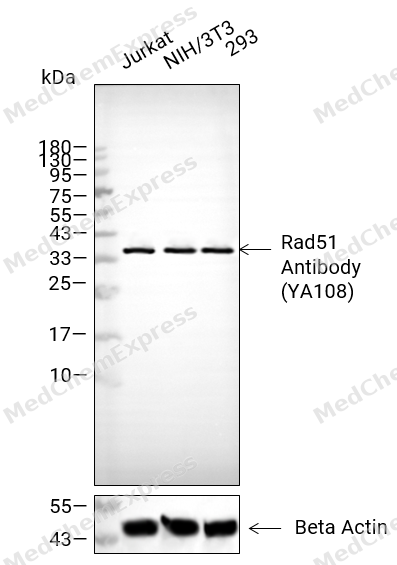 Western blot analysis of extracts from Jurkat (lane 2(40μg), NIH/3T3 (lane 3(40μg), 293 (lane 4(40μg)using Rad51 Antibody (YA108). Proteins were transferred to a PVDF membrane and blocked with 5% BSA in TBST for 2 hour at room temperature. The primary antibody and Loading control antibody (Beta Actin, HY-P80438, 1/3000) was used in 5% BSA in TBST at 4°C overnight. Goat Anti-Mouse/Rabbit IgG-HRP Secondary Antibody (HY-P8004/HY-P8001, 1/10,000) was used for 1 hour at room temperature.
 -
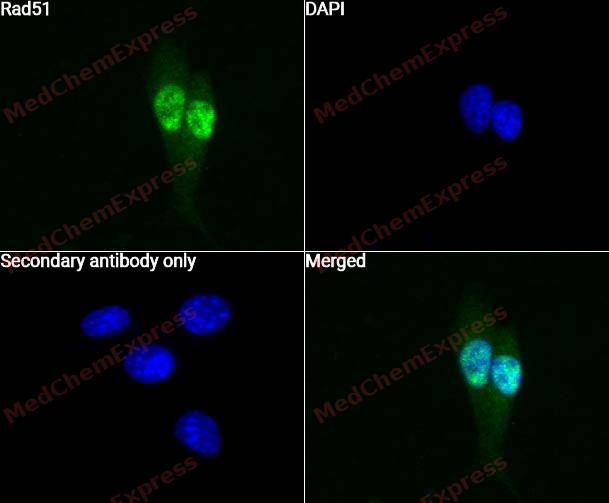 Immunocytochemistry analysis of NIH/3T3 cells labeling Rad51 with Rad51 Antibody (HY-P80297)at 1/50 dilution. Cells were fixed in 4% paraformaldehyde for 15 minutes at room temperature, permeabilized with 0.1% Triton X-100 for 10 minutes at room temperature, then blocked with QuickBlock™ Blocking Buffer for Immunol Staining for 10 min at room temperature. Cells were then incubated with Rad51 Antibody (HY-P80297) at 1/50 dilution in QuickBlock™ Blocking Buffer for Immunol Staining at 4 ℃. Alexa Fluor® 488-conjugated AffiniPure Goat Anti-Rabbit IgG H&L(HY-P8002, Green) was used as the secondary antibody at 1/1,000 dilution. PBS instead of the primary antibody was used as the secondary antibody only control. The Nuclear counterstain was DAPI (Blue).
 -
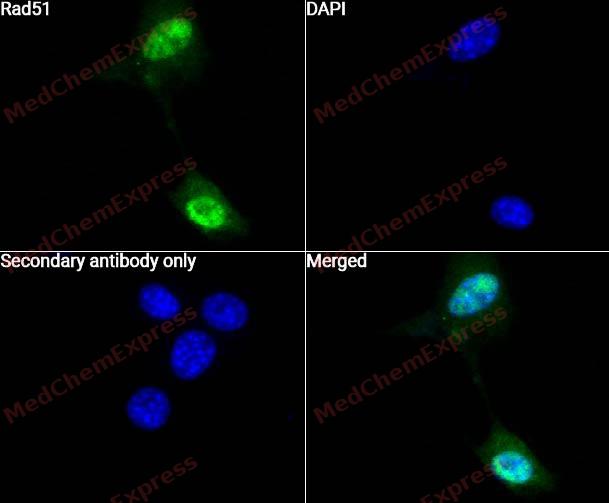 Immunocytochemistry analysis of NIH/3T3 cells labeling Rad51 with Rad51 Antibody (HY-P80297) at 1/100 dilution. Cells were fixed in 4% paraformaldehyde for 15 minutes at room temperature, permeabilized with 0.1% Triton X-100 for 10 minutes at room temperature, then blocked with QuickBlock™ Blocking Buffer for Immunol Staining for 10 min at room temperature. Cells were then incubated with Rad51 Antibody (HY-P80297) at 1/100 dilution in QuickBlock™ Blocking Buffer for Immunol Staining at 4 ℃. Alexa Fluor® 488-conjugated AffiniPure Goat Anti-Rabbit IgG H&L(HY-P8002, Green) was used as the secondary antibody at 1/1,000 dilution. PBS instead of the primary antibody was used as the secondary antibody only control. The Nuclear counterstain was DAPI (Blue).
 -
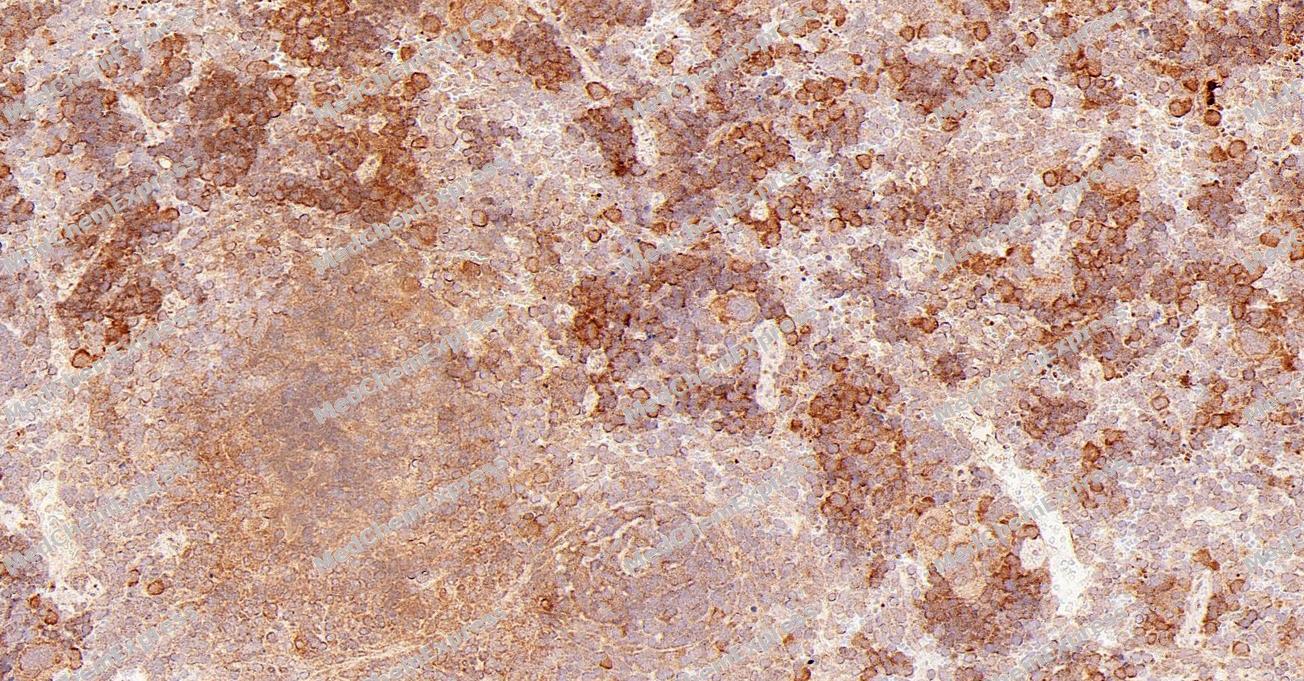 Immunohistochemical analysis of paraffin-embedded Mouse spleen tissue using Rad51 Antibody. The section was pre-treated using heat mediated antigen retrieval with Tris-EDTA buffer (pH 9.0) for 8 minutes. The tissues were blocked in QuickBlock for 20 minutes at room temperature, washed with ddH2O and PBS, and then probed with the primary antibody (HY-P80297, 1/500) in 4℃ overnight. The detection was performed using an HRP conjugated compact polymer system. DAB was used as the chromogen. Tissues were counterstained with hematoxylin and mounted with DPX.
 -
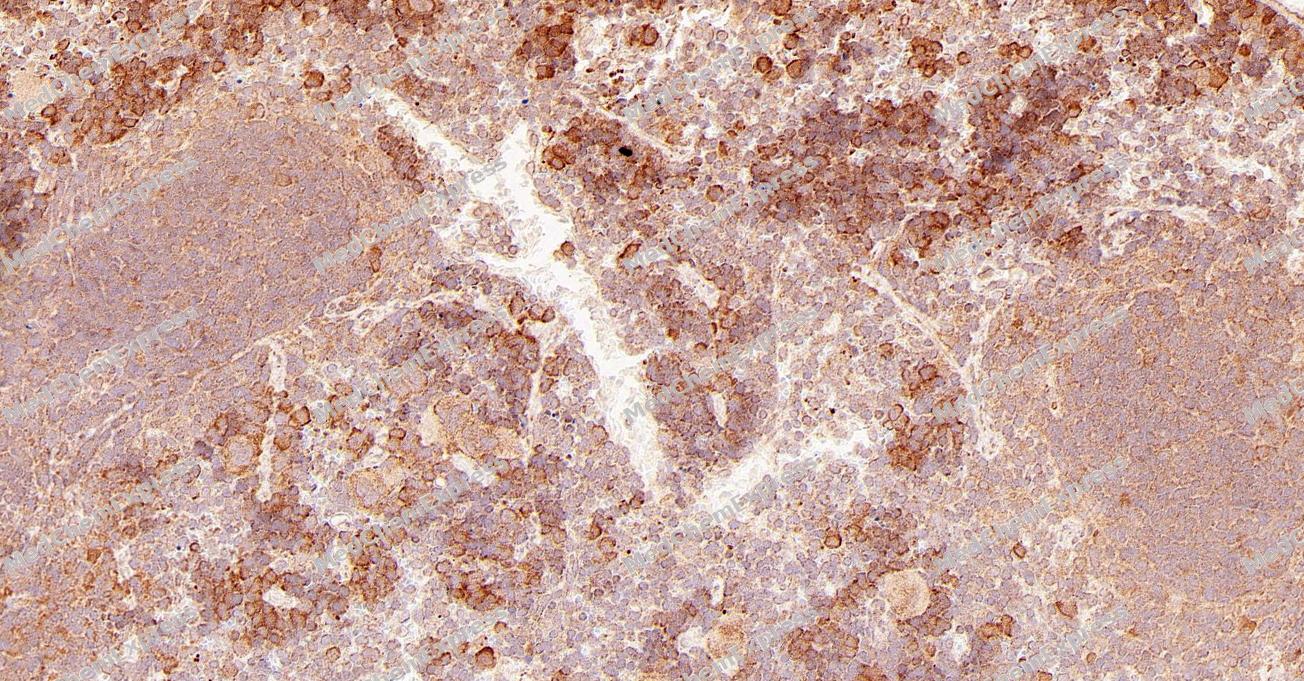 Immunohistochemical analysis of paraffin-embedded Mouse spleen tissue using Rad51 Antibody. The section was pre-treated using heat mediated antigen retrieval with Tris-EDTA buffer (pH 9.0) for 8 minutes. The tissues were blocked in QuickBlock for 20 minutes at room temperature, washed with ddH2O and PBS, and then probed with the primary antibody (HY-P80297, 1/500) in 4℃ overnight. The detection was performed using an HRP conjugated compact polymer system. DAB was used as the chromogen. Tissues were counterstained with hematoxylin and mounted with DPX.
 -
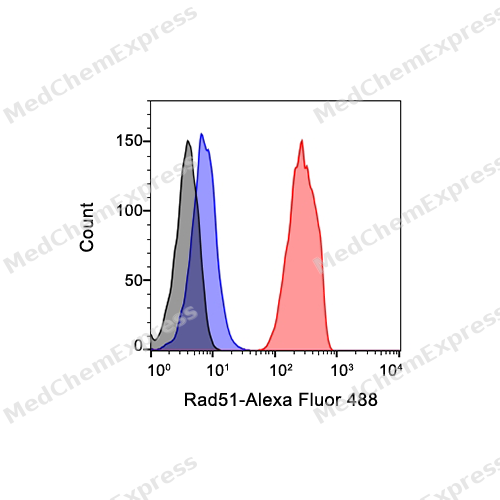 Flow cytometric analysis of 1X10^6 Jurkat cells labeling Rad51 Antibody (HY-P80297, red). Cells were fixed with 4% paraformaldehyde and permeabilised with 90% methanol. Then stained with the primary antibody at 1/100 dilution for an hour at 4℃. Alexa Fluor® 488-conjugated AffiniPure Goat Anti-Rabbit IgG H&L (HY-P8002) was used as the secondary antibody at 1/1,000 dilution for 30 minutes at 4℃. Rabbit IgG Isotype Control (HY-P80879, blue) was used as the isotype control, cells without incubation with primary antibody were used as the unlabeled control (black).


Background
-
Function
RAD51, an essential eukaryotic DNA recombinase, promotes homologous pairing and strand exchange during homologous recombination (HR) and the recombinational repair of double strand breaks. RAD51 protein is recruited onto the DNA break by BRCA2 and forms homopolymeric filaments that invade the homologous chromatid and use it as a template for repair. RAD51 filaments are detectable by immunofluorescence as distinct foci in the cell nucleus, and their presence is a read out of HR proficiency. RAD51 is an essential gene, protecting cells from genetic instability.
RAD51 recombinase activity plays a critical role for cancer cell proliferation and survival, and often contributes to drug-resistance. Abnormally elevated RAD51 function and hyperactive homologous recombination (HR) rates have been found in a panel of cancers, including breast cancer and chronic myeloid leukaemia (CML) . Directly targeting RAD51 and attenuating the deregulated RAD51 activity has therefore been proposed as an alternative and supplementary strategy for cancer treatment.
-
Subcellular Localization
Nucleus; Cytoplasm; Cytoplasm, perinuclear region; Mitochondrion matrix; Chromosome; Cytoplasm, cytoskeleton, microtubule organizing center, centrosome
-
Expression
Tissue_specificity:It is highly expressed in the testes and thymus, followed by the small intestine, placenta, colon, pancreas, and ovary. Expression is weaker in the mammary gland.
Induction:Stress-induced increase in the mitochondrial levels is seen -
Subunit
Forms linear homooligomers, giving rise to a RAD51 nucleoprotein filament, which is essential for strand-pairing reactions during DNA recombination.
-
SwissProt ID
-
Synonyms
RAD51A, RECA, RAD51, DNA repair protein RAD51 homolog 1, HsRAD51, hRAD51, RAD51 homolog A
-
Research Field
Epigenetics and Nuclear Signaling
Documentation
-
Data Sheet (235 KB)
-
SDS (252 KB)
- English - EN (252 KB)
- Français - FR (252 KB)
- Deutsch - DE (252 KB)
- Norwegian - NO (252 KB)
- Español - ES (252 KB)
- Swedish - SV (252 KB)
- Italian - IT (252 KB)
- Korean - KR (252 KB)
- Portuguese - PT (252 KB)
-
User Guide for Antibodies (1077 KB)

 Powered by Bioz
