



RIP Antibody (YA091)
(Synonyms: RIP1, RIPK1, Receptor-Interacting Protein Kinase 1)
Based on 1 Customer Validation
RIP Antibody (YA091) is a Rabbit-derived and non-conjugated IgG monoclonal antibody, targeting to RIP.
-
Host:
Rabbit
-
Isotype:
IgG
-
Application:
WB, FC
-
Reactivity :
Human
-
Formulation:
Supplied in 1*TBS (pH7.4), 0.05% BSA and 40% Glycerol. Preservative: 0.05% Sodium Azide.
-
Conjugation:
Non-conjugated


To place orders, for customer services and technical support, please contact: MedChemExpress USA
Tel: 609-228-6898 E-mail: [email protected] [email protected]





Applications
| Application |
WB

WB: Western Blot
|
FC
FC: Flow Cytometry
|
|---|---|---|
| Dilution Ratio | 1:500-1:1000 | 1:50 |


Product Details
RIP Antibody (YA091) is a Rabbit-derived and non-conjugated IgG monoclonal antibody, targeting to RIP.
-
Host Rabbit

-
Clonality Recombinant,Monoclonal

-
Species ReactivityHuman
-
Observed Molecular WeightObserved band size: 76 kDa
Note: Due to possible protein modifications or aggregation, the molecular weight should be confirmed by actual measurement, and the predicted value is for reference only.

-
Calculated Molecular Weight Predicted band size: 76 kDa

Synthetic peptide corresponding to Human RIP.AA range:250-500.
Endogenous
Protein A affinity purified.
Non-conjugated
Unmodified
IgG


Product Properties
-
Appearance
Solution
-
Formulation
Supplied in 1*TBS (pH7.4), 0.05% BSA and 40% Glycerol. Preservative: 0.05% Sodium Azide.
-
Concentration
Batch-dependent, Please check the COA for the concentration of each lot. Check Lot Concentration
-
Storage & Stability
Stored at -20°C for 1 year. Avoid repeated freeze / thaw cycles.
-
Shipping
Shipping with blue ice.


Verification Images
-
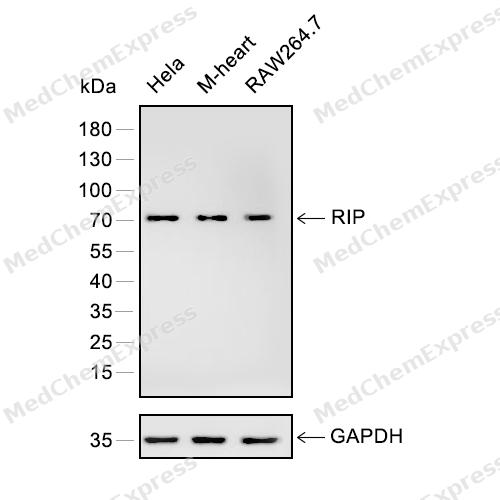 Western blot analysis of extracts from Hela (lane 1) and M-heart (lane 2) and RAW264.7 (lane 3) using RIP antibody. Proteins were transferred to a PVDF membrane and blocked with 5% nonfat powdered milk in PBST for 2 hour at room temperature. The primary antibody (1/1000) and Loading control antibody (GAPDH, 1/3000) was diluted with 5% nonfat powdered milk in PBST at 4°C overnight. Goat Anti-Rabbit IgG-HRP Secondary Antibody (1/8,000) was incubated for 45min at room temperature.
 -
 Flow cytometric analysis of 1X10⁶ HeLa cells labeling RIP Antibody (HY-P80313, red). Cells were fixed with 4% paraformaldehyde and permeabilised with 90% methanol. Then stained with the primary antibody at 1/50 dilution for an hour at 4℃. AF488-conjugated Goat Anti-Rabbit IgG H&L (HY-P8002) was used as the secondary antibody at 1/1,000 dilution for 30 minutes at 4℃. Rabbit IgG Isotype Control (HY-P80879, blue) was used as the isotype control, cells without incubation with primary antibody were used as the unlabeled control (black).


Background
-
Function
RIP is a Serine-threonine kinase which is a key regulator of TNF-mediated apoptosis, necroptosis and inflammatory pathways. Exhibits kinase activity-dependent functions that regulate cell death and kinase-independent scaffold functions regulating inflammatory signaling and cell survival. Has kinase-independent scaffold functions: upon binding of TNF to TNFR1, RIPK1 is recruited to the TNF-R1 signaling complex (TNF-RSC also known as complex I) where it acts as a scaffold protein promoting cell survival, in part, by activating the canonical NF-kappa-B pathway. Kinase activity is essential to regulate necroptosis and apoptosis, two parallel forms of cell death: upon activation of its protein kinase activity, regulates assembly of two death-inducing complexes, namely complex IIa (RIPK1-FADD-CASP8), which drives apoptosis, and the complex IIb (RIPK1-RIPK3-MLKL), which drives necroptosis. RIPK1 is required to limit CASP8-dependent TNFR1-induced apoptosis. In normal conditions, RIPK1 acts as an inhibitor of RIPK3-dependent necroptosis, a process mediated by RIPK3 component of complex IIb, which catalyzes phosphorylation of MLKL upon induction by ZBP1. Inhibits RIPK3-mediated necroptosis via FADD-mediated recruitment of CASP8, which cleaves RIPK1 and limits TNF-induced necroptosis. Required to inhibit apoptosis and necroptosis during embryonic development: acts by preventing the interaction of TRADD with FADD thereby limiting aberrant activation of CASP8. In addition to apoptosis and necroptosis, also involved in inflammatory response by promoting transcriptional production of pro-inflammatory cytokines, such as interleukin-6 (IL6). Phosphorylates RIPK3: RIPK1 and RIPK3 undergo reciprocal auto- and trans-phosphorylation. Phosphorylates DAB2IP at 'Ser-728' in a TNF-alpha-dependent manner, and thereby activates the MAP3K5-JNK apoptotic cascade. Required for ZBP1-induced NF-kappa-B activation in response to DNA damage[1][2][3][4][5][6][7][8][9][10][11][12][13].
-
Subcellular Localization
Cytoplasm; Cell membrane
-
Isoforms & Post-Translational Modification
Q13546 has 2 isomers: Q13546-1: 75931 Da (predicted); Q13546-2: 70733 Da (predicted).
(Microbial infection) Proteolytically cleaved by S.flexneri OspD3 within the RIP homotypic interaction motif (RHIM), leading to its degradation and inhibition of necroptosis;Proteolytically cleaved by CASP8 at Asp-324 (PubMed:10521396, PubMed:31827280, PubMed:31827281). Cleavage is crucial for limiting TNF-induced apoptosis, necroptosis and inflammatory response (PubMed:31827280, PubMed:31827281). Cleavage abolishes NF-kappa-B activation and enhances the interaction of TRADD with FADD (PubMed:10521396). Proteolytically cleaved by CASP6 during intrinsic apoptosis (PubMed:22858542);RIPK1 and RIPK3 undergo reciprocal auto- and trans-phosphorylation (PubMed:18408713, PubMed:19524513, PubMed:31827280). Phosphorylation of Ser-161 by RIPK3 is necessary for the formation of the necroptosis-inducing complex (PubMed:18408713). Phosphorylation at Ser-25 represses its kinase activity and consequently prevents TNF-mediated RIPK1-dependent cell death (PubMed:30988283). Phosphorylated at Ser-320 by MAP3K7 which requires prior ubiquitination with 'Lys-63'-linked chains by BIRC2/c-IAP1 and BIRC3/c-IAP2 (By similarity). This phosphorylation positively regulates RIPK1 interaction with RIPK3 to promote necroptosis but negatively regulates RIPK1 kinase activity and its interaction with FADD to mediate apoptosis (By similarity);Deubiquitinated by USP7; this modification is required for TNF-alpha-induced apoptosis;Ubiquitinated with 'Lys-11'-, 'Lys-48'-, 'Lys-63'- and linear-linked type ubiquitin (PubMed:15258597, PubMed:16603398, PubMed:17703191, PubMed:18450452, PubMed:21455173, PubMed:21931591, PubMed:29883609, Ref.35). Polyubiquitination with 'Lys-63'-linked chains by TRAF2 induces association with the IKK complex (PubMed:15258597). Deubiquitination of 'Lys-63'-linked chains and polyubiquitination with 'Lys-48'-linked chains by TNFAIP3 leads to RIPK1 proteasomal degradation and consequently down-regulates TNF-alpha-induced NF-kappa-B signaling (PubMed:15258597). 'Lys-48'-linked polyubiquitination by RFFL or RNF34 also promotes proteasomal degradation and negatively regulates TNF-alpha-induced NF-kappa-B signaling (PubMed:18450452, Ref.35). Linear polyubiquitinated; the head-to-tail linear polyubiquitination ('Met-1'-linked) is mediated by the LUBAC complex and decreases protein kinase activity (PubMed:21455173). Deubiquitination of linear polyubiquitin by CYLD promotes the kinase activity (By similarity). Polyubiquitinated with 'Lys-48' and 'Lys-63'-linked chains by BIRC2/c-IAP1 and BIRC3/c-IAP2, leading to activation of NF-kappa-B (PubMed:21931591). Ubiquitinated with 'Lys-63'-linked chains by PELI1 (PubMed:29883609). Ubiquitination at Lys-377 with 'Lys-63'-linked chains by BIRC2/c-IAP1 and BIRC3/c-IAP2 is essential for its phosphorylation at Ser-320 mediated by MAP3K7 (By similarity). This ubiquitination is required for NF-kB activation, suppresses RIPK1 kinase activity and plays a critical role in preventing cell death during embryonic development (By similarity);(Microbial infection) Glycosylated at Arg-603 by enteropathogenic E.coli protein NleB1: arginine GlcNAcylation prevents homotypic/heterotypic death domain interactions -
Subunit
Homodimer (PubMed:29440439, PubMed:29681455). Interacts (via RIP homotypic interaction motif) with RIPK3 (via RIP homotypic interaction motif); this interaction induces RIPK1 phosphorylation and formation of a RIPK1-RIPK3 necroptosis-inducing complex (PubMed:10358032, PubMed:11734559, PubMed:19524512, PubMed:29681455, PubMed:29883609). Upon TNF-induced necrosis, the RIPK1-RIPK3 dimer further interacts with PGAM5 and MLKL; the formation of this complex leads to PGAM5 phosphorylation and increase in PGAM5 phosphatase activity (PubMed:22265414). Interacts (via the death domain) with TNFRSF6 (via the death domain) and TRADD (via the death domain) (PubMed:8612133). Is recruited by TRADD to TNFRSF1A in a TNF-dependent process (PubMed:24130170). Binds RNF216, EGFR, IKBKG, TRAF1, TRAF2 and TRAF3 (PubMed:11116146, PubMed:11854271, PubMed:8612133, PubMed:9927690). Interacts with BNLF1 (PubMed:10409763). Interacts with SQSTM1 upon TNF-alpha stimulation (PubMed:10356400). May interact with MAVS/IPS1 (PubMed:16127453). Interacts with ZFAND5 (PubMed:14754897). Interacts with RBCK1 (PubMed:17449468). Interacts with ZBP1 (By similarity). Interacts with BIRC2/c-IAP1, BIRC3/c-IAP2 and XIAP/BIRC4 (PubMed:21931591). Interacts (via kinase domain) with DAB2IP (via Ras-GAP domain); the interaction occurs in a TNF-alpha-dependent manner (PubMed:15310755, PubMed:17389591). Interacts with ARHGEF2 (PubMed:21887730). Interacts (via protein kinase domain) with RFFL; involved in RIPK1 ubiquitination (PubMed:18450452). Interacts with RNF34; involved in RIPK1 ubiquitination (Ref.35). Interacts with TICAM1 and this interaction is enhanced in the presence of WDFY1 (PubMed:25736436). Interacts with PELI1 (PubMed:29883609). Interacts (via death domain) with CRADD (via death domain); the interaction is direct (PubMed:9044836). Component of complex IIa composed of at least RIPK1, FADD and CASP8 (By similarity). Component of the AIM2 PANoptosome complex, a multiprotein complex that drives inflammatory cell death (PANoptosis) (By similarity). Interacts with MAP3K7, CFLAR, CASP8, FADD and NEMO (By similarity). Interacts with TAX1BP1; this interaction negatively regulates RIPK1 ubiquitination (PubMed:17703191). Interacts with GRB2 (PubMed:35831301). Interacts with DDX24; this interaction disrupts RLR signaling activation of IFN-dependent transcription factor IRF7 (PubMed:24204270)
-
SwissProt ID
-
Synonyms
RIP1, RIPK1, Receptor-Interacting Protein Kinase 1
-
Research Field
Cell Biology


Documentation
-
Data Sheet (263 KB)
-
SDS (251 KB)
- English - EN (251 KB)
- Français - FR (251 KB)
- Deutsch - DE (251 KB)
- Norwegian - NO (251 KB)
- Español - ES (251 KB)
- Swedish - SV (251 KB)
- Italian - IT (251 KB)
- Korean - KR (251 KB)
- Portuguese - PT (251 KB)
-
User Guide for Antibodies (1077 KB)
References
[1]. Shembade N, et al. Essential role for TAX1BP1 in the termination of TNF-alpha-, IL-1- and LPS-mediated NF-kappaB and JNK signaling. EMBO J. 2007 Sep 5;26(17):3910-22. [Content Brief]
[2]. Zaman MM, et al. Ubiquitination-deubiquitination by the TRIM27-USP7 complex regulates tumor necrosis factor alpha-induced apoptosis. Mol Cell Biol. 2013 Dec;33(24):4971-84. [Content Brief]
[3]. Tao P, et al. A dominant autoinflammatory disease caused by non-cleavable variants of RIPK1. Nature. 2020 Jan;577(7788):109-114. [Content Brief]
[4]. Lalaoui N, et al. Mutations that prevent caspase cleavage of RIPK1 cause autoinflammatory disease. Nature. 2020 Jan;577(7788):103-108. [Content Brief]
[5]. Ashida H, et al. A unique bacterial tactic to circumvent the cell death crosstalk induced by blockade of caspase-8. EMBO J. 2020 Sep 1;39(17):e104469. [Content Brief]
[6]. Hou B, et al. Grb2 interacts with necrosome components and is involved in rasfonin-induced necroptosis. Cell Death Discov. 2022 Jul 13;8(1):319. [Content Brief]
[7]. Holler N, et al. Fas triggers an alternative, caspase-8-independent cell death pathway using the kinase RIP as effector molecule. Nat Immunol. 2000 Dec;1(6):489-95. [Content Brief]
[8]. He S, et al. Receptor interacting protein kinase-3 determines cellular necrotic response to TNF-alpha. Cell. 2009 Jun 12;137(6):1100-11. [Content Brief]
[9]. Cho YS, et al. Phosphorylation-driven assembly of the RIP1-RIP3 complex regulates programmed necrosis and virus-induced inflammation. Cell. 2009 Jun 12;137(6):1112-23. [Content Brief]
[10]. Meng H, et al. Death-domain dimerization-mediated activation of RIPK1 controls necroptosis and RIPK1-dependent apoptosis. Proc Natl Acad Sci U S A. 2018 Feb 27;115(9):E2001-E2009. [Content Brief]
[11]. Dondelinger Y, et al. Serine 25 phosphorylation inhibits RIPK1 kinase-dependent cell death in models of infection and inflammation. Nat Commun. 2019 Apr 15;10(1):1729. [Content Brief]
[12]. Zhang H, et al. AIP1/DAB2IP, a novel member of the Ras-GAP family, transduces TRAF2-induced ASK1-JNK activation. J Biol Chem. 2004 Oct 22;279(43):44955-65. [Content Brief]
[13]. Zhang H, et al. RIP1-mediated AIP1 phosphorylation at a 14-3-3-binding site is critical for tumor necrosis factor-induced ASK1-JNK/p38 activation. J Biol Chem. 2007 May 18;282(20):14788-96. [Content Brief]

 Powered by Bioz
