



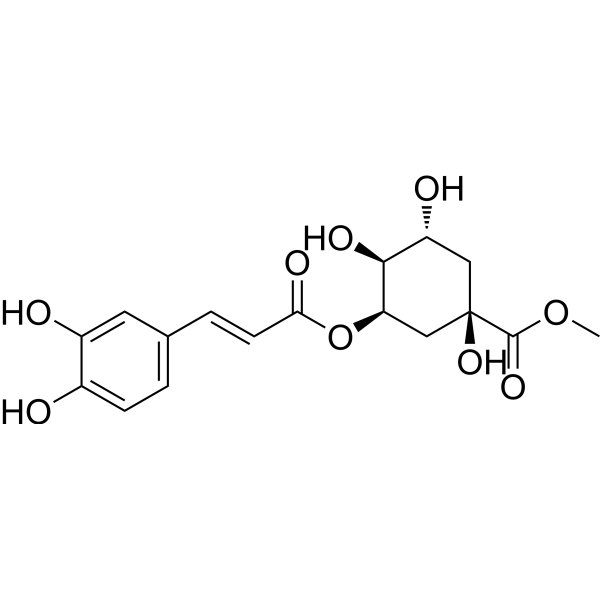
Neochlorogenic acid methyl ester
Neochlorogenic acid (5-O-Caffeoylquinic) methyl ester is a selective quinone reductase inducer (EC50 = 6.7 μM) and also exhibits hydroxyl radical scavenging activity (EC50 = 0.81 μM). Neochlorogenic acid methyl ester scavenges hydroxyl radicals by donating electrons or hydrogen atoms, while simultaneously inducing quinone reductase expression to enhance carcinogen detoxification, thus exerting antioxidant and cancer chemopreventive activities. Neochlorogenic acid methyl ester is used in research on antioxidant damage and promoting detoxification metabolism, primarily in the fields of cancer chemotherapy and antioxidant-related diseases. Neochlorogenic acid methyl ester is also an HBV inhibitor and can be isolated from the flower buds of *L. japonica*.
Nur für Forschungszwecke. Wir verkaufen nicht an Patienten.
- Reinheit: 98.12%
- CAS. Nr.: 123410-65-1
- Formel: C17H20O9
- Molecular Weight:368.34
-
Speicherung:
4°C, protect from light
* In solvent : -80°C, 6 months; -20°C, 1 month (protect from light)


-
 Biologische Aktivität
-
Chemical Information
-
Lösungsmittel & Löslichkeit
- Reinheit & Dokumentation
- Verweise
-
 Help & FAQs
-

Anti-Infection Compound Library
HY-L002
-
Metabolism/Protease Compound Library
HY-L012
-
Natural Product Library
HY-L021
-
Anti-Cancer Compound Library
HY-L025
-
Antiviral Compound Library
HY-L027
-
Antioxidant Compound Library
HY-L037
-
Anti-diabetic Compound Library
HY-L040
-
Medicine Food Homology Compound Library
HY-L055
-
Phenols Library
HY-L057
-
Anti-Cancer Natural Product Library
HY-L107
-
Plant-Sourced Natural Product Library
HY-L115
-
Highly Selective Inhibitors Library
HY-L158
-
Highly Selective Activators Library
HY-L159
-
Radioprotector Library
HY-L178
-
Bioactive Compound Library Max
HY-L181
-
MCE Bioactive Compound Library
HY-L001V
-
Natural Product Library Plus
HY-L021P
-
Natural Product and Natural Product-Like Compound Library
HY-L021M
-
Bioactive Compound Library
HY-L001
-
Anti-Fibrosis Compound Library
HY-L185
-
High-Throughput Bioactive Compound Library
HY-L205
-
High-Throughput Natural Product Library
HY-L206
-
Mass Spectrometry Natural Product Library
HY-L262




Biologische Aktivität
Neochlorogenic acid methyl ester (72 h + 72 h) showed no inhibitory effect on HBsAg secretion by HepG 2.2.15 cells, but exhibited weak inhibitory activity on HBeAg secretion, with an IC50 of 2488.4 μM and a selectivity index (SI) of 1.2[1].
Neochlorogenic acid methyl ester (cultured for 2 days, then treated for 5 days, with drug-containing medium replaced every two days) inhibited HBV DNA replication in HepG 2.2.15 cells, with an IC50 of 144.7 μM and a selectivity index (SI) >20.2[1].
Neochlorogenic acid methyl ester (48 h) significantly induced quinone reductase (QR) activity in mouse hepa1c1c7 cells, with a concentration (CD) that doubled the specific QR activity of 6.7 μM, IC50>100 μM, and a chemopreventive index (CI) >14.9[2].
Neochlorogenic acid methyl ester (30 min) showed significant hydroxyl radical scavenging activity, with an ED50 of 0.81 μM[2].
MedChemExpress (MCE) has not independently confirmed the accuracy of these methods. They are for reference only.
MedChemExpress (MCE) has not independently confirmed the accuracy of these methods. They are for reference only.


Chemical Information
-
CAS. Nr. 123410-65-1
-
Appearance Solid
-
Molecular Weight 368.34
-
Formel C17H20O9
-
Color White to off-white
-
SMILES
O=C([C@]1(O)C[C@@H](OC(/C=C/C2=CC=C(O)C(O)=C2)=O)[C@@H](O)[C@H](O)C1)OC
-
Synonyms
5-O-Caffeoylquinic acid methyl ester
-
Structure Classification
-
Initial Source
-
Versand
Room temperature in continental US; may vary elsewhere.
-
Speicherung
4°C, protect from light
* In solvent : -80°C, 6 months; -20°C, 1 month (protect from light)


Lösungsmittel & Löslichkeit
DMSO : 100 mg/mL (271.49 mM; Need ultrasonic; Hygroscopic DMSO has a significant impact on the solubility of product, please use newly opened DMSO)
Please refer to the solubility information to select the appropriate solvent. Once prepared, please aliquot and store the solution to prevent product inactivation from repeated freeze-thaw cycles.
Storage method and period of stock solution: -80°C, 6 months; -20°C, 1 month (protect from light). When stored at -80°C, please use it within 6 months. When stored at -20°C, please use it within 1 month.
Please refer to the solubility information to select the appropriate solvent. Once prepared, please aliquot and store the solution to prevent product inactivation from repeated freeze-thaw cycles.
Storage method and period of stock solution: -80°C, 6 months; -20°C, 1 month (protect from light). When stored at -80°C, please use it within 6 months. When stored at -20°C, please use it within 1 month.
Konzentration (Stammlösung) × Volumen (Stammlösung) = Konzentration (Ziellösung) × Volumen (Ziellösung)
Select the appropriate dissolution method based on your experimental animal and administration route.
- For the following dissolution methods, please ensure to first prepare a clear stock solution using an In Vitro approach and then sequentially add co-solvents:
- To ensure reliable experimental results, the clarified stock solution can be appropriately stored based on storage conditions. As for the working solution for In Vivo experiments, it is recommended to prepare freshly and use it on the same day.
- The percentages shown for the solvents indicate their volumetric ratio in the final prepared solution. If precipitation or phase separation occurs during preparation, heat and/or sonication can be used to aid dissolution.
Add each solvent one by one: 10% DMSO 40% PEG300 5% Tween-80 45% Saline
Solubility: ≥ 2.5 mg/mL (6.79 mM); Clear solution
This protocol yields a clear solution of ≥ 2.5 mg/mL (saturation unknown).
Taking 1 mL working solution as an example, add 100 μL DMSO stock solution (25.0 mg/mL) to 400 μL PEG300, and mix evenly; then add 50 μL Tween-80 and mix evenly; then add 450 μL Saline to adjust the volume to 1 mL.
Preparation of Saline: Dissolve 0.9 g sodium chloride in ddH₂O and dilute to 100 mL to obtain a clear Saline solution.
Add each solvent one by one: 10% DMSO 90% (20% SBE-β-CD in Saline)
Solubility: ≥ 2.5 mg/mL (6.79 mM); Clear solution
This protocol yields a clear solution of ≥ 2.5 mg/mL (saturation unknown).
Taking 1 mL working solution as an example, add 100 μL DMSO stock solution (25.0 mg/mL) to 900 μL 20% SBE-β-CD in Saline, and mix evenly.
Preparation of 20% SBE-β-CD in Saline (4°C, storage for one week): 2 g SBE-β-CD powder is dissolved in 10 mL Saline, completely dissolve until clear.
Please enter the basic information of animal experiments:
-
-
-
-
Recommended: Prepare an additional quantity of animals to account for potential losses during experiments.
Please enter your animal formula composition:
-
%DMSO +
Recommended: Keep the proportion of DMSO in working solution below 2% if your animal is weak.
-
%+
-
+%Tween-80 + +
-
%Saline +
The co-solvents required include: DMSO, . All of co-solvents are available by MedChemExpress (MCE). , Tween 80. All of co-solvents are available by MedChemExpress (MCE).
Working solution concentration: 0.22 mg/mL
Method for preparing stock solution: mg drug dissolved in μL DMSO. Stock solution concentration: mg/mL. * In solvent : -80°C, 6 months; -20°C, 1 month (protect from light)
1. Take μL DMSO stock solution;
2. Add μL .
μL , mix evenly;
3. Then add μL Tween 80, mix evenly;
4. Then add μL
Please ensure that the stock solution in the first step is dissolved to a clear state, and add co-solvents in sequence. You can use ultrasonic heating (ultrasonic cleaner, recommended frequency 20-40 kHz), vortexing, etc. to assist dissolution.


Reinheit & Dokumentation
-
Data Sheet (274 KB)
-
SDS (252 KB)
- English - EN (252 KB)
- Français - FR (252 KB)
- Deutsch - DE (252 KB)
- Norwegian - NO (252 KB)
- Español - ES (252 KB)
- Swedish - SV (252 KB)
- Italian - IT (252 KB)
- Portuguese - PT (252 KB)
-
Handling Instructions (2659 KB)
Verweise
[1]. Zhao Y, et al. UFLC/MS-IT-TOF guided isolation of anti-HBV active chlorogenic acid analogues from Artemisia capillaris as a traditional Chinese herb for the treatment of hepatitis. J Ethnopharmacol. 2014 Oct 28;156:147-54. [Content Brief]
[2]. Li J, et al. Antioxidant and quinone reductase-inducing constituents of black chokeberry (Aronia melanocarpa) fruits. J Agric Food Chem. 2012 Nov 21;60(46):11551-9. [Content Brief]
[4]. Xu M, et al. Mechanistic insights into the anti-tumor effects of neochlorogenic acid in hepatocellular carcinoma: in vitro and in vivo studies. J Gastrointest Oncol. 2025 Aug 30;16(4):1699-1710. [Content Brief]


Complete Stock Solution Preparation Table
Please refer to the solubility information to select the appropriate solvent. Once prepared, please aliquot and store the solution to prevent product inactivation from repeated freeze-thaw cycles.
Storage method and period of stock solution: -80°C, 6 months; -20°C, 1 month (protect from light). When stored at -80°C, please use it within 6 months. When stored at -20°C, please use it within 1 month.
| Optional Solvent | Concentration Solvent Mass | 1 mg | 5 mg | 10 mg | 25 mg |
|---|---|---|---|---|---|
| DMSO | 1 mM | 2.7149 mL | 13.5744 mL | 27.1488 mL | 67.8721 mL |
| 5 mM | 0.5430 mL | 2.7149 mL | 5.4298 mL | 13.5744 mL | |
| 10 mM | 0.2715 mL | 1.3574 mL | 2.7149 mL | 6.7872 mL | |
| 15 mM | 0.1810 mL | 0.9050 mL | 1.8099 mL | 4.5248 mL | |
| 20 mM | 0.1357 mL | 0.6787 mL | 1.3574 mL | 3.3936 mL | |
| 25 mM | 0.1086 mL | 0.5430 mL | 1.0860 mL | 2.7149 mL | |
| 30 mM | 0.0905 mL | 0.4525 mL | 0.9050 mL | 2.2624 mL | |
| 40 mM | 0.0679 mL | 0.3394 mL | 0.6787 mL | 1.6968 mL | |
| 50 mM | 0.0543 mL | 0.2715 mL | 0.5430 mL | 1.3574 mL | |
| 60 mM | 0.0452 mL | 0.2262 mL | 0.4525 mL | 1.1312 mL | |
| 80 mM | 0.0339 mL | 0.1697 mL | 0.3394 mL | 0.8484 mL | |
| 100 mM | 0.0271 mL | 0.1357 mL | 0.2715 mL | 0.6787 mL |


 Powered by Bioz