



BChE-IN-11

Based on 1 Customer Validation
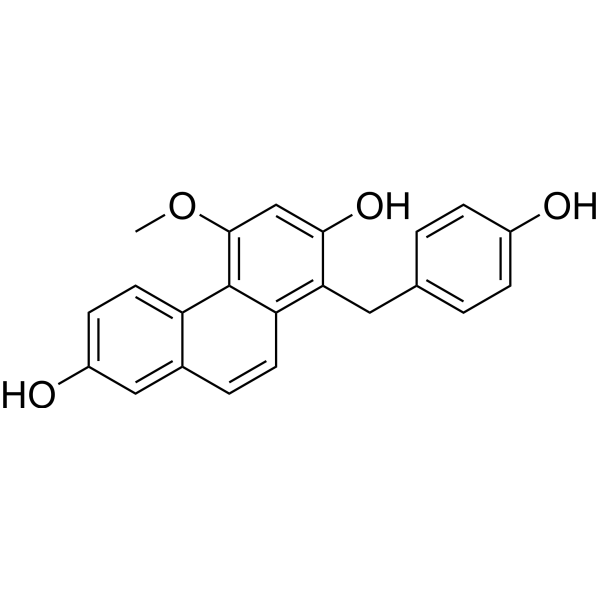
BChE-IN-11 (compound 10) is a potent, selective and non-competitive BChE (butyrylcholinesterase) inhibitor, with an IC50 of 2.1 μM. BChE-IN-11 can be used for Alzheimer's disease (AD) research.
Nos produits utilisent uniquement pour la recherche. Nous ne vendons pas aux patients.
- Pureté : 98.78%
- CAS No.: 133740-30-4
- Formule: C22H18O4
- Masse moléculaire:346.38
-
Stockage:
4°C, protect from light
* In solvent : -80°C, 6 months; -20°C, 1 month (protect from light)

To place orders, for customer services and technical support, please contact: MedChemExpress USA
Tel: 609-228-6898 E-mail: [email protected] [email protected]


-
 Activité biologique
-
Chemical Information
- Protocole
- Pureté et documentation
- Références
-
 Help & FAQs




Activité biologique
Description
IC50 & Target
|
BChE 2.1 ± 0.3 μM (IC50) |
AChE |
Cellular Effect
|
Cell Line

|
Type | Value | Description | References |
|---|---|---|---|---|
| BV-2 | IC50 |
30.2 μM
Compound: 30
|
Antineuroinflammatory activity against mouse BV2 cells assessed as inhibition of LPS-induced NO production incubated for 24 hrs by Griess assay
Antineuroinflammatory activity against mouse BV2 cells assessed as inhibition of LPS-induced NO production incubated for 24 hrs by Griess assay
|
[PMID: 31415170] |
| Neutrophil | IC50 |
0.5 μM
Compound: 14
|
Antiinflammatory activity in human neutrophils assessed as inhibition of FMLP/cytochalasin B-induced superoxide anion generation by measuring superoxide dismutase-inhibitable reduction of ferricytochrome c preincubated for 5 mins followed by FMLP/cytochal
Antiinflammatory activity in human neutrophils assessed as inhibition of FMLP/cytochalasin B-induced superoxide anion generation by measuring superoxide dismutase-inhibitable reduction of ferricytochrome c preincubated for 5 mins followed by FMLP/cytochal
|
[PMID: 27525452] |
| Neutrophil | IC50 |
0.9 μM
Compound: 14
|
Antiinflammatory activity in human neutrophils assessed as inhibition of fMLP/CB-induced elastase release using MeO-Suc-Ala-Ala-Pro-Val-p-nitroanilide as elastase substrate preincubated for 5 mins followed by fMLP/CB-induction
Antiinflammatory activity in human neutrophils assessed as inhibition of fMLP/CB-induced elastase release using MeO-Suc-Ala-Ala-Pro-Val-p-nitroanilide as elastase substrate preincubated for 5 mins followed by fMLP/CB-induction
|
[PMID: 27525452] |
In Vitro
BChE-IN-11 (compound 10) shows inhibition activity for BChE and AChE, with inhibition of 96.6 ± 1.2% and 19.1 ± 3.8% at 25 μg/mL, respectively[1]. BChE-IN-11 binds to the active pocket of BChE via multiple hydrogen bonds with His438, Pro285, Gly115 and π–π stacking with Tyr332 and Trp82[1].
MedChemExpress (MCE) has not independently confirmed the accuracy of these methods. They are for reference only.


Chemical Information
-
CAS No. 133740-30-4
-
Appearance Solid
-
Masse moléculaire 346.38
-
Formule C22H18O4
-
Color Light brown to brown
-
SMILES
OC1=CC(OC)=C2C3=CC=C(O)C=C3C=CC2=C1CC4=CC=C(O)C=C4
-
Structure Classification
-
Livraison
Room temperature in continental US; may vary elsewhere.
-
Stockage
4°C, protect from light
* In solvent : -80°C, 6 months; -20°C, 1 month (protect from light)


Pureté et documentation
-
Fiche technique (267 KB)
-
SDS (251 KB)
- English - EN (251 KB)
- Français - FR (251 KB)
- Deutsch - DE (251 KB)
- Norwegian - NO (251 KB)
- Español - ES (251 KB)
- Swedish - SV (251 KB)
- Italian - IT (251 KB)
- Korean - KR (251 KB)
- Portuguese - PT (251 KB)
-
Instruction de manipulation (2659 KB)
Références

Calculators
Concentration (start) × Volume (start) = Concentration (final) × Volume (final)


BChE-IN-11 Related Classifications
HY-N10488 Related Classifications
 Powered by Bioz