



Benzylacetone

Based on 1 Customer Validation
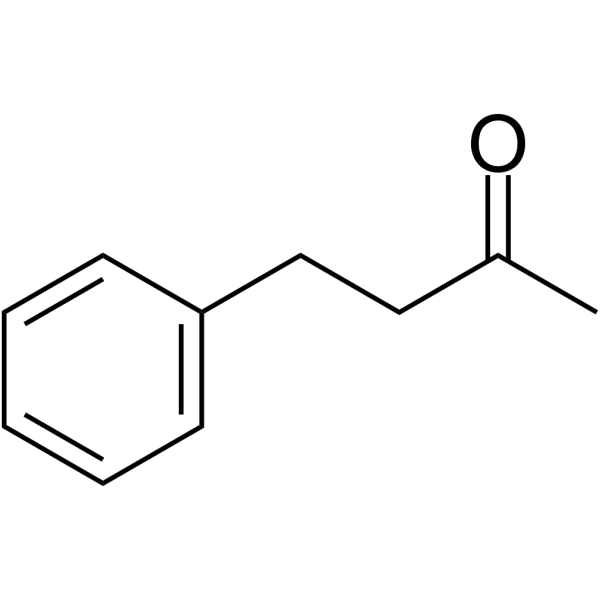
Benzylacetone (4-Penylbutan-2-one) is an aromatic compound. Benzylacetone is a mushroom tyrosinase inhibitor with an IC50 of 2.8 mM, a Ki of 1.25 mM for monophenolase and an IC50 of 0.6 mM, a Ki of 0.39 mM for diphenolase. Benzylacetone inhibits free mushroom tyrosinase and enzyme-substrate complex. Benzylacetone acts as an appetite enhancer via olfactory stimulation, reduces spontaneous locomotor activity, induces weight gain. Benzylacetone exhibits repellent, fumigant, and contact toxicity against Tribolium castaneum adults.
For research use only. We do not sell to patients.
- Purity : 99.90%
- CAS No.: 2550-26-7
- Formula: C10H12O
- Molecular Weight:148.21
-
Storage:Pure form -20°C, 3 years , 4°C, 2 years ; In solvent -80°C, 6 months , -20°C, 1 month

To place orders, for customer services and technical support, please contact: MedChemExpress USA
Tel: 609-228-6898 E-mail: [email protected] [email protected]


-
 Biological Activity
-
Chemical Information
-
Solvent & Solubility
- Protocols
- Purity & Documentation
- References
-
 Help & FAQs


-
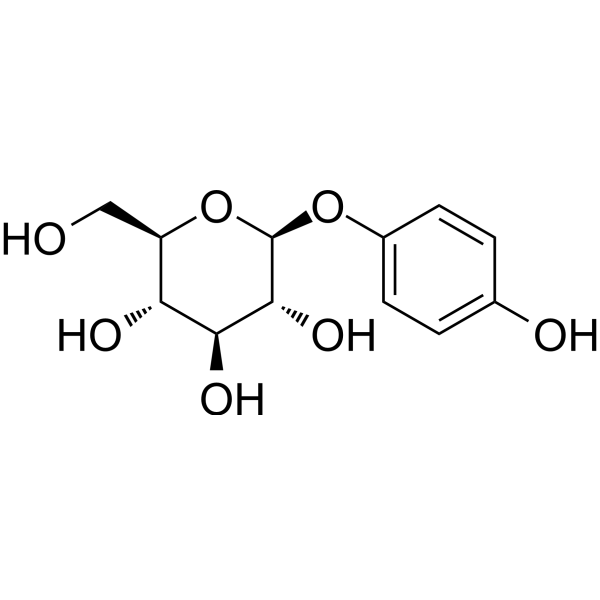
HY-N0192
ArbutinEndogenous Metabolite -
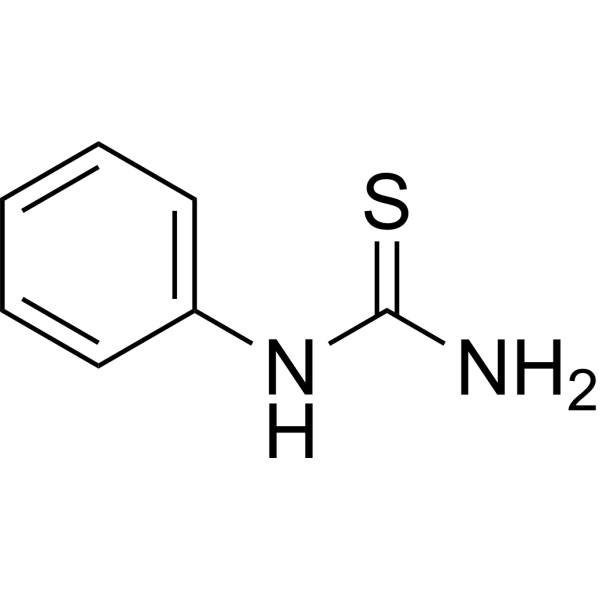
HY-Y0351
PhenylthioureaPhenoloxidase Inhibitor -

HY-W015616R
Benzylacetone (Standard)Analytical Standard -
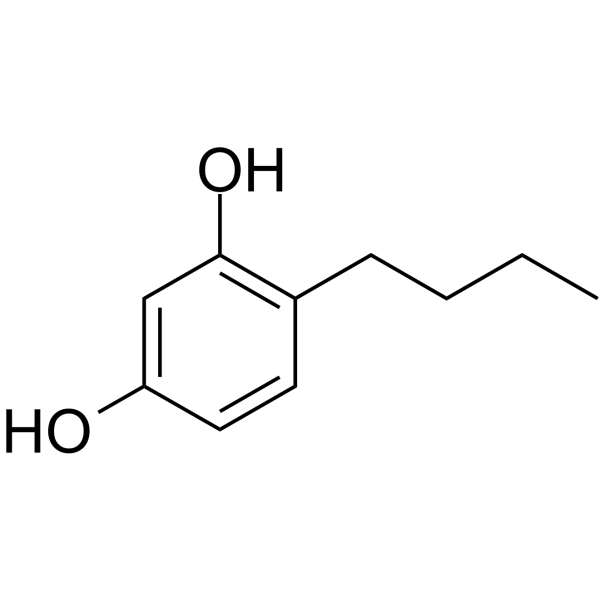
HY-107369
4-ButylresorcinolTyrosinase Inhibitor -

HY-N0192R
Arbutin (Standard)Endogenous Metabolite -
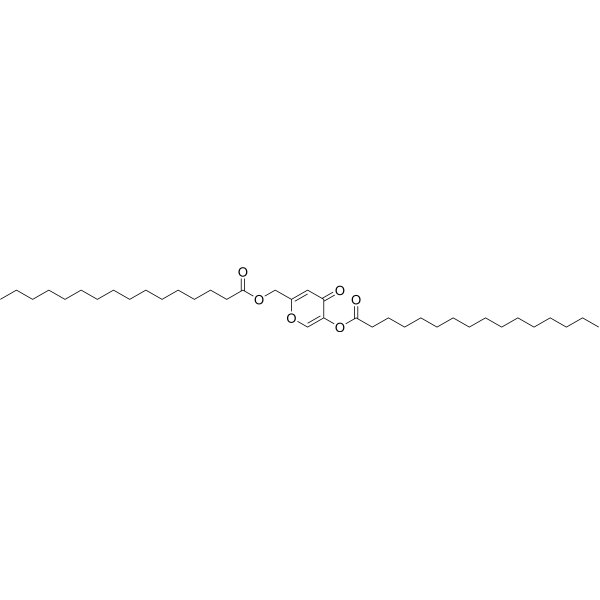
HY-W099579
Kojic acid dipalmitateTyrosinase Inhibitor -

HY-107369R
4-Butylresorcinol (Standard)Tyrosinase Inhibitor -

HY-W099579R
Kojic acid dipalmitate (Standard)Tyrosinase Inhibitor


Biological Activity
Description
IC50 & Target
IC50: 2.8 mM (monophenolase, tyrosinase mushroom), 0.6 mM (diphenolase, tyrosinase mushroom)[2]
Cellular Effect
|
Cell Line

|
Type | Value | Description | References |
|---|---|---|---|---|
| Raji | IC50 |
222 molar ratio
Compound: 58
|
Cytotoxicity against human Raji cells expressing EBV-EA assessed as inhibition of TPA-induced EBV-EA activation after 48 hrs by trypan blue staining based immunofluorescence method relative to TPA
Cytotoxicity against human Raji cells expressing EBV-EA assessed as inhibition of TPA-induced EBV-EA activation after 48 hrs by trypan blue staining based immunofluorescence method relative to TPA
|
[PMID: 26796952] |
In Vitro
Benzylacetone (0-3.0 mM) reversibly inhibits mushroom tyrosinase diphenolase activity as a mixed-type inhibitor with an IC50 of 0.6 mM and a Ki of 0.39 mM[1].
Benzylacetone (0-5.0 mM) reversibly inhibits mushroom tyrosinase monophenolase activity as a mixed-type inhibitor with an IC50 of 1.5 mM, and a Ki of 1.25 mM, without significantly altering the reaction lag time, and it primarily inhibits the enzyme-substrate complex[1].
Benzylacetone (0.13-78.63 nL/cm2; 2-4 h) exhibits dose-dependent and time-dependent repellent activity against 1-2 week old adult Tribolium castaneum, and sustained activity even at low concentrations after 4 h exposure[3].
Benzylacetone (1.875-30% (v/v); 6 h) exhibits concentration-dependent fumigation toxicity against 1-2 week old adult Tribolium castaneum, with an LC50 of 122.15 mg/L air[3].
Benzylacetone (1.875-30% (v/v); 6 h) exhibits contact toxicity against 1-2 week old adult Tribolium castaneum, with an LD50 of 25.54 μg/adult[3].
MedChemExpress (MCE) has not independently confirmed the accuracy of these methods. They are for reference only. Further protocols information, click here.
In Vivo
Benzylacetone (inhalation; once daily; 14 days, 60 min per day) produces significant weight gain in healthy male ddY mice, with a total weight gain approximately 2.5 g greater than controls and significantly elevated body weights measured on most days of the study[2].
Benzylacetone (7.4×10⁻⁷-7.4×10⁻³ mg/L; inhalation; 60 min) produces significant, reduction in locomotor activity in healthy male ddY mice[2].
MedChemExpress (MCE) has not independently confirmed the accuracy of these methods. They are for reference only.
-
Animal Model:ddY mice (male, 4-week-old at purchase, 19 g at experiment start, fasted)[2]
-
Dosage:7.4×10⁻⁸ mg/L; 7.4×10⁻⁷ mg/L; 7.4×10⁻⁶ mg/L; 7.4×10⁻⁵ mg/L; 7.4×10⁻⁴ mg/L; 7.4×10⁻³ mg/L; 7.4×10⁻² mg/L
-
Administration:Inhalation; 5, 15, 30, 60 min
-
Result:Produced significant appetite-enhancing effects at doses of 7.4×10⁻⁶ to 7.4×10⁻⁴ mg/L, with the strongest effect at 7.4×10⁻⁶ mg/L.
Increased food intake 1.158-fold (15 min inhalation), 1.203-fold (30 min inhalation), and 1.241-fold (60 min inhalation) compared to controls at 7.4×10⁻⁶ mg/L.
Increased food intake 1.2-fold compared to controls at 7.4×10⁻³ mg/L for 5 min.
Decreased food intake lower than controls at the highest dose tested (7.4×10⁻² mg/L).


Chemical Information
-
CAS No. 2550-26-7
-
Appearance Liquid (Density: 0.989 g/cm3 )
-
Molecular Weight 148.21
-
Formula C10H12O
-
Color Colorless to off-white
-
SMILES
CC(CCC1=CC=CC=C1)=O
-
Synonyms
4-Penylbutan-2-one
-
Structure Classification
-
Initial Source
-
Shipping
Room temperature in continental US; may vary elsewhere.
-
Storage
Pure form -20°C 3 years 4°C 2 years In solvent -80°C 6 months -20°C 1 month


Solvent & Solubility
In Vitro:
DMSO : 100 mg/mL (674.72 mM; Need ultrasonic; Hygroscopic DMSO has a significant impact on the solubility of product, please use newly opened DMSO)
Please refer to the solubility information to select the appropriate solvent. Once prepared, please aliquot and store the solution to prevent product inactivation from repeated freeze-thaw cycles.
Storage method and period of stock solution: -80°C, 6 months; -20°C, 1 month. When stored at -80°C, please use it within 6 months. When stored at -20°C, please use it within 1 month.
Please refer to the solubility information to select the appropriate solvent. Once prepared, please aliquot and store the solution to prevent product inactivation from repeated freeze-thaw cycles.
Storage method and period of stock solution: -80°C, 6 months; -20°C, 1 month. When stored at -80°C, please use it within 6 months. When stored at -20°C, please use it within 1 month.
Concentration (start) × Volume (start) = Concentration (final) × Volume (final)
In Vivo:
Select the appropriate dissolution method based on your experimental animal and administration route.
- For the following dissolution methods, please ensure to first prepare a clear stock solution using an In Vitro approach and then sequentially add co-solvents:
- To ensure reliable experimental results, the clarified stock solution can be appropriately stored based on storage conditions. As for the working solution for In Vivo experiments, it is recommended to prepare freshly and use it on the same day.
- The percentages shown for the solvents indicate their volumetric ratio in the final prepared solution. If precipitation or phase separation occurs during preparation, heat and/or sonication can be used to aid dissolution.
Add each solvent one by one: 10% DMSO 40% PEG300 5% Tween-80 45% Saline
Solubility: ≥ 2.5 mg/mL (16.87 mM); Clear solution
This protocol yields a clear solution of ≥ 2.5 mg/mL (saturation unknown).
Taking 1 mL working solution as an example, add 100 μL DMSO stock solution (25.0 mg/mL) to 400 μL PEG300, and mix evenly; then add 50 μL Tween-80 and mix evenly; then add 450 μL Saline to adjust the volume to 1 mL.
Preparation of Saline: Dissolve 0.9 g sodium chloride in ddH₂O and dilute to 100 mL to obtain a clear Saline solution.
Add each solvent one by one: 10% DMSO 90% (20% SBE-β-CD in Saline)
Solubility: ≥ 2.5 mg/mL (16.87 mM); Clear solution
This protocol yields a clear solution of ≥ 2.5 mg/mL (saturation unknown).
Taking 1 mL working solution as an example, add 100 μL DMSO stock solution (25.0 mg/mL) to 900 μL 20% SBE-β-CD in Saline, and mix evenly.
Preparation of 20% SBE-β-CD in Saline (4°C, storage for one week): 2 g SBE-β-CD powder is dissolved in 10 mL Saline, completely dissolve until clear.
In Vivo Dissolution Calculator
Please enter the basic information of animal experiments:
-
-
-
-
Recommended: Prepare an additional quantity of animals to account for potential losses during experiments.
Please enter your animal formula composition:
-
%DMSO +
Recommended: Keep the proportion of DMSO in working solution below 2% if your animal is weak.
-
%+
-
+%Tween-80 + +
-
%Saline +
The co-solvents required include: DMSO, . All of co-solvents are available by MedChemExpress (MCE). , Tween 80. All of co-solvents are available by MedChemExpress (MCE).
Working solution concentration: 0.22 mg/mL
Method for preparing stock solution: mg drug dissolved in μL DMSO. Stock solution concentration: mg/mL.
1. Take μL DMSO stock solution;
2. Add μL .
μL , mix evenly;
3. Then add μL Tween 80, mix evenly;
4. Then add μL
Please ensure that the stock solution in the first step is dissolved to a clear state, and add co-solvents in sequence. You can use ultrasonic heating (ultrasonic cleaner, recommended frequency 20-40 kHz), vortexing, etc. to assist dissolution.

Protocols
-
Protocol for Open Field Test (OF)
The Open Field Test is a rodent behavioral assay that measures spontaneous locomotion, exploratory behavior, and anxiety-like behavior when an animal is placed in a novel open arena. The main readouts are total distance traveled, movement time, velocity, center-zone entries, center-zone time, peripheral-zone time, and thigmotaxis. The assay is based on the conflict between exploration of a novel environment and avoidance of exposed open areas; higher center exploration is commonly interpreted as lower anxiety-like behavior, whereas increased wall-following or peripheral occupancy is interpreted as higher anxiety-like behavior.
-
Cell Cytotoxicity Assay
Cytotoxicity assays are usually based on the assessment of cell membrane damage, which can also be indirectly detected by measuring cell viability. Detection methods include MTT assay, CKK-8 assay, LDH assay and ATP assay, etc.


Purity & Documentation
-
Data Sheet (274 KB)
-
SDS (393 KB)
- English - EN (393 KB)
- Français - FR (393 KB)
- Deutsch - DE (393 KB)
- Norwegian - NO (393 KB)
- Español - ES (393 KB)
- Swedish - SV (393 KB)
- Italian - IT (393 KB)
- Korean - KR (393 KB)
- Portuguese - PT (393 KB)
-
Handling Instructions (2659 KB)
References
[1]. Liu X, et al. Inhibition effects of benzylideneacetone, benzylacetone, and 4-phenyl-2-butanol on the activity of mushroom tyrosinase. J Biosci Bioeng. 2015;119(3):275-279. [Content Brief]
[2]. Ogawa K, et al. Appetite-Enhancing Effects: The Influence of Concentrations of Benzylacetone and trans-Cinnamaldehyde and Their Inhalation Time, as Well as the Effect of Aroma, on Body Weight in Mice. Biol Pharm Bull. 2016;39(5):794-798. [Content Brief]
[3]. Xin Y, et al. Anti-insect activity of benzylacetone and its structural analogues against Tribolium castaneum (Coleoptera: Tenebrionidae). Toxicon. 2025;261:108378. [Content Brief]


Complete Stock Solution Preparation Table
Please refer to the solubility information to select the appropriate solvent. Once prepared, please aliquot and store the solution to prevent product inactivation from repeated freeze-thaw cycles.
Storage method and period of stock solution: -80°C, 6 months; -20°C, 1 month. When stored at -80°C, please use it within 6 months. When stored at -20°C, please use it within 1 month.
| Optional Solvent | Concentration Solvent Mass | 1 mg | 5 mg | 10 mg | 25 mg |
|---|---|---|---|---|---|
| DMSO | 1 mM | 6.7472 mL | 33.7359 mL | 67.4718 mL | 168.6796 mL |
| 5 mM | 1.3494 mL | 6.7472 mL | 13.4944 mL | 33.7359 mL | |
| 10 mM | 0.6747 mL | 3.3736 mL | 6.7472 mL | 16.8680 mL | |
| 15 mM | 0.4498 mL | 2.2491 mL | 4.4981 mL | 11.2453 mL | |
| 20 mM | 0.3374 mL | 1.6868 mL | 3.3736 mL | 8.4340 mL | |
| 25 mM | 0.2699 mL | 1.3494 mL | 2.6989 mL | 6.7472 mL | |
| 30 mM | 0.2249 mL | 1.1245 mL | 2.2491 mL | 5.6227 mL | |
| 40 mM | 0.1687 mL | 0.8434 mL | 1.6868 mL | 4.2170 mL | |
| 50 mM | 0.1349 mL | 0.6747 mL | 1.3494 mL | 3.3736 mL | |
| 60 mM | 0.1125 mL | 0.5623 mL | 1.1245 mL | 2.8113 mL | |
| 80 mM | 0.0843 mL | 0.4217 mL | 0.8434 mL | 2.1085 mL | |
| 100 mM | 0.0675 mL | 0.3374 mL | 0.6747 mL | 1.6868 mL |


Benzylacetone Related Classifications
HY-W015616 Related Classifications
 Powered by Bioz