



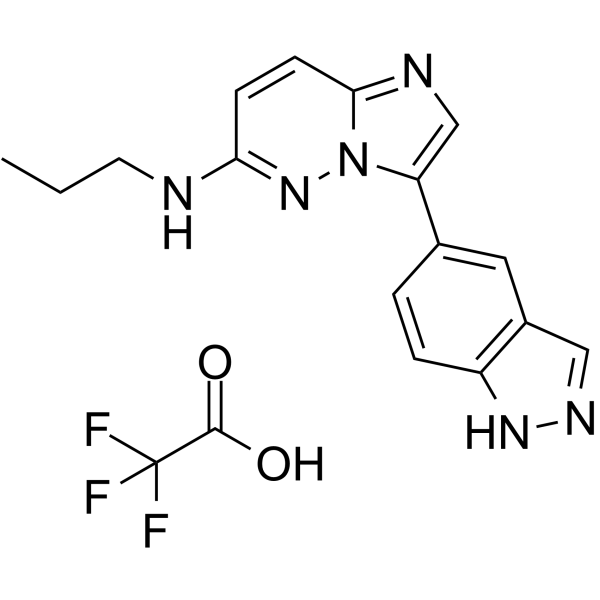
CHR-6494 TFA
Based on 8 publication(s) in Google Scholar
CHR-6494 TFA is a potent inhibitor of haspin, with an IC50 of 2 nM. CHR-6494 TFA inhibits histone H3T3 phosphorylation. CHR-6494 TFA induces the apoptosis of cancer cells, including melanoma and breast cancer. CHR-6494 TFA can be used in the research of cancer.
Nos produits utilisent uniquement pour la recherche. Nous ne vendons pas aux patients.
- CAS No.: 1458630-17-5
- Formule: C18H17F3N6O2
- Masse moléculaire:406.36
-
Stockage:
Please store the product under the recommended conditions in the Certificate of Analysis.

To place orders, for customer services and technical support, please contact: MedChemExpress USA
Tel: 609-228-6898 E-mail: [email protected] [email protected]


-
 Activité biologique
-
Chemical Information
- Pureté et documentation
- Références
-
 Help & FAQs




Publications Citing Use of MedChemExpress (MCE) CHR-6494 TFA
More- Cancer Commun (Lond). 2021 Feb;41(2):121-139. [Abstract]
- Cell Death Discov. 2023 Aug 23;9(1):307. [Abstract]
- Eur J Med Chem. 2024 Mar 5:267:116209. [Abstract]
- Mol Syst Biol. 2018 Aug 13;14(8):e8238. [Abstract]
- J Mol Med (Berl). 2019 Aug;97(8):1183-1193. [Abstract]
- Transl Oncol. 2022 Dec:26:101540. [Abstract]
- Mol Cell Endocrinol. 2025 Aug 28:609:112645. [Abstract]
- Research Square Preprint. 2024 Jan 31.


Activité biologique
|
haspin 2 nM (IC50) |
CHR-6494 (TFA; 0-105 nM; 72 hours) dose-dependently inhibits the growth of cancer cells, such as HCT-116, HeLa, MDA-MB-231, and Wi-38 cells, with IC50s of 500 nM, 473 nM, 752 nM and 1059 nM, respectively[1].
CHR-6494 (TFA; 500 nM) produces a mitotic catastrophe with abnormal morphology of the mitotic spindle and centrosome amplification, and upregulates the spindle assembly checkpoint protein BUB1 and the marker of mitotic arrest cyclin B1[1].
CHR-6494 (TFA; 0, 0.5, 1.0 μM; 24 to 36 h) is an inhibitor of angiogenesis in the ex vivo chicken embryo aortic arch ring assay[1].
CHR-6494 (TFA) exhibits inhibitory activities against melanoma cell lines, including BRAFV600E mutants, NRAS mutants, and wild type cells, with IC50s ranging from 396 nM to 1229 nM[2].
CHR-6494 (TFA; 300 nM and 600 nM; 72 hours) induces apoptosis, increases caspase 3/7 activity by 3- and 6-fold, respectively in COLO-792 cells, and to 8.5- and 16-fold in RPMI-7951 melanoma cells[2].
CHR-6494 (TFA; 50, 200 nM; 1 week) enhances the antiproliferative effects of MLN8237 in MDA-MB-231, SKBR3 breast cancer cells[3].
CHR-6494 (TFA; 200 nM; 72 hours) enhances the apoptosis of MDA-MB-231 and SKBR3 cells when combined with MLN8237[3].
MedChemExpress (MCE) has not independently confirmed the accuracy of these methods. They are for reference only.
CHR-6494 (TFA; 20 mg/kg; intraperitoneal injection for 15 consecutive days) inhibits the tumor growth in nude mice bearing MDA-MB-231 xenograft tumors[3].
MedChemExpress (MCE) has not independently confirmed the accuracy of these methods. They are for reference only.
-
Animal Model:Male 4-5 weeks old athymic nu/nu mice harboring HCT-116 cells xenograft tumor with a tumor volume of 200 mm3[1]
-
Dosage:50 mg/kg (diluted in a solution of 10% DMSO/20% 2-hydroxypropyl-b-cyclodextrin)
-
Administration:i.p. in two cycles of five consecutive days for 15 days
-
Result:Dose-dependent tumor growth inhibition was demonstrated.
Did not change the body weight of mice.
-
Animal Model:4‐week‐old female nude mice bearing MDA-MB-231 xenograft tumors
-
Dosage:20 mg/kg in a final formulation in 10% DMSO/20% 2‐hydroxypropyl‐β‐cyclodextrin
-
Administration:i.p. for 15 consecutive days
-
Result:Inhibited the tumor volume and weight compared with the control group in nude mice bearing MDA-MB-231 xenograft tumors.
Enhanced the tumor volume and weight inhibition of MLN8237 (20 mg/kg; p.o.) in vivo.


Chemical Information
-
CAS No. 1458630-17-5
-
Masse moléculaire 406.36
-
Formule C18H17F3N6O2
-
SMILES
CCCNC1=NN2C(C3=CC4=C(C=C3)NN=C4)=CN=C2C=C1.OC(C(F)(F)F)=O
-
Livraison
Room temperature in continental US; may vary elsewhere.
-
Stockage
Please store the product under the recommended conditions in the Certificate of Analysis.


Publications (8)
-
Journal Impact Factor
-
Most Recent
-
Cancer Commun (Lond)
CRISPR/Cas9 screening identifies a kinetochore-microtubule dependent mechanism for Aurora-A inhibitor resistance in breast cancer. [Abstract]2021 Feb;41(2):121-139. PMID: 33471959 -
Cell Death Discov
Haspin balances the ratio of asymmetric cell division through Wnt5a and regulates cell fate decisions in mouse embryonic stem cells. [Abstract]2023 Aug 23;9(1):307. PMID: 37612272 -
Eur J Med Chem
Novel inhibitors targeting the PGK1 metabolic enzyme in glycolysis exhibit effective antitumor activity against kidney renal clear cell carcinoma in vitro and in vivo. [Abstract]2024 Mar 5:267:116209. PMID: 38354523 -
Mol Syst Biol
2018 Aug 13;14(8):e8238. PMID: 30104419 -
J Mol Med (Berl)
2019 Aug;97(8):1183-1193. PMID: 31201471 -
Transl Oncol
2022 Dec:26:101540. PMID: 36115073 -
Mol Cell Endocrinol
The N-terminal region of HASPIN regulates phosphorylation of AURKA and meiotic progression in spermatocytes. [Abstract]2025 Aug 28:609:112645. PMID: 40885374 -


Pureté et documentation
Références
[1]. Huertas D, et al. Antitumor activity of a small-molecule inhibitor of the histone kinase Haspin. Oncogene. 2012 Mar 15;31(11):1408-18. [Content Brief]
[2]. Han L, et al. Anti-Melanoma Activities of Haspin Inhibitor CHR-6494 Deployed as a Single Agent or in a Synergistic Combination with MEK Inhibitor. J Cancer. 2017 Aug 25;8(15):2933-2943. [Content Brief]
[3]. Chen A, et al. CRISPR/Cas9 screening identifies a kinetochore-microtubule dependent mechanism for Aurora-A inhibitor resistance in breast cancer. Cancer Commun (Lond). 2021 Feb;41(2):121-139. [Content Brief]

Calculators
Concentration (start) × Volume (start) = Concentration (final) × Volume (final)


CHR-6494 TFA Related Classifications
HY-110350 Related Classifications
 Powered by Bioz