



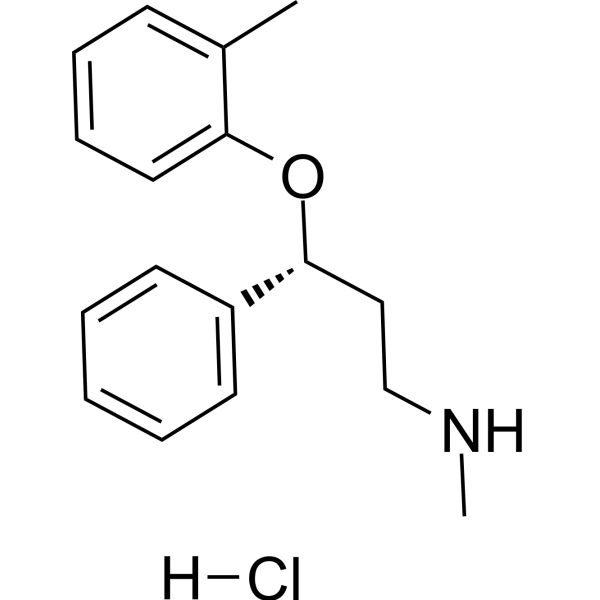
Atomoxetine hydrochloride
Based on 4 publication(s) in Google Scholar
Atomoxetine (Tomoxetine) hydrochloride is a selective noradrenaline reuptake inhibitor with Ki values of 5 nM, 77 nM and 1451 nM for norepinephrine (NE), serotonin (5-HT) and dopamine (DA) transporters, respectively. Atomoxetine hydrochloride is a potent Na+ channels (VGSCs) blocker. Atomoxetine hydrochloride can be used for attention-deficit hyperactivity disorder (ADHD) research.
Nur für Forschungszwecke. Wir verkaufen nicht an Patienten.
- Reinheit: 99.91%
- CAS. Nr.: 82248-59-7
- Formel: C17H22ClNO
- Molecular Weight:291.82
-
Speicherung:
4°C, sealed storage, away from moisture
* In solvent : -80°C, 6 months; -20°C, 1 month (sealed storage, away from moisture)


-
 Biologische Aktivität
-
Chemical Information
-
Lösungsmittel & Löslichkeit
- Reinheit & Dokumentation
- Verweise
-
 Help & FAQs
-

GPCR/G Protein Compound Library
HY-L006
-
Membrane Transporter/Ion Channel Compound Library
HY-L011
-
Neuronal Signaling Compound Library
HY-L013
-
FDA-Approved Drug Library
HY-L022
-
CNS-Penetrant Compound Library
HY-L028
-
Drug Repurposing Compound Library
HY-L035
-
NMPA-Approved Drug Library
HY-L053
-
Orally Active Compound Library
HY-L061
-
Neurotransmitter Receptor Compound Library
HY-L062
-
FDA Approved & Pharmacopeial Drug Library
HY-L066
-
Neuroprotective Compound Library
HY-L070
-
Drug-Induced Liver Injury (DILI) Compound Library
HY-L076
-
Rare Diseases Drug Library
HY-L102
-
Pediatric Drug Library
HY-L104
-
Antidepressant Compound Library
HY-L108
-
Sodium Channel Blocker Library
HY-L118
-
Human Metabolite Library
HY-L123
-
Coagulation and Anti-coagulation Compound Library
HY-L136
-
Off-patent Drug Library
HY-L141
-
Membrane Protein-targeted Compound Library
HY-L149
-
Membrane Receptor-targeted Compound Library
HY-L150
-
Highly Selective Inhibitors Library
HY-L158
-
Ion Channel Compound Library
HY-L166
-
Multi-Target Compound Library
HY-L176
-
Bioactive Compound Library Max
HY-L181
-
MCE Bioactive Compound Library
HY-L001V
-
Drug Repurposing Compound Library Plus
HY-L035P
-
FDA-Approved Drug Library Plus
HY-L022P
-
FDA-Approved Drug Library Mini
HY-L022M
-
Bioactive Compound Library
HY-L001
-
High-Throughput Bioactive Compound Library
HY-L205
-
Mass Spectrometry Human Metabolite Library
HY-L215
-
Cardiotoxic Compound Library
HY-L225
-
Lactylation Compound Library
HY-L249


Publications Citing Use of MedChemExpress (MCE) Atomoxetine hydrochloride
MoreAlle Adrenergic Receptor Isoform-spezifische Produkte anzeigen
More

Biologische Aktivität
|
Cell Line

|
Type | Value | Description | References |
|---|---|---|---|---|
| HEK293 | IC50 |
0.02 μM
Compound: Atomoxetine
|
Inhibition of the Norepinephrine transporter (NET, SLC6A2) as assessed by GPCR-mediated changes in cell morphology using the impedance-based transporter activity through receptor activation (TRACT) assay in HEK-293 JumpIN-SLC6A2 cells
Inhibition of the Norepinephrine transporter (NET, SLC6A2) as assessed by GPCR-mediated changes in cell morphology using the impedance-based transporter activity through receptor activation (TRACT) assay in HEK-293 JumpIN-SLC6A2 cells
|
[PMID: 34112854] |
| HEK293 | IC50 |
0.02 μM
Compound: Atomoxetine
|
Inhibition of the Norepinephrine transporter (NET, SLC6A2) as assessed by GPCR-mediated changes in cell morphology using the impedance-based transporter activity through receptor activation (TRACT) assay in HEK-293 JumpIN-SLC6A2 cells (PubChem AID: 174586
Inhibition of the Norepinephrine transporter (NET, SLC6A2) as assessed by GPCR-mediated changes in cell morphology using the impedance-based transporter activity through receptor activation (TRACT) assay in HEK-293 JumpIN-SLC6A2 cells (PubChem AID: 174586
|
[PMID: 34112854] |
Atomoxetine (Tomoxetine) (1-100 µM; 0.5-20 seconds; tsA201 cells) hydrochloride interacts with the human heart muscle sodium channel (hNav1.5) in a state and dose-dependent manner[2].
MedChemExpress (MCE) has not independently confirmed the accuracy of these methods. They are for reference only.
Atomoxetine (0.1-5 mg/kg; i.p. and p.o; for 14 days; spontaneously hypertensive rat) hydrochloride can improve behaviors associated with ADHD in rats[3].
MedChemExpress (MCE) has not independently confirmed the accuracy of these methods. They are for reference only.
-
Animal Model:Male Sprague-Dawley rats[1]
-
Dosage:0.3, 1 and 3 mg/kg
-
Administration:Intraperitoneal injection; for 4 hours
-
Result:Increased the number of cells expressing Fos-like immunoreactivity in PFC 3.7-fold and increased extracellular norepinephrine and dopamine by 3-fold.
-
Animal Model:Spontaneously hypertensive rat (SHR)[3]
-
Dosage:0.1, 0.3, 1.25 and 5.0 mg/kg
-
Administration:Intraperitoneal injection and oral administration; for 14 days
-
Result:Had non-impact on the measurement of motor activity.


Chemical Information
-
CAS. Nr. 82248-59-7
-
Appearance Solid
-
Molecular Weight 291.82
-
Formel C17H22ClNO
-
Color White to off-white
-
SMILES
CC1=CC=CC=C1O[C@@H](C2=CC=CC=C2)CCNC.[H]Cl
-
Synonyms
Tomoxetine hydrochloride; (R)-Tomoxetine hydrochloride; LY 139603
-
Versand
Room temperature in continental US; may vary elsewhere.
-
Speicherung
4°C, sealed storage, away from moisture
* In solvent : -80°C, 6 months; -20°C, 1 month (sealed storage, away from moisture)


Publications (4)
-
Journal Impact Factor
-
Most Recent
-
Brain Behav Immun
Ghrelin modulates dopaminergic neuron formation and attention deficit hyperactivity disorder-like behaviors: From animals to human models. [Abstract]2021 May:94:327-337. PMID: 33412253 -
Ecotoxicol Environ Saf
Long-life triclosan exposure induces ADHD-like behavior in rats via prefrontal cortex dopaminergic deficiency. [Abstract]2024 Jul 23:282:116766. PMID: 39047361 -
Behav Brain Res
Manipulation of vocal communication and anxiety through pharmacologic modulation of norepinephrine in the Pink1-/- rat model of Parkinson disease. [Abstract]2022 Feb 10:418:113642. PMID: 34755639 -


Lösungsmittel & Löslichkeit
DMSO : ≥ 100 mg/mL (342.68 mM; Hygroscopic DMSO has a significant impact on the solubility of product, please use newly opened DMSO)
H2O : 50 mg/mL (171.34 mM; Need ultrasonic)
* "≥" means soluble, but saturation unknown.
Please refer to the solubility information to select the appropriate solvent. Once prepared, please aliquot and store the solution to prevent product inactivation from repeated freeze-thaw cycles.
Storage method and period of stock solution: -80°C, 6 months; -20°C, 1 month (sealed storage, away from moisture). When stored at -80°C, please use it within 6 months. When stored at -20°C, please use it within 1 month.
* Note: If you choose water as the stock solution, please dilute it to the working solution, then filter and sterilize it with a 0.22 μm filter before use.
Please refer to the solubility information to select the appropriate solvent. Once prepared, please aliquot and store the solution to prevent product inactivation from repeated freeze-thaw cycles.
Storage method and period of stock solution: -80°C, 6 months; -20°C, 1 month (sealed storage, away from moisture). When stored at -80°C, please use it within 6 months. When stored at -20°C, please use it within 1 month.
* Note: If you choose water as the stock solution, please dilute it to the working solution, then filter and sterilize it with a 0.22 μm filter before use.
Konzentration (Stammlösung) × Volumen (Stammlösung) = Konzentration (Ziellösung) × Volumen (Ziellösung)
Select the appropriate dissolution method based on your experimental animal and administration route.
- For the following dissolution methods, please ensure to first prepare a clear stock solution using an In Vitro approach and then sequentially add co-solvents:
- To ensure reliable experimental results, the clarified stock solution can be appropriately stored based on storage conditions. As for the working solution for In Vivo experiments, it is recommended to prepare freshly and use it on the same day.
- The percentages shown for the solvents indicate their volumetric ratio in the final prepared solution. If precipitation or phase separation occurs during preparation, heat and/or sonication can be used to aid dissolution.
Add each solvent one by one: 10% DMSO 40% PEG300 5% Tween-80 45% Saline
Solubility: ≥ 2.5 mg/mL (8.57 mM); Clear solution
This protocol yields a clear solution of ≥ 2.5 mg/mL (saturation unknown).
Taking 1 mL working solution as an example, add 100 μL DMSO stock solution (25.0 mg/mL) to 400 μL PEG300, and mix evenly; then add 50 μL Tween-80 and mix evenly; then add 450 μL Saline to adjust the volume to 1 mL.
Preparation of Saline: Dissolve 0.9 g sodium chloride in ddH₂O and dilute to 100 mL to obtain a clear Saline solution.
Add each solvent one by one: 10% DMSO 90% (20% SBE-β-CD in Saline)
Solubility: ≥ 2.5 mg/mL (8.57 mM); Clear solution
This protocol yields a clear solution of ≥ 2.5 mg/mL (saturation unknown).
Taking 1 mL working solution as an example, add 100 μL DMSO stock solution (25.0 mg/mL) to 900 μL 20% SBE-β-CD in Saline, and mix evenly.
Preparation of 20% SBE-β-CD in Saline (4°C, storage for one week): 2 g SBE-β-CD powder is dissolved in 10 mL Saline, completely dissolve until clear.
For the following dissolution methods, please prepare the working solution directly:
It is recommended to prepare fresh solutions and use them promptly within a short period of time.
The percentages shown for the solvents indicate their volumetric ratio in the final prepared solution. If precipitation or phase separation occurs during preparation, heat and/or sonication can be used to aid dissolution.
Add each solvent one by one: PBS
Solubility: 8.33 mg/mL (28.54 mM); Clear solution; Need ultrasonic and warming and heat to 60°C
Please enter the basic information of animal experiments:
-
-
-
-
Recommended: Prepare an additional quantity of animals to account for potential losses during experiments.
Working solution concentration: 0.22 mg/mL
This product has good water solubility, please refer to the measured solubility data in water/PBS/Saline for details.


Reinheit & Dokumentation
-
Data Sheet (281 KB)
-
SDS (396 KB)
- English - EN (396 KB)
- Français - FR (396 KB)
- Deutsch - DE (396 KB)
- Norwegian - NO (396 KB)
- Español - ES (396 KB)
- Swedish - SV (396 KB)
- Italian - IT (396 KB)
- Portuguese - PT (396 KB)
-
Handling Instructions (2659 KB)
Verweise
[1]. Turner M, et, al. Effects of atomoxetine on locomotor activity and impulsivity in the spontaneously hypertensive rat. Behav Brain Res. 2013 Apr 15;243:28-37. [Content Brief]
[2]. Föhr KJ, et, al. Block of Voltage-Gated Sodium Channels by Atomoxetine in a State- and Use-dependent Manner. Front Pharmacol. 2021 Feb 25;12:622489. [Content Brief]
[3]. Bymaster FP, et, al. Atomoxetine increases extracellular levels of norepinephrine and dopamine in prefrontal cortex of rat: a potential mechanism for efficacy in attention deficit/hyperactivity disorder. Neuropsychopharmacology. 2002 Nov;27(5):699-711. [Content Brief]


Complete Stock Solution Preparation Table
Please refer to the solubility information to select the appropriate solvent. Once prepared, please aliquot and store the solution to prevent product inactivation from repeated freeze-thaw cycles.
Storage method and period of stock solution: -80°C, 6 months; -20°C, 1 month (sealed storage, away from moisture). When stored at -80°C, please use it within 6 months. When stored at -20°C, please use it within 1 month.
| Optional Solvent | Concentration Solvent Mass | 1 mg | 5 mg | 10 mg | 25 mg |
|---|---|---|---|---|---|
| H2O / DMSO | 1 mM | 3.4268 mL | 17.1338 mL | 34.2677 mL | 85.6692 mL |
| 5 mM | 0.6854 mL | 3.4268 mL | 6.8535 mL | 17.1338 mL | |
| 10 mM | 0.3427 mL | 1.7134 mL | 3.4268 mL | 8.5669 mL | |
| 15 mM | 0.2285 mL | 1.1423 mL | 2.2845 mL | 5.7113 mL | |
| 20 mM | 0.1713 mL | 0.8567 mL | 1.7134 mL | 4.2835 mL | |
| 25 mM | 0.1371 mL | 0.6854 mL | 1.3707 mL | 3.4268 mL | |
| 30 mM | 0.1142 mL | 0.5711 mL | 1.1423 mL | 2.8556 mL | |
| 40 mM | 0.0857 mL | 0.4283 mL | 0.8567 mL | 2.1417 mL | |
| 50 mM | 0.0685 mL | 0.3427 mL | 0.6854 mL | 1.7134 mL | |
| 60 mM | 0.0571 mL | 0.2856 mL | 0.5711 mL | 1.4278 mL | |
| 80 mM | 0.0428 mL | 0.2142 mL | 0.4283 mL | 1.0709 mL | |
| 100 mM | 0.0343 mL | 0.1713 mL | 0.3427 mL | 0.8567 mL |
* Note: If you choose water as the stock solution, please dilute it to the working solution, then filter and sterilize it with a 0.22 μm filter before use.


 Powered by Bioz