



Genz-123346
Based on 7 publication(s) in Google Scholar
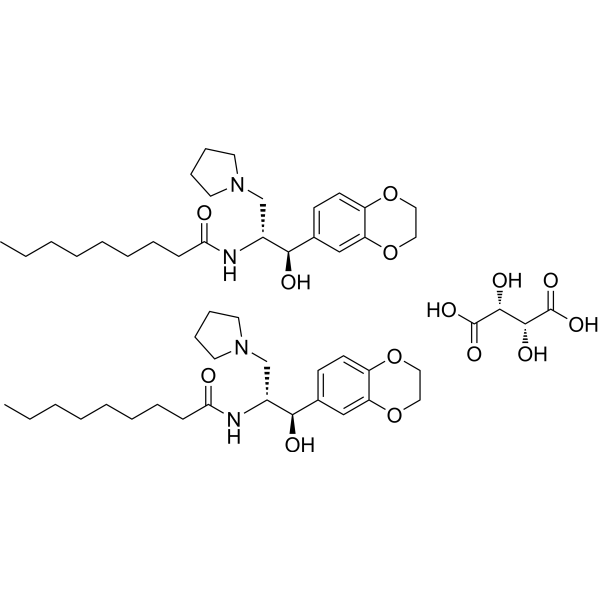
Genz-123346 is a potent, orally available glucosylceramide synthase inhibitor. Genz-123346 blocks the conversion of ceramide to glucosylceramide (GL1) and inhibits GM1 with an IC50 value of 14 nM.
For research use only. We do not sell to patients.
- Purity: 98.86%
- CAS No.: 943344-58-9
- Formula: C24H38N2O4·1/2C4H6O6
- Molecular Weight:493.63
-
Storage:Powder -20°C, 3 years , 4°C, 2 years ; In solvent -80°C, 6 months , -20°C, 1 month

To place orders, for customer services and technical support, please contact: MedChemExpress USA
Tel: 609-228-6898 E-mail: [email protected] [email protected]


-
 Biological Activity
-
Chemical Information
-
Solvent & Solubility
- Protocol
- Purity & Documentation
- References
-
 Help & FAQs
-

Neuronal Signaling Compound Library
HY-L013
-
Anti-diabetic Compound Library
HY-L040
-
Lipid Metabolism Compound Library
HY-L091
-
Heterocyclic Compound Library
HY-L138
-
Bioactive Compound Library Max
HY-L181
-
MCE Bioactive Compound Library
HY-L001V
-
Bioactive Compound Library
HY-L001
-
High-Throughput Bioactive Compound Library
HY-L205


Publications Citing Use of MedChemExpress (MCE) Genz-123346
More- Nat Cell Biol. 2025 Mar;27(3):449-463. [Abstract]
- Am J Respir Crit Care Med. 2019 Nov 1;200(9):1113-1125. [Abstract]
- Hepatol Commun. 2025 Sep 5;9(9):e0793. [Abstract]
- Int Immunopharmacol. 2025 Sep 13:165:115532. [Abstract]
- Front Pharmacol. 2024 Oct 1:15:1409625. [Abstract]
- PeerJ. 2021 Sep 14:9:e12138. [Abstract]
- University College London. 2019 Oct.


Biological Activity
IC50: 14 nM (GM1)[1]
Exposure of cells to Genz-123346 and to other GCS inhibitors at nontoxic concentrations can enhance the killing of tumor cells by cytotoxic anti-cancer agents. Genz-123346 and a few other GCS inhibitors are substrates for multi-drug resistance efflux pumps such as P-gp (ABCB1, gP-170). In cell lines selected to over-express P-gp or which endogenously express P-gp, chemosensitization by Genz-123346 is primarily due to the effects on P-gp function[2]. Genz-123346(Genz) is an enhancer of autophagy flux[3].
MedChemExpress (MCE) has not independently confirmed the accuracy of these methods. They are for reference only.
Genz-123346 treatment results in a dose-dependent reduction of renal GlcCer and GM3 levels that translates into effective inhibition of cystic disease. A direct effect of Genz-123346 on the Akt-mTOR signaling pathway is observed, with reduced phosphorylation of Akt and ribosomal protein S6[4].
A group of WT mice received Genz-123346 (0.11% final concentration in regular chow); after 2 weeks of feeding, renal Gb3 was reduced by approximately 50%, in comparison with WT mice fed with chow diet only[5].
MedChemExpress (MCE) has not independently confirmed the accuracy of these methods. They are for reference only.


Chemical Information
-
CAS No. 943344-58-9
-
Appearance Solid
-
Molecular Weight 493.63
-
Formula C24H38N2O4·1/2C4H6O6
-
Color White to off-white
-
SMILES
CCCCCCCCC(N[C@H](CN1CCCC1)[C@@H](C2=CC=C(OCCO3)C3=C2)O)=O.O=C(O)[C@H](O)[C@@H](O)C(O)=O.[1/2]
-
Shipping
Room temperature in continental US; may vary elsewhere.
-
Storage
Powder -20°C 3 years 4°C 2 years In solvent -80°C 6 months -20°C 1 month


Publications (7)
-
Journal Impact Factor
-
Most Recent
-
Nat Cell Biol
2025 Mar;27(3):449-463. PMID: 39984654 -
Am J Respir Crit Care Med
2019 Nov 1;200(9):1113-1125. PMID: 31265321 -
Hepatol Commun
2025 Sep 5;9(9):e0793. PMID: 40906894 -
Int Immunopharmacol
Targeting GCS regulates the NRF2 axis to inhibit hepatocyte endoplasmic reticulum stress-ferroptosis improving immune-mediated liver injury. [Abstract]2025 Sep 13:165:115532. PMID: 40946670 -
Front Pharmacol
Inhibiting glycosphingolipids alleviates cardiac hypertrophy by reducing reactive oxygen species and restoring autophagic homeostasis. [Abstract]2024 Oct 1:15:1409625. PMID: 39411072 -
PeerJ
Glucosylceramide synthase regulates hepatocyte repair after concanavalin A-induced immune-mediated liver injury. [Abstract]2021 Sep 14:9:e12138. PMID: 34611503 -


Solvent & Solubility
DMSO : ≥ 100 mg/mL (202.58 mM; Hygroscopic DMSO has a significant impact on the solubility of product, please use newly opened DMSO)
* "≥" means soluble, but saturation unknown.
Please refer to the solubility information to select the appropriate solvent. Once prepared, please aliquot and store the solution to prevent product inactivation from repeated freeze-thaw cycles.
Storage method and period of stock solution: -80°C, 6 months; -20°C, 1 month. When stored at -80°C, please use it within 6 months. When stored at -20°C, please use it within 1 month.
Please refer to the solubility information to select the appropriate solvent. Once prepared, please aliquot and store the solution to prevent product inactivation from repeated freeze-thaw cycles.
Storage method and period of stock solution: -80°C, 6 months; -20°C, 1 month. When stored at -80°C, please use it within 6 months. When stored at -20°C, please use it within 1 month.
Concentration (start) × Volume (start) = Concentration (final) × Volume (final)
Select the appropriate dissolution method based on your experimental animal and administration route.
- For the following dissolution methods, please ensure to first prepare a clear stock solution using an In Vitro approach and then sequentially add co-solvents:
- To ensure reliable experimental results, the clarified stock solution can be appropriately stored based on storage conditions. As for the working solution for In Vivo experiments, it is recommended to prepare freshly and use it on the same day.
- The percentages shown for the solvents indicate their volumetric ratio in the final prepared solution. If precipitation or phase separation occurs during preparation, heat and/or sonication can be used to aid dissolution.
Add each solvent one by one: 10% DMSO 40% PEG300 5% Tween-80 45% Saline
Solubility: ≥ 10 mg/mL (20.26 mM); Clear solution
This protocol yields a clear solution of ≥ 10 mg/mL (saturation unknown).
Taking 1 mL working solution as an example, add 100 μL DMSO stock solution (100.0 mg/mL) to 400 μL PEG300, and mix evenly; then add 50 μL Tween-80 and mix evenly; then add 450 μL Saline to adjust the volume to 1 mL.
Preparation of Saline: Dissolve 0.9 g sodium chloride in ddH₂O and dilute to 100 mL to obtain a clear Saline solution.
Add each solvent one by one: 10% DMSO 90% (20% SBE-β-CD in Saline)
Solubility: ≥ 10 mg/mL (20.26 mM); Clear solution
This protocol yields a clear solution of ≥ 10 mg/mL (saturation unknown).
Taking 1 mL working solution as an example, add 100 μL DMSO stock solution (100.0 mg/mL) to 900 μL 20% SBE-β-CD in Saline, and mix evenly.
Preparation of 20% SBE-β-CD in Saline (4°C, storage for one week): 2 g SBE-β-CD powder is dissolved in 10 mL Saline, completely dissolve until clear.
Please enter the basic information of animal experiments:
-
-
-
-
Recommended: Prepare an additional quantity of animals to account for potential losses during experiments.
Please enter your animal formula composition:
-
%DMSO +
Recommended: Keep the proportion of DMSO in working solution below 2% if your animal is weak.
-
%+
-
+%Tween-80 + +
-
%Saline +
The co-solvents required include: DMSO, . All of co-solvents are available by MedChemExpress (MCE). , Tween 80. All of co-solvents are available by MedChemExpress (MCE).
Working solution concentration: 0.22 mg/mL
Method for preparing stock solution: mg drug dissolved in μL DMSO. Stock solution concentration: mg/mL.
1. Take μL DMSO stock solution;
2. Add μL .
μL , mix evenly;
3. Then add μL Tween 80, mix evenly;
4. Then add μL
Please ensure that the stock solution in the first step is dissolved to a clear state, and add co-solvents in sequence. You can use ultrasonic heating (ultrasonic cleaner, recommended frequency 20-40 kHz), vortexing, etc. to assist dissolution.

Protocol
Rats: Genz-123346 is dissolved in water. Zucker diabetic fatty rats treated with Genz-123346 (75 mg/kg) for 6 weeks are fasted overnight. The following morning, the fasted rats are anesthetized and injected with 5 units human insulin into the hepatic portal vein. Quadriceps muscle and liver are harvested 2 min after injection and immediately frozen in liquid nitrogen. Insulin receptor is immunoprecipitated. The immunoprecipitates are analyzed by immunoblotting[1].
Mice: C57BL/6 mice are fed on a high-fat (45% of kcal) diet for 8 weeks, obese mice with comparable body weight gain, glucose, and insulin levels are assigned to either the treated or control groups. The mice are then gavaged daily with Genz-123346 or water for 10 weeks[1].
MedChemExpress (MCE) has not independently confirmed the accuracy of these methods. They are for reference only.


Purity & Documentation
-
Data Sheet (280 KB)
-
SDS (252 KB)
- English - EN (252 KB)
- Français - FR (252 KB)
- Deutsch - DE (252 KB)
- Norwegian - NO (252 KB)
- Español - ES (252 KB)
- Swedish - SV (252 KB)
- Italian - IT (252 KB)
- Korean - KR (252 KB)
- Portuguese - PT (252 KB)
-
Handling Instructions (2659 KB)
References
[1]. Zhao H, et al. Inhibiting glycosphingolipid synthesis improves glycemic control and insulin sensitivity in animal models of type 2 diabetes. Diabetes. 2007 May;56(5):1210-8. [Content Brief]
[2]. Chai L, et al. The chemosensitizing activity of inhibitors of glucosylceramide synthase is mediated primarily through modulation of P-gp function. Int J Oncol. 2011 Mar;38(3):701-11. [Content Brief]
[3]. Shen W, et al. Inhibition of glucosylceramide synthase stimulates autophagy flux in neurons. J Neurochem. 2014 Jun;129(5):884-94 [Content Brief]
[4]. Natoli TA, et al. Inhibition of glucosylceramide accumulation results in effective blockade of polycystic kidney disease in mouse models. Nat Med. 2010 Jul;16(7):788-92. [Content Brief]
[5]. Morace I, et al. Renal globotriaosylceramide facilitates tubular albumin absorption and its inhibitionprotects against acute kidney injury. Kidney Int. 2019 Aug;96(2):327-341. [Content Brief]


Complete Stock Solution Preparation Table
Please refer to the solubility information to select the appropriate solvent. Once prepared, please aliquot and store the solution to prevent product inactivation from repeated freeze-thaw cycles.
Storage method and period of stock solution: -80°C, 6 months; -20°C, 1 month. When stored at -80°C, please use it within 6 months. When stored at -20°C, please use it within 1 month.
| Optional Solvent | Concentration Solvent Mass | 1 mg | 5 mg | 10 mg | 25 mg |
|---|---|---|---|---|---|
| DMSO | 1 mM | 2.0258 mL | 10.1290 mL | 20.2581 mL | 50.6452 mL |
| 5 mM | 0.4052 mL | 2.0258 mL | 4.0516 mL | 10.1290 mL | |
| 10 mM | 0.2026 mL | 1.0129 mL | 2.0258 mL | 5.0645 mL | |
| 15 mM | 0.1351 mL | 0.6753 mL | 1.3505 mL | 3.3763 mL | |
| 20 mM | 0.1013 mL | 0.5065 mL | 1.0129 mL | 2.5323 mL | |
| 25 mM | 0.0810 mL | 0.4052 mL | 0.8103 mL | 2.0258 mL | |
| 30 mM | 0.0675 mL | 0.3376 mL | 0.6753 mL | 1.6882 mL | |
| 40 mM | 0.0506 mL | 0.2532 mL | 0.5065 mL | 1.2661 mL | |
| 50 mM | 0.0405 mL | 0.2026 mL | 0.4052 mL | 1.0129 mL | |
| 60 mM | 0.0338 mL | 0.1688 mL | 0.3376 mL | 0.8441 mL | |
| 80 mM | 0.0253 mL | 0.1266 mL | 0.2532 mL | 0.6331 mL | |
| 100 mM | 0.0203 mL | 0.1013 mL | 0.2026 mL | 0.5065 mL |


Genz-123346 Related Classifications
HY-12744A Related Classifications
 Powered by Bioz