



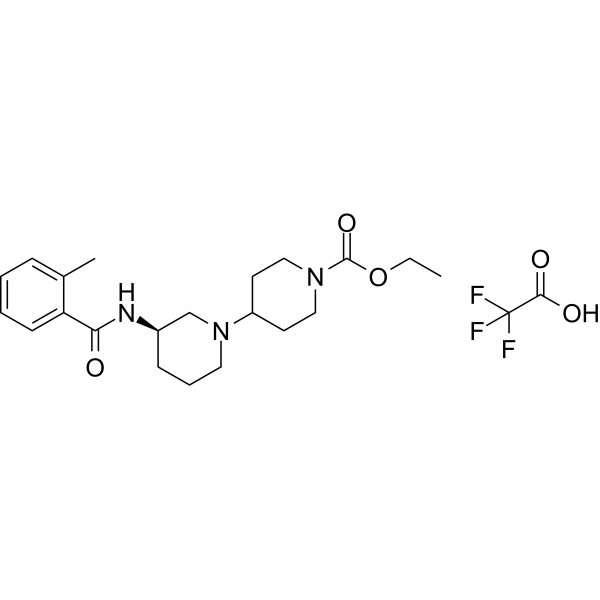
VU0364572 TFA

Based on 1 Customer Validation
VU0364572 TFA is an orally active and selective allosteric agonist of the M1 muscarinic receptor with an EC50 of 0.11 μM. VU0364572 TFA has neuroprotective potential for preventing memory impairments and reducing neuropathology in Alzheimer’s Disease. VU0364572 TFA is CNS penetrant.
For research use only. We do not sell to patients.
- Purity: 98.79%
- CAS No.: 1240514-89-9
- Formula: C23H32F3N3O5
- Molecular Weight:487.51
-
Storage:
4°C, sealed storage, away from moisture and light
* In solvent : -80°C, 6 months; -20°C, 1 month (sealed storage, away from moisture and light)


-
 Biological Activity
-
Chemical Information
-
Solvent & Solubility
- Purity & Documentation
- References
-
 Help & FAQs
-

GPCR/G Protein Compound Library
HY-L006
-
Neuronal Signaling Compound Library
HY-L013
-
CNS-Penetrant Compound Library
HY-L028
-
Cytoskeleton Compound Library
HY-L060
-
Orally Active Compound Library
HY-L061
-
Neurotransmitter Receptor Compound Library
HY-L062
-
Anti-Alzheimer's Disease Compound Library
HY-L069
-
Neuroprotective Compound Library
HY-L070
-
Neurodegenerative Disease-related Compound Library
HY-L086
-
Membrane Protein-targeted Compound Library
HY-L149
-
Membrane Receptor-targeted Compound Library
HY-L150
-
Highly Selective Activators Library
HY-L159
-
Multi-Target Compound Library
HY-L176
-
Bioactive Compound Library Max
HY-L181
-
MCE Bioactive Compound Library
HY-L001V
-
Bioactive Compound Library
HY-L001
-
High-Throughput Bioactive Compound Library
HY-L205
-
Lactylation Compound Library
HY-L249




Biological Activity
|
mAChR1 0.11 μM (EC50) |
VU0364572 (30 μM; 25 min) TFA promotes KCNQ2, NR1 and MARCKS phosphorylation in striatal/NAc slices[2].
MedChemExpress (MCE) has not independently confirmed the accuracy of these methods. They are for reference only.
-
Cell Line:Striatal/NAc slices
-
Concentration:30 μM
-
Incubation Time:25 min
-
Result:Significantly increased the phosphorylation of KCNQ2 at T217, NR1 at S890, and MARCKS at S152/156.
MedChemExpress (MCE) has not independently confirmed the accuracy of these methods. They are for reference only.
-
Animal Model:5XFAD transgenic Alzheimer’s mice[1]
-
Dosage:10 mg/kg/day
-
Administration:In drinking water, from 2 months of age to 6 months
-
Result:Preserved hippocampal memory. Significantly reduced levels of soluble and insoluble Aβ40,42 in the cortex and hippocampus of these animals. Significantly decreased oligomeric (oAβ) levels in the cortex.


Chemical Information
-
CAS No. 1240514-89-9
-
Appearance Solid
-
Molecular Weight 487.51
-
Formula C23H32F3N3O5
-
Color White to off-white
-
SMILES
O=C(N1CCC(N2C[C@H](NC(C3=CC=CC=C3C)=O)CCC2)CC1)OCC.O=C(O)C(F)(F)F
-
Shipping
Room temperature in continental US; may vary elsewhere.
-
Storage
4°C, sealed storage, away from moisture and light
* In solvent : -80°C, 6 months; -20°C, 1 month (sealed storage, away from moisture and light)


Solvent & Solubility
DMSO : 55 mg/mL (112.82 mM; Need ultrasonic; Hygroscopic DMSO has a significant impact on the solubility of product, please use newly opened DMSO)
Please refer to the solubility information to select the appropriate solvent. Once prepared, please aliquot and store the solution to prevent product inactivation from repeated freeze-thaw cycles.
Storage method and period of stock solution: -80°C, 6 months; -20°C, 1 month (sealed storage, away from moisture and light). When stored at -80°C, please use it within 6 months. When stored at -20°C, please use it within 1 month.
Please refer to the solubility information to select the appropriate solvent. Once prepared, please aliquot and store the solution to prevent product inactivation from repeated freeze-thaw cycles.
Storage method and period of stock solution: -80°C, 6 months; -20°C, 1 month (sealed storage, away from moisture and light). When stored at -80°C, please use it within 6 months. When stored at -20°C, please use it within 1 month.
Concentration (start) × Volume (start) = Concentration (final) × Volume (final)
Select the appropriate dissolution method based on your experimental animal and administration route.
- For the following dissolution methods, please ensure to first prepare a clear stock solution using an In Vitro approach and then sequentially add co-solvents:
- To ensure reliable experimental results, the clarified stock solution can be appropriately stored based on storage conditions. As for the working solution for In Vivo experiments, it is recommended to prepare freshly and use it on the same day.
- The percentages shown for the solvents indicate their volumetric ratio in the final prepared solution. If precipitation or phase separation occurs during preparation, heat and/or sonication can be used to aid dissolution.
Add each solvent one by one: 10% DMSO 40% PEG300 5% Tween-80 45% Saline
Solubility: ≥ 2.75 mg/mL (5.64 mM); Clear solution
This protocol yields a clear solution of ≥ 2.75 mg/mL (saturation unknown).
Taking 1 mL working solution as an example, add 100 μL DMSO stock solution (27.5 mg/mL) to 400 μL PEG300, and mix evenly; then add 50 μL Tween-80 and mix evenly; then add 450 μL Saline to adjust the volume to 1 mL.
Preparation of Saline: Dissolve 0.9 g sodium chloride in ddH₂O and dilute to 100 mL to obtain a clear Saline solution.
Add each solvent one by one: 10% DMSO 90% (20% SBE-β-CD in Saline)
Solubility: ≥ 2.75 mg/mL (5.64 mM); Clear solution
This protocol yields a clear solution of ≥ 2.75 mg/mL (saturation unknown).
Taking 1 mL working solution as an example, add 100 μL DMSO stock solution (27.5 mg/mL) to 900 μL 20% SBE-β-CD in Saline, and mix evenly.
Preparation of 20% SBE-β-CD in Saline (4°C, storage for one week): 2 g SBE-β-CD powder is dissolved in 10 mL Saline, completely dissolve until clear.
Please enter the basic information of animal experiments:
-
-
-
-
Recommended: Prepare an additional quantity of animals to account for potential losses during experiments.
Please enter your animal formula composition:
-
%DMSO +
Recommended: Keep the proportion of DMSO in working solution below 2% if your animal is weak.
-
%+
-
+%Tween-80 + +
-
%Saline +
The co-solvents required include: DMSO, . All of co-solvents are available by MedChemExpress (MCE). , Tween 80. All of co-solvents are available by MedChemExpress (MCE).
Working solution concentration: 0.22 mg/mL
Method for preparing stock solution: mg drug dissolved in μL DMSO. Stock solution concentration: mg/mL. * In solvent : -80°C, 6 months; -20°C, 1 month (sealed storage, away from moisture and light)
1. Take μL DMSO stock solution;
2. Add μL .
μL , mix evenly;
3. Then add μL Tween 80, mix evenly;
4. Then add μL
Please ensure that the stock solution in the first step is dissolved to a clear state, and add co-solvents in sequence. You can use ultrasonic heating (ultrasonic cleaner, recommended frequency 20-40 kHz), vortexing, etc. to assist dissolution.


Purity & Documentation
-
Data Sheet (272 KB)
-
SDS (252 KB)
- English - EN (252 KB)
- Français - FR (252 KB)
- Deutsch - DE (252 KB)
- Norwegian - NO (252 KB)
- Español - ES (252 KB)
- Swedish - SV (252 KB)
- Italian - IT (252 KB)
- Portuguese - PT (252 KB)
-
Handling Instructions (2659 KB)
References
[1]. Lebois EP, et al. Disease-Modifying Effects of M1 Muscarinic Acetylcholine Receptor Activation in an Alzheimer's Disease Mouse Model. ACS Chem Neurosci. 2017 Jun 21;8(6):1177-1187. [Content Brief]
[2]. Faruk MO, et al. Muscarinic signaling regulates voltage-gated potassium channel KCNQ2 phosphorylation in the nucleus accumbens via protein kinase C for aversive learning. J Neurochem. 2022 Feb;160(3):325-341. [Content Brief]
[3]. Lebois EP, et al. Development of a highly selective, orally bioavailable and CNS penetrant M1 agonist derived from the MLPCN probe ML071. Bioorg Med Chem Lett. 2011 Nov 1;21(21):6451-5. [Content Brief]


Complete Stock Solution Preparation Table
Please refer to the solubility information to select the appropriate solvent. Once prepared, please aliquot and store the solution to prevent product inactivation from repeated freeze-thaw cycles.
Storage method and period of stock solution: -80°C, 6 months; -20°C, 1 month (sealed storage, away from moisture and light). When stored at -80°C, please use it within 6 months. When stored at -20°C, please use it within 1 month.
| Optional Solvent | Concentration Solvent Mass | 1 mg | 5 mg | 10 mg | 25 mg |
|---|---|---|---|---|---|
| DMSO | 1 mM | 2.0512 mL | 10.2562 mL | 20.5124 mL | 51.2810 mL |
| 5 mM | 0.4102 mL | 2.0512 mL | 4.1025 mL | 10.2562 mL | |
| 10 mM | 0.2051 mL | 1.0256 mL | 2.0512 mL | 5.1281 mL | |
| 15 mM | 0.1367 mL | 0.6837 mL | 1.3675 mL | 3.4187 mL | |
| 20 mM | 0.1026 mL | 0.5128 mL | 1.0256 mL | 2.5640 mL | |
| 25 mM | 0.0820 mL | 0.4102 mL | 0.8205 mL | 2.0512 mL | |
| 30 mM | 0.0684 mL | 0.3419 mL | 0.6837 mL | 1.7094 mL | |
| 40 mM | 0.0513 mL | 0.2564 mL | 0.5128 mL | 1.2820 mL | |
| 50 mM | 0.0410 mL | 0.2051 mL | 0.4102 mL | 1.0256 mL | |
| 60 mM | 0.0342 mL | 0.1709 mL | 0.3419 mL | 0.8547 mL | |
| 80 mM | 0.0256 mL | 0.1282 mL | 0.2564 mL | 0.6410 mL | |
| 100 mM | 0.0205 mL | 0.1026 mL | 0.2051 mL | 0.5128 mL |


 Powered by Bioz